Tektite size limits
The Micro-Drop Disintegration: Why Large Moldavites Are Rare
A very large moldavite is uncommon because size is tested at almost every stage: formation, flight, cooling, preservation, and recovery. The likely answer is not one hidden “rarity secret,” but a chain of Tektite Size Limits. Molten impact material can separate into smaller bodies, larger drops may be harder to keep stable in motion, cooling may favor certain forms, and later breakage, erosion, burial, and collection bias can remove large survivors from view.
That answer needs a careful edge. The available material does not establish a precise moldavite size law, a confirmed mass distribution, or a rule that large pieces cannot form. It supports a narrower reading: large moldavites can exist, but the path from molten ejecta to large surviving specimen is difficult.
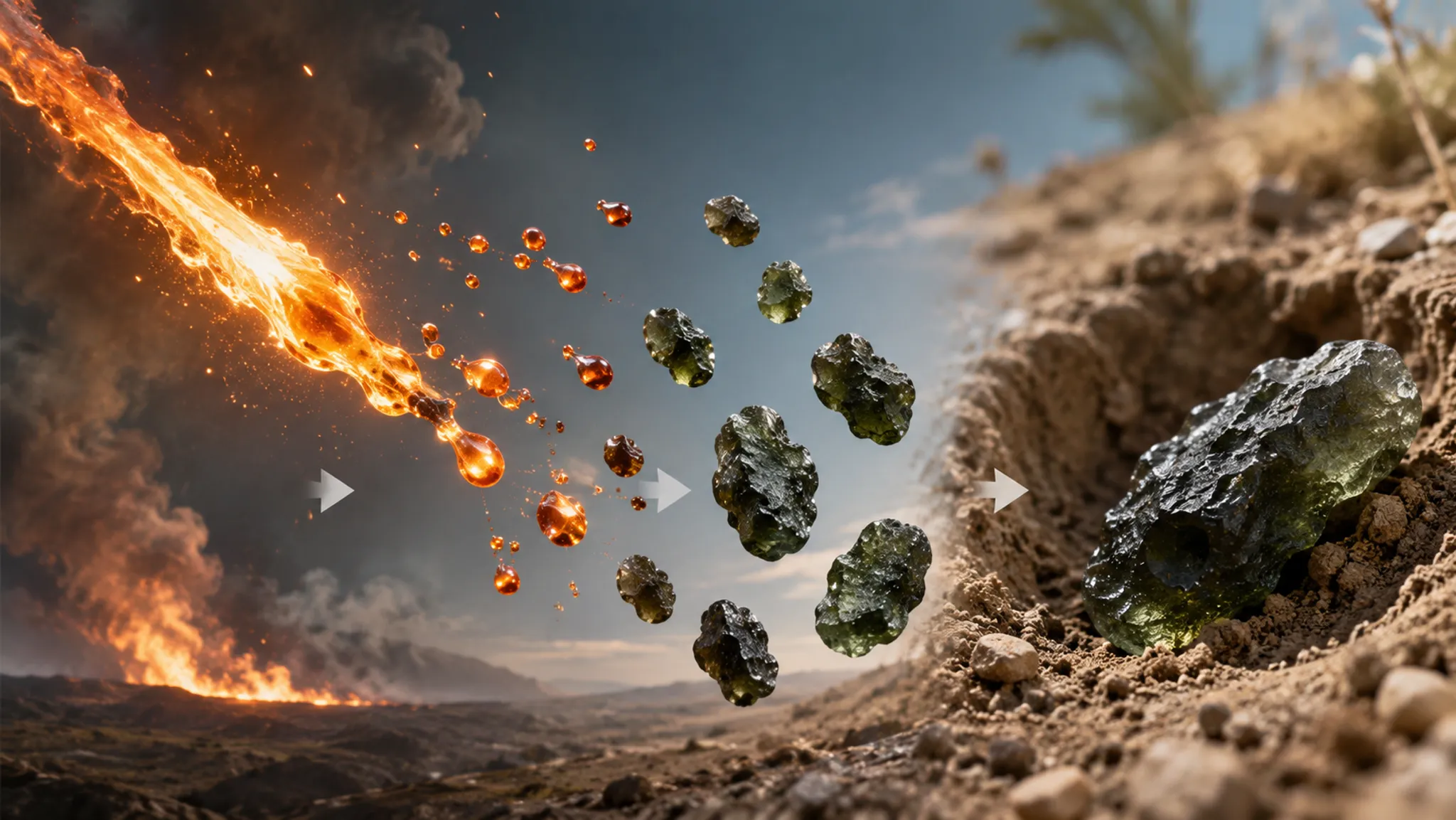
broader context
Broader moldavite archive
This narrower page makes more sense after the broader moldavite archive page.
The short answer: size is filtered more than once
People often meet this question through collector language. A seller calls a big piece scarce. A listing makes size sound like proof of importance. A dramatic photo circulates as if it explains the geology by itself.
That language may explain why the question comes up, but it does not prove the cause.
A more grounded way to think about large moldavite rarity is as a sequence of filters:
Formation
Impact melt has to be ejected in a form that can become a tektite rather than remaining as local impact glass or breaking into smaller melt bodies.
Droplet stability
Molten material in motion can stretch, spin, thin, divide, or separate before it solidifies.
Cooling
The body has to cool into glass while still holding together.
Flight and landing
Aerodynamic stress, collision, thermal stress, and landing impact may reduce larger bodies into smaller fragments.
Preservation and recovery
Weathering, burial, excavation, and human collecting shape what is visible today.
“Micro-drop disintegration” is useful as an image: a larger molten body breaking into smaller drops before it becomes a collectible specimen. It should not be treated here as a settled technical threshold. The stronger point is simpler. Large moldavite rarity is probably cumulative.
Size has to survive several gates.
Why melt fragmentation matters
Moldavite belongs to the wider tektite family: natural glass associated with impact events. In the broad formation model, hot melt or vapor-melt material is launched, shaped, and cooled. Within that frame, melt fragmentation is one plausible reason very large moldavites are less common than small ones.
A moving mass of hot melt is not a carved stone. It behaves like a fluid under stress. If a melt stream thins, stretches, or separates, one larger body can become many smaller droplets. Each division lowers the chance that a single large object will remain intact long enough to cool as one piece.
Surface tension belongs in the discussion, but it should not be made to carry the whole answer. In fluid behavior, surface tension tends to pull liquid surfaces toward compact forms, while motion, shear, rotation, and airflow can disturb them. For moldavite, the cautious point is that droplet stability may matter. A small drop may hold together more easily under some conditions; a larger moving body has more opportunity to deform or divide before solidification.
That is the “micro-drop” idea in plain language. The melt does not vanish. It may simply stop being one large future specimen and become several smaller ones.
Why cooling does not automatically protect a large drop
Rapid cooling can preserve glass, but it does not rescue every large molten body. A smaller droplet has a shorter distance from surface to center, so it can lose heat more quickly than a larger mass. A larger body may remain internally hot for longer, leaving more time for motion, deformation, or stress before the form is locked.
This does not mean every small moldavite formed easily, or that every large one was unstable. It means size changes the balance. A larger molten mass must stay coherent while cooling through a difficult interval. It has to avoid being pulled apart while fluid, avoid cracking as it stiffens, and avoid later breakage once glassy.
Visible shape can also mislead. A smooth outline, splash-like form, or sculpted surface may look as if it tells the whole formation story. It rarely does. Shape can reflect formation, flight, chemical weathering, erosion, and later damage. A large moldavite with an impressive outline is still not a complete record of the forces that made it.
For the size question, cooling is best treated as one constraint among several. It may contribute to moldavite size limits, but it is not the single explanation.
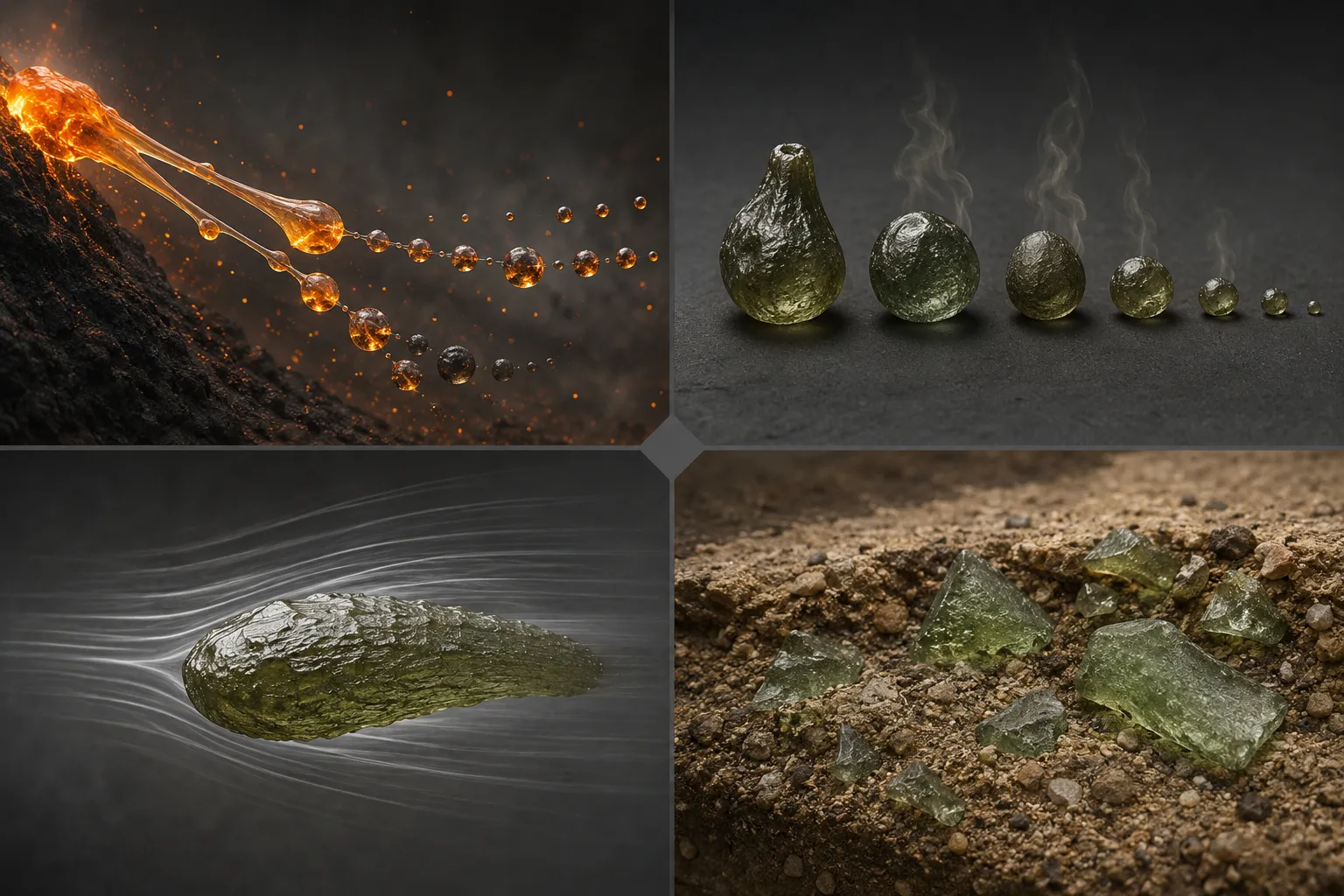
Aerodynamic stress and the problem of staying whole
A molten or partly solidified object moving through air is exposed to aerodynamic forces. For a small body, those forces act over a limited form. For a larger one, stress can be distributed across more surface and more volume. That opens the possibility of stretching, flattening, rotation, surface stripping, or breakup before landing.
Without a stronger moldavite-specific source set, it would be too strong to say aerodynamic breakup is the reason large moldavites are rare. It is better kept inside the explanatory group. Any large moldavite formation hypothesis has to answer a basic question: how did a large body remain coherent while moving, cooling, and meeting the atmosphere?
The survival problem continues after solidification. Glass can break. A larger piece may contain more flaws, expose more surface, and suffer more damage during landing, sediment transport, pressure, excavation, or handling. A once-larger object can reach collectors only as smaller fragments.
That distinction matters: formation rarity is not the same as survival rarity. Large moldavites may be uncommon because fewer large bodies formed. They may also be uncommon because fewer large bodies survived.
Both can be true.
Size distribution is not the same as seller scarcity
Collectors often judge size through availability. Small pieces appear more often. Larger pieces are described with stronger language. Exceptional examples may be treated as trophy specimens. None of that is the same as a scientific moldavite size distribution.
A real size distribution would need documented records: locality, mass, recovery context, sampling method, and clarity about what is being counted. Whole natural pieces, broken fragments, cut material, repaired pieces, and altered specimens should not be mixed as if they mean the same thing.
Reader phrase
“Large moldavites are rare”
What it may mean: Large pieces appear less often in collections or sales.
What it does not prove by itself: A fixed natural maximum size.
Reader phrase
“This is unusually big”
What it may mean: The specimen is large compared with many commonly seen pieces.
What it does not prove by itself: Authenticity, provenance, or value.
Reader phrase
“Museum-size” or “collector-grade”
What it may mean: A display or market phrase.
What it does not prove by itself: A geological category.
Reader phrase
“Massive moldavite”
What it may mean: A description of weight or appearance.
What it does not prove by itself: That the piece formed as one intact drop.
This is where collector literacy matters. A larger specimen should prompt better documentation, not faster certainty. Provenance, locality history, natural surface features, signs of breakage, and possible alteration all become more important as the claim becomes stronger.
Size alone is not authentication. Size alone is not a value promise. Size alone is not spiritual proof.
What would make the answer stronger?
The answer would be stronger with traceable geological and catalog material that compares moldavite mass distribution, formation models, and preservation patterns. Seller claims and short collector comments cannot carry that work.
The most useful evidence would separate five questions:
- What sizes have been documented for natural moldavites?
A measured record is different from a marketplace impression.
- How were those specimens counted?
Whole pieces, fragments, repaired pieces, and altered material need separate handling.
- Which localities show which size patterns?
Moldavite occurrence is not uniform. Local geology and recovery history can influence what appears.
- Which physical models explain droplet breakup and survival?
General fluid fragmentation and impact melt behavior can help, but applying them to moldavite requires care.
- How much of the observed pattern is collection bias?
Human recovery favors accessible places, recognizable surfaces, and pieces that survived long enough to be found.
Until those questions are supported more directly, the best answer stays bounded: large moldavites are uncommon because large tektite bodies face more chances to fragment, deform, cool unevenly, break, erode, remain buried, or be undercounted.
Common confusion around large moldavite rarity
One confusion is treating “rare” as a single claim. A moldavite can be rare because it is large, rare because it is well preserved, rare from a particular locality, or rare because few comparable pieces are visible to collectors. Those are related ideas, but they are not identical.
Another confusion is treating large size as automatic superiority. From a geology perspective, a smaller specimen with clear natural features and better context can be more informative than a larger piece surrounded by vague language. From a collecting perspective, size is only one trait among condition, form, surface, provenance, and documentation.
A third confusion comes from symbolism. Some readers connect moldavite with intense transformation language. That belongs to cultural and personal interpretation, not to the physical explanation for size. A large moldavite does not become geologically more meaningful because it is framed with stronger symbolic language.
Keep the layers separate.
A careful answer, without the hype
Very large moldavites are rare because size has to pass through a narrow chain. Molten material must remain large enough during ejection, stable enough during flight, cool into glass without losing coherence, survive later breakage and weathering, and finally be recovered and recognized.
Melt fragmentation, surface tension effects, droplet stability, rapid cooling, aerodynamic stress, and preservation bias are all plausible parts of that explanation. This page should not pretend that a precise moldavite size law has been established here.
The modest collector conclusion is enough. Large pieces can exist. Large claims need context. The physical story probably favors smaller survivors, but provenance and specimen traits still matter more than rarity language.