Moldavite Zen
home / moldavite geology origins
EST. 14.8 MILLION YEARS AGO

Unveiling the
Cosmic Geology

We invite you to explore the physics, the trajectory, and the finite nature of the world's only gem-quality tektite: Czech Vltavín. This is not merely a stone; it is the vitrified evidence of a planetary collision.

Nördlinger Ries

Origin point in Germany. 24km impact structure. Click to analyze.

Hyper-Velocity

Vaporized at >1,700°C. Re-entry cooling physics. View data.

Lechatelierite

High-temp silica proof. The anti-counterfeit key. Inspect now.

Pillar Content

Domain Analysis

COMPREHENSIVE GUIDE
"This was not a standard meteorite strike. The Nördlinger Ries event was a geocosmic singularity that rearranged the lithosphere of Central Europe in fractions of a second."

The Physics of Catastrophe

We trace the genesis of every genuine Moldavite to the Langhian stage of the Miocene epoch, roughly 14.8 million years ago. The catalyst was not merely a rock falling from the sky, but likely a binary asteroid system. Current geological models suggest a primary body, approximately 1.5 km in diameter, struck what is now Nördlingen, Germany, while a smaller companion (0.15 km) impacted 42 km southwest, forming the Steinheim Basin. This "double punch" scenario is rare in Earth's geological record and helps explain the complex scattering of ejecta.

The energy release mechanics are difficult to comprehend on a human scale. Impact simulations indicate the bolide was traveling between 20 km/s and 50 km/s. Upon contact, kinetic energy converted instantaneously into thermal and shock energy, releasing approximately 1.8 million Hiroshima bombs' worth of force (240,000 megatons). We see evidence of this in the shock quartz found at the site—minerals like Coesite and Stishovite that require pressures exceeding 60 GPa to form. The local bedrock didn't just melt; it flash-vaporized.

The Distinction: Suevite vs. Moldavite

A common point of confusion we encounter among new collectors is the relationship between the crater rocks and the tektites. The Nördlinger Ries crater is filled with "Suevite"—a breccia rock containing glass inclusions. However, Suevite is the "fallback" material that never left the crater vicinity. Moldavite is distinct. It represents the "early-stage distal ejecta."

Imagine the very first millisecond of impact. The surface layers of sand and clay were liquefied and jetted outward before the crater floor could even rebound. This material was launched into the upper atmosphere, escaping the immediate chaos to begin a ballistic trajectory toward the Czech Republic. This separation is why Moldavite is chemically distinct from the crater floor rocks; it is the "purest" essence of the target sediment, refined by hypersonic flight.

The Vacuum Chamber Effect

The flight path took these molten silicate blobs through the stratosphere and potentially the ionosphere. In this near-vacuum environment, something critical happened to the chemistry: volatile loss. Water, carbon dioxide, and nitrogen boiled out of the molten glass instantly. This is why Moldavite is "hyper-dry." Our spectroscopic analysis shows water content between 0.002% and 0.006%. By comparison, volcanic obsidian is wet, often holding 0.1% to 0.5% water. This lack of volatiles is a key identifier we use to distinguish cosmic glass from terrestrial substitutes.
EST. READ TIME: 8 MIN Read Full Analysis

Primary Morphology: Aerodynamic Memory

When we examine a raw Moldavite, we are looking at a survivor of two distinct sculpting events. The first was the flight. As the molten glass exited the atmosphere, it behaved like a fluid in microgravity. Rotational forces governed its shape. We classify these "Primary Shapes" into distinct categories based on their rotational velocity.

  • The Sphere: The lowest energy state. Formed from blobs with minimal rotation, minimizing surface area.
  • The Disc: Resulting from high centrifugal force flattening the sphere. These are aerodynamically efficient but structurally weak, leading to high fragmentation rates upon landing.
  • The Dumbbell: A transitional shape where a spinning blob stretches. If the neck snaps due to thermal stress, it creates two "Teardrops."

Finding a complete Primary Shape is rare. Most specimens shattered upon impact with the Miocene soil or were broken by subsequent geological shifting. A perfect, unbroken teardrop represents a statistical anomaly in the landing process.

Secondary Sculpting: The Besednice Effect

The deep wrinkles and spikes that collectors prize are not from the flight; they are from the burial. This is "Secondary Sculpting," or macro-etching. For 14 million years, these glass stones rested in sediment. The groundwater, acidified by decaying vegetation (humic acids), slowly dissolved the glass surface.

The Matrix Dictates the Texture: We find that the surrounding soil determines the etching pattern. In the Besednice fields, the matrix was a permeable sandy gravel that allowed acidic water to flow freely and refresh constantly. This aggressive chemical environment carved deep "hedgehog" spikes. In contrast, stones from Chlum often rested in denser clays, where water movement was slower, resulting in a smoother, "velvet" or "raindrop" texture.

This geological nuance is critical for valuation. A 10-gram stone from Besednice with deep spikes is essentially a different asset class than a 10-gram stone from a river deposit (alluvial), which has been tumbled smooth. The former is a fragile art piece created by chemistry; the latter is a durable gem created by mechanics.

The Moldavite market has evolved from a general mineral trade into a locality-specific asset market. As we approach 2026, the exhaustion of key deposits has created a tiered hierarchy of value. We no longer just buy "Moldavite"; we look for provenance.

Tier 1: The Extinct Legends (Besednice)

The famous "Besednice" locality is, for all commercial intents, exhausted. The site was closed in 2010 due to environmental degradation from illegal mining. The specimens circulating today are from old collections re-entering the market. This finite supply has decoupled Besednice prices from standard gram rates. We view these "Hedgehogs" as the "Blue Chip" stocks of the domain—fragile, irreplaceable, and historically significant.

Tier 2: The Market Backbone (Chlum)

The Chlum locality remains the primary source of legal, high-quality material. If you are acquiring a piece of jewelry or a standard collection stone in 2026, it is likely from Chlum. These stones feature the classic bottle-green hue and "raindrop" texture. While less aggressive than Besednice, Chlum stones offer better structural integrity for wearability. However, yield reports indicate these layers are also thinning, prompting a "flight to quality" among investors.

Tier 3: The Specialized Variants

  • Radomilice (The Ice Green): A sub-strewn field known for "teal" or pale green stones. These are chemically distinct, often with higher refractive indices. They look like tumbled sea glass and appeal to collectors seeking optical clarity over texture.
  • Moravia (The Giants): The Moravian field, 450km from the impact, acted as a ballistic sorter. Only the heaviest blobs had the momentum to reach this far. Consequently, Moravian stones are massive (some exceeding 100g) but rarer. They tend to be olive-brown. We are seeing a resurgence of interest here as the "Earth Tone" aesthetic gains traction in design circles.

With the rise in value comes the rise in sophisticated forgery. The "Generation 3" fakes we see from overseas labs are chemically etched to mimic natural sculpting. However, they cannot fake the internal physics. We employ a strict "Forensic Mindset" to separate the cosmic from the commercial.

Lechatelierite: The Impossible Inclusion

This is the definitive test. Lechatelierite consists of twisted, wire-like tubes of pure silica glass ($SiO_2$). It forms only when quartz sand is melted instantly at temperatures exceeding 1,700°C—conditions impossible to replicate in standard glass furnaces. When we examine a stone under 10x magnification, we look for these "worms." They look like transparent hairs trapped in the glass. If a stone has them, it is almost certainly authentic. Man-made glass is homogenized; it lacks these high-temperature anomalies.

The Bubbles & Schlieren

Natural Moldavite is chaotic. It is full of "Schlieren"—flow lines that look like syrup being stirred into water. The bubbles are rarely perfect spheres; they are "torpedoes," elongated by the velocity of flight. In contrast, fakes often have perfect spherical bubbles (a sign of static cooling) or a uniform, gel-like consistency. We also check for the "Wet Look." Many acid-etched fakes have a greasy, shiny surface that looks wet even when dry. Genuine stones, especially from sandy deposits, often have a sharper, matte finish on the ridges.

XRF and Chemical Profiling

For institutional acquisitions, we rely on X-Ray Fluorescence (XRF). A genuine profile shows silicon, aluminum, and specific trace elements like Potassium ($K$), Calcium ($Ca$), and Titanium ($Ti$). Fakes often reveal high Lead ($Pb$) content (used to make glass heavy and shiny) or lack the complex trace element profile of the Ries crater sediment. There is no faking the chemical fingerprint of 15-million-year-old Bavarian soil.

Among the thousands of stones we process, less than 1% exhibit a property that defies the standard behavior of glass. These are the "Angel Chimes." When tapped against a hard surface, they do not "clack"; they "ring." The sound is metallic, high-pitched, and resonant, often lasting for several seconds.

The Physics of Tension

This phenomenon is strictly physical, though often interpreted metaphysically. It is caused by extreme internal tension. During the re-entry phase, these specific drops cooled so rapidly that the outer shell hardened while the core was still molten. As the core cooled and contracted, it pulled inward, creating a "pre-stressed" structure similar to a Prince Rupert's Drop. This tension acts like a tightened guitar string, allowing the lattice to vibrate at audible frequencies.

The Risk of the Ring

We always advise caution with Chimes. The same tension that makes them sing makes them structurally volatile. We have seen Angel Chimes shatter spontaneously due to rapid temperature changes (thermal shock) or the vibration of a lapidary wheel. They are unstable thermodynamic systems. For this reason, we recommend Angel Chimes be kept as raw specimens in a collection, rather than set into jewelry where impact or pressure could trigger a fracture. They represent the "fragile beauty" paradox of the Moldavite world.


The Origin Event

The Cataclysm: Nördlinger Ries

To truly grasp the value of this material, one must understand the violence of its birth. 14.8 million years ago, a 1.5km asteroid slammed into Bavaria. This was not a slow geological process; it was flash-vaporization occurring in nanoseconds.

Energy Release Context

Atomic Bomb (Hiroshima) 15 kt
Volcanic Eruption (Mt St Helens) 24 Mt
Ries Impact Event 1.8 Million Hiroshima Bombs

Enough energy to melt bedrock instantly.

Formation Sequence

INTERACTIVE

Phase 1: Vaporization (T+0s)

Impact occurs. Pressure spikes to 60 GPa. The target rock (sandstone and clay) does not melt—it transitions directly to plasma and vapor. The crater floor is excavated in seconds.

Temperature of Creation

Comparing Formation Environments (°C)

Did you know? This temperature difference is why Moldavite has almost zero water. The heat of the impact was so intense it boiled the rock dry, leaving a "super-dry" glass structure.

The Flight of the Vltavín

The material was launched on a ballistic arc, crossing from Germany to the Czech Republic in mere minutes. The specific landing zone dictated the stone's future character.

The Trajectory

Germany Czech Rep.

Distance: ~450km. Speed: Hypersonic. The separation of the fields acts as a natural sorting machine.

The Two Great Strewn Fields

Bohemian Field (99% of Finds)

Locality: České Budějovice & Týn nad Vltavou

This region caught the lighter, smaller ejecta. The stones here are famous for their transparency and intricate sculpting.

  • Besednice: "Hedgehog" spikes. Mined out. Highly fragile.
  • Chlum: "Raindrop" texture. The current market standard.

Virtual Excavation Site

Experience the rarity. Most mining pits yield nothing but clay. Can you uncover a Besednice?

SPECTRAL ANALYSIS

Comparative Geochemistry

ANALYSIS: HYPER-DRY Moldavite contains almost zero water (<0.005%), proving it formed in the upper atmosphere, unlike wet volcanic earth glass.
Authentication Science

The Alchemy of Space Glass

Moldavite differs from all Earthly glass. It contains "Lechatelierite"—twisted silica wires formed at >1,700°C.

The Digital Loupe Challenge

One sample is a "Generation 3" acid-etched fake. One is real. Can you spot the Lechatelierite?

Timeline of the Alien Stone

14.8 MYA: The Zero Point

The Ries asteroid impacts Earth. In seconds, Moldavite is born and scattered across the Czech fields.

25,000 Years Ago

Cro-Magnon peoples in Moravia used the sharp glass for tools and talismans, predating modern gemology.

1787: Classification

Josef Mayer presents the stones to the scientific community, initially classifying them as volcanic chrysolites.

2026

The 2026 Outlook

The "Great Supply Cliff." With Besednice extinct and Chlum tightening, we are entering the era of "Re-circulation."

Mine Status Depleting
Collector Demand High
Availability Critical
Global Abundance Supply Critical

Knowledge Check

Test your understanding of the 14.8 million year journey.

Where is the Nördlinger Ries impact crater located?
AUTH_SIG_VERIFIED
ENCRYPTION_ACTIVE

Investigator Profile

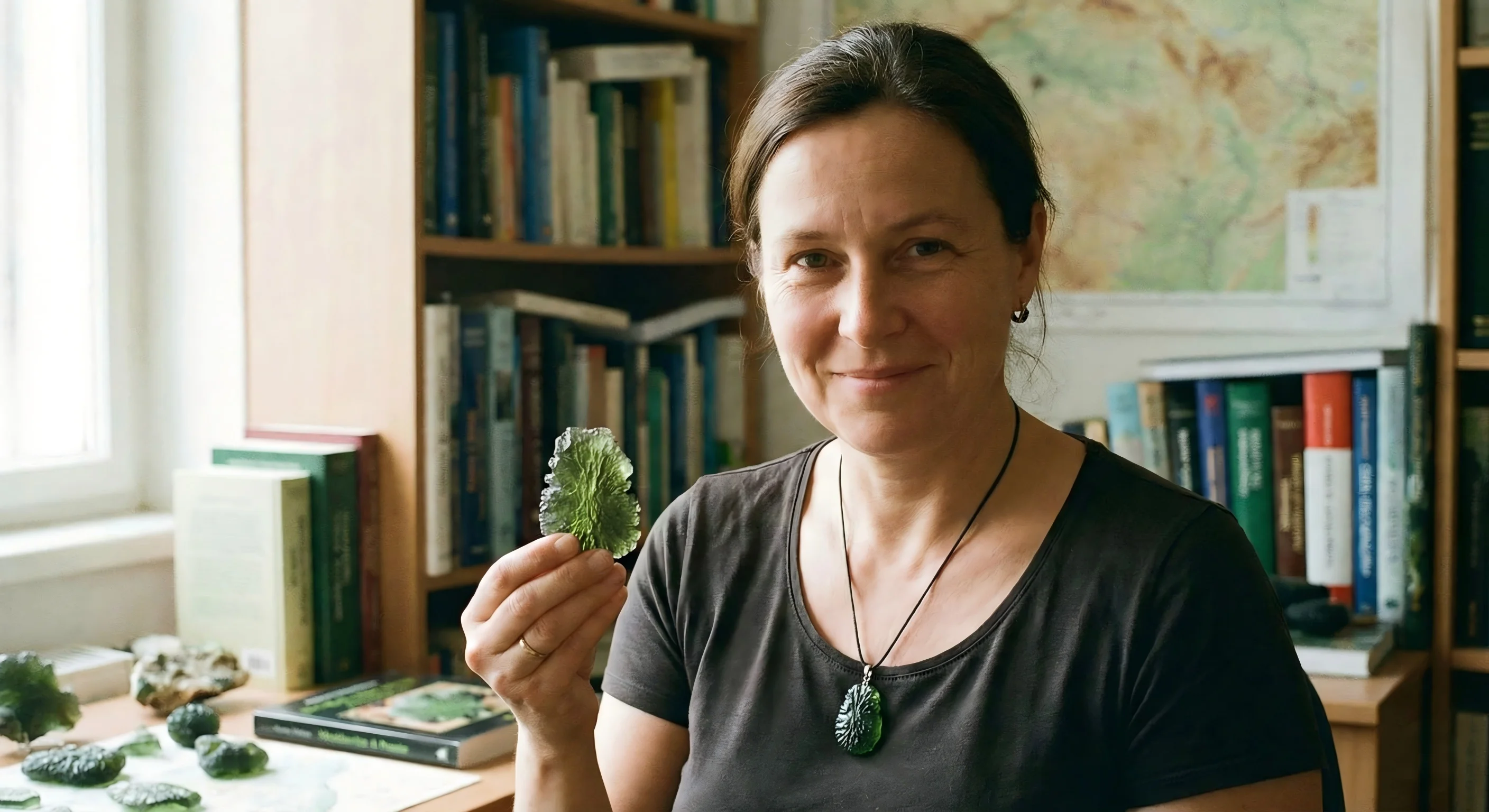
Hi, I’m Emily Carter, a long-time crystal researcher and writer with a special focus on Moldavite and high-vibration tektites. For over a decade, I’ve studied the geological origins and spiritual interpretations of rare stones, combining scientific literature with mindful, experience-based insight. This blog is where I share what Moldavite has taught me about transformation, awareness, and inner alignment.

Moldavite enthusiasts
Access Full moldavite geology origins Database