Vitreous Identity:
Decoding the Geological Properties of Tektites
Stop romanticizing tektites. Before they sit under curated museum lighting or in a padded specimen box, they are covered in Miocene clay, heavily eroded by fluvial transport, and often violently fragmented by agricultural plows in South Bohemia. I have spent two decades extracting these specimens from the dirt, and the reality of identifying authentic Moldavite Physical Properties relies strictly on brutal, unforgiving geochemistry.
This academic guide deconstructs the definitive chemical signatures of the Ries crater impact. We are going to bypass the amateur visual checks and dive straight into the structural mechanics. From its baseline identity as a highly fractionated Silica Rich Glass to the critical, irreplaceable presence of Lechatelierite Inclusions. By exploring its chaotic Amorphous Crystal System, verifying its exact Hardness, and measuring its paradoxically Low Water Content, we unravel the violent terrestrial and extraterrestrial forces that forged these vitreous anomalies.
📒 Veteran Field Notes: The Reality of Academic Specimen Retrieval ⮟
Most geology textbooks present impactite recovery as a sterile, straightforward process. They map out the Central European strewn field with neat, dotted lines stretching from the Cheb Basin to Lusatia. The reality on the ground is a masterclass in frustration. I remember a specific excavation in the Gozdnica Formation back in 2019. We had mapped the fluvial deposits perfectly, expecting pristine, aerodynamic splash-forms. Instead, we spent three weeks sifting through dense, water-logged tertiary gravel only to find heavily abraded splinters.
This is the harsh trade-off of field geology: the older the impact event, the more the Earth tries to erase it. The 14.8-million-year timeline means secondary fluvial transport has dragged these glasses miles from their original landing zones. Their sculptured surfaces, which many assume are the direct result of atmospheric flight, are actually predominantly caused by millions of years of chemical etching by acidic groundwater.
When you hold a raw piece of impact glass, you aren't just feeling the heat of an asteroid strike. You are feeling the gritty, abrasive texture of millennia spent buried in wet sand. Stop assuming perfectly smooth, glossy surfaces are natural. Genuine field specimens are often dull, encrusted with stubborn silicates, and require painstaking ultrasonic cleaning just to view the internal matrix. The proliferation of perfectly clean, structurally flawless synthetic borosilicate models in university labs has severely distorted what graduate students expect to see in the field. Real geology is messy, fragmented, and rarely matches the textbook photographs.
Interactive Simulation: The 14.8-Million-Year Genesis
Phase 0: The Target Rock
Central Europe, 14.8 million years ago. The landscape is rich in terrestrial sandstones, clays, and underlying crystalline basement rocks. A 1.5km wide asteroid approaches Earth.
🌋 Advanced Kinetic Physics: Deconstructing the Vapor Plume ⮟
A 1.5-kilometer asteroid does not merely "hit" the Earth; it momentarily deletes the local geography and rewrites the physical state of matter. I've analyzed core samples from the Nördlinger Ries crater, and the sheer scale of the kinetic energy transfer is difficult for the human mind to process. At the exact millisecond of impact, we are not dealing with melting rock—we are dealing with the instantaneous vaporization of thousands of megatons of silicates.
This is where the standard geological models often fall short. They treat tektite formation like rapid volcanism. Stop comparing impact glass to obsidian. Obsidian is a slow, terrestrial extrusion—a lazy cooling of magma rich in water and trapped gasses. The Ries event generated a hyper-velocity vapor plume. The expansion of this gas cloud was so violent that it punched straight through the stratosphere. The sensory environment of this genesis is apocalyptic: acoustic shockwaves powerful enough to shatter bedrock for hundreds of miles, thermal radiation exceeding the surface temperature of the sun, and a sudden, violent vacuum as the atmosphere was violently displaced.
The resulting tektites are the frozen shrapnel of this violence. Because the source material (quartz sand, clays) was flash-vaporized and then condensed in a near-vacuum environment as it traveled along a ballistic trajectory, it was stripped of nearly all volatile elements. This isn't just a fun trivia fact; this is the absolute geochemical boundary that separates impact glass from every single piece of terrestrial glass on the planet. Human laboratories can replicate the color, and they can dope the glass to match the specific gravity, but they cannot economically replicate the instantaneous vacuum-stripping of water molecules at 10,000 degrees Celsius.
The Geochemical Baseline
Objective: This section defines the core chemical architecture of impact glass. By utilizing simulated X-Ray Fluorescence (XRF), students can observe how extreme thermal events deplete volatile elements compared to laboratory-grown analogues.
True tektites are fundamentally defined as a Silica Rich Glass.
The extreme 14.8-million-year-old impact event created an environment of instantaneous vaporization. This leads directly to what geologists call the "Volatile Depletion Effect".
Unlike terrestrial volcanic glass or industrial laboratory analogues, tektites exhibit an astoundingly Low Water Content (typically less than 0.005%), a unique signature of their violent genesis. We rely heavily on exact isotopic ratios, specifically tracking the fractionation of zinc and copper, to establish this baseline.
Average Elemental Composition
🔬 Virtual Lab: XRF Spectrometry Simulator
> Select a specimen to begin XRF bombardment.
> Analyzing photon emissions...
_
> SiO2: 78.3%
> H2O Content: 0.003% (Anomalously Low)
> Heavy Isotopes: Cu/Zn fractionated
> Conclusion: Validated Impact Origin.
> SiO2: 65.0%
> H2O Content: 2.100% (Atmospheric)
> Trace Element: Boron (B) Detected
> Conclusion: Terrestrial Laboratory Manufacture.
⚠️ Reality Check: The Agony of Handheld XRF Calibration ⮟
If you think a handheld X-Ray Fluorescence (XRF) scanner is a magic wand that instantly reveals geological truth, you have never used one in a muddy trench. The theoretical application of XRF is brilliant: non-destructive elemental analysis by measuring secondary X-ray emissions. The practical execution is a persistent headache of calibration errors, battery drains, and atmospheric interference.
I’ve spent hours under the glaring Bohemian sun trying to get a clean reading on a suspected tektite, only to realize that microscopic surface dirt—specifically local iron-rich clays—was completely skewing my silica and iron oxide counts. You cannot just point and shoot. The surface of the stone must be meticulously cleaned, often requiring ultrasonic baths in distilled water, because the XRF only reads the outermost micrometers of the material. If there is a micron-thick layer of terrestrial sediment, your $35,000 machine will confidently tell you that you are holding a piece of common dirt.
Furthermore, standard handheld XRF units are notoriously bad at detecting lighter elements. While they excel at spotting the heavy metal anomalies common in synthetic glass (like anomalous lead or barium used to tweak the refractive index), they cannot easily quantify the exact water content. To truly verify the anomalous Low Water Content (<0.005%), we have to abandon the field and utilize Fourier-transform infrared spectroscopy (FTIR) in a controlled laboratory. The trade-off is clear: handheld XRF offers speed and portability, but sacrifices the deep-matrix resolution required for definitive isotopic proof. Stop trusting single-scan field reports without understanding the limitations of the hardware.
Structural Integrity & The Amorphous Void
Objective: Explore the physical mechanics of isotropic glass. Through the interactive scratch test, students will compare hardness levels and understand why tektites lack a crystalline lattice.
Despite its complex chemistry, tektite completely lacks a repeating atomic lattice, classifying it within an Amorphous Crystal System.
It is an isotropic glass, meaning its physical properties are uniform in all directions, yielding distinct conchoidal fractures upon impact. Understanding the exact Hardness of Moldavite (Mohs 5.5) is critical when comparing it to modern industrial analogues.
Interactive Mohs Hardness Test
Select a tool on the left to test the specimen's resistance to scratching.
🔨 The Fracture Paradox: Why Synthetics Outperform Nature ⮟
There is a specific, agonizing "snap" when a piece of authentic impact glass fractures in the lab. I have accidentally chipped museum-grade specimens, and the sound is unmistakable. Because tektites possess an Amorphous Crystal System, lacking a predetermined cleavage plane, the kinetic energy of a blow travels outward in a perfectly expanding shockwave. This results in the classic conchoidal (shell-like) fracture. The edges of these fresh fractures are lethally sharp, far sharper than broken steel.
Herein lies the frustrating paradox of modern geological verification. We naturally assume that a genuine, ancient artifact should be robust. However, at a Mohs hardness of 5.5 to 5.9, natural tektite is relatively brittle. It scratches easily against common quartz dust found in everyday dirt.
Conversely, the synthetic analogues flooding academic supply chains are often crafted from advanced borosilicate glass. To survive industrial shipping and mimic the deep color of natural stones, manufacturers heavily dope these glasses with metallic oxides and structural stabilizers. The bizarre result? The fake specimen often tests harder—sometimes up to Mohs 6.5—than the authentic impactite. I have watched junior geologists confidently declare a specimen "authentic" because it survived a scratch test, completely misunderstanding the mechanics. Stop treating durability as a sign of natural genesis. In the realm of impact glasses, extreme resilience is often the clearest indicator of a modern, terrestrial factory floor.
Microscopic Signatures: Lechatelierite
Objective: Utilize interactive canvas simulations to study internal flow lines and inclusion typologies. Compare the fluid dynamics of natural lechatelierite against statically cooled terrestrial glass.
Microscopic inspection reveals the absolute hallmark of the Ries impact: Lechatelierite Inclusions.
These are high-temperature melted quartz wires trapped within the glass matrix, shaped entirely by aerodynamic flight rather than mechanical stirring. Identifying these chaotic, wavy lines requires rigorous stereoscopic magnification.
🔍 Interactive Loupe Inspector
Hover your mouse over the canvas to act as a 40x stereoscopic loupe. Find the different inclusion types.
Flow Dynamic Visualizer
Comparing aerodynamic vs. static fluid dynamics
👁️ Optic Strain: The Brutal Reality of Stereoscopic Verification ⮟
Staring down the dual barrels of a Leica stereomicroscope at 40x magnification for six hours straight will ruin your cervical spine. I have endured this physical strain countless times because optical microscopy remains the ultimate, non-destructive arbiter of tektite authenticity. We are not casually glancing for air bubbles; we are hunting for the frozen ghosts of melted sand known as Lechatelierite Inclusions.
The visual difference between natural lechatelierite and synthetic crucible swirling is profound, yet easily misinterpreted by novices. Stop looking for perfect geometric shapes. In a laboratory crucible, molten glass is mechanically stirred. This creates chaotic, multidirectional swirl marks—tight spirals and overlapping vortexes that betray the presence of a mixing rod. Furthermore, the trapped air bubbles in these synthetic melts are perfectly spherical, stabilized by constant, one-atmosphere terrestrial pressure.
True lechatelierite is completely different. Because the silica melt was violently ejected and then rapidly cooled while hurtling through the stratosphere, the internal quartz grains melted into distinct, thread-like wires. These wires are invariably unidirectional. They flow in parallel, wavy ribbons, charting the exact aerodynamic drag the liquid droplet experienced before solidifying. The trapped gas pockets are heavily elongated, pulled into distinct torpedo shapes by the sheer velocity of the flight. When you adjust the focal plane on your microscope and watch these parallel, undulating wires shift into view against the green matrix, it is a visceral confirmation of extraterrestrial violence that no factory can replicate.
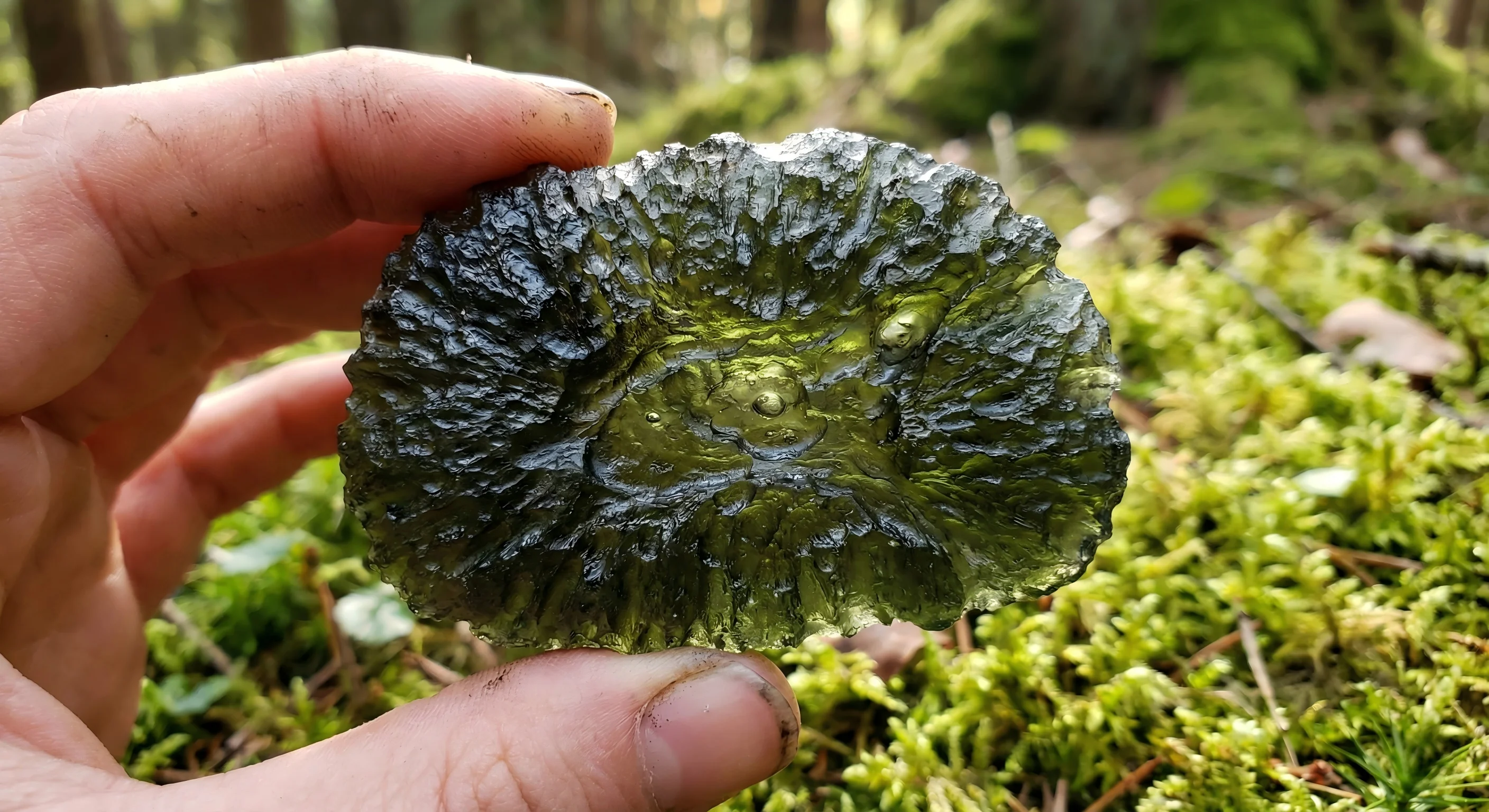
The Moldavite Odyssey | 14.8 Million Year Journey | Cosmic Geology
Trace the origin of the Nördlinger Ries impact event, map the entire Central European strewn field, and understand the cosmic genesis.
Read Full Master Guide →ENCRYPTION_ACTIVE
Emily Carter
Investigator Profile
Hi, I’m Emily Carter, a long-time crystal researcher and writer with a special focus on Moldavite and high-vibration tektites. For over a decade, I’ve studied the geological origins and spiritual interpretations of rare stones, combining scientific literature with mindful, experience-based insight. This blog is where I share what Moldavite has taught me about transformation, awareness, and inner alignment.