Impact origin framework
Cosmic Impact: The Nördlinger Ries Event and Tektite Formation
If you are tracing the Moldavite Impact Origin, the real question is not simply “Did a meteorite make moldavite?” It is: how can a crater in southern Germany explain green glass found across parts of Central Europe?
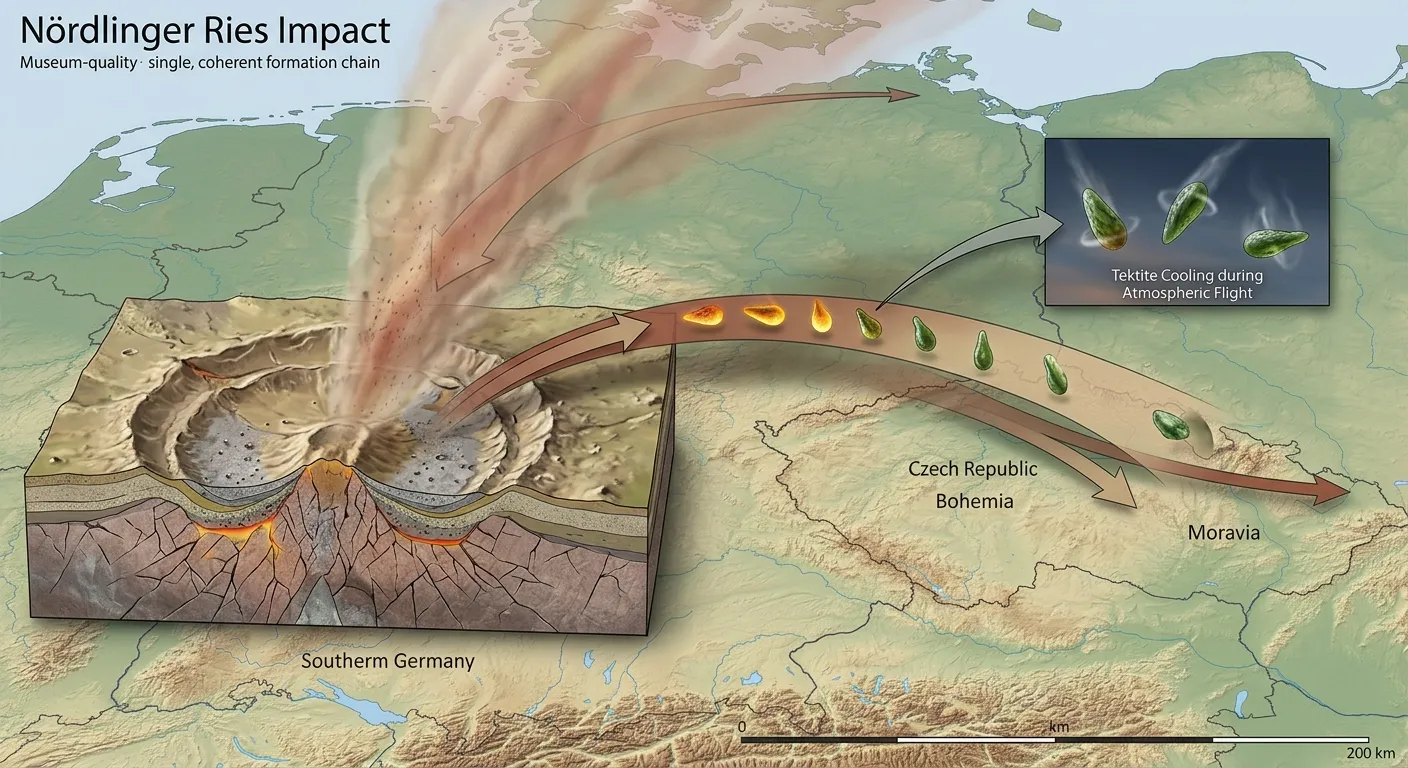
The most useful geological answer is a chain, not a slogan. The Nördlinger Ries event is understood as a hypervelocity impact into silica-bearing terrestrial rocks. That impact generated shock effects, melt, and ejecta. Some silica-rich material was launched away from the crater setting, modified during high-speed atmospheric travel, and cooled into glassy tektites. Moldavite belongs in that framework.
The important editorial boundary is just as simple: the Ries impact explains the origin model, but it does not automatically prove every detail of each specimen, every collector rule, or every dramatic version of the story.
broader context
Moldavite context note
This narrower page makes more sense after the broader moldavite archive page.
Why the Ries Crater matters to moldavite
The Ries Crater matters because it gives the Central European tektite field a plausible impact engine: a large, confirmed impact structure in the right regional setting. Public resources such as the Earth Impact Database help establish the crater as an impact site, while Geopark Ries and the RiesKraterMuseum Nördlingen make the landscape, impact rocks, and shock evidence easier to understand.
For moldavite, the crater is not just a dramatic backdrop. It is where several necessary conditions come together:
- An extraterrestrial body struck terrestrial rocks at extreme speed.
- Rocks were shocked, fractured, melted, and mixed.
- Silica-bearing material was mobilized.
- Some material was ejected beyond the crater area.
- Part of that material cooled into natural glass.
That sequence separates moldavite from volcanic glass, industrial slag, bottle glass, or later artificial green glass. Moldavite is not best understood as “space glass” that fell to Earth as a meteorite. The impactor supplied the energy; the glass is generally interpreted as transformed Earth material.
The event is commonly placed at about 14.8 million years ago. That date gives the story its Miocene setting, but precise age values, crater dimensions, launch conditions, and melt-source details belong to more technical literature. The public-facing sources support the broad impact context better than they support every fine point of tektite formation.
The formation chain: from impact to glass
A clearer way to read the Ries crater tektite formation story is to follow the material step by step.
1. Impact into silica-bearing target rocks
A hypervelocity impact is not an ordinary collision. At planetary speeds, pressure and temperature can exceed normal surface geological processes by a wide margin. Rocks may fracture, melt, mix, vaporize in part, or be thrown outward.
For moldavite, the key idea is silica-rich melt. Material with enough silica can cool as glass if it loses heat quickly instead of crystallizing into a normal rock texture. That does not mean every melt at the crater became moldavite. It also does not mean every piece of impact glass near a crater is moldavite.
The narrower claim is this: some impact-generated, silica-bearing material associated with the Ries event was ejected, traveled away from the crater region, and cooled into the Central European tektites known as moldavites.
That distinction corrects a common shortcut. “A meteorite made moldavite” is memorable, but incomplete. The impactor triggered the event. The moldavite itself is interpreted mainly as terrestrial material transformed under extreme impact conditions.
2. Ejecta leaves the crater setting
Ejection is the bridge between the Ries Crater and moldavites found far away from it. If moldavite occurs outside the crater area, the model cannot stop at “melt formed in the crater.” Material also had to be launched outward.
A cautious version of the model says the impact excavated and expelled material from the target region. Some of that material entered high-temperature, high-speed flight. During that stage, molten or partly molten droplets and fragments could separate, stretch, cool, or break apart.
The public crater and museum sources help with the setting: Ries is an impact structure with associated impact rocks and shock evidence. They do not reconstruct every launch angle, melt layer, flight time, or droplet path. Those details require claim-specific scientific studies.
So the responsible claim is not “we know every route each piece took.” It is that the Ries event provides the impact source and process framework for Central European tektite formation.
3. Atmospheric flight changes shape and texture
Moldavite is not simply described as crater melt because atmospheric flight is part of the tektite story. Material traveling through the atmosphere can rotate, stretch, flatten, fragment, or cool unevenly. That helps explain why moldavites are often irregular rather than perfectly round.
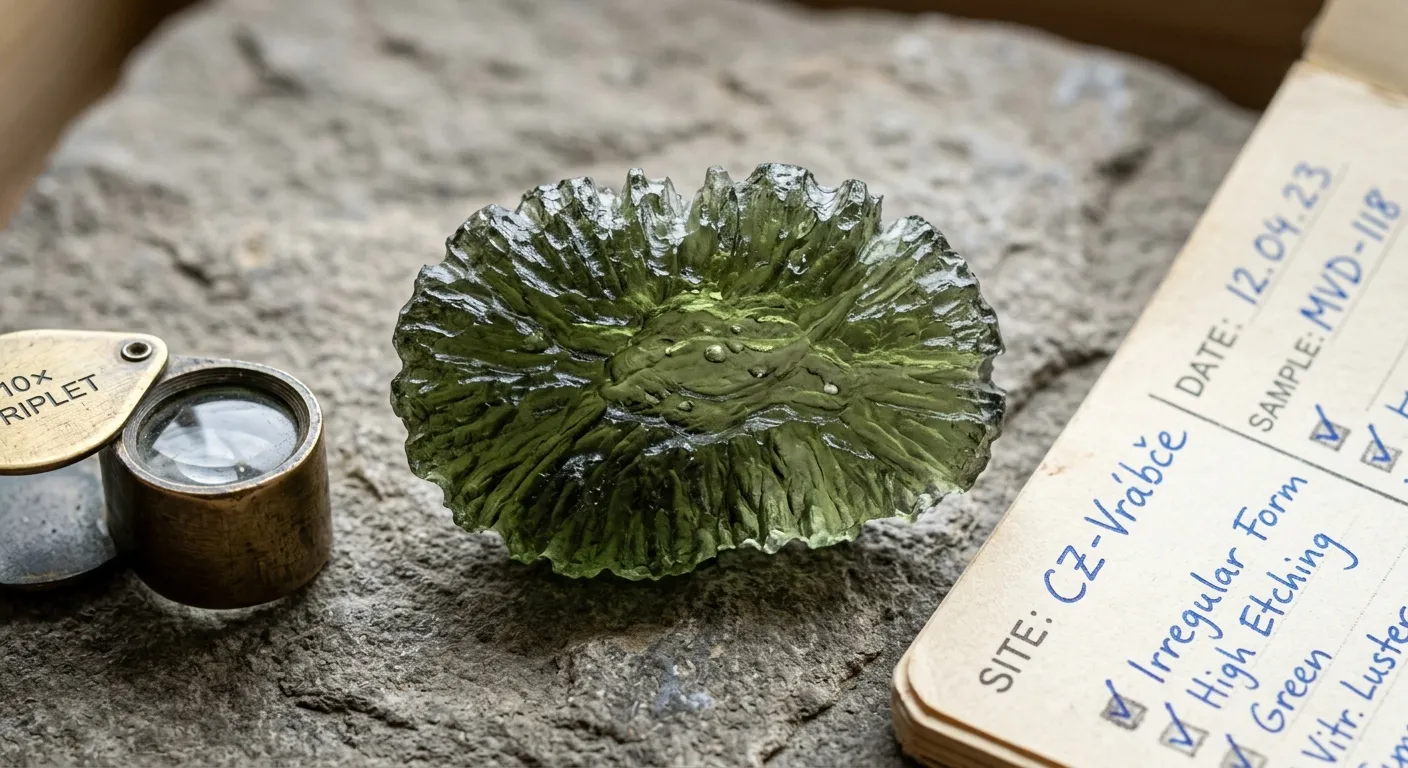
Some forms invite aerodynamic interpretation: drops, splashes, rods, discs, and broken fragments. Later history can complicate the picture. Burial, chemical weathering, erosion, transport in sediments, and cleaning after discovery may all affect surface texture.
The sharply etched Besednice “hedgehog” style is a useful example. Its spiky surface is usually discussed in relation to long-term natural etching, not as a direct frozen snapshot of flight. Original formation, breakage, burial, and weathering can all contribute to what a collector sees today.
4. Rapid cooling preserves glass
Moldavite is glass because the material cooled without forming a normal crystalline rock. Its glassy nature is not a decorative after-effect; it is part of its origin.
Collectors often hear simplified rules: real moldavite is “dry” glass, bubbles prove origin, or a particular inclusion settles the question. A better geological framing is more careful. Natural moldavite may show flow lines, bubbles, schlieren, and inclusions, but no single visible trait should be treated as an absolute authentication test.
Lechatelierite, a silica-rich inclusion often mentioned in moldavite discussions, can be meaningful in a broader tektite context. It should not be turned into a stand-alone label that settles everything. Serious identification depends on a pattern: composition, internal structure, morphology, surface texture, provenance, and comparison with known natural and artificial glass.
What Ries impact evidence proves, and what it does not
The Ries Crater is important in impact geology because it preserves impact-related rocks and shock features. Museum and geopark interpretation help explain why the structure is understood as an impact crater rather than an ordinary volcanic or erosional feature.
Three evidence types often appear in Ries discussions:
| Evidence type | Why it matters | What it does not prove by itself |
|---|---|---|
| Suevite | A mixed impact breccia associated with crater-forming processes | The exact moldavite melt source or flight route |
| Shocked quartz | A shock feature that supports extreme pressure conditions | That every green glass object in the market is moldavite |
| Coesite and stishovite | High-pressure minerals linked to intense impact conditions | The full tektite formation mechanism without additional studies |
This is the key boundary: crater evidence supports the impact engine. It does not authenticate every specimen, prove every collector rule, or resolve every mechanism-level question.
For moldavite, the argument works across two connected levels:
- Crater-level evidence: Ries is a confirmed impact structure with impact rocks and shock indicators.
- Tektite-level evidence: Moldavite is a Central European natural glass interpreted through distribution, chemistry, morphology, and impact-formation models.
Confusion starts when those levels are collapsed. The Ries impact can explain the origin pathway without making every green glass object “moldavite.”
The strewn field problem: moldavite is tied to the event, not simply the crater floor
One easy mistake is to imagine moldavite forming as a pool of green glass inside the Ries Crater. That picture is tidy, but it misses the tektite part of the story.
Tektites are associated with dispersal. A strewn field is the area over which tektite material is distributed. For moldavite, the Central European tektite field is the important regional expression. The crater is the source event; the moldavite-bearing areas record where material was later preserved, moved, eroded, and found.
Formation life
Impact melting, ejection, atmospheric flight, cooling into glass.
Residence life
Burial, sediment transport, weathering, erosion, and eventual discovery.
That second life matters. Surface sculpture, color changes, breakage, and preservation can reflect long geological residence after formation. Stratigraphy is important for serious locality work, but specific claims about which layers hold moldavite in a given place need local geological evidence, not broad crater summaries.
Ries and Steinheim: why the “twin impact” idea needs restraint
The Nördlinger Ries is often discussed alongside the nearby Steinheim Basin. Some sources present this as a binary-impact or “twin crater” story: two structures, one dramatic cosmic episode.
For moldavite’s origin, that claim is not necessary. The central model rests on the Ries hypervelocity impact and the formation of Central European tektites through impact melting, ejection, atmospheric travel, and glassy cooling. If a source claims that Ries and Steinheim were definitely paired in a single event, that is a more specific claim requiring stronger support.
It helps to separate the layers:
- Ries is the main confirmed impact structure used in the moldavite origin model.
- Steinheim is a related regional geological question, not the core requirement for explaining moldavite.
- Moldavite is an impact glass connected to the Central European tektite field.
- Binary-impact interpretations should not be treated as settled background unless the source is built for that exact claim.
The geology is stronger when it does not need the most sensational version of the story.
Color, inclusions, and flow lines: what formation can explain
Moldavite’s appearance invites overinterpretation. Green color, internal swirls, bubbles, etched surfaces, and locality names all feel meaningful. Some are meaningful, but usually as part of a pattern, not as single-proof features.
Schlieren and flow structure
Schlieren are streaks or flow structures in glassy material. In moldavite, internal swirling can fit the broader formation story of moving, stretching, and cooling melt. But visible flow alone is not an origin certificate. Artificial glass can also show flow features, and natural moldavite varies.
Bubbles need context
Bubble shape may reflect melt viscosity, stretching, pressure changes, and deformation while the glassy body was forming. Bubbles can help an experienced assessment, but they should not be reduced to a simple rule such as “this shape proves it.”
Color needs chemistry, not folklore
Names such as Chlum, Radomilice, Moravian moldavite, or Besednice carry locality and collector meaning. Color may range from bottle green to olive, brownish green, or darker tones depending on composition, thickness, weathering, and viewing conditions.
A color difference can suggest a question; it does not answer it by itself. Responsible color interpretation needs analytical data and locality context.
“Cosmic glass” is useful only if it stays geological
“Cosmic glass” is a good phrase when it is used carefully. Moldavite is cosmic in the sense that an extraterrestrial impact supplied the energy that transformed terrestrial material. It is not simply a frozen piece of the impactor, and it is not a meteorite in the ordinary collecting sense.
In cultural and crystal-market language, “cosmic” often becomes symbolic language about intensity, change, or personal meaning. That explains why many readers come to moldavite in the first place. It is not evidence for geological origin.
A person can value moldavite symbolically and still keep the formation story grounded in rocks, pressure, heat, ejecta, atmospheric flight, and glass. The Ries event explains a natural process; it does not validate every seller description or every personal-effect claim attached to the stone.
What the current source base can support
The available source base is useful for orientation but limited for precision. It supports a responsible branch-level explanation, not a full technical reconstruction of every step.
Supported with reasonable confidence from the curated material
- The Nördlinger Ries is the key crater setting used to explain moldavite’s impact origin.
- The Ries landscape is interpreted through impact geology, including impact rocks and shock evidence.
- Moldavite is best understood as impact glass associated with tektite formation, not ordinary volcanic glass.
- The broad formation pathway involves impact energy, silica-bearing material, melt or ejecta, transport away from the crater, atmospheric modification, and glassy cooling.
Claims that should be stated more cautiously unless supported by claim-level scientific sources
- Exact crater age, size, and numerical impact parameters.
- Exact target beds and melt-source chemistry.
- Detailed ejection trajectory, launch angle, or flight duration.
- Precise thermal history of individual droplets.
- Specimen authentication from one inclusion, bubble, or surface feature.
- Firm conclusions about Ries-Steinheim pairing.
- Detailed maps of all primary and secondary moldavite deposits.
That boundary does not weaken the Moldavite Impact Origin model. It keeps the explanation in the right scale: public crater resources establish the setting; detailed mechanism claims need more specialized evidence.
A practical judgment frame for readers
When you encounter a claim about the Ries event and moldavite, first ask what level of claim it is making.
If it says moldavite is linked to a major impact event, it fits the broad geological framework.
If it says the Ries impact generated silica-rich melt and ejecta that help explain Central European tektites, it is still within the responsible formation model, as long as it does not pretend every pathway is known in detail.
If it says one bubble, groove, “worm” inclusion, or surface texture proves a specimen is authentic, slow down. Those features may matter, but only in context.
If it says moldavite formed as a pool inside the crater, it is probably oversimplifying the strewn-field story.
If it says Ries and Steinheim were definitely twin impacts and that this is essential to moldavite, treat it as a narrower claim that needs stronger sourcing.
If it uses the Ries event mainly to sell certainty, rarity panic, or guaranteed personal results, it has moved away from geology.
The strongest version of the moldavite origin story is not the loudest one. It is the one that keeps the sequence clear: about 14.8 million years ago in the commonly cited chronology, a hypervelocity impact at the Ries Crater transformed terrestrial material under extreme conditions. Some silica-rich material was melted or mobilized, ejected, modified during atmospheric flight, and cooled into glass. Later geological processes shaped where pieces were preserved and how their surfaces look today.
That chain is already extraordinary. It does not need every unresolved detail turned into certainty.