Inside the Plume: How Temperature Created "Cosmic Glass"
Moldavite formed because a hypervelocity impact generated extreme heat, melted silica-rich surface material, and then cooled that material fast enough for glass to form. If you are searching this as a Plasma Plume question, the careful answer is slightly narrower: impact researchers often describe a hot thermal plume or vapor-rich cloud as part of the process, but not as one fully settled mechanism with one exact formation temperature.
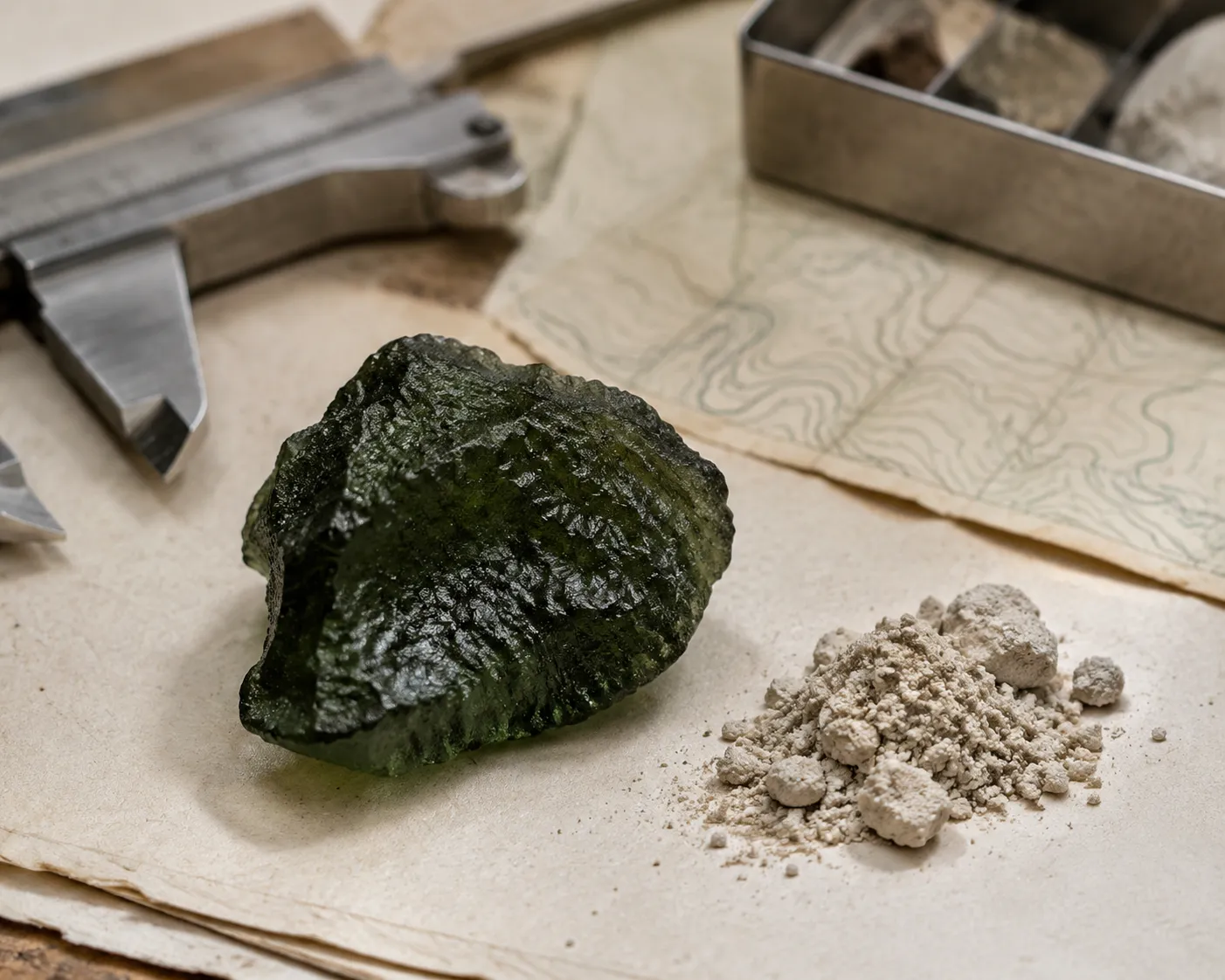
What “plasma plume” means in this context
In search language, “plasma plume” usually means the superheated cloud produced by a major impact. That is close to the idea, but it can be more precise to call it a thermal plume or impact plume.
The useful point is not the label itself. It is the role of that hot, expanding, turbulent environment. In plume-based tektite models, impact energy creates conditions that can melt fine silica-rich material, move it outward, and help shape it before it quenches into glass.
So if the question is whether moldavite formed in a plume, the bounded answer is: possibly as part of a hot impact-plume process, according to some models. That is different from saying moldavite has one universally agreed “plasma plume” origin in a strict laboratory-style sense.
Why temperature mattered so much
Temperature is the key reason ordinary sediment became impact glass.
Material linked to moldavite’s formation started as silica-rich near-surface target matter associated with the Ries impact event. To become glass, that material had to be driven far beyond normal surface temperatures, into conditions where it could melt, briefly behave as a low-viscosity fluid, and then cool quickly.
A few points matter here:
- Extreme heat was necessary. Hypervelocity impacts can generate enough energy to melt near-surface material and, in some models, partly vaporize it.
- Exact numbers depend on the model. Some plume-based work discusses temperature ranges high enough to melt tektite-like dust and quartz-rich particles, but those figures should be read as model guidance, not one exact moldavite formation temperature.
- More than one high-temperature pathway may be involved. Some explanations emphasize direct melting and ejection. Others give more weight to vapor-phase processing, condensation, and droplet formation.
That is why the safest conclusion is not “moldavite formed at one exact plume temperature,” but rather: its formation required an unusually intense thermal event, and plume-like conditions can help explain how the melt was processed and cooled.
How a hot impact plume could produce moldavite
A simple version of the process looks like this:
A large impact strikes silica-rich surface material. Energy is released almost instantly. Some of that material melts, and some may enter a vapor-rich state. Hot gases expand outward and upward.
In plume-based models, fine particles are carried within that turbulent hot cloud. As they move through it, they can melt, merge into droplets, and deform while still fluid. That helps explain why tektites often show splash-form shapes instead of looking like random broken rock.
Cooling is the other half of the story. Once molten material leaves the hottest part of the system, it can lose heat fast enough to solidify as glass rather than forming a fully crystalline rock texture.
This is the main role of temperature in moldavite formation: it controlled not only whether material melted, but also how fluid it became, how long it could deform, and when its glassy structure locked in.
What is still model-dependent
A common misunderstanding is that plume language settles the whole question. It does not.
Some formation models emphasize:
- near-surface melting and ejection from the Ries impact
- transport of molten material away from the crater
- vapor-rich processing and condensation
- a hot turbulent plume that melts, carries, and reshapes particles
These ideas can overlap rather than cancel each other out. A single impact can produce melt, vapor, droplets, and turbulent transport in the same broader event.
So the strongest answer is limited but clear: extreme temperature from the impact was essential; a thermal-plume environment is a credible part of the explanation; the exact pathway remains model-based rather than fully settled in one simplified statement.
A few common mix-ups
One mistake is to picture moldavite as ordinary crater melt thrown into the air and frozen. The research picture is more specific than that. Moldavite is tied to near-surface target material, and some models include not only melting but also vapor-related processing, droplet breakup, and reshaping during transport.
Another is to treat “plasma plume” as the exact technical term used in every geology discussion. In this context, thermal plume, impact plume, or vapor-rich cloud is usually safer.
A third is to turn the dramatic origin story into proof of non-geological claims. Moldavite’s impact origin and high-temperature formation are geological questions. Reports about personal meaning or intense experiences belong to interpretation, not to the temperature evidence itself.
Quick answers
Is “plasma plume” the best scientific term here?
Not usually. It matches search intent, but thermal plume or impact plume is more careful.
Did moldavite need extremely high temperatures to form?
Yes. That part is not controversial. The debate is about the exact pathway, not whether extreme heat was required.
Did moldavite form only from direct molten ejecta?
Not necessarily. Some models also involve vapor-rich processing, plume transport, and droplet coalescence.
Moldavite’s “cosmic glass” character comes from an impact event that combined extreme heat, rapid transport, and fast cooling. That broad picture is strong. The narrower question of exactly how much of the process happened within a plume remains a matter of modeling rather than a single final mechanism.