Aerodynamic Sculpting: Why Most Moldavites Aren't Round
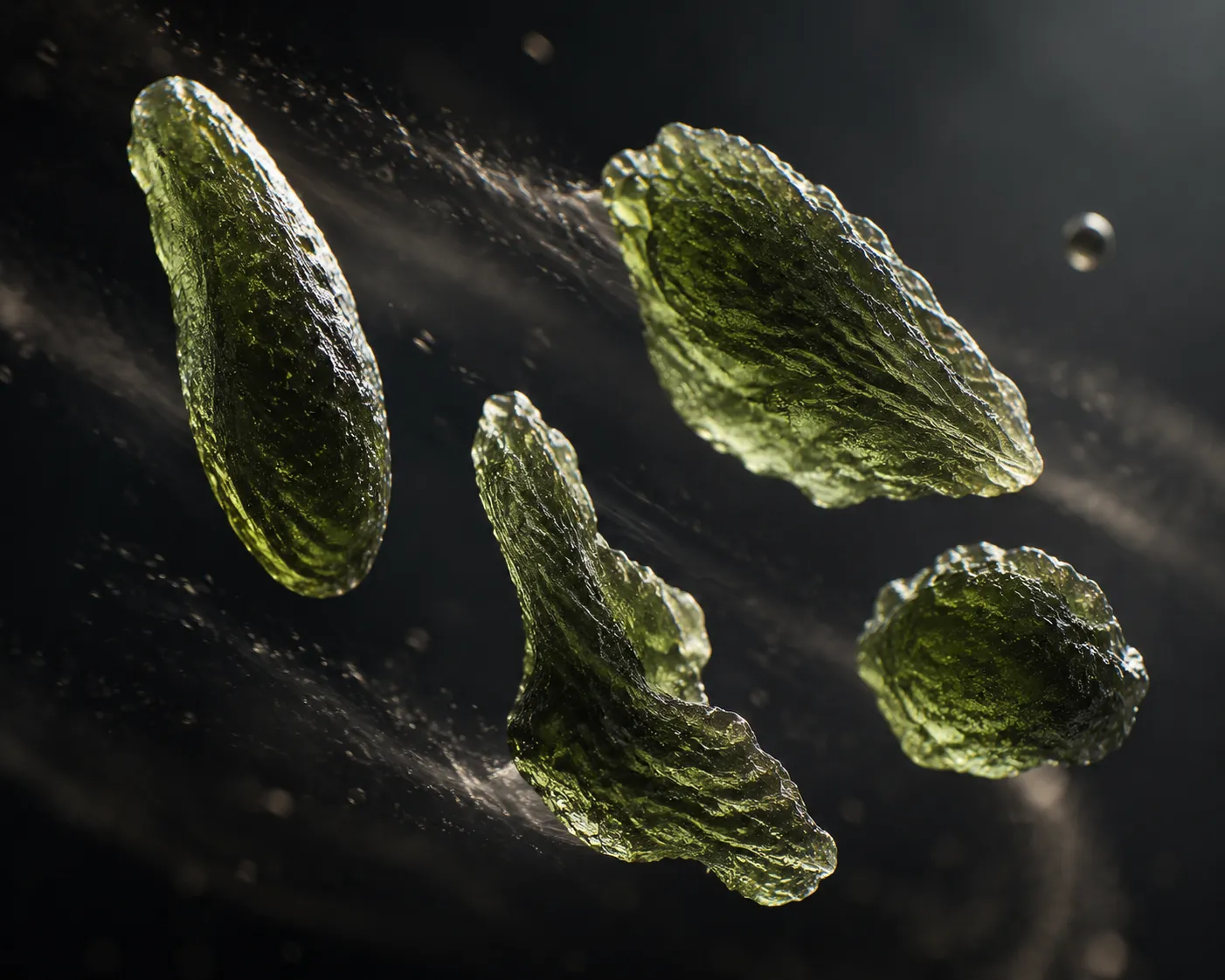
Most moldavites are not round because they did not cool as quiet, isolated droplets. They are impact glass—tektites made from Earth material ejected during the Ries impact—and most formed in fast, unstable motion. Tektite aerodynamics helps explain part of that: molten glass could stretch, spin, flatten, or break before it fully solidified. Later burial, stream transport, abrasion, and weathering could change the outline again. So round pieces can exist, but roundness is not the default, and shape alone cannot confirm authenticity.
The short answer
The simplest mental picture is also the most misleading: a neat green droplet slowly turning into a sphere.
If that were the real process, round moldavites would be common. But moldavite belongs to the tektite family, and tektites form under impact conditions, not calm bead-making conditions. Moldavite is not a meteorite. It is terrestrial glass created when impact-melted material was thrown outward, moved through the air, cooled, and in many cases fractured or was later reworked in sediments.
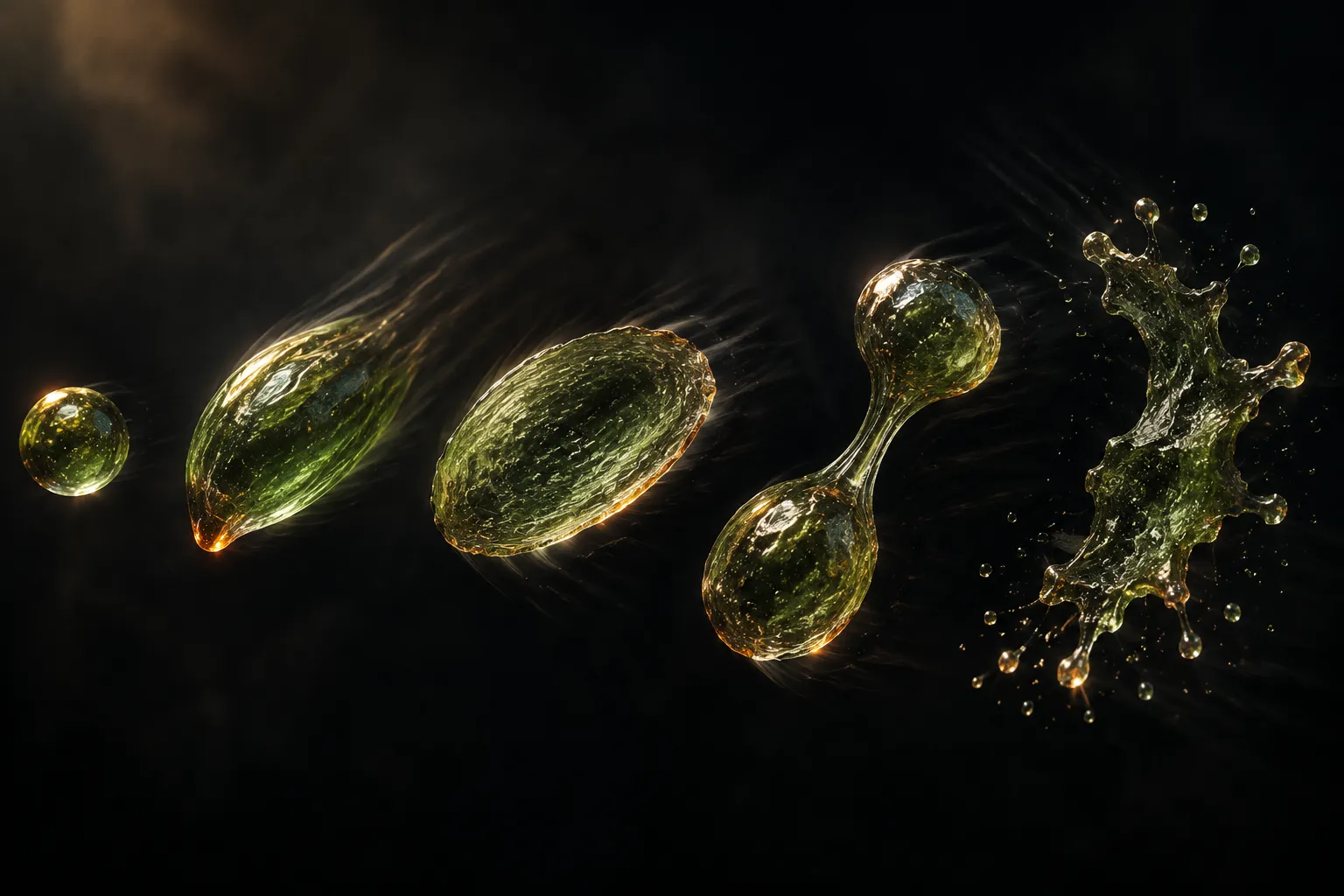
That matters because most pieces seem to have “frozen” out of motion rather than stillness. Instead of settling into spheres, they could be stretched into drops, flattened into discs, pulled into elongated forms, narrowed in the middle, or broken into irregular pieces before cooling finished.
Why molten glass does not automatically become a sphere
Surface tension does pull liquid toward a rounded shape. That part is real. At very small scales, it can dominate, which is why tiny droplets such as microtektites are often more nearly spherical.
But most collectible moldavites are larger and formed under less stable conditions. Their shapes reflect several forces acting at once:
- surface tension
- rotation
- aerodynamic drag
- inertia
- viscosity
- rapid cooling
A spinning molten body does not have to stay round. It can flatten, elongate, neck down, or become unstable. If cooling locks that shape in place, the result is a glass form that looks stretched or oddly balanced rather than spherical.
So the problem is not that the droplet idea is completely wrong. It is that the droplet idea by itself is too simple.
Why splash-form moldavites often look stretched or irregular
Many moldavites are described as splash-form tektites. In plain terms, that means they record a violent formation process rather than a quiet one.
Collector language such as “flight shapes” or “primary shapes” can be useful here, as long as it is kept modest. Some pieces are drop-like, some flattened, some elongated, some more compact, and some plainly irregular. Those forms are broadly consistent with molten material that was moving, rotating, deforming, and cooling at the same time.
That does not mean every individual piece can be read with certainty from shape alone. It only means the overall range of moldavite forms fits an impact-glass origin far better than the idea of perfect glass marbles.
Later geology changes the shape too
A moldavite’s outline is not only a record of flight.
After formation, moldavites entered a long Earth history. Geological reviews describe reworking, redeposition, and fluvial transport as part of that history. In practical terms, pieces could be buried, exposed, moved by water, knocked against sediment, and weathered at the surface.
That later history can:
- round edges
- soften sharp outlines
- make pieces look more pebble-like
- alter surface detail
Primary shape: the form produced while the glass was molten, moving, cooling, or breaking
Secondary wear: later changes from transport, abrasion, weathering, corrosion, or breakage
So a rounded moldavite may be rounded because of later transport, not because it originally formed as a near-perfect sphere.
The common misunderstanding about “aerodynamic” moldavite
“Aerodynamic” is easy to overread. It does not mean moldavite should be explained like a meteorite with a melted outer crust.
Moldavite is impact glass, not the incoming object from space. Some tektite literature discusses aerodynamic modification, but that does not justify treating every groove, pit, or textured surface as a burn feature from atmospheric passage. The broader review literature also places limits here, including caution around ablation-style explanations for moldavite surfaces.
For this page, the safest takeaway is simple:
- aerodynamics can help explain overall form during flight
- it does not explain every surface detail by itself
Surface sculpture may reflect more than one process, including melt behavior, cooling, breakage, weathering, and sedimentary wear.
Why some moldavites do look round
Some moldavites are more rounded or spheroidal than others. That does not contradict the main explanation.
A piece may look rounder because:
- it started as a smaller droplet, where surface tension mattered more
- it cooled into a compact form
- it was later rounded by water and sediment transport
- it is a fragment whose edges were softened over time
This is also why roundness is a weak standalone clue. It can result from primary formation, secondary wear, or both.
What shape can and cannot tell you
Shape is useful, but only within limits.
It can help explain why most moldavites are not round: they formed as moving, deforming impact glass rather than quiet droplets. It can also help distinguish broad categories such as drop-like, flattened, elongated, or irregular splash forms.
What shape cannot do on its own is prove that a piece is authentic. Natural moldavite can be rounded, elongated, flattened, twisted, or irregular, and imitation glass can also be made in convincing outlines. Shape is one observation, not a final verdict.
A better mental picture
Do not picture a tray of green glass marbles.
A better picture is a burst of terrestrial glassy material thrown into motion by impact: some portions stretching, some spinning, some flattening, some fragmenting, and many cooling before they could settle into stable spheres. Then add a second chapter in which streams, sediments, and weathering modify some of those pieces further.
That is why most moldavites are not round. Their shapes are the overlap of molten flight behavior, cooling, fragmentation, and later geological reworking.
Quick interpretation notes
- Round moldavite can be natural, but roundness is not the norm.
- Non-round shape does not mean “random”; it often reflects splash-form behavior.
- Shape and surface texture are not the same thing.
- “Aerodynamic” should be used carefully and not as a catch-all for every etched or sculpted surface.
- Shape alone is not enough to authenticate a specimen.