Collector terminology and evidence limits
The 1% Phenomenon: Why True Angel Chime Moldavites Are Exceedingly Rare
A true angel chime moldavite is considered rare because several narrow conditions have to meet in one specimen. It must be genuine moldavite, remain intact as natural impact glass, have a form that can produce a light audible ring, be handled carefully enough for that sound to be noticed, and not simply carry a romantic seller label.
That is the practical answer behind Angel chime rarity. The “1%” phrase is best read as collector shorthand for extreme rarity, not as a verified acoustic statistic. Public references support moldavite’s identity, formation background, and authenticity concerns; they do not establish that exactly one percent of moldavites chime, or that “angel chime moldavite” is a formal mineralogical class.
broader context
Broader moldavite archive
This narrower page makes more sense after the broader moldavite archive page.
What Collectors Mean by Angel Chime Moldavite
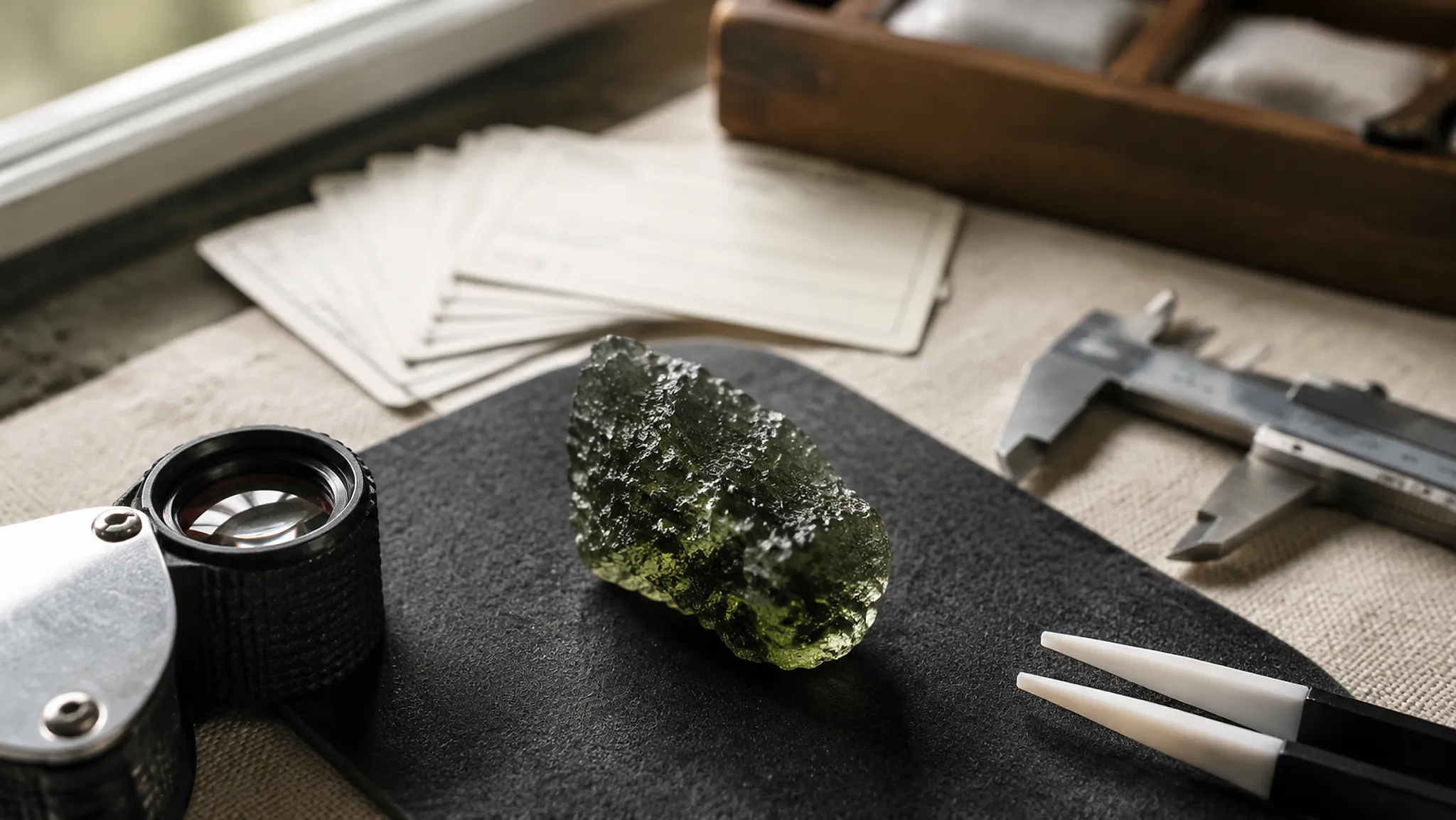
In collector and seller language, “angel chime moldavite” usually refers to a moldavite specimen said to make a delicate ringing, chiming, or glass-like sound when handled very lightly. Some descriptions compare the sound to crystal or fine glass. Others describe pieces that ring when gently touched, brushed, or moved against another hard surface.
The wording matters, but it has limits. “Angel chime” is not a standard mineral species, lab grade, or universally measured gemological category. It is a collector angel chime label built around perceived acoustic behavior. The label belongs to market and collecting language more than formal geology.
Moldavite itself has a stronger evidence base. It is a natural green impact glass, commonly described as a Central European tektite, formed in connection with an ancient impact event and found within a known strewn-field context. That background explains why collectors treat moldavite differently from ordinary manufactured green glass. It does not, by itself, explain why one individual piece may ring.
The chime claim sits on top of the material identity. First comes the question of whether the specimen is moldavite at all. Only then does the acoustic question become useful.
Why the Rare Filter Gets So Tight
The rarity argument is strongest when it is framed as a chain of conditions, not as a confirmed percentage.
Authenticity comes first
First, the specimen needs to be genuine moldavite. The consumer market includes imitation and misrepresented material, so sound alone cannot establish authenticity. A ringing object can still be ordinary glass. A quiet object can still be real moldavite. The angel chime moldavite sound is not an authentication method.
The glass must remain intact
Second, the piece has to remain intact enough to resonate. Moldavite is glass. It can chip, fracture, or break if struck or handled roughly. A specimen with the right shape, mass, edge condition, or internal tension to produce a chime may lose that behavior if damaged. Acoustic rarity depends on preservation as well as origin.
Audible vibration is conditional
Third, the piece must have physical conditions that allow audible vibration. The available material does not establish a measured mechanism. Collector discussion sometimes points to an internal stress hypothesis: the idea that tension locked inside the glass may contribute to the chime. That remains a hypothesis. Shape, thickness, edge condition, and the way a specimen is held could also affect whether anyone hears a sound.
Someone has to notice it carefully
Fourth, someone has to notice the behavior without harming the piece. Many moldavites are bought from photos, kept in display cases, wrapped for sale, or handled mainly for visual inspection. A subtle sound trait can be missed when the handler is focused on locality, surface texture, size, color, or provenance.
Those filters make rare angel chime pieces plausible as collector language. They do not make the 1% number proven.
Why the 1% Claim Should Stay Bounded
The phrase “1% phenomenon” is memorable because it sounds precise. For this topic, precision is where the evidence is weakest.
The available public material does not verify a broad acoustic survey of moldavite inventory. It does not establish a repeatable moldavite sound testing protocol across locality, size, shape, damage history, and handling conditions. It does not provide measured acoustic statistics showing how often true angel chime moldavites occur.
A better reading is this: collectors use the number to express that the acoustic subset is believed to be exceptionally uncommon. It signals top tier collectibles in market language, not a confirmed population count.
That distinction protects the claim from doing too much. A seller may use “angel chime” to describe an observed sound. A collector may value that sound as an unusual specimen trait. But neither party should treat the number as a census of moldavite.
This also keeps the topic separate from other rarity claims. A specimen may be desirable because of sculpture, surface texture, locality association, color, or size. Those traits can overlap with a chime label in listings, but they are not the same claim. Besednice-style surface character, locality talk, and moldavite chime behavior should not be collapsed into one category.
Sound Is a Trait, Not a Shortcut
The glass-like moldavite sound is interesting because it gives collectors another way to notice a specimen beyond appearance. Still, sound should be treated as a secondary trait, not a shortcut to certainty.
A chime does not prove provenance. It does not prove Czech origin. It does not prove market value. It does not prove that the piece belongs to a measured one-percent group. At most, it suggests that the specimen, as handled in that moment, produced an audible acoustic response.
The reverse is also true. A moldavite that does not chime during casual handling should not be dismissed as ordinary or inferior. It may be thicker, smaller, more irregular, held differently, wrapped differently, or simply not shaped in a way that rings. Many real tektite specimens are collected for geology, locality context, texture, or visual character rather than sound.
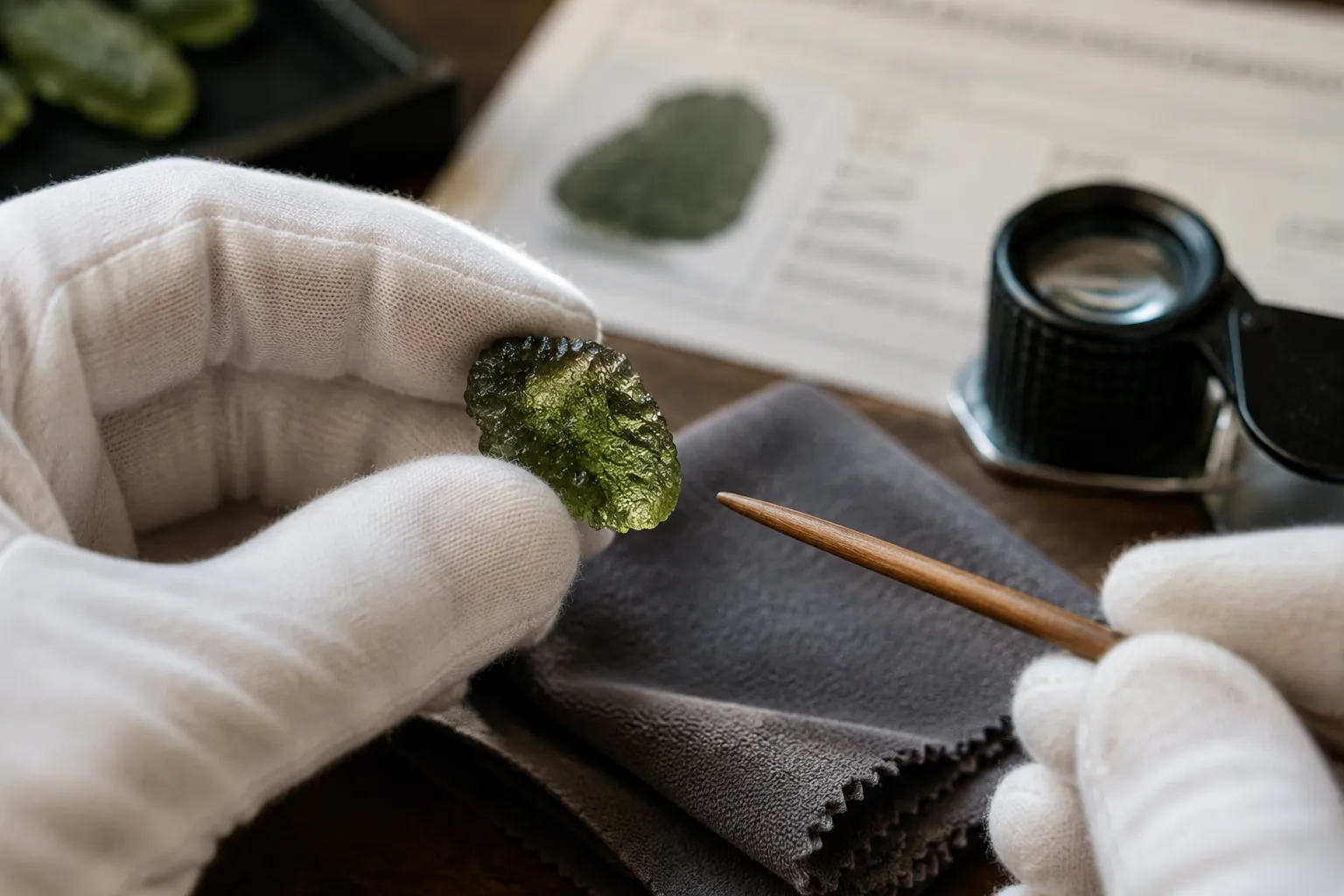
Handling matters. Because moldavite is glass, readers should not strike, drop, or repeatedly tap a specimen to chase a sound. If a sound check is considered at all, it should be gentle, optional, and preferably left to someone who understands the risk of chips and fractures. A broken specimen is not a better-tested specimen.
The practical collector question is not “Can I make it ring?” It is: “Is there credible, careful evidence that this particular piece has been observed to chime, and does that evidence sit alongside normal authenticity and provenance checks?”
Where the Confusion Comes From
The phrase “angel chime” creates search confusion before the moldavite question even begins. In many results, angel chimes are not stones at all. They are Scandinavian candle carousel ornaments, vintage brass Christmas objects, wind chimes, memorial chimes, or decorative angel products.
That alternate meaning should not be imported into moldavite collecting. It explains why the phrase feels familiar and why searches can drift into decor listings, but it does not provide evidence for moldavite acoustic rarity.
There is also market-language confusion. Commercial pages may use phrases such as rare, rarest form, crystal-like sound, or different from regular moldavite. Those phrases show how the term is being used, but they cannot carry the factual burden alone. Seller language can describe a category; it cannot establish the true population size of that category.
| Claim Type | What It Can Mean | What It Does Not Prove |
|---|---|---|
| Genuine moldavite | The specimen is represented as natural Central European tektite | That it will chime |
| Angel chime label | The seller or collector says it has a ringing sound | That the label is formal or measured |
| 1% rarity language | A market way to express extreme rarity | A verified acoustic statistic |
| Glass-like sound | An observed acoustic behavior under gentle handling | Authenticity, provenance, or value |
The strongest collector position is cautious: the term may be meaningful when attached to a specific observed sound behavior, but the claim weakens when it becomes a loose glamour label.
What Would Make an Angel Chime Claim More Credible
A more credible angel chime claim would connect the label to a specific specimen and keep the acoustic statement modest.
Useful supporting details might include ordinary authenticity context, careful provenance information where available, and a description that explains the sound as an observed handling trait rather than a guaranteed property. A short, non-destructive demonstration may be more informative than dramatic rarity language, but even then it should be viewed as evidence of sound behavior only.
Proportion test
- If a listing talks more about rarity than specimen traits, slow down.
- If the sound is presented as proof of origin, value, or promised effect, the claim is doing more work than the evidence allows.
- If a piece is described as angel chime but no acoustic observation is given, the label may simply be market vocabulary.
Collectors can still care about the trait. A genuine moldavite specimen that audibly rings under careful handling may be unusual and desirable to some buyers. The point is not to dismiss the category. The point is to keep the category honest.
The Bottom Line on Angel Chime Rarity
True angel chime moldavites are considered exceedingly rare because the label depends on a narrow acoustic subset inside an already specific natural material category. The specimen must be real moldavite, intact, physically capable of resonating, carefully recognized, and described without turning seller language into proof.
The “1%” phrase should be read as a signal of extreme rarity in collector speech, not as a verified statistic. Current public evidence supports moldavite’s identity as a Central European tektite and supports the market definition of angel chime as a sound-based descriptor. It does not verify the exact percentage, the mechanism, or a formal testing standard.
That leaves a restrained but useful conclusion: angel chime can be a meaningful collector term when tied to a specific, gently observed sound behavior. It should not replace authenticity checks, provenance judgment, or careful handling. Specimen traits come first; the chime label comes after.