Intention-Driven Commerce: The Rise of Emotional Wellness Crystal Kits
Moldavite intention kits are best understood as curated, meaning-centered retail bundles, not as evidence-backed wellness tools. Their appeal comes from the way crystal culture, gifting, aesthetic self-care, and e-commerce language can turn a small object into a personal prompt. The “rise” here is not a verified Moldavite-specific market boom; it is a broader retail pattern in which products are framed around intentions, moods, milestones, and identity.
Within that frame, Moldavite intention kits may feel emotionally resonant to buyers who already value crystals symbolically. The boundary is just as important: they should not be presented as producing health results, guaranteed transformation, or reliable manifestation outcomes.
broader context
Start with the main moldavite page
This narrower page makes more sense after the broader moldavite archive page.
What an intention kit is actually selling
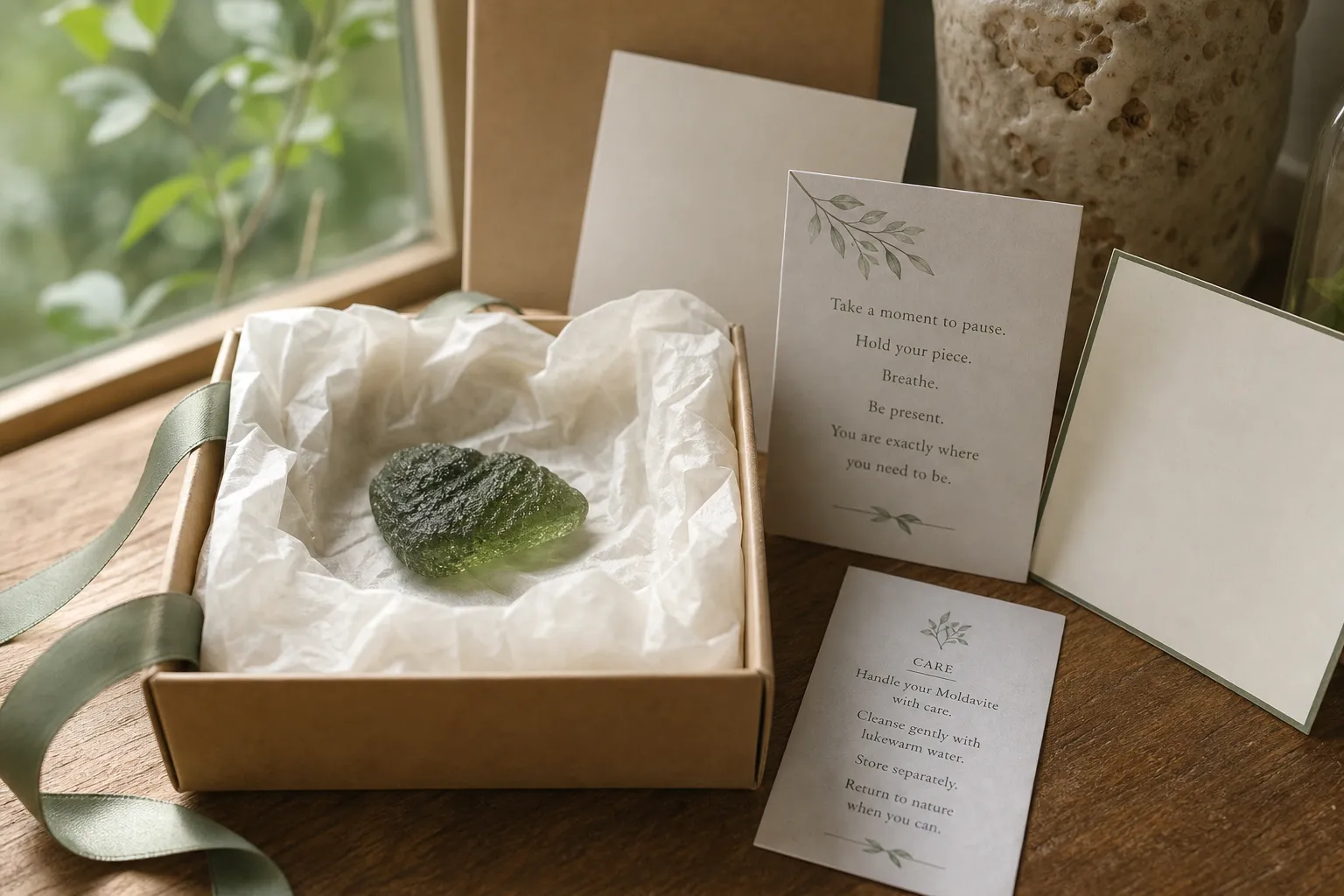
An intention kit usually sells more than the crystal itself. It sells a small structure around the object: a theme, a card, a ritual suggestion, a giftable presentation, or a moment of reflection. In Moldavite-focused versions, the stone becomes the center of a bundle that may be described with language about change, new beginnings, clarity, or personal transition within belief-based crystal culture.
That does not make those ideas true in a medical, psychological, or scientific sense. It means the product format gives the buyer a way to organize meaning around an object.
Buyer questions
This is where intention-driven commerce works. The buyer is not only asking, “What is this material?” They may also be asking:
- “What does this gift say?”
- “Does this object mark a change I am going through?”
- “Can this support a small reflective practice?”
- “Does the packaging match the feeling I want to convey?”
- “Does this feel personal rather than generic?”
For a collector, the Moldavite piece may matter most as a specimen, with questions about authenticity, origin, surface features, and seller transparency. For a spiritually curious buyer, the same piece may be approached as a symbolic object. For a gift buyer, the kit format can make the choice feel less random by wrapping the crystal in a clear emotional message.
The useful distinction is simple: symbolic value is not the same as demonstrated effectiveness. A kit can be meaningful, beautiful, and personally grounding as a ritual object without proving any specific result.
Why emotional wellness retail fits the kit format
“Emotional wellness” is often used in retail as a broad self-care phrase. In this setting, it usually points to comfort, mood, reflection, identity, or a desire for calm structure. It should not be read as a clinical claim.
A crystal kit may sit in someone’s personal routine in the same way a journal, candle, keepsake, or handwritten note can sit inside a reflective moment. That is a cultural and consumer-behavior observation, not evidence that the object changes mental health.
The kit format fits emotional wellness retail because it reduces ambiguity. A loose crystal asks the buyer to supply all the meaning. A curated bundle gives the buyer a ready-made frame: “new beginning,” “clarity,” “release,” “protection,” “confidence,” or another emotionally legible theme. Those words are powerful in marketing because they convert a material object into a story.
Research on symbolic gifts and online gift choice helps explain why this works. Gifts can communicate care, enjoyment, values, support, or longer-term meaning. A Moldavite kit is not just a stone in a box; it can be presented as a message: “I see this transition you are in,” or “I wanted to give you something with meaning.”
This is also why bespoke subscription boxes are an easy comparison, though they should not become the main subject. Personalized-box commerce often turns selection into a service. The buyer receives a curated experience rather than a single item. In crystal culture, the same logic appears when sellers group stones, cards, prompts, and packaging into a themed set. The value is partly material and partly interpretive.
What the available source base does not support is a strong claim about Moldavite-kit sales growth, typical contents, pricing patterns, or consumer adoption. Those would require direct retail or platform-level evidence. The tighter answer is: the kit format fits known patterns of meaning-oriented e-commerce, but Moldavite-specific market claims remain uncertain.
The Moldavite-specific tension
Moldavite occupies an intense place in crystal culture. It is often surrounded by language about acceleration, transformation, awakening, and major life change. That reputation makes Moldavite commercially attractive: the stone already carries a dramatic story that sellers can package into a themed bundle.
That is also where careful wording matters.
Reasonable descriptions
- a symbolic crystal bundle;
- a reflective or ritual-adjacent product;
- a giftable object for someone who values crystal culture;
- an aesthetic self-care item;
- a curated set built around intention-setting language;
- a collector-adjacent purchase that still requires authenticity awareness.
Claims to avoid
It should not be described as a product that guarantees emotional change, promises specific life outcomes, or replaces professional support. Even when a buyer personally feels comforted by the ritual, that experience should not be turned into a general claim about what Moldavite does.
The same boundary applies to seller language. Words such as “alignment,” “energy,” “activation,” “release,” and “transformation” may be meaningful inside a belief-based community. In retail copy, though, they can slide into overstatement when they are tied to certainty, urgency, health outcomes, or life results.
A responsible Moldavite kit page would make the symbolic frame clear. It would not pressure the buyer with fear, destiny, crisis language, or claims that the stone will change their life. It would also separate the physical object from the ritual suggestion: the stone is the product; the intention practice is a personal interpretive layer.
What changes the answer
If the claim is that Moldavite intention kits are a form of intention-driven commerce, that is a reasonable editorial description. They combine product curation, symbolic language, aesthetic presentation, and emotionally themed purchase motives.
If the claim is that these kits are meaningful to some buyers, that is also reasonable when phrased as a subjective or cultural point. People often use objects to mark grief, change, hope, identity, commitment, or renewal. A kit can give those feelings a physical form.
If the claim is that Moldavite kits are a fast-growing retail category, the evidence is not strong enough here. The word “rise” should be treated as a visible retail framing, not a verified market statistic.
If the claim is that the kit has a dependable wellness effect, the answer should stay narrow: the available material does not support medical, psychological, or guaranteed spiritual outcomes. Crystal kits are not a substitute for professional medical or mental-health care. Anyone experiencing significant distress, crisis, or ongoing symptoms should seek qualified support.
If the claim is that a kit is a good gift, the answer depends on the recipient. It may be thoughtful for someone who already enjoys crystals, ritual objects, journaling, symbolic keepsakes, or aesthetic self-care products. It may feel inappropriate or confusing for someone who does not share that language, is skeptical of crystal culture, or would feel pressured by transformation claims.
Common confusion around Moldavite intention kits
The most common confusion is treating market language as evidence. A seller can describe a kit as “for transformation” without showing that transformation will occur. In retail, these words often describe the story attached to the product, not a verified result.
A second confusion is assuming that more items make the kit more powerful. A bundle may feel richer because it includes a card, pouch, candle, journal prompt, or additional crystals, but the added structure is still symbolic. The number of objects does not establish efficacy.
A third confusion is mixing authenticity questions with wellness questions. Authenticity matters because Moldavite is a collectible material and buyers should care about what they are actually purchasing. But even an authentic specimen does not validate exaggerated wellness claims. Authenticity can support material trust; it does not prove emotional outcomes.
A fourth confusion is assuming that “bespoke” always means better. Personalized or bespoke subscription boxes can feel more intimate because they match a theme, zodiac sign, milestone, mood, or gifting occasion. But personalization improves fit and presentation; it does not automatically improve truthfulness. A custom label can still carry unsupported claims.
There is also a cultural flattening risk. Research on spiritual symbols and ritual products in other markets shows how commerce can turn complex practices into simplified aesthetics. Moldavite intention kits are not the same as those cultural cases, but the ethical lesson is relevant: belief-based products should be presented with restraint, context, and respect rather than used as a shortcut to emotional urgency.
A practical standard for responsible crystal marketing
A Moldavite kit does not need inflated claims to be appealing. Responsible crystal marketing can still be warm, beautiful, and meaningful while staying within honest boundaries.
A stronger product description focuses on
- the material object being sold;
- any sourcing or authenticity information the seller can support;
- the symbolic theme of the kit;
- intended use as reflection, gifting, display, journaling, or ritual;
- clear language that the kit is not medical or mental-health care;
- respectful handling of spiritual or cultural references;
- no pressure tactics aimed at emotionally vulnerable buyers.
A weaker product description leans on
A weaker product description leans on certainty where certainty is not available. It tells the buyer what the crystal will do, uses crisis or destiny language, or implies that purchasing the kit is necessary for personal change. That kind of framing should be treated as marketing, not guidance.
For readers, the simplest verification point is this: ask what part of the kit is factual, what part is symbolic, and what part is promotional.
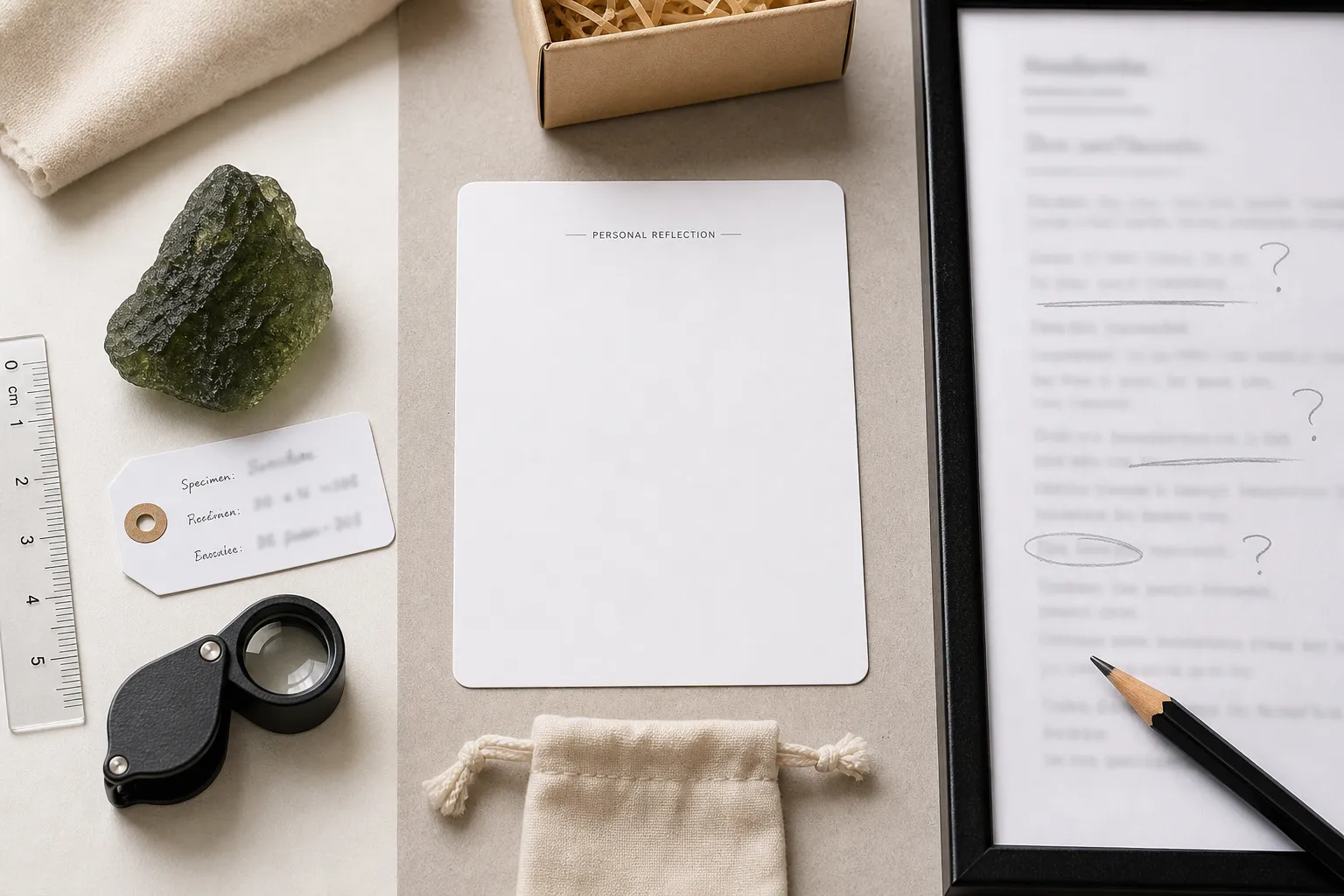
The factual layer may include the stone, packaging, included objects, seller policies, and authenticity documentation. The symbolic layer may include intention prompts, ritual language, and personal meaning. The promotional layer is where claims can become exaggerated.
Keeping those layers separate makes the category easier to appreciate without overstating it.
Bottom line
Moldavite intention kits function as emotional wellness retail because they package a crystal object with intention-setting language, aesthetic self-care cues, and giftable meaning. They belong to a broader pattern of intention-driven commerce, where buyers are offered not just an item but a story, a ritual prompt, or a symbolic way to mark change.
That can be legitimate as culture, gifting, and personal reflection. It becomes misleading when the language turns symbolic use into promised outcomes. The most balanced view is simple: a Moldavite kit may be a meaningful curated object for someone who values crystal symbolism, but its value should be understood as personal, aesthetic, ritual-adjacent, and belief-based—not as proof of emotional, health, or life-changing effects.