The Strewn Field Map: Tracking the Debris of a Catastrophe
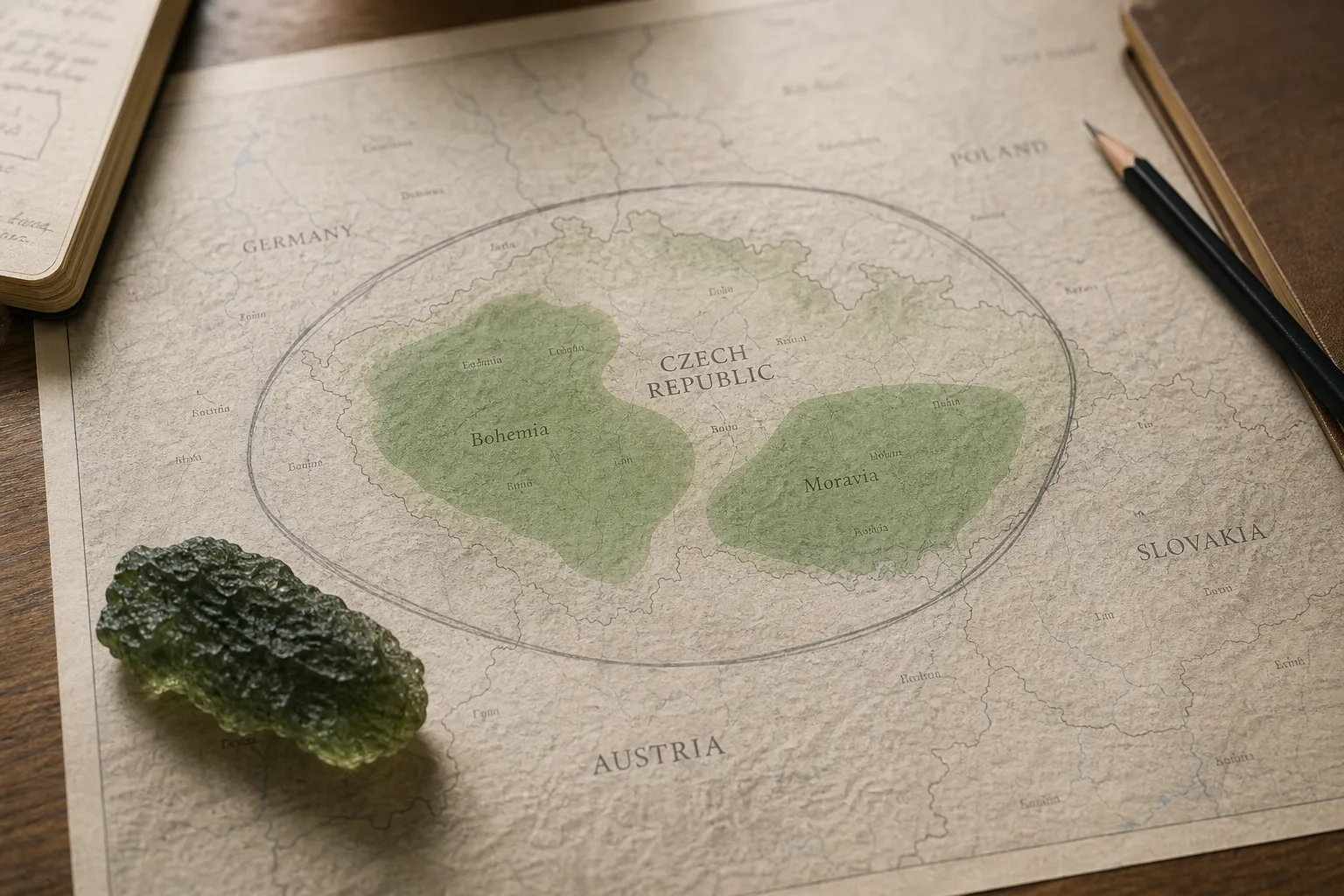
A Moldavite Strewn Field map is most useful as a distribution map, not as a verdict on a single specimen. It helps readers see how moldavite-bearing material is commonly discussed across broad Central European zones, especially when the conversation turns to Bohemia vs Moravia.
That is the direct answer: the map gives context for moldavite debris distribution. It can show regional pattern, separation, and plausibility. It cannot confirm that one piece came from a named village, pit, field, or seller-listed locality.
The map belongs to impact history and map interpretation. Provenance needs more than a shaded region.
broader context
Start with the main moldavite page
This narrower page makes more sense after the broader moldavite archive page.
What a Strewn Field Map Actually Shows
A strewn field map shows the geographic spread of material associated with an impact event. In moldavite language, that usually means marking areas where moldavite has been reported, studied, collected, or historically associated with known distribution zones.
For a collector, the better question is not, “Does this dot confirm my stone?” The better question is, “Does this claimed origin fit the broad distribution pattern a careful map would allow?”
That distinction keeps the map in its proper role. It is not just decorative, but it is also not a certificate. It places scattered pieces of impact glass into a wider landscape so the reader can see pattern before accepting a narrow origin claim.
The current source set for this page does not include usable public references, geological survey links, museum pages, or peer-reviewed source records. Because of that, this article does not draw exact field boundaries, list verified locality densities, or present a technical map. It explains how to read a Moldavite Strewn Field map without asking it to carry more certainty than the evidence allows.
Why Bohemia vs Moravia Matters
Bohemia and Moravia matter because those names appear often in moldavite origin language. A strewn field map may separate them into different regional frames, helping readers see why “Czech moldavite” is broader than either label.
The problem begins when regional language sounds more exact than the evidence behind it. A listing may use “Bohemian,” “Moravian,” or a smaller locality name to make a specimen feel more specific. A map can show that a region belongs inside the broader moldavite conversation, but it does not establish that one specimen came from the exact place named in a sales description.
Map region is not specimen provenance.
A useful map should make the Bohemia vs Moravia distinction clearer, not turn it into a value claim. This page does not support regional claims about price, rarity, quality, investment potential, or personal effects. Those claims require a different evidence base. Here, the distinction is geographic and interpretive: where a claim sits on the map, how broad it is, and whether the wording becomes too precise.
A good map shows separation. A weak map can make separation look cleaner than it is.
How Distal Ejecta Changes the Map
Distal ejecta is the concept that keeps moldavite mapping from becoming a simple “found here, formed here” story. In general impact language, distal ejecta refers to material transported far from the impact area. For moldavite, that helps explain why a strewn field can be discussed across regional zones rather than as one neat point on a map.
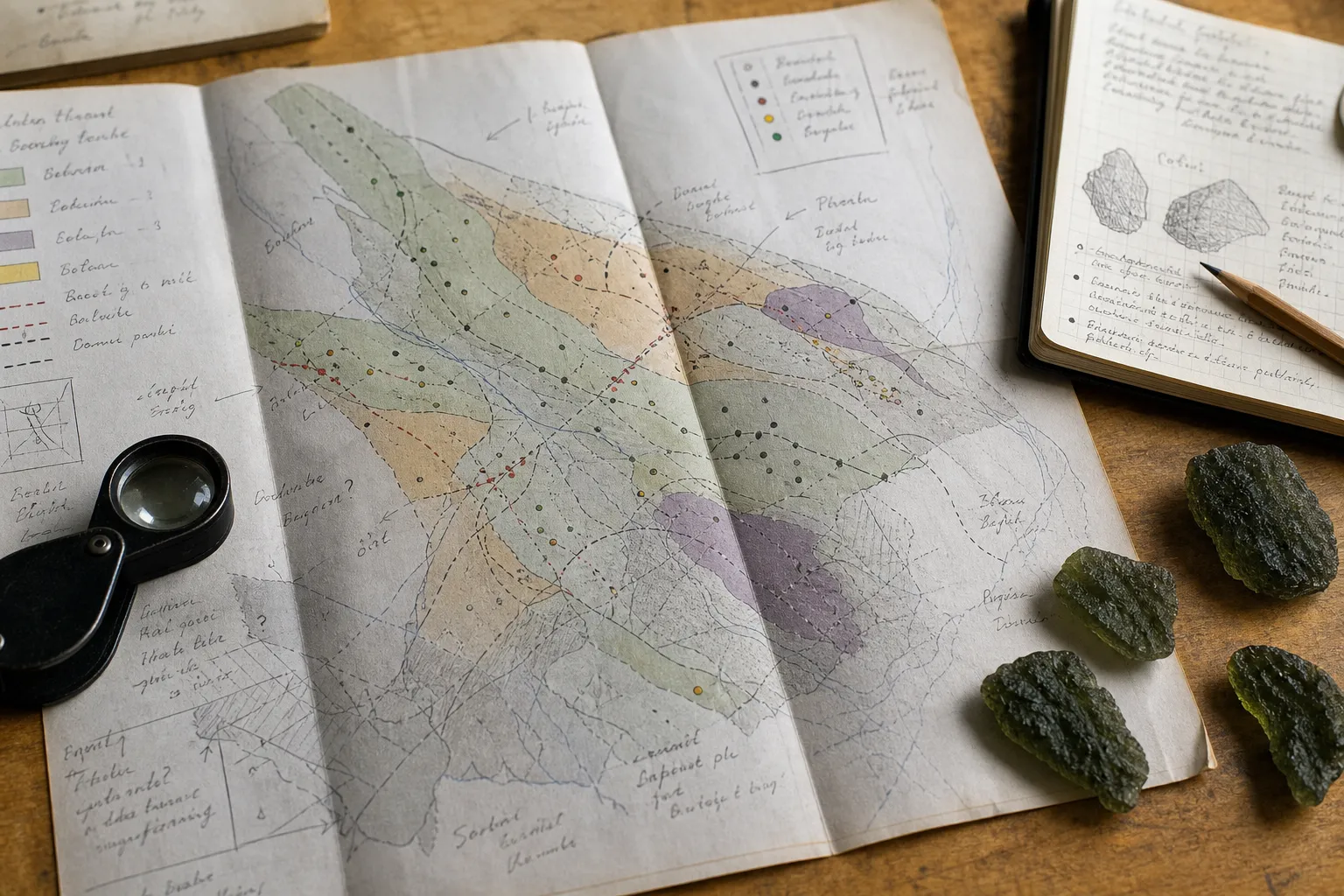
That does not make every moldavite map precise. Shaded areas, arrows, dots, and labels all compress uncertainty. A clean graphic may be easier to read, but readability is not the same as geological certainty.
Map layers
Impact history, transport, deposition, erosion, later discovery, and collector labeling all affect how a distribution map should be read.
Boundary caution
Natural distribution zones rarely behave like political borders. If a map presents every boundary as exact, read it cautiously.
The better mental model is layered: impact history, transport, deposition, erosion, later discovery, and collector labeling. A Moldavite Strewn Field map is useful because it keeps those layers visible. It helps prevent a flat reading of geography.
How to Read the Map Without Overclaiming
Start with scale. Is the map showing Central European strewn fields, the Moldavite Strewn Field as a whole, or a smaller collector-facing locality area? These are different map tasks. A broad map can explain distribution logic; a closer map may help compare origin language. Neither one authenticates a specimen by itself.
Then look for source context. A stronger map should point toward geological, museum, university, scholarly, or reputable cartographic material. A weaker map may circulate as an unattributed image with no author, date, data note, or source trail.
Next, notice how certainty is drawn. Shaded zones can look official even when they are approximate. Dots can suggest precision even when they represent reported finds, study samples, or generalized localities. Labels can imply more confidence than the underlying material supports.
Use the map this way
- Treat regional placement as orientation, not proof.
- Read Bohemia and Moravia as map categories, not automatic value claims.
- Ask what sources the map is based on.
- Do not treat shaded areas as hard geological borders.
- Do not use a map alone to decide authenticity, provenance, or specimen origin.
The most useful map interpretation is modest. It tells you where a claim fits, where it becomes too specific, and where more evidence is needed.
Common Misreadings
Treating a map like an origin document
A map can make a regional claim seem more or less plausible, but it cannot inspect glass texture, document chain of custody, or confirm a seller’s locality note.
Turning Bohemia vs Moravia into a quality hierarchy
A map may show distribution zones, but it does not support broad claims about superiority, rarity, or market outcome by region.
Trusting a map because it looks polished
Unattributed graphics, repeated SEO visuals, and image-board diagrams can spread familiar shapes without giving readers a way to check them. Such maps may start a conversation, but they should not set geological fact boundaries.
Spiritual or symbolic readings should also stay separate from map interpretation. Some readers bring personal meaning to moldavite, but a strewn field map is not evidence for personal outcomes. It belongs first to impact science, tektite distribution, and collector caution.
What This Page Can and Cannot Support
This page can support one bounded reading method: a Moldavite Strewn Field map helps readers understand broad debris distribution, the regional importance of Bohemia vs Moravia, and the difference between map pattern and specimen proof.
It cannot provide exact field boundaries, verified locality lists, density comparisons, fieldwork conclusions, or a technical account of the Ries impact event. The available material for this page is not strong enough for those claims.
A stronger treatment would need geological survey material on moldavite and tektites, museum or university explainers on impact debris, scholarly tektite research, and reputable geographic sources clarifying regional names and mapped localities. Until then, the safer conclusion stays narrow: the map is a context tool. It improves the questions you ask about origin language. It does not turn a specimen into a verified origin story.
The Bottom Line for Collectors
Use the map to slow down the claim. If a specimen is described as Bohemian, Moravian, or from a more specific locality, the Moldavite Strewn Field map can help you ask whether that wording fits the broad distribution frame.
The best reading order is simple: impact science before interpretation, provenance before certainty, and specimen traits before seller language. A map belongs in that sequence as context, not as the final word.
A good strewn field map shows the footprint of a catastrophe across a landscape. A careful collector reads that footprint as distribution evidence, not as a guarantee attached to one piece of green impact glass.