Moldavite identification clue
Lechatelierite: The “Worm” Inclusion That Proves Cosmic Origin
Lechatelierite is natural silica glass. In moldavite, collectors often use “worm inclusion” for a pale, thread-like, bent, or cloudy feature suspended inside the green glass. The nickname is visual; the more useful term is lechatelierite, a silica-rich glass associated with extreme heat acting on quartz-bearing material.
In a moldavite context, that matters. A convincing worm-like lechatelierite inclusion can support the high-temperature, impact-related story of moldavite as a tektite. It is not a single-feature verdict on every green glass specimen.
The short answer: lechatelierite in moldavite is a meaningful authenticity clue because it fits impact-glass formation, but it works only in context with the rest of the specimen.
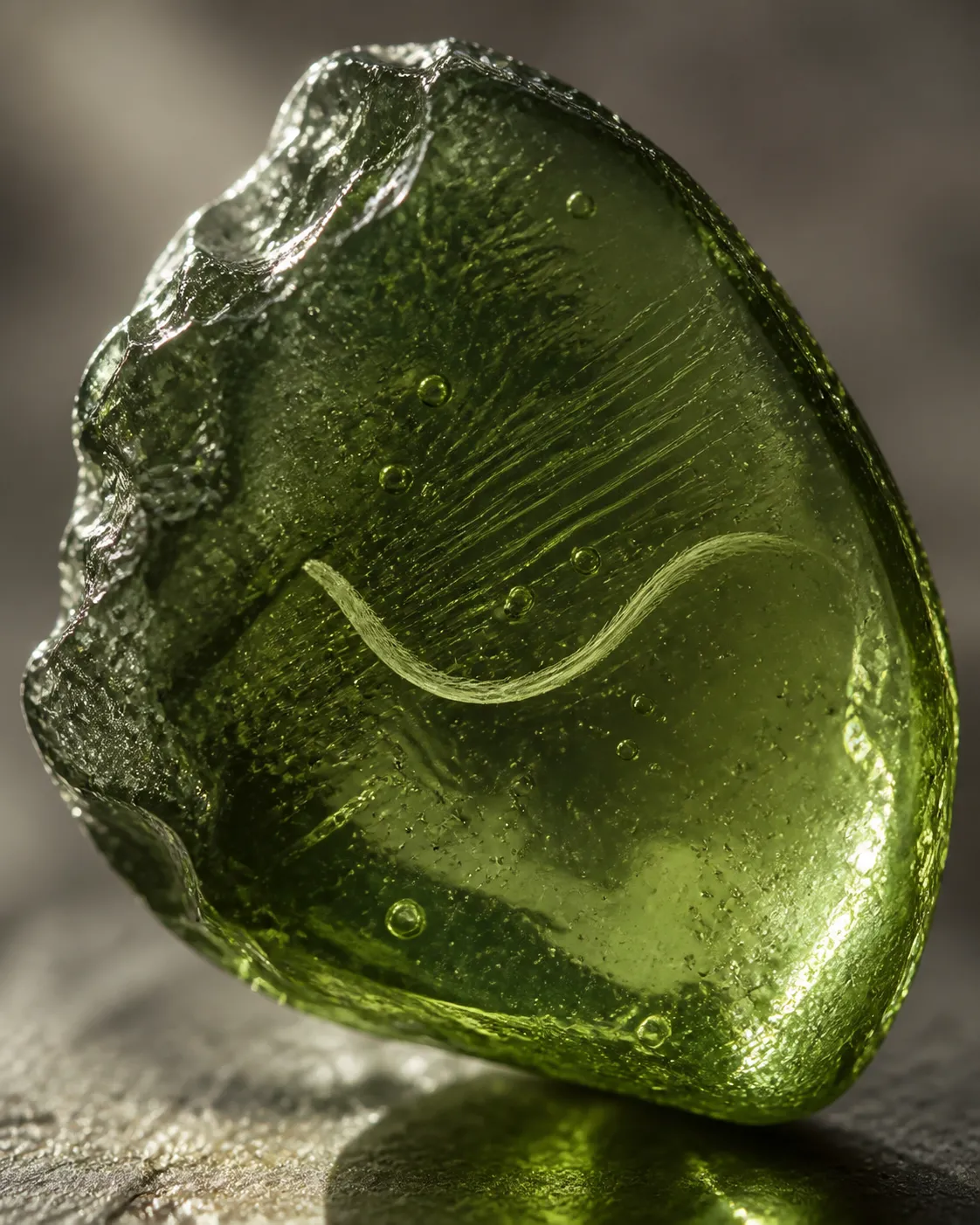
What the “worm inclusion” actually is
The “worm” is not a fossil, animal trace, root, or living imprint. It is a collector nickname for an internal silica-glass feature that may look curved, stretched, pale, whitish, thread-like, fibrous, or irregular when seen through moldavite.
Common names readers may see
- worm inclusion
- snake-like inclusion
- silica glass inclusion
- quartz inclusion
- quartz-derived glass
- lechatelierite thread or filament
Those phrases point in the same general direction, but they are not equally precise. “Quartz inclusion” is understandable because silica is the main component of quartz. Still, it can mislead if it sounds like an ordinary unmelted quartz crystal sitting inside the stone. In moldavite identification, the point is usually different: the feature is interpreted as silica glass linked to very high-temperature transformation.
Lechatelierite is commonly defined as natural silica glass. That definition is important because quartz-rich material does not become glass under normal surface conditions. It takes extreme heat and rapid change to produce a glassy silica phase.
Why lechatelierite matters in moldavite
Moldavite is a tektite: a natural terrestrial glass associated with a meteorite impact event. That wording is careful. Moldavite is not a meteorite, and it did not arrive from space already formed. It is understood as Earth material transformed during an impact-related event and distributed as part of the Central European tektite field.
Within that setting, lechatelierite fits the formation story. Tektites are generally described as silica-rich natural glasses, and moldavite research discusses internal features such as bubbles, pores, flow textures, and silica-rich inclusions as part of the broader tektite picture.
When a moldavite-like specimen contains a believable worm-like lechatelierite inclusion, the observation can support several connected ideas:
- the material has an internal feature consistent with natural tektite glass;
- the inclusion points to extreme heating of silica-rich source material;
- the feature fits an impact-glass interpretation;
- the specimen should be judged as a geological object, not just as green decorative glass.
This is why collectors pay attention to lechatelierite. It gives the eye something physical to look for, unlike vague seller language or purely symbolic claims. But it is strongest when the host material already looks and behaves like moldavite.
What it proves — and what it does not
The title phrase “proves cosmic origin” needs a narrow reading. In moldavite, lechatelierite supports an impact-related origin because moldavite belongs to the tektite family, and tektites are terrestrial glasses connected with impact events. In that context, a worm-like silica-glass inclusion is meaningful high-temperature evidence.
It does not mean the inclusion is a piece of meteorite. It does not mean the whole stone came from outer space. It does not mean every green stone with a pale thread is moldavite.
This distinction keeps the evidence useful without turning it into a sales slogan. Lechatelierite is evidence of extreme heat. In moldavite, that evidence aligns with impact formation. Outside that setting, the interpretation is not automatic.
There is also a boundary case worth knowing: fulgurites. These glassy materials can form when lightning strikes and melts silica-rich sand or rock. That does not make moldavite less real, but it does show why lechatelierite should not be treated as exclusive to impact glass in every possible context.
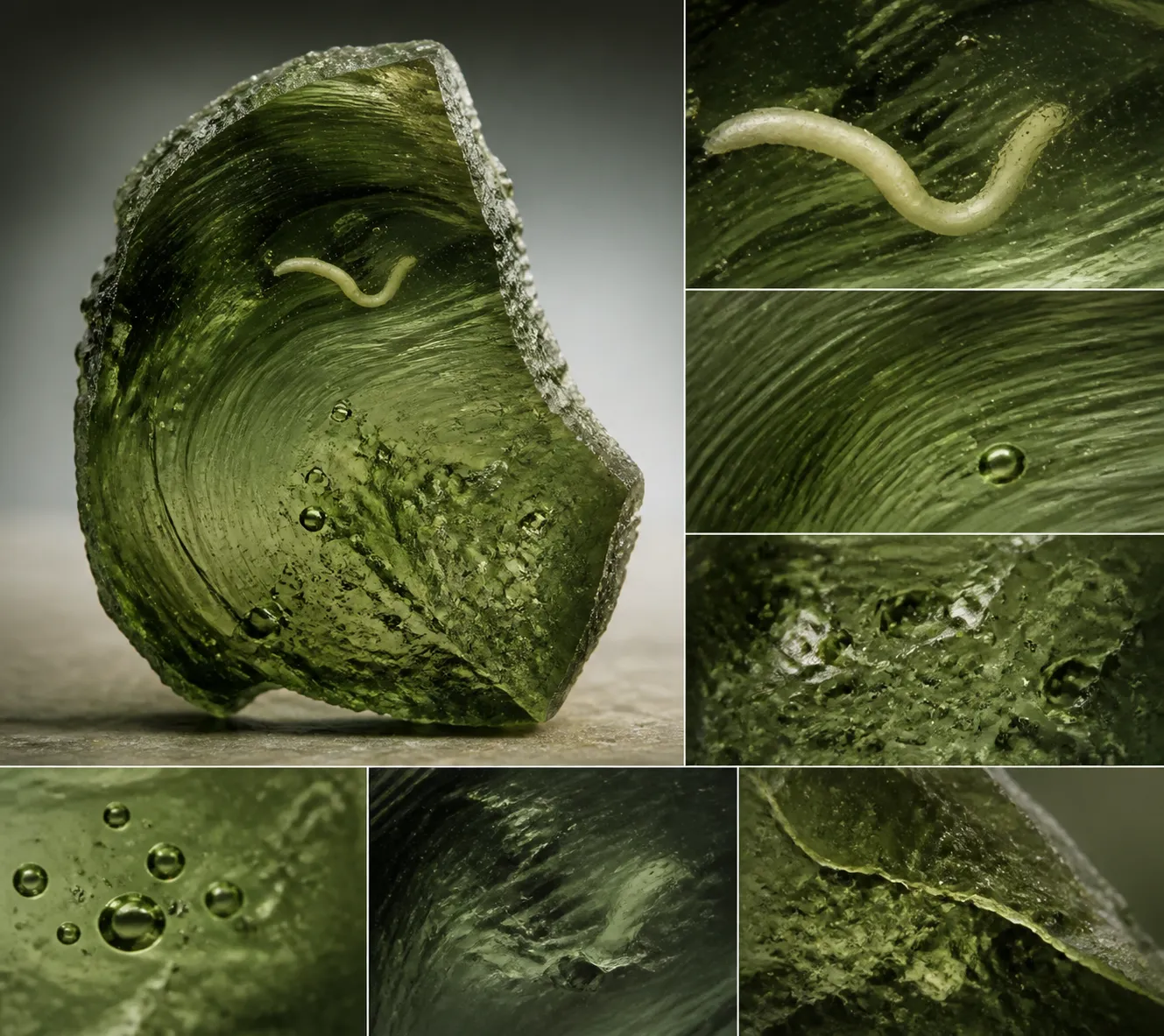
Why it can look like a worm, thread, or halo
A worm-like inclusion is partly a visual effect of silica-rich material inside a molten, moving glass environment. Moldavite is not perfectly uniform manufactured glass. It can contain flow lines, streaks, bubbles, pores, optical distortions, and silica-rich inclusions. When a silica-glass phase is stretched, folded, or suspended inside another glassy mass, it may appear as a curved thread or small worm.
Collectors sometimes use phrases like “lechatelierite halo” when the inclusion seems to have a faint surrounding zone or optical disturbance. That can be useful as description, but it is not a separate mineral name or a stand-alone test.
Visibility depends on lighting, angle, thickness, surface condition, polish, and how the inclusion sits inside the glass. Rough moldavite may hide internal features behind textured or weathered surfaces. Cut or polished pieces may make inclusions easier to see, but they may also remove some natural surface context. A dramatic macro photo can exaggerate a feature; poor lighting can hide one.
For this page, the inspection logic is simple: a worm-like inclusion may be lechatelierite if it behaves like a natural silica-glass feature inside a moldavite-like host. Its meaning still depends on the broader identification picture.
Common confusion around lechatelierite
Lechatelierite is not Le Chatelier’s principle
The name can be confusing because it resembles “Le Chatelier’s principle,” a chemistry concept about chemical equilibrium. That is a different search intent. In moldavite discussions, lechatelierite means natural silica glass, not a classroom chemistry rule.
Moldavite is impact glass, not a meteorite
“Cosmic origin” is common moldavite language, but it can blur the geology. Moldavite’s importance comes from an impact-related event involving terrestrial material. The glass is Earth-derived, even though the event is linked to a cosmic impactor.
So a lechatelierite inclusion can support moldavite’s impact-glass identity. It does not turn moldavite into a meteorite.
Lechatelierite is not unique to moldavite
Lechatelierite can occur in other high-temperature natural glass settings. Impact glasses and lightning-formed fulgurites are the relevant comparison points here. For a moldavite collector, that does not make the feature useless. It means the host material and geological setting matter.
A visible worm is not the whole authenticity question
Some commercial moldavite talk treats worm-like inclusions as if they settle the entire identification. That is too strong. A visible lechatelierite inclusion can be valuable, especially when other features also fit natural moldavite. Still, one internal line, bubble, or thread should not carry the entire conclusion.
The reverse is also true. The absence of an obvious worm-like inclusion does not automatically make a specimen false. Some features are subtle, hidden by thickness or surface texture, removed by cutting, or simply not visible under ordinary viewing conditions.
The best way to use this clue
For a moldavite-curious reader, the useful question is not “Does this one worm prove everything?” A better question is: “Does this inclusion fit the rest of the moldavite evidence?”
A balanced reading is:
- If the stone has a natural moldavite-like body, appropriate internal flow features, and a convincing worm-like silica-glass inclusion, lechatelierite strengthens the impact-origin interpretation.
- If the stone is unknown green glass with one pale streak, the streak alone is not enough.
- If the stone has no obvious worm inclusion, that single absence should not outweigh every other feature.
- If lechatelierite is presented as an absolute answer, the claim is more certain than the evidence allows.
Lechatelierite is powerful because it connects a visible feature with a real geological process. It gives collectors a bridge between the language of “worms” and the science of natural silica glass. Used carefully, it can make moldavite identification more grounded. Used carelessly, it becomes another shortcut.
The clearest conclusion is this: in moldavite, a worm-like lechatelierite inclusion is high-temperature proof in context. It supports the impact-glass origin of the material, but it does not authenticate every specimen alone, and it does not mean the glass itself is extraterrestrial matter.