Impact evidence, not surface appearance
Suevite & Shocked Quartz: The “Smoking Gun” of the Impact
Shocked quartz is quartz that preserves microscopic shock damage from an extreme, short-lived event, most often a meteorite impact. It gets called a “smoking gun” because, when specialists identify the right internal features—especially planar deformation features, or PDFs—it can be one of the strongest markers of impact-level pressure.
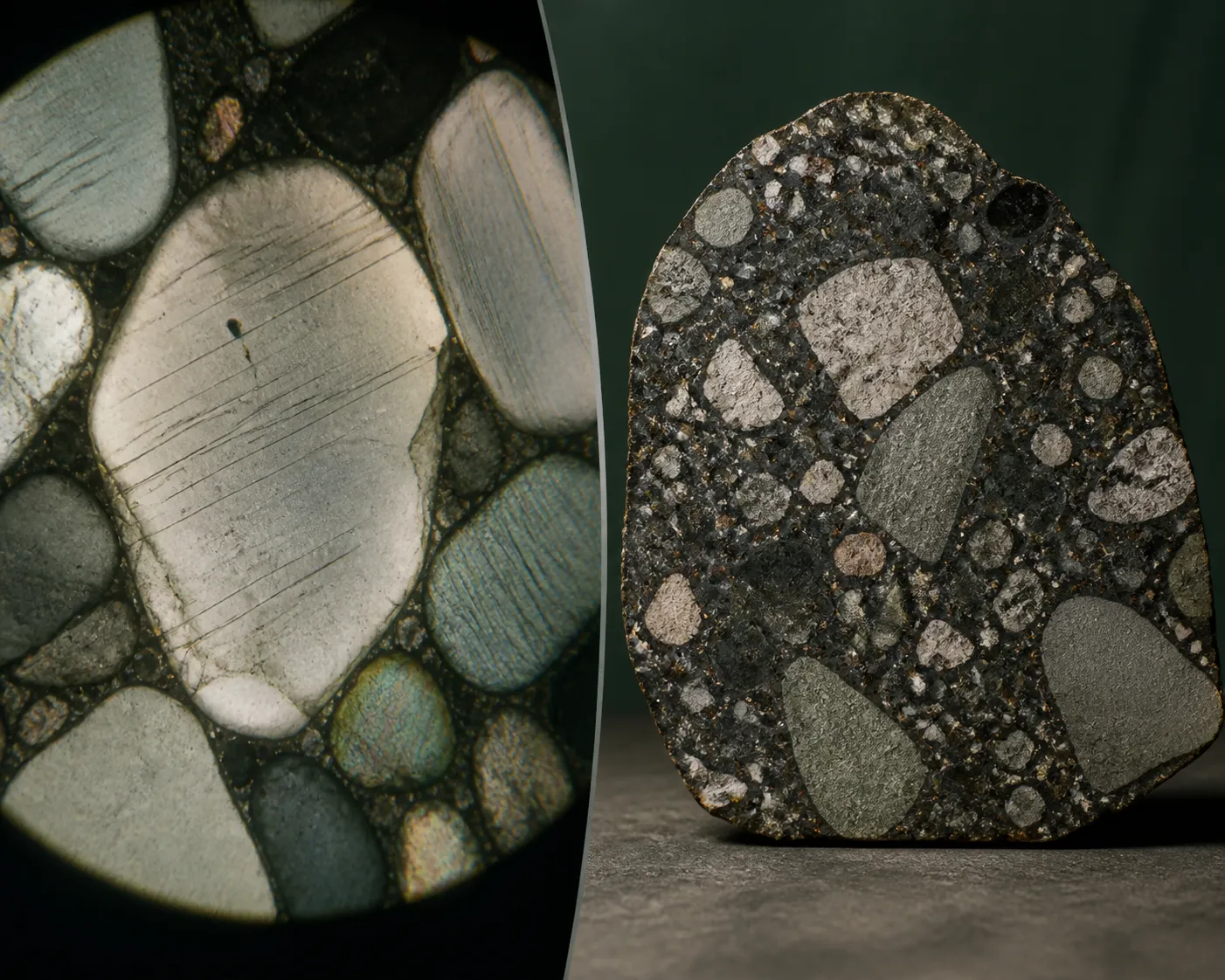
Suevite belongs in the same conversation because it is an impact breccia, a kind of impactite made of broken rock fragments and often glassy material. But suevite is a rock type, while shocked quartz is a feature inside quartz grains.
What shocked quartz actually is
Quartz is common, which is part of why it matters in impact geology. When a powerful shock wave passes through quartz-bearing rock, some grains can record that event in their crystal structure.
That does not mean any damaged-looking quartz counts. Shocked quartz is not defined by chips, cracks, cloudiness, or a dramatic surface texture. The meaningful evidence is microscopic shock deformation, not ordinary breakage.
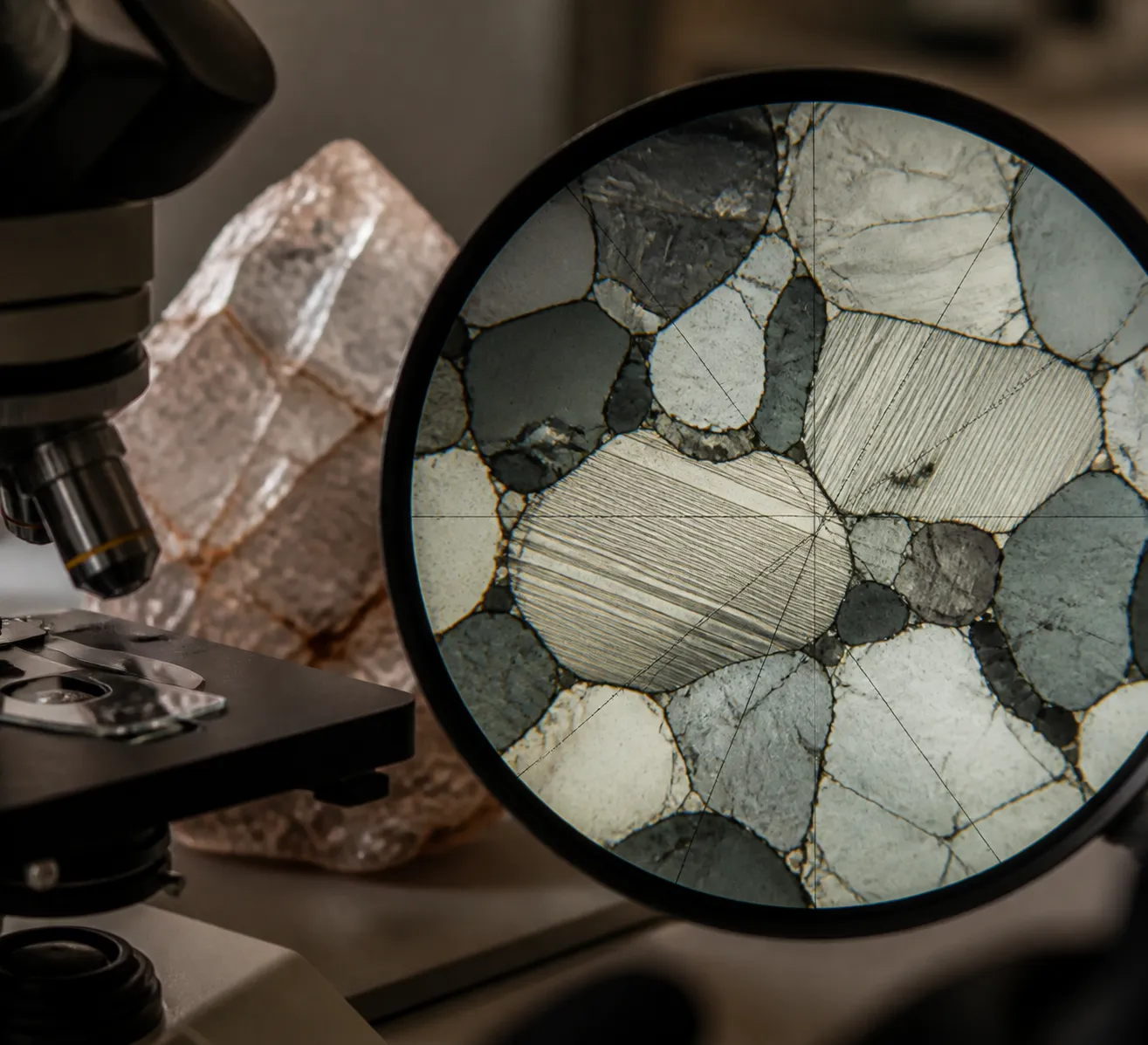
The feature most often discussed is the planar deformation feature. PDFs are extremely narrow, straight internal features that follow specific crystallographic directions in quartz. In plain terms, they are tiny planes inside the crystal that form in a highly ordered way under extreme pressure.
So shocked quartz is not a decorative quartz variety like smoky quartz or amethyst. It is a geological condition recognized under microscopy.
Why it carries so much weight in impact geology
“Smoking gun” is useful shorthand, but only with limits. Shocked quartz matters because properly identified PDFs form under very unusual conditions associated with shock metamorphism.
The strength of the evidence comes from a combination of factors:
- Quartz grains are present.
- The grains contain the right microscopic planar features.
- The features are interpreted in a geological setting that supports impact.
That last part matters. Shocked quartz is not just “quartz with lines.” The diagnostic value belongs to the specific microstructure, read correctly, in context.
Shocked quartz is often discussed alongside other impact markers such as shatter cones, impact melt, suevite breccia, and high-pressure minerals. Coesite and stishovite are common examples of high-pressure silica forms that may strengthen an impact interpretation. But shocked quartz stays central because quartz is widespread and can preserve readable shock effects.
Where suevite fits
Suevite helps explain the rock setting around impact materials. It is an impact breccia: a rock made of broken fragments produced or reworked during an impact event, commonly mixed with melt or glassy material. More broadly, it is an impactite, meaning a rock formed or altered by impact processes.
The clean distinction is simple:
Shocked quartz
What it refers to
Quartz grains with specialist-recognized shock features, especially PDFs.
What it does not establish by itself
That visible lines, cracks, or a seller label count as evidence.
Suevite breccia
What it refers to
An impact breccia with rock fragments and often glassy material.
What it does not establish by itself
That every quartz grain in it is shocked.
Impactite
What it refers to
A broad category of rocks formed or modified by impact.
What it does not establish by itself
That the material is automatically tektite or a collectible glass.
High-pressure minerals
What it refers to
Minerals or mineral forms associated with extreme pressure, such as coesite or stishovite.
What it does not establish by itself
That casual visual inspection is enough for identification.
A piece of suevite may contain shocked minerals, but the term itself describes the rock. Shocked quartz describes a condition inside quartz grains.
What shocked quartz is not
Most confusion starts when people treat shocked quartz as a visible look.
It is not simply quartz with cracks, veils, cloudy bands, needles, or parallel-looking lines. Quartz can show many kinds of natural damage and internal texture, and those do not automatically indicate shock metamorphism.
It is not something that can be confirmed from a sales photo or a dramatic listing title. If a claim depends on shocked quartz PDFs, the relevant evidence comes from microscopy and interpretation, not product language.
It is not the same thing as tektite, moldavite, or impact glass. Those are related impact topics, but they are not interchangeable terms.
And it is not just “ordinary quartzite with a more intense name.” If quartz-bearing rock is claimed to contain shocked quartz, the shock features still have to be shown in the grains.
How shocked quartz is identified
For most readers, the practical takeaway is straightforward: shocked quartz identification is usually a microscope question, not a hand-sample question.
Specialists commonly examine thin sections or separated grains under petrographic microscopes. They look for planar fractures, planar deformation features, and other shock-related textures. PDFs matter most because their orientation within the quartz crystal can be measured and compared with accepted criteria. In harder cases, higher-resolution methods may be used.
These features are tiny—typically discussed at micrometer scale, not at the scale of a specimen photo or casual magnification. That is why online images can mislead non-specialists. A strong thin-section image does not mean the same feature can be judged by eye in a loose specimen.
A cautious reading usually asks:
- Is the feature inside quartz?
- Is it narrow, planar, and organized in a way consistent with shock microstructures?
- Are there multiple sets or measurable orientations supporting that interpretation?
- Does the geological setting make an impact explanation plausible?
- Are related impact markers considered rather than assumed?
This is also why “straight lines” are not enough. Ordinary fractures can look suggestive. PDFs carry weight because of their structure and crystallographic control, not because they appear dramatic.
Why context matters so much
Shocked quartz is famous partly because tiny mineral evidence can support very large geological conclusions. But that only works when the evidence is documented carefully.
The lesson is not “one unusual grain settles the story.” The lesson is that a small feature can be powerful when it is identified by accepted criteria and placed in the right geological context.
That is also where overclaiming tends to happen. Terms like shocked quartz, suevite, impactite, and high-pressure minerals can sound impressive on their own, but the value lies in how the material was analyzed and how the interpretation was supported. A label is not the same thing as evidence.
For readers arriving through moldavite, tektites, or impact glass, the useful boundary is simple: impact origin is a geological interpretation built from evidence. Shocked quartz can be one of the strongest parts of that evidence, but only when properly identified.
A quick reality check for readers
If you are reading a claim about shocked quartz, these questions help:
- Does the source mention PDFs, or only “lines,” “veils,” or “shock marks”?
- Does it refer to thin sections, microscopy, or mineral analysis?
- Does it keep suevite, impactite, tektite, and shocked quartz as separate terms?
- Is the claim tied to a real geological setting?
- Does it treat shocked quartz as strong evidence in context, rather than as a standalone slogan?
Careful sources usually get more specific, not more dramatic.
Short answers to common questions
Can shocked quartz be identified by eye?
Not reliably. The meaningful features are microscopic, and visible cracks or parallel-looking lines are not enough.
Is suevite breccia the same as shocked quartz?
No. Suevite is an impact breccia rock type. Shocked quartz is a shock feature in quartz grains.
Does shocked quartz prove an impact by itself?
Properly identified shocked quartz is a strong impact marker, especially when PDFs are present and the geological context fits. But the strongest interpretations do not rest on a photo, a label, or a single visual impression alone.