2026 status
The End of an Era: The Geology of Depletion
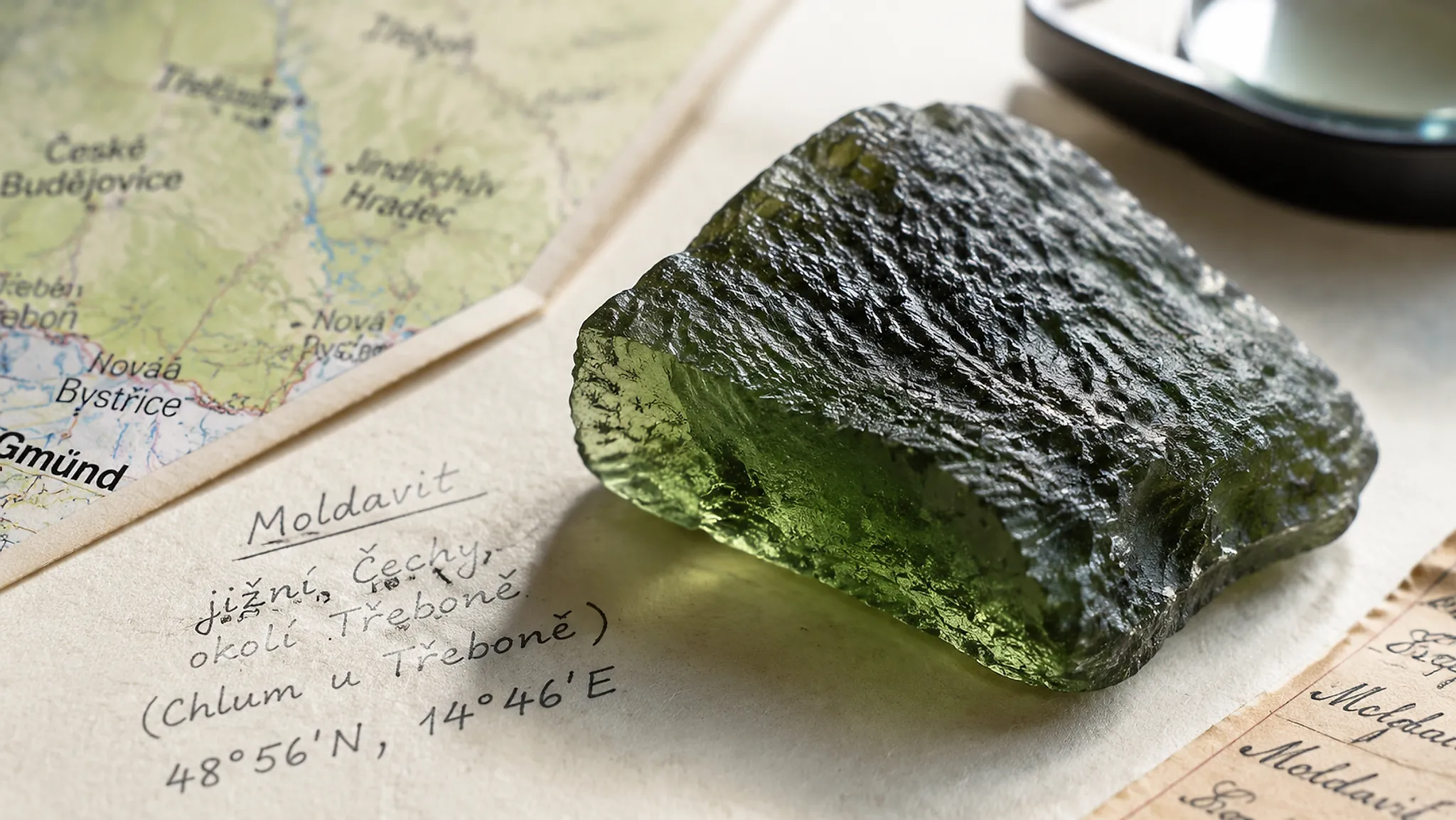
A rough green piece of moldavite carries more than color: etched surface, broken edge, and a locality story that generic “green glass” cannot supply. The 2026 answer is direct: moldavite depletion is real as a geological and practical supply constraint, but the public evidence does not support a precise moldavite exhaustion date or a claim that all natural moldavite is about to disappear.
For this page, Resource Depletion means a finite Central European tektite occurrence becoming harder to access, recover, and sort into desirable collector material. It does not mean every remaining fragment has already been found.
That distinction matters because scarcity language around moldavite often moves faster than the evidence. Moldavite is finite. Known deposits are locality-bound. Recoverable pieces vary by place, sedimentary setting, quality, and access. A seller’s claim that supply is “almost finished” is not the same thing as a verified remaining-volume estimate.
broader context
Broader moldavite archive
This narrower page makes more sense after the broader moldavite archive page.
What Depletion Means for Moldavite in 2026
Moldavite is not a renewable gemstone source in the ordinary sense. It is a natural glass associated with the Central European tektite field, formed in connection with an impact event and later preserved in specific regional deposits. For a collector, the key point is not only age; it is geography. Public geoscience literature places moldavite occurrence within limited Central European areas, including South Bohemia, Western Bohemia, Western Moravia, Upper Austria, Lusatia, and Lower Silesia.
That supports the finite moldavite resource claim. It does not support every dramatic version of that claim.
| Question | What the evidence can support | What it cannot support here |
|---|---|---|
| Is moldavite geologically finite? | Yes. It is tied to limited Central European occurrence zones. | A total inventory of every remaining fragment. |
| Can practical supply tighten? | Yes. Accessible, legal, recoverable, desirable pieces can become harder to obtain. | A verified annual production figure for 2026. |
| Is there a confirmed exhaustion date? | No reliable date is established in the supplied evidence. | A countdown, deadline, or last-chance buying claim. |
The useful distinction is physical occurrence vs practical supply. Some moldavite may remain in the ground, in low-yield sediment, in inaccessible places, in damaged fragments, or in pieces too small for most collector demand. That is different from saying the resource has vanished.
Depletion is most defensible when described as pressure on accessible and recoverable material from known deposits. It becomes weaker when it turns into a precise prediction.
Finite Geology Is Not a Simple Countdown
Moldavite is locality-bound impact glass, not a globally interchangeable commodity. Its occurrence pattern is part of why collectors care about provenance, deposit names, texture, and regional character. A piece tied to a known locality carries a different kind of collector meaning than a loose market object described only as “green tektite.”
The Central European framing also corrects a common oversimplification. Czech localities are central to collector culture and supply discussion, but moldavite is not accurately reduced to one national label. The broader Central European tektite field includes multiple areas, with locality-specific nuance. That does not make the resource abundant. It makes the geography more accurate.
Deposit variation matters too. Geological records support the cautious idea that moldavites from different deposits can be compared by setting, alteration, and occurrence context. That is enough to say deposits are not identical. It is not enough, from the available material, to rank current deposits by remaining supply, legal access, or 2026 mining yield.
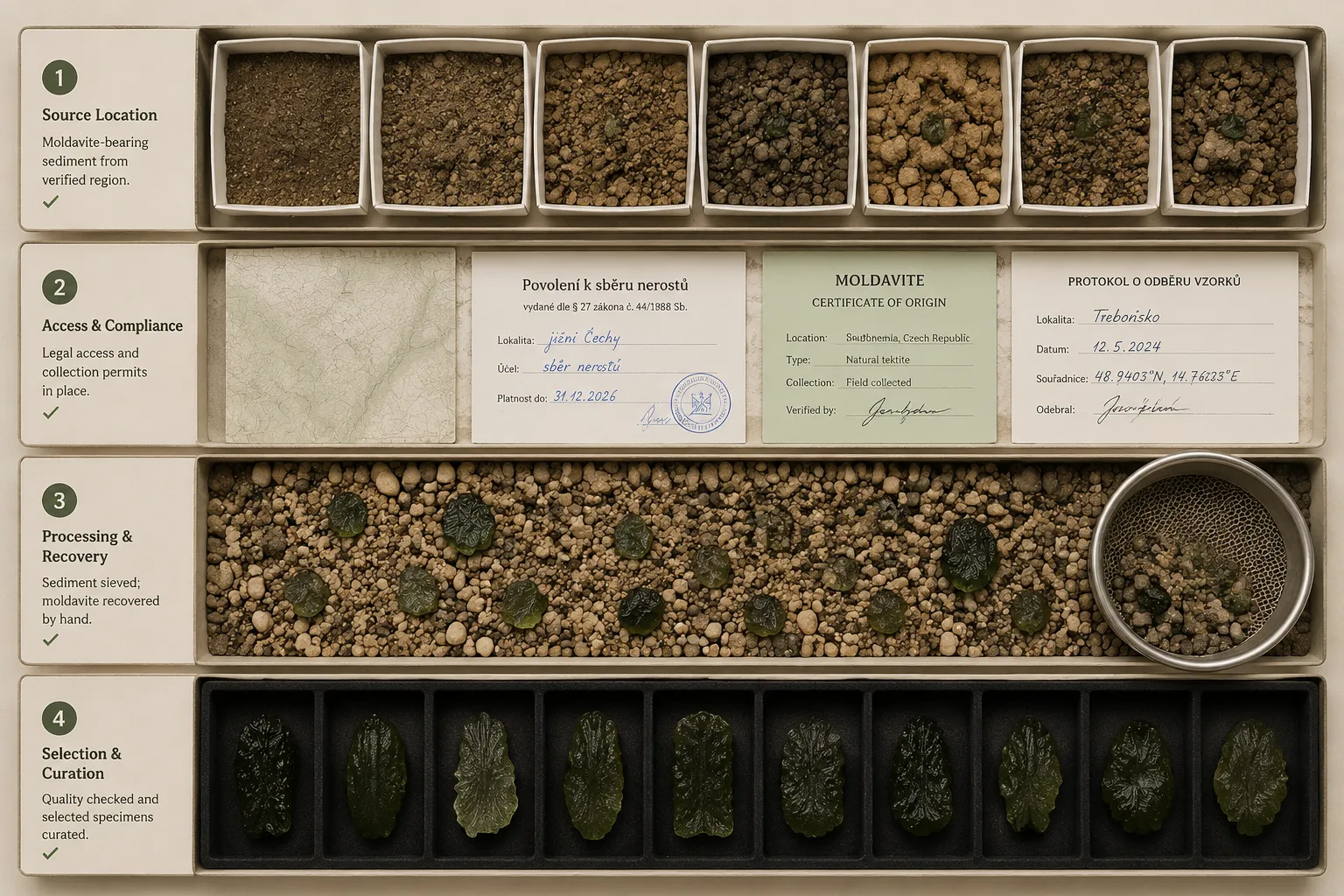
Four Layers That Often Get Collapsed
Physical occurrence
Moldavite exists in particular geological settings.
Practical supply
Pieces can be legally accessed, recovered, sorted, and brought into circulation.
Mining yield
Recovery under real extraction conditions, not the amount imagined from a map.
Collector supply
Pieces that meet demand for size, surface, color, locality, and condition.
Those layers are often collapsed into one phrase: “moldavite is running out.” The phrase is too blunt. A deposit can become practically depleted for desirable pieces while small, damaged, inaccessible, or uneconomic fragments remain. A locality can be famous while current access is uncertain. A market can feel tight without proving a final geological endpoint.
The honest 2026 status is narrower: moldavite has real geological limits, and practical supply can be constrained. The public evidence here does not verify a final exhaustion date.
Why Scarcity Language Misleads Collectors
Moldavite attracts unusually strong market language. Commercial pages and collector discussions often emphasize rarity, beauty, high desirability, locality prestige, sculpted surfaces, and intense symbolic meaning. Those words help explain why readers ask about depletion, but they are not proof of geological depletion.
Price movement, popularity, or spiritual-intensity language does not establish remaining supply. A specimen can be desirable because of locality, condition, texture, color, size, or story. Demand can rise even when geological facts have not changed. Supply can feel scarce because certain qualities are less available, not because all moldavite is near disappearance.
High price is not a geological measurement.
It may reflect demand, fashion, seller positioning, attractive-piece availability, or buyer anxiety. It should not be treated as a deposit survey.
“Rare” is not a complete resource term.
Moldavite can be rare in a broad sense because its occurrence is limited, but that does not give a current reserve number, mining yield, or legal-access status.
A reserve is not the same as every physical fragment left in the ground.
In mineral-resource language, practical availability depends on economics, extraction conditions, technology, regulation, and definitions. That terminology is useful here only as a frame. Moldavite still has to be read through its own tektite geology and locality constraints.
Not all green glass-like material in circulation proves new natural moldavite supply.
The market can contain natural specimens, misdescribed material, and objects requiring closer authenticity evaluation. This is not an authentication page, but depletion talk should never replace specimen-level judgment.
The better collector question is not “Is the hype true?” It is: “Which part of the scarcity claim is geological, which part is practical supply, and which part is sales pressure?”
What Would Make the 2026 Answer Stronger
The answer would become stronger if reliable, moldavite-specific evidence showed current extraction status, remaining recoverable volumes, annual recovery figures, access rules by locality, and quality distribution over time. Those are the missing pieces for a confident 2026 depletion estimate.
Without that evidence, the strongest supported statement remains conditional: moldavite is a finite, locality-constrained tektite, and recoverable collector-grade supply from known accessible deposits can face real constraints.
The weaker statement is the dramatic one: moldavite is nearly gone everywhere, by a known date, because sellers say so.
Concrete Checks for a Depletion Claim
- Does the claim name a locality, or does it speak about “moldavite” as one undifferentiated supply?
- Does it distinguish known deposits from current legal access?
- Does it separate small fragments from desirable recoverable pieces?
- Does it explain mining yield assumptions, or only repeat scarcity language?
- Does it provide evidence for a date, volume, or access change, or does it imply urgency without support?
These questions keep the claim attached to the material object. Moldavite is found in sediments and deposits with specific histories; it is not an abstract scarcity token.
Legal access is important, but it must be handled carefully. Some commercial discussions refer to restrictions, slowed mining, or limited excavation. Those claims may be relevant to practical supply, but the supplied evidence here does not verify current legal mine-access status by locality. The cautious version is simple: legal access can affect practical supply, but this page does not confirm the 2026 access status of individual moldavite sites.
The same restraint applies to quality. Collector-grade supply can be constrained because size, condition, surface sculpting, and locality desirability are not evenly distributed. The available evidence does not provide a quantified 2026 quality breakdown. The point is practical, not statistical.
How to Read Depletion Claims Without Overreacting
A grounded 2026 reading starts with impact science before interpretation. Moldavite’s finite occurrence is real enough to take seriously. Its cultural and symbolic reputation may shape demand, but symbolism does not prove supply conditions. Collector excitement should not be used as a substitute for geological evidence.
The most defensible middle position is also the most useful one: moldavite is not endlessly replenished, and the best recoverable pieces from known accessible deposits may become harder to source over time. That supports careful buying, provenance questions, and skepticism toward vague listings. It does not support panic, promised price outcomes, or claims that rarity increases any personal or spiritual effect.
“End of an era” can be a poetic way to describe a maturing collector market around a finite tektite. It becomes misleading when it is used as a deadline. The geology does not need exaggeration. Locality-bound impact glass already has enough reality behind it.
| Claim you see | Better reading |
|---|---|
| “Moldavite is almost gone.” | Ask whether this refers to a specific locality, legal access, mining yield, or desirable pieces. |
| “Only Czech moldavite is real.” | Treat that as too simplified; Central European occurrence needs more nuance. |
| “Prices prove depletion.” | Prices can reflect demand and supply pressure, but they are not geological evidence. |
| “There is a known exhaustion date.” | Look for a reliable source with volume, recovery, and access data. Without it, be cautious. |
| “Rarity makes it more powerful.” | That is symbolic or marketing language, not a geological conclusion. |
The practical takeaway is not to dismiss depletion. It is to define it properly.
FAQ
Is moldavite depletion real in 2026?
Yes, if depletion means pressure on a finite, locality-constrained tektite resource and on recoverable collector material from known deposits. No, if the claim means all natural moldavite has a verified exhaustion date in 2026.
Is moldavite a finite resource?
Yes. Moldavite is tied to limited Central European occurrence zones and is not renewed on a human timescale. The evidence supports geological finiteness, not a complete inventory of remaining pieces.
Does scarcity prove that moldavite prices will rise?
No. Price can reflect demand, availability, seller positioning, and collector preference. It is not a geological measurement, and this page does not make investment-return claims.
Does moldavite rarity prove anything about spiritual effects?
No. Rarity and symbolic meaning are different from geological evidence. Readers may use moldavite in personal or spiritual practice, but depletion evidence does not establish personal outcomes.
What is the most reliable way to read a depletion claim?
Look for locality, access status, recoverable supply, mining yield assumptions, and evidence for any date or volume. If a claim only creates urgency, treat it as market language.
Bottom Line
Moldavite geological depletion is real in the sense that the material is finite, locality-bound, and dependent on known Central European deposits. Practical supply can tighten when accessible deposits yield fewer desirable recoverable pieces, when extraction is limited, or when collector demand concentrates around specific localities and specimen traits.
The evidence available for a 2026 status does not justify a hard moldavite exhaustion date, a verified remaining-volume estimate, or a claim that the market is facing immediate total disappearance. Treat broad scarcity language as a prompt to ask better questions, not as proof.
The end of an era, if that phrase is used carefully, means the easy story is over: moldavite cannot be discussed only as mystical green glass or only as a market object. It has to be read as impact material with geological limits, practical supply constraints, and evidence boundaries. That is the strongest answer the current page evidence supports.