Impact Models
The "Splash" Theory vs. The 2026 Plasma Model
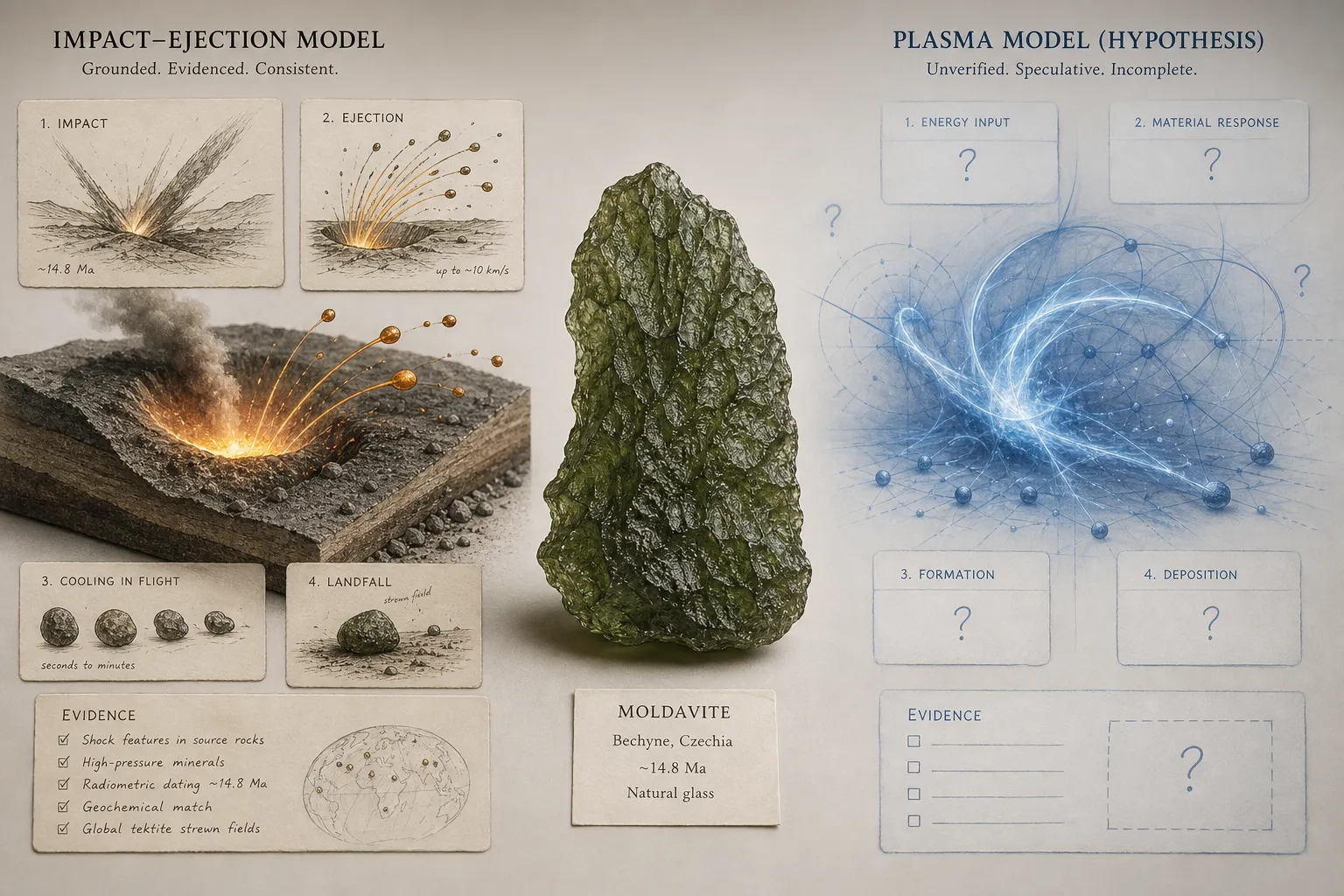
For moldavite readers, the difference is not “old science versus new science.” The older “splash” theory is best read as plain impact-model language: molten material is formed during a major impact, thrown outward, cooled, and later found as glassy tektite material. The “2026 plasma model,” based on the material available for this page, should be treated only as a claimed label unless it can be traced to credible scientific sources.
Both phrases sit inside the broader world of Impact Models, but they do not carry the same weight. “Splash” language is a familiar shorthand for an impact-ejection explanation. It is simplified, but recognizable. “2026 plasma model” sounds more technical and more recent, but there is no usable source trail here showing that it is an accepted model, a published framework, or a confirmed replacement for earlier formation theories.
That distinction matters because moldavite is often surrounded by dramatic origin language. A phrase can sound stronger simply because it uses words like plasma, hypervelocity, or revision. In science-facing writing, a newer label only becomes meaningful when its mechanism, evidence, limits, and publication context can be checked.
broader context
Start with the main moldavite page
This narrower page makes more sense after the broader moldavite archive page.
The practical difference
The splash framing gives readers a mechanical picture: impact, melting, ejection, flight, cooling, and later recovery of glassy material. It is not a complete laboratory model by itself. It does not explain every thermal, chemical, aerodynamic, or pressure condition involved in tektite formation. Used carefully, it is a shorthand for an impact-ejection style explanation.
The claimed plasma model appears to point toward a high-energy physical process. In general scientific language, plasma refers to ionized matter under certain energetic conditions. But that does not automatically explain moldavite formation. A plasma-based impact model would need to show when plasma conditions arise, how they affect target material, and why that explanation fits the evidence better than existing impact explanations.
Splash framing
- Emphasizes melted material ejected or dispersed by impact conditions.
- Should be treated as a familiar impact-model shorthand that still needs careful sourcing.
- Does not replace older explanations by itself.
- Depends on geological, chemical, spatial, and thermal evidence for impact-derived glass.
- Main risk: making a complex process sound too simple.
Claimed 2026 plasma model
- Emphasizes a possible plasma-related stage or mechanism.
- Should be treated as an unverified claim unless tied to public, attributable research.
- Is not established as a replacement by the available material.
- Needs the same evidence as impact-derived glass, plus clear support for the plasma mechanism.
- Main risk: treating novelty language as scientific acceptance.
The useful comparison is not “which term sounds more advanced?” It is “what part of the formation process is being explained, and what evidence supports that explanation?”
What a plasma model would need to show
A serious plasma-based explanation would need more than a dramatic name. It would need to connect the proposed mechanism to observable features of moldavite or closely related tektites.
Minimum questions
- What exact stage of the impact event involves plasma?
- Is plasma proposed to create the melt, modify it, transport it, or briefly surround the impact event?
- What measurable features would distinguish this model from older impact-ejection explanations?
- Does it explain chemistry, shape, distribution, surface texture, inclusions, or thermal history better than existing models?
- Has the claim appeared in a traceable scientific venue, not only in collecting, retail, or online discussion language?
Those questions are not a rejection of new ideas. They are the normal burden of any scientific model revision. If a proposed model cannot say what it changes, what it preserves, and what evidence could challenge it, it is not yet useful as a reader-facing explanation.
This is especially important with terms borrowed from physics. “Hypervelocity” and “plasma” sound precise, but they do different jobs. Hypervelocity impact language describes an extreme collision regime. Plasma language describes a state of matter or a process condition. A formation model may involve high-energy physics without making plasma the central explanation. Likewise, a claim can mention plasma without showing that plasma explains moldavite’s specific properties.
For now, “2026 plasma model” should be read as a prompt to ask for sources, not as proof that the origin story has changed.
Why the “2026” label needs caution
The year attached to the phrase creates a special problem. “2026 plasma model” sounds like a named update, a recent discovery, or a scheduled scientific revision. But the supplied material does not show that this term exists as an accepted framework or recognized replacement for earlier formation theories.
That does not prove the claim false. It means the claim is not established here. Those are different statements.
A year can enter moldavite language for many reasons. It may come from a blog trend, seller education copy, a speculative post, a misread paper, a draft idea, or a reader-created phrase that spreads faster than its evidence. Without a source trail, the date should not be treated as scientific chronology.
More careful wording
- “A plasma-based explanation has been claimed, but this page does not have enough source support to treat it as accepted.”
- “If such a model is documented later, it should be compared against existing impact evidence.”
- “Until then, readers should separate a possible mechanism from the claim that science has already changed.”
That keeps the door open without giving the phrase authority it has not earned.
Where readers get confused
Much of the confusion is linguistic, not just scientific. Moldavite sits between geology, collecting culture, symbolism, and online retail. The same phrase can do different work in each setting.
One common mistake is treating a simple image as a weak theory. “Splash” is easy to picture, so it can sound less serious than a phrase built around plasma physics. But a plain metaphor is not automatically weak, and a technical-sounding phrase is not automatically strong. Evidence matters more than vocabulary.
Another mistake is assuming that formation models compete in a clean winner-takes-all way. In impact geology, explanations may be revised, narrowed, combined, or limited to one stage of the process. One explanation may focus on ejection, another on heating, another on atmospheric flight, and another on chemical signatures. A responsible comparison should say which part of the formation chain is being discussed.
Collector language can also turn origin stories into value stories. If an explanation sounds rarer, more energetic, or more mysterious, it may be used to make a stone feel more desirable. That does not make curiosity wrong. It only means formation language should not stand in for evidence, authenticity checks, or careful interpretation.
Spiritual language can blur the boundary further. Some readers connect moldavite with intense personal change or symbolic transformation. That is a cultural and interpretive layer, not evidence for a formation model. A claim about how moldavite formed still has to stand on geological and physical support.
What evidence would change the answer?
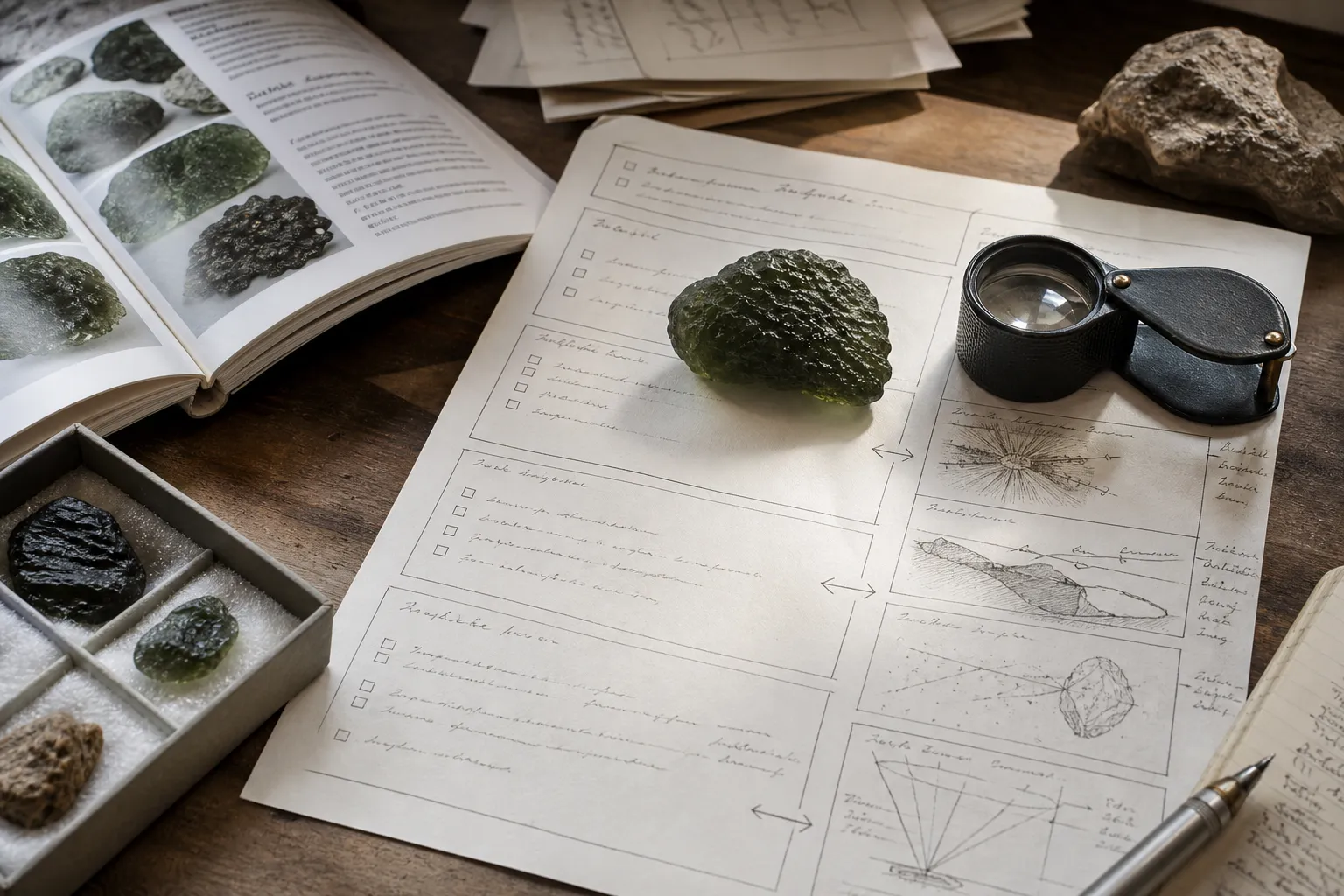
The answer would change if reliable, public, topic-relevant sources documented the “2026 plasma model” clearly enough to evaluate it. A useful source would not merely repeat the phrase. It would define the mechanism, set its scope, and show how it relates to known tektite formation research.
Strong support would likely include
- A traceable publication or technical source with identifiable authorship and context.
- A clear definition of “plasma model,” not just high-energy wording.
- Evidence connecting the mechanism to moldavite or closely relevant tektite material.
- A comparison with prior impact models, including what the new model changes.
- Limits, uncertainties, and competing explanations, not only confident promotion.
If that kind of material becomes available, the comparison can become more substantial. The article could then ask whether a plasma-based model explains a specific part of moldavite formation better than splash-style ejection language, and whether it is widely accepted, narrowly proposed, or still speculative.
Without that evidence, the answer stays narrow: splash theory is a familiar impact-formation shorthand, while the “2026 plasma model” is only a claimed label in this context. It should not be described as consensus, a breakthrough, or a replacement.
A careful way to read both terms
Treat each phrase as a claim about a process, not as a badge of authority.
When you see “splash theory,” ask what the writer means by splash. Are they describing molten ejection from an impact event? Are they using the term loosely? Do they connect it to observations, or is it just a visual story?
When you see “2026 plasma model,” ask stricter questions. Who named it? Where was it published? What does it explain? Does it apply specifically to moldavite, to tektites generally, or only to impact physics more broadly? Is the date part of a real publication history, or just a timestamp attached to an online claim?
The careful summary is this: the splash theory and a claimed plasma model are not equal alternatives unless both are supported by comparable evidence. Splash language may be an older, simplified way to talk about impact-derived molten material and ejection. The plasma label may point toward a possible high-energy mechanism, but in the available evidence for this page, it remains unverified.
Bottom line
The older splash theory and the claimed 2026 plasma model should not be presented as a settled old-versus-new handoff. “Splash” is best understood as simplified impact-ejection language. “2026 plasma model” should be treated as an unsupported or not-yet-verified label unless credible sources establish it.
A plasma-based model could become meaningful if it is publicly defined, sourced, and shown to explain moldavite-related evidence. Until then, the responsible wording is “claimed plasma model,” not accepted scientific evolution.