Mindfulness Metrics Boundary
Quantifying Mindfulness: Bridging High-Frequency Tektites with Smart Wearables
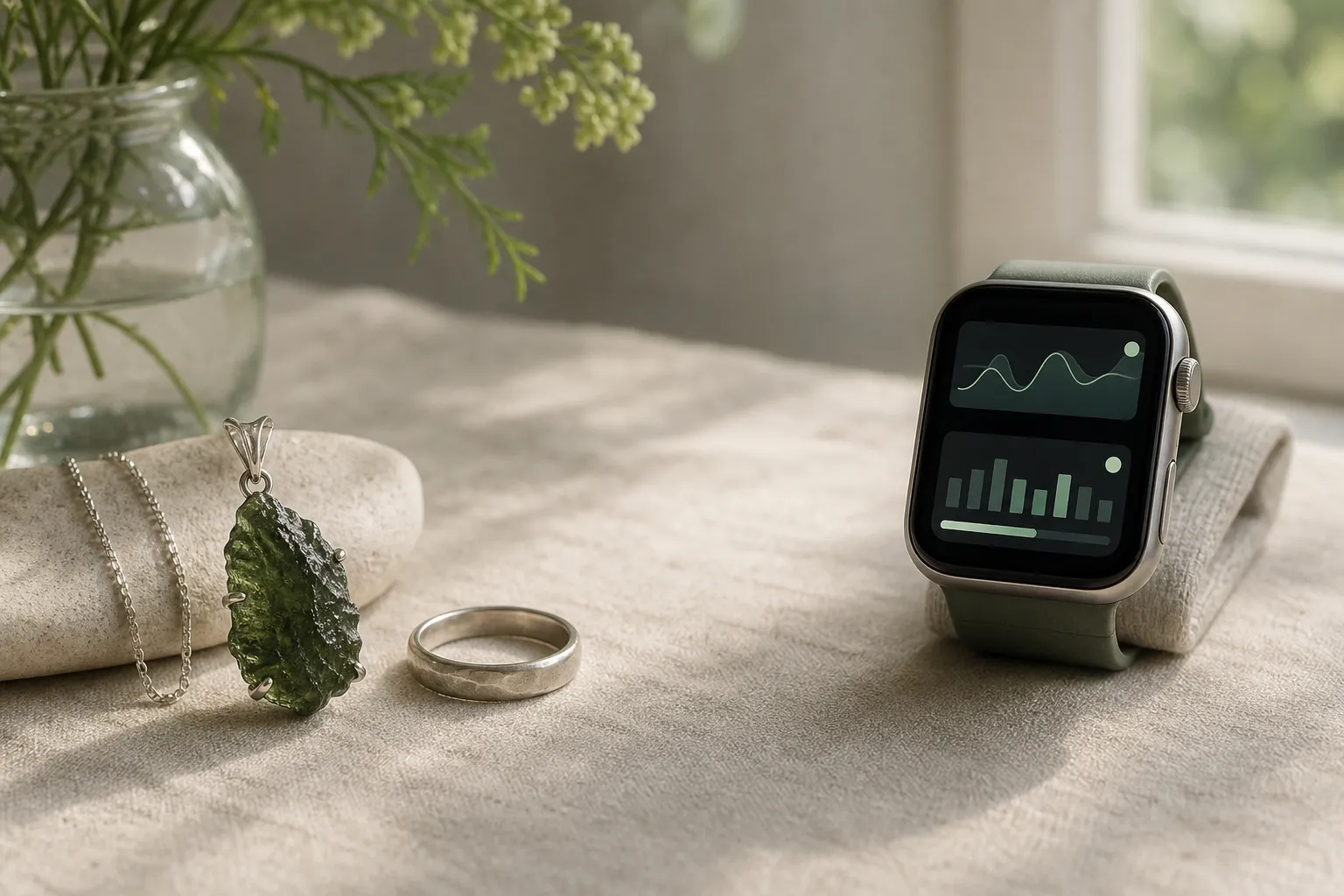
A moldavite pendant has weight, green glass, surface texture, and an impact-history story. A smartwatch has sensors, algorithms, and a dashboard. The careful bridge between them is narrow: Moldavite wearable tech can pair a tektite necklace, bracelet, or ring with smart wearable metrics as a mindfulness cue, but the device is measuring the wearer’s physiological signals, not the stone’s metaphysical energy.
Heart rate variability, resting heart rate, sleep timing, and stress or recovery trends can add context around a repeated practice. They do not show that moldavite caused a bodily change. In this pairing, moldavite can serve as an attentional anchor; the measurable layer remains the person’s data.
broader context
Start with the main moldavite page
This narrower page makes more sense after the broader moldavite archive page.
What “Quantifying Mindfulness” Can Mean
Moldavite is described in geology and collecting language as a green vitreous silica tektite associated with impact processes. In spiritual and crystal communities, it is also surrounded by “high-frequency” and transformation language. Those are different categories. One belongs to material identity and impact history; the other belongs to symbolic interpretation and personal meaning.
Smart wearables sit in a third category: physiological monitoring. They estimate body-based signals and translate them into metrics such as heart rate variability, resting heart rate, sleep regularity, respiratory trends, activity load, stress scores, recovery scores, or readiness-style summaries. These dashboards may help someone notice patterns when a calming routine is repeated under similar conditions.
The useful question is not, “Can a watch measure moldavite energy?” Based on the available evidence, no. The better question is, “Can someone wear moldavite as a reminder to pause, breathe, journal, or meditate while a wearable records body-based trends around that routine?” Yes, if the interpretation stays clean.
Mindfulness is not fully captured by a number. Attention, intention, breath, emotional tone, and personal symbolism remain partly subjective. Wearable data can provide context. It does not replace self-observation.
The Measurable Layer: HRV, Stress Context, and Baselines
Heart rate variability, often shortened to HRV, refers to variation in the timing between heartbeats. It is often discussed as one window into autonomic nervous system activity, including stress-response and recovery-related processes. Consumer wearables may estimate HRV during rest, sleep, or quiet periods and present it through simplified dashboard language.
That dashboard can be useful, but it can compress too much meaning into one score. A higher or lower HRV value is not a universal verdict. Personal baseline, sleep, illness, training load, alcohol, stress, medication, menstrual cycle, sensor fit, device model, and measurement timing can all affect the number. For this page’s purpose, the most useful reading is trend-based: compare a person with their own usual pattern, not with an idealized number.
If someone wears moldavite during breathwork or journaling, the wearable may record physiological metrics before, during, or after that period. The cautious reading is: “During this routine, my wearable recorded this pattern.” Not: “The stone caused the pattern.”
Moldavite pendant or ring
Can support: a visible or tactile mindfulness cue.
Cannot show: a measured energetic effect.
Smartwatch HRV trend
Can support: a body-based trend around rest or stress context.
Cannot show: a diagnosis or single cause.
Breathwork or quiet sitting
Can support: a repeatable routine for comparison.
Cannot show: a guaranteed metric shift.
Journal note
Can support: subjective context for the data.
Cannot show: objective evidence of crystal influence.
This is where measurable physiology and meaning can coexist without being collapsed into one claim. The tektite gives the ritual a focal point. The wearable records the wearer.
How to Pair a Tektite Wearable with Smart Metrics
The useful setup is simple. Wear the moldavite piece consistently, choose one or two smart wearable metrics, and keep the practice repeatable enough that patterns are easier to compare. Consistency matters more than dramatic interpretation.
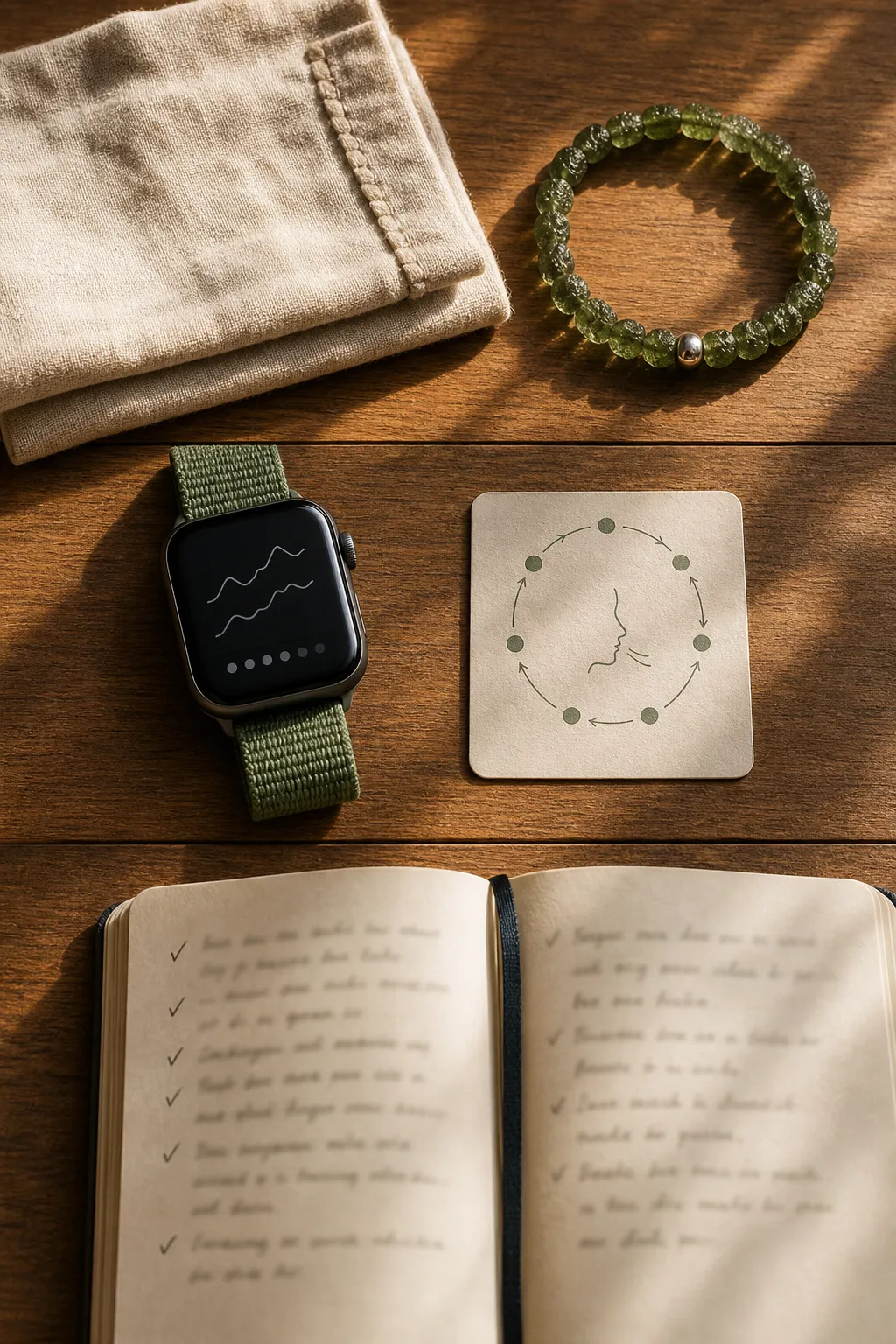
A reader might use moldavite as an attentional anchor before a five-minute breathing practice. The watch records heart rate or HRV according to its normal method. A short journal note captures context: sleep quality, caffeine, stress load, exercise, and what the practice felt like. Over time, the reader can look for ordinary patterns around routines rather than a single moment that seems to settle the whole question.
A steadier process
- Choose the purpose of the practice: settling attention, marking a pause, or creating a reflective ritual.
- Keep the moldavite role clear: symbolic, tactile, aesthetic, cultural, or spiritual.
- Use the wearable for body-based metrics only.
- Compare trends against personal baseline, not universal ideals.
- Treat unusual or concerning readings as a reason to seek qualified medical guidance, not as a crystal interpretation.
The same principle applies to third-party HRV apps and recovery tools. They may add charts, notes, and trend views, but they do not change what is being measured. The sensor still estimates physiological signals from the person. The moldavite remains outside the measurement pathway unless stronger direct evidence appears later.
That boundary does not make the practice meaningless. It makes the meaning more honest. A symbolic mindfulness anchor can matter in a personal or ritual sense without becoming a physiological claim.
Where IoT Metaphysics Gets Confusing
“IoT metaphysics” is a useful phrase for a modern confusion: connected devices create numbers, while spiritual objects create meaning. When the two sit on the same wrist or chest, it can feel as if the number is validating the meaning. The current evidence does not support that leap.
A smartwatch can estimate heart-related and activity-related signals. A ring or watch may infer stress or recovery from sensor patterns. A moldavite pendant may carry symbolic weight for a collector or spiritually curious wearer. But a device dashboard is not a tektite detector, an authenticity test, or a measurement of “frequency” in the metaphysical sense used by crystal communities.
The word “frequency” is especially slippery. In physics and electronics, frequency has technical meanings. In moldavite spirituality, “high-frequency” is usually meaning-language, not a wearable metric. If a reader says moldavite feels high-frequency, that can be treated as personal or cultural language. It should not be rewritten as an electromagnetic, medical, or HRV result.
Commercial language often blurs these categories. Wearable marketing can turn complex physiology into neat stress, readiness, and recovery labels. Crystal retail language can turn symbolic associations into effect-style phrasing. A careful moldavite page has to slow both down: impact science before interpretation, and physiology before dashboard confidence.
What Would Change the Answer?
The answer would become stronger only if direct, well-described evidence existed for moldavite-plus-wearable use. That would need more than social posts, seller claims, or individual anecdotes. Useful evidence would have to separate the stone from the routine, the expectation, the device, the baseline, and the surrounding life factors that influence HRV.
Even then, study design would matter. Was there a comparison condition? Were measurements taken at consistent times? Was the wearable method reliable enough for the claim being made? Could expectation shape the practice? Were sleep, activity, stress, and illness context tracked? Without those controls, a changed metric is only a changed metric.
For now, the evidence supports a narrower statement: smart wearables can help users observe physiological signals around mindfulness routines, and moldavite can be used as a symbolic or tactile cue within that routine. It does not support saying a tektite produces measurable wearable changes.
This is not a dismissal of personal experience. It is a classification of claims. A person can value the stone, use it in ritual, and still keep the data interpretation clean.
Practical Boundaries for Readers
If the goal is mindfulness tracking, decide what each object is allowed to mean before reading the dashboard.
The moldavite piece can mean
- “This is my cue to pause.”
- “This specimen connects my practice to impact history, collecting, and symbolic transformation.”
- “The texture and green glass help me return attention to the present moment.”
The wearable can mean
- “Here is an estimate of my physiological pattern under this device’s method.”
- “My sleep, stress context, or recovery trend may be shifting.”
- It should not mean: “The stone caused this score.”
Readers should also avoid turning HRV into a personal grade. Wearable monitoring limits are real. Sensor placement, algorithm design, missing data, and measurement timing can all alter the result. Some devices emphasize overnight HRV; others present daytime stress estimates. A one-day dip or spike is usually less informative than a pattern across time and context.
The grounded use is modest: pair the tektite wearable with a repeatable mindfulness habit, review trends gently, and keep notes that separate subjective meaning from physiological metrics. If readings are concerning, or if symptoms are present, use the device as a prompt to consult a qualified healthcare professional rather than as an interpretive tool for the stone.
The Short Answer for Moldavite and HRV
Moldavite and HRV can be paired in a mindfulness routine, but only in a limited way. The wearable may estimate heart rate variability and related body signals while the wearer practices. Moldavite may serve as a symbolic mindfulness anchor. The current evidence does not show that a smartwatch can quantify tektite energy.
That boundary leaves room for a careful practice. Wear the specimen if it helps focus attention. Track the body if the data feels useful. Keep geology, personal meaning, and physiology in their own lanes. That is the most responsible bridge between high-frequency tektite language and smart wearable metrics.