Moldavite authenticity note
Chlum vs. Hydrofluoric Acid: Spotting High-Tech Counterfeits from True Fluvial Erosion
A convincing green, textured specimen is not automatically moldavite. When buyers search for HF Acid Fakes, the safest answer is this: hydrofluoric acid and machined-glass work may be part of counterfeit concerns, but surface texture alone cannot prove either fraud or authenticity.
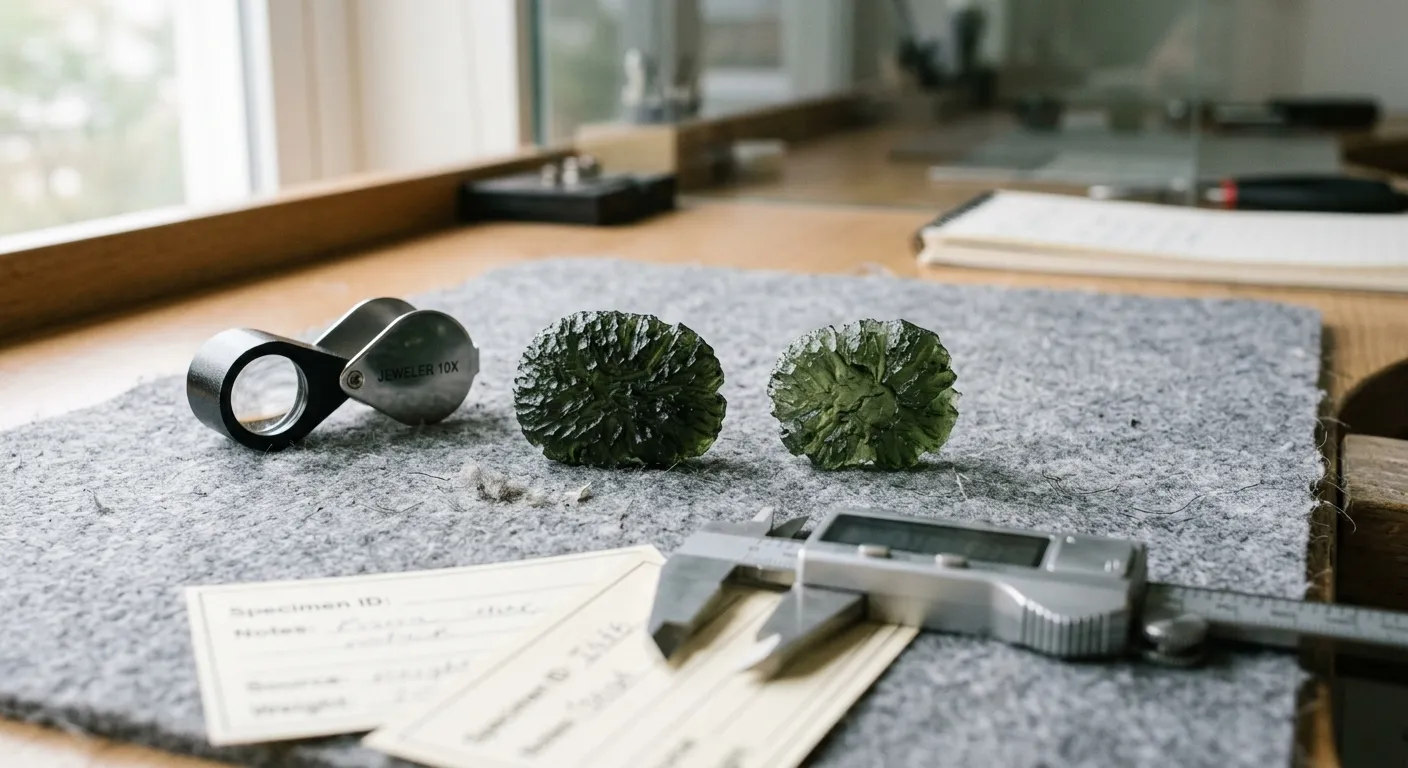
Genuine moldavite is a natural tektite. Some imitations try to copy its rough, pitted, folded, or weathered look. A visual check can raise suspicion, but it should stay in its lane: it is a screening step, not a verdict. Ask provenance questions, compare with credible moldavite references, and use qualified gemological review when the value or uncertainty justifies it. Hydrofluoric acid belongs in the warning category, not in a home testing plan.
broader context
Moldavite context note
This narrower page makes more sense after the broader moldavite archive page.
Chlum texture is a provenance question, not a magic visual code
“Chlum” is often used in the moldavite market as a locality-linked description, especially for Czech material. The issue is not the word itself. The issue is how confidently it is attached to a particular piece.
A seller may describe a specimen as Chlum, Besednice, South Bohemian, river-worn, field-collected, or old-stock. Those labels matter only when they are supported by the object’s full context: credible documentation, consistent appearance, clear seller history, and a description that separates known facts from assumptions.
The material identity is more stable than the marketplace vocabulary. GIA describes moldavite as a natural tektite, a natural glassy material associated with meteorite impact events. That is the anchor: moldavite is not simply “green glass with texture.”
Hydrofluoric etching enters the discussion because hydrogen fluoride is chemically relevant to glass and silicate materials, and collectors worry that counterfeiters may use chemical or mechanical methods to create more convincing surfaces. That concern is reasonable. What is not reasonable is turning it into a one-glance rule such as:
- “Natural-looking texture means real.”
- “Sharp texture means fake.”
- “Smooth worn texture means river origin.”
- “Matte or etched texture means HF acid.”
A better set of questions is:
- Does the surface make sense with the whole object?
- Is the claimed locality supported by more than seller confidence?
- Do color, luster, form, internal features, and documentation fit natural tektite moldavite?
- Is the piece expensive or unusual enough to need qualified review?
That answer is less dramatic than a quick detection trick, but it is more useful.
What surface clues can tell you
Non-destructive observation still matters. It can help you avoid an impulsive purchase, especially when a listing leans heavily on one dramatic close-up.
Texture deserves closer attention when it looks too evenly repeated, too decorative, or strangely disconnected from the rest of the piece. Be cautious with grooves that seem arranged for effect, glossy or matte patches that do not visually fit nearby areas, or a surface that looks designed to imitate “moldavite roughness” rather than naturally formed.
Machined glass moldavite counterfeits may be suspected when a specimen looks shaped for display effect instead of naturally broken, worn, or formed. But that remains a suspicion unless someone with proper tools and reference experience can examine it.
The reverse is also true: a natural-looking surface does not prove genuine moldavite. Photos can hide scale, weight, translucency, internal features, edge behavior, and surface continuity. A close-up can make one rough patch look convincing while concealing uniformity elsewhere.
A simple buyer routine works better than staring at one pit or ridge
- Judge the whole piece first. Counterfeits often rely on one convincing feature to distract from the overall object.
- Look for surface continuity. Texture should change in a way that makes sense across high areas, low areas, edges, and breaks.
- Compare with credible references, not only seller photos. Marketplace repetition can train the eye badly.
- Check whether locality, size, price, and condition fit together. An exceptional claim should come with stronger support.
- Pause when uncertain. Uncertainty is a reason to ask more, not to improvise a test.
True fluvial surface features are often discussed as natural wear or alteration from movement and environmental exposure. But they cannot be reliably diagnosed from a few casual photos. Similar-looking effects can come from different histories. In the Chlum-versus-HF-acid question, surface clues may guide suspicion; they do not replace material identification.
Do not turn hydrofluoric acid into an authentication method
Hydrofluoric acid is not a collector’s test. NIOSH treats hydrogen fluoride and hydrofluoric acid as hazardous substances in occupational safety contexts, and PubChem provides chemical identity information for hydrogen fluoride. For this page, that is enough context to draw a firm boundary: do not use HF acid to test a stone.
Online discussions often blur two very different ideas:
- HF can be chemically relevant to glass or silicate surfaces.
- A buyer can use HF to verify moldavite.
The first is broad chemical context. The second is unsafe and not supported here. This article does not provide concentrations, procedures, sourcing advice, handling steps, or any acid-testing workflow.
Use non-destructive checks instead
- request better photos under neutral lighting;
- ask for weight, dimensions, and origin details;
- compare against credible gemological material;
- avoid sellers who rely on vague dramatic claims;
- seek qualified gemological review for expensive or disputed pieces.
The phrase “HF acid moldavite fakes” is useful search language because it captures a real buyer fear: modern counterfeits may be too convincing for the eye. But it should not become a folk category where every odd surface is blamed on acid, or every matte texture is treated as proof of fraud.
Provenance often matters more than one surface feature
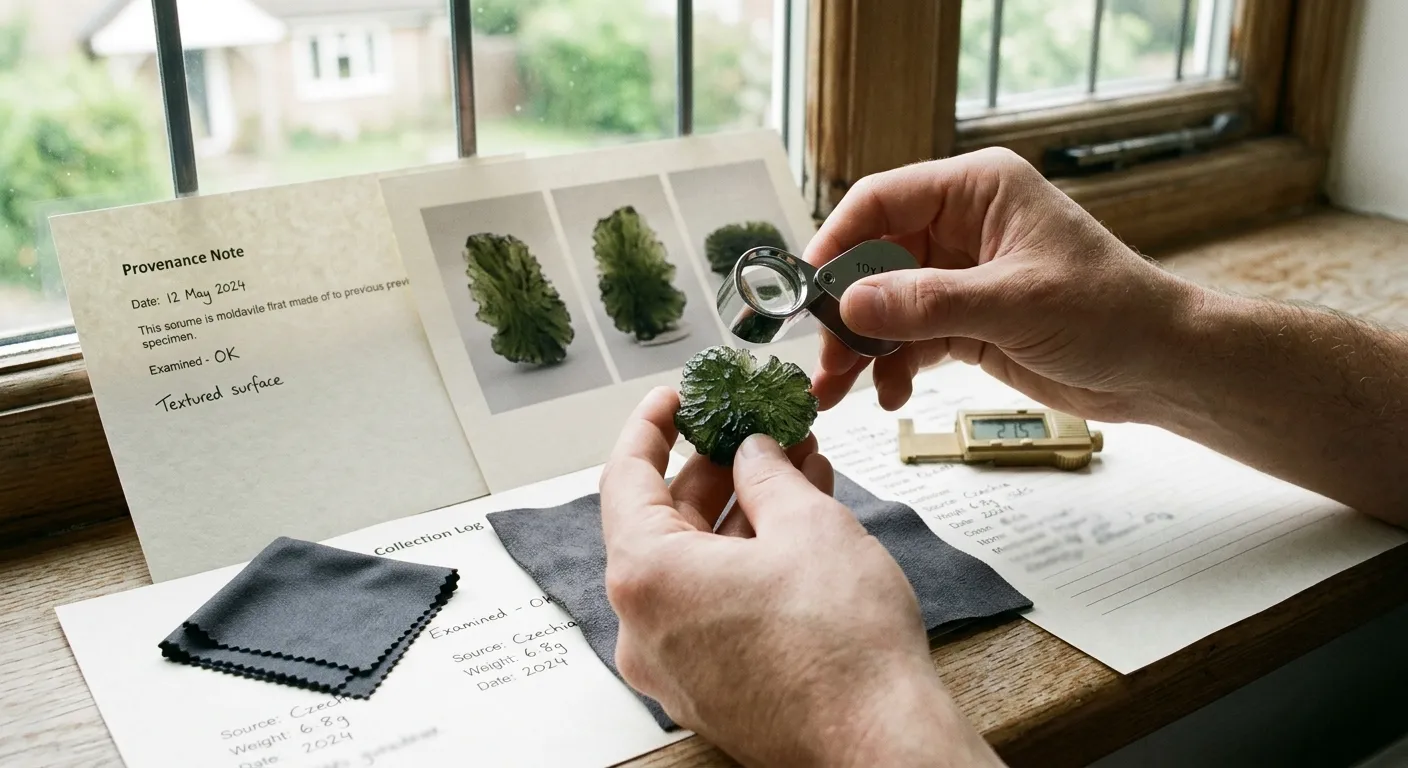
When the surface is ambiguous, documentation becomes more important. Provenance is not a guarantee, but it can strengthen or weaken the story around a specimen.
Useful questions include
- What is the basis for the Chlum or other locality claim?
- Is the piece sold as rough, carved, tumbled, drilled, repaired, or altered?
- Are there clear photos in neutral light, with multiple angles and scale?
- Is there a return policy if a qualified review raises concerns?
- Does any certificate identify the material, or does it mainly repeat seller wording?
- Is the seller honest about uncertainty, or using certainty as pressure?
For lower-value purchases, a careful visual screen plus a reputable seller may be enough for your risk tolerance. For high-value specimens, unusual locality claims, or pieces marketed as exceptional, casual visual checks become much weaker.
Qualified gemological review can provide a better-supported conclusion than listing photos. Still, even professional review has limits. A report may address whether the material is moldavite; locality, alteration history, or the exact cause of a surface feature may be harder to determine depending on the evidence and methods used.
Common confusion around green textured glass
The easiest mistake is treating “moldavite-looking” as the same as moldavite. A green object with bubbles, shine, pits, folds, or roughness can resemble what buyers expect, especially when a listing uses the right vocabulary. Natural tektite identity is not established by color alone, and it is not established by dramatic texture alone.
Another mistake is assuming every convincing fake must be acid-etched. Some suspicious pieces may be molded glass, machined glass, altered glass, or simply misdescribed material. Without direct evidence, it is better to say “possible acid-etched or machined-glass counterfeit” than to assign a specific manufacturing method.
There is also the opposite error: rejecting every unusual genuine piece because it does not match a narrow mental image. Natural materials vary. Wear, breakage, soil history, handling, cleaning, and collection context can all affect appearance.
“This texture is interesting, but I cannot authenticate it from the surface alone.”
That keeps you away from both overconfidence and panic.
A practical stopping point
If you are deciding whether to buy, keep the process modest and evidence-based.
Green light
The piece has coherent appearance, reasonable pricing for its claim, clear photos, consistent seller information, and no pressure tactics. That does not prove every detail, but it may be acceptable for your risk tolerance.
Yellow light
The surface looks unusually uniform, the origin story is vague, the locality claim is specific but unsupported, or the photos avoid important angles. Ask more before buying.
Red light
The seller presents texture as absolute proof, refuses basic documentation, makes extreme claims, or encourages unsafe testing. Walk away.
The clearest answer is this: Chlum-like or river-worn character may be part of a genuine moldavite story, and hydrofluoric etching or machined glass may be part of a counterfeit story. Neither can be confirmed by one surface cue alone. Authenticity rests on the whole object, the documentation behind it, and—when needed—qualified assessment.