Surface screening note
Acid Etching Exposed: Differentiating Natural Erosion from Chemical Trickery
A rough, matte, pitted surface does not automatically make a piece of moldavite natural. The better question is whether the texture looks like it formed through uneven geological wear, or whether it looks like a smooth glass object was given one shallow “aged” skin.
Natural erosion on moldavite tends to show irregular depth, broken grooves, uneven ridges, nested hollows, and non-repeating surface patterns. Suspected Acid Etched Fakes may also show a dull matte finish, surface pitting, and soft edges, but the texture often looks too even, too shallow, too softened, or repeated across similar pieces.
That is a screening clue, not authentication. A surface can raise suspicion; it cannot certify moldavite by itself.
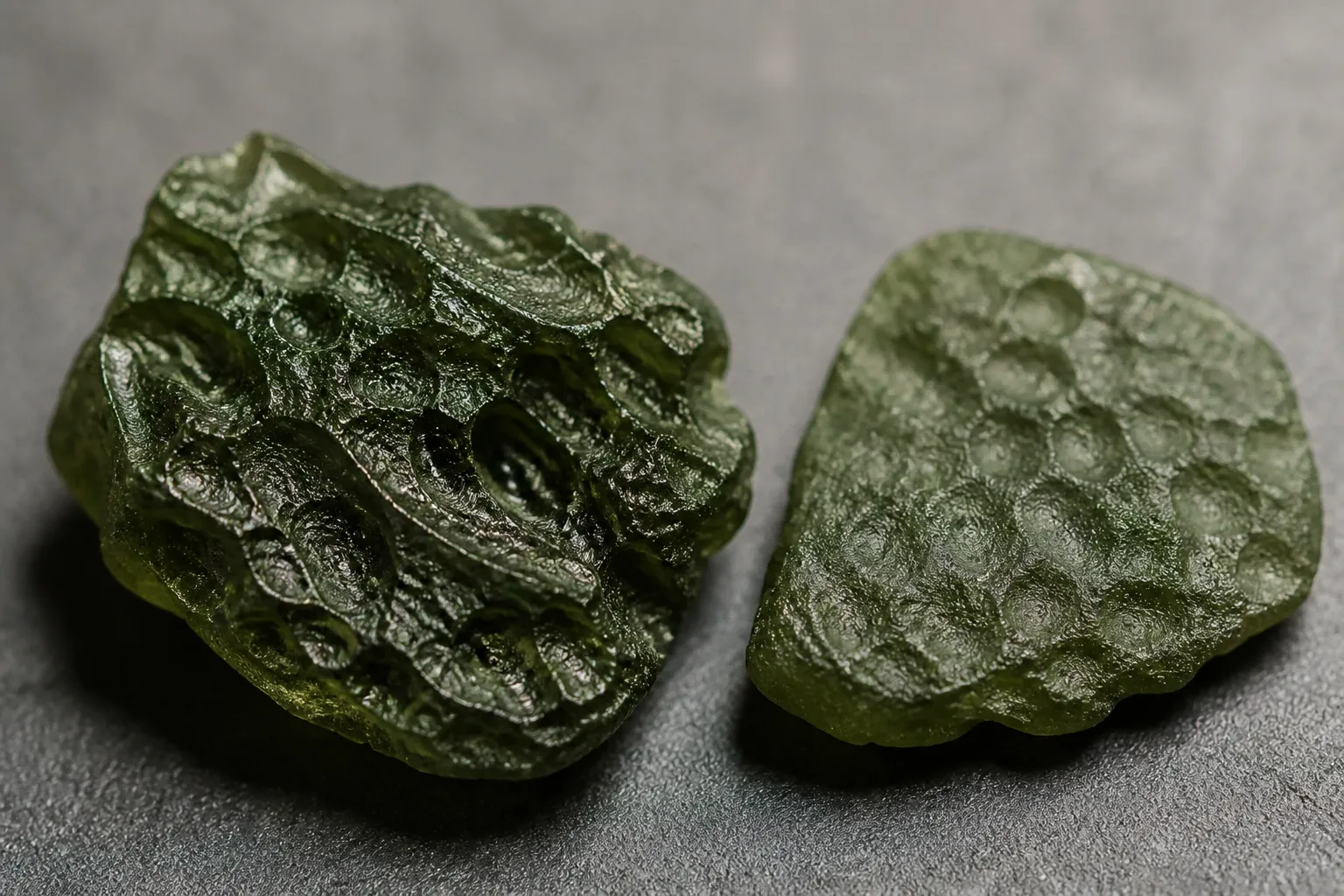
The surface clue that matters: irregular history, not roughness alone
Moldavite is a natural tektite, a glassy material associated with impact processes. When a natural glassy object spends time in sediment, soil, water, and abrasive environments, its surface can develop a complicated outer skin. That history usually does not look perfectly even.
On a naturally eroded rough specimen, look for surface behavior that changes as you rotate the piece:
- pits that vary in size and depth
- grooves that start, stop, branch, or fade
- ridges that rise and fall instead of forming a flat decorative pattern
- small channels that appear layered or nested
- high points that wear differently from protected recesses
- relief that looks interrupted rather than stamped on
The useful phrase is irregular layered erosion. Natural corrosion and abrasion rarely create the same-depth texture across every exposed face. A genuine rough surface may be dramatic or subtle, sharp or softened, open or compact. What you do not want is a surface that looks as if one uniform treatment was applied everywhere at once.
This is where the common shortcut “real moldavite is deeply etched” can mislead buyers. Some real rough moldavite has strong sculptural relief, but depth alone is not the deciding feature. A convincing natural surface has variation, direction changes, and small interruptions that do not reduce to one repeated visual trick.
What artificial etching can imitate
Chemical etching can alter glassy surfaces. Research on silica-based ceramics shows that hydrofluoric acid etching can change surface micromorphology, increase roughness, and produce pores or grooves under controlled conditions. That does not prove how any individual moldavite-like object was made. It simply explains why “rough,” “matte,” or “pitted” is not enough.
In buyer language, “acid etched moldavite fakes” usually means glass or glass-like material treated to look more natural. The concern is not pitting by itself. It is pitting without geological complexity.
Suspicion-raising surface features
Uniform shallow texture
The whole piece looks evenly dulled rather than naturally varied.
Matte finish everywhere
A matte finish can be produced artificially and is not proof of natural erosion.
Soft edges on every ridge
Natural high points may wear, but uniformly rounded detail can look over-treated.
Repeated pits or grooves
Similar marks across one piece, or across several pieces, can suggest copied texture.
Decorative-looking roughness
The surface looks designed to appear “wild” rather than naturally interrupted.
Glossy glass beneath dull areas
The top may look aged while the underlying material still reads as smooth glass.
None of these signs works alone. A naturally weathered piece can be matte. A real surface can have softened areas. The concern grows when several clues appear together: uniform shallow texture, repeated surface pitting, evenly soft ridges, and mass-produced sameness.
Natural erosion vs acid etching under light
The safest useful inspection is non-destructive: light, magnification, angles, comparison, and documentation. You are not trying to run a chemical test. You are trying to see whether the surface has natural complexity or a generalized rough skin.
Start with side lighting. Hold the piece so light skims across the surface instead of shining straight through it. Side light makes relief easier to read: ridges cast tiny shadows, pits show depth, and grooves become more visible. A 10× loupe or phone macro image can help, but a single front-lit product photo often hides the details you need.
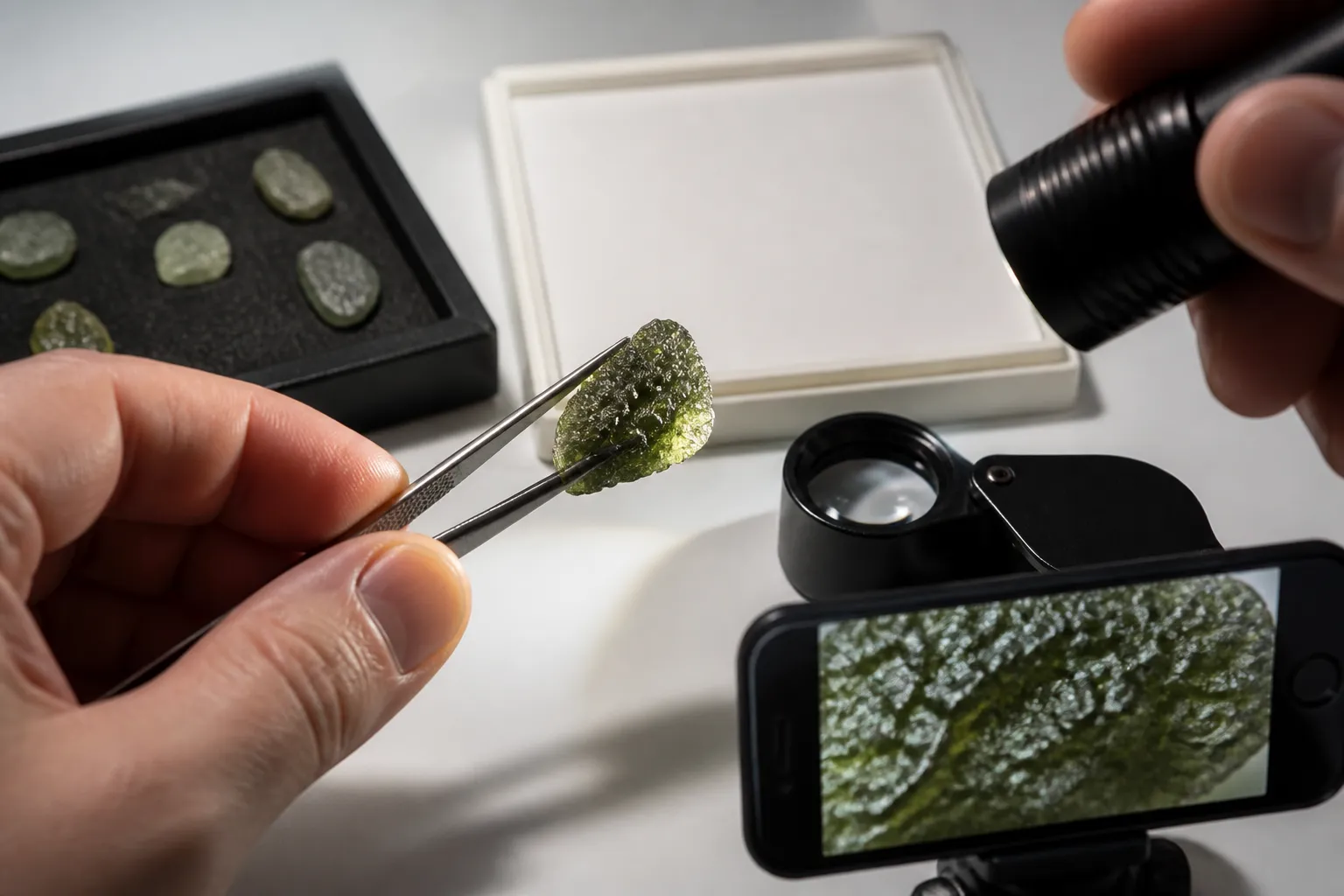
Questions to ask while comparing surfaces
Does the depth change?
Natural erosion often moves between deeper pits, shallower channels, raised ridges, and worn high points. A suspicious surface may look evenly frosted or etched to a similar depth across broad areas.
Do the pits, grooves, and ridges interact?
Natural surface features tend to interrupt each other. A groove may cut across an older depression, a ridge may break, or a pit may sit inside a wider hollow. Isolated dots on a smooth base are less convincing.
Are all the edges softened the same way?
Soft edges on fake moldavite are often discussed, but the key is uniformity. Natural pieces can have rounded areas. Uniform rounding across every ridge can look less believable.
Does the texture repeat?
Non-repeating surface patterns matter. If several pieces in a listing show similar size, shape, pitting rhythm, and matte skin, the concern shifts from one odd feature to manufactured consistency.
Is the rough shape too perfect?
A too-perfect outline is not a diagnosis, especially for cut stones or beads. But in rough-looking pieces, repeated outlines with repeated surface treatment can point toward production rather than natural variation.
A useful rule of thumb: natural rough moldavite should reward slow looking. The longer you rotate it, the more small irregularities should appear. A suspiciously etched surface often does the opposite: after the first impression of “rough,” it starts to look repetitive, shallow, or evenly dulled.
Matte finish, bubbles, and glossy glass can all mislead
A matte finish gives a quick impression of age, which is why it is so easy to overvalue. But matte does not equal natural. The stronger clue is whether the matte surface contains uneven relief, layered detail, and interruptions.
Surface pitting has the same problem. Pits can be natural, and pits can be imitated. A few holes or tiny depressions do not settle the question. Look at how the pits behave in relation to the whole surface. Are they embedded within ridges and grooves of different depths, or scattered across a flat, uniformly treated skin?
Gloss is also easy to misread. A smooth glossy surface may be normal on polished, cut, or naturally smoother areas. But a very wet-looking glassiness on a rough-style piece deserves a second look if the outer texture seems shallow or decorative. The warning sign is not shine by itself; it is the mismatch between a supposedly natural rough exterior and a surface that still reads as newly made glass.
Bubbles are another common confusion. Moldavite can contain internal features, including bubbles, flow textures, and pore structures. But bubbles need to be interpreted with the rest of the object. Uniform round bubbles in very clear glass, for example, do not automatically support authenticity. Surface and interior clues have to be read together.
A short non-destructive inspection routine
For a rough or rough-style specimen, keep the check simple:
-
Use side light.
Rotate the piece slowly. Look for changing relief, not just a rough silhouette.
-
Use a 10× loupe or macro photo.
Examine pits, grooves, and ridges. Natural-looking texture should vary in depth and direction.
-
Check edges and high points.
Watch for uniformly soft edges, rounded ridges, or texture that fades too evenly.
-
Compare more than one face.
A naturally eroded object may show different surface behavior on different areas. A uniform matte skin across all sides can raise suspicion.
-
Compare multiple pieces if available.
Repeated shape, repeated pitting, identical size, and similar surface rhythm across many pieces are stronger warning signs than one odd mark.
-
Do not rely on one listing photo.
If the piece is valuable enough to question, ask for angled images, close-ups, and backlit photos.
This routine helps you decide whether a specimen deserves more scrutiny before buying, returning, or sending it for evaluation. It is not a verdict.
When surface clues are not enough
Surface reading is most useful for rough moldavite or pieces sold as natural rough. It becomes less decisive for beads, cabochons, faceted stones, or heavily polished pieces because much of the original surface has been removed or reshaped. In those cases, internal features, manufacturing consistency, optical character, and professional testing matter more.
Even on rough specimens, a convincing surface does not prove origin, and a suspicious surface does not identify the exact treatment. Public evidence supports the broader boundaries: moldavite is a natural tektite; natural surfaces can be irregular and complex; chemical etching can roughen glassy materials; and high-risk acids such as hydrofluoric acid are not appropriate for home experimentation. What is much thinner is any definitive public rule that identifies acid-etched fake moldavite from appearance alone.
That limit matters. A photo can hide depth. Lighting can exaggerate texture. Dirt, oil, polish, abrasion, or handling can change how a surface reads. Some natural pieces are less dramatic than buyers expect. Some imitations may be visually careful enough that surface inspection alone is not enough.
For a high-value or disputed specimen, the next step is professional gemological or laboratory evaluation rather than stronger guesswork.
Safety boundary: do not try acid testing
Hydrofluoric acid is a severe chemical hazard and should not be treated as a collector’s testing tool. It is mentioned here only because “hydrofluoric acid moldavite fakes” appears in buyer discussions around chemically etched glass.
Do not test, clean, etch, expose, or experiment with moldavite or glass using acid at home. Stay with visual, non-destructive observation: light, magnification, comparison, documentation, and professional review when needed.
Bottom line
The best quick distinction is this: natural moldavite erosion usually looks irregular, layered, depth-variable, and non-repeating. Suspected acid-etched fakes may imitate roughness with a matte finish, surface pitting, and soft edges, but they often look uniformly shallow, evenly dulled, overly softened, glossy underneath, or repeated across similar pieces.
Do not ask only whether the piece is rough. Ask whether the roughness has a believable natural history.