Collector geology note
Besednice “Hedgehogs”: 14 Million Years of Acid Erosion Explained
Besednice “hedgehog” moldavites are best understood as old impact glass with a later, strongly sculptured surface. The glass belongs to the Middle Miocene Ries impact story, roughly 14 million years old. The sharp, spiky, grooved outer relief is more cautiously explained as secondary surface alteration: differential corrosion, dissolution, and weathering acting on glass that was already chemically and texturally uneven.
So the short answer for Besednice Texture is this: the hedgehog look is geologically plausible, but “14 million years of acid erosion” is too neat. The age describes the moldavite’s formation context, not a proven record of continuous acid attack on every groove.
A prickly surface can be meaningful. It does not, by itself, prove that a piece is from Besednice, natural, untouched, or more valuable.
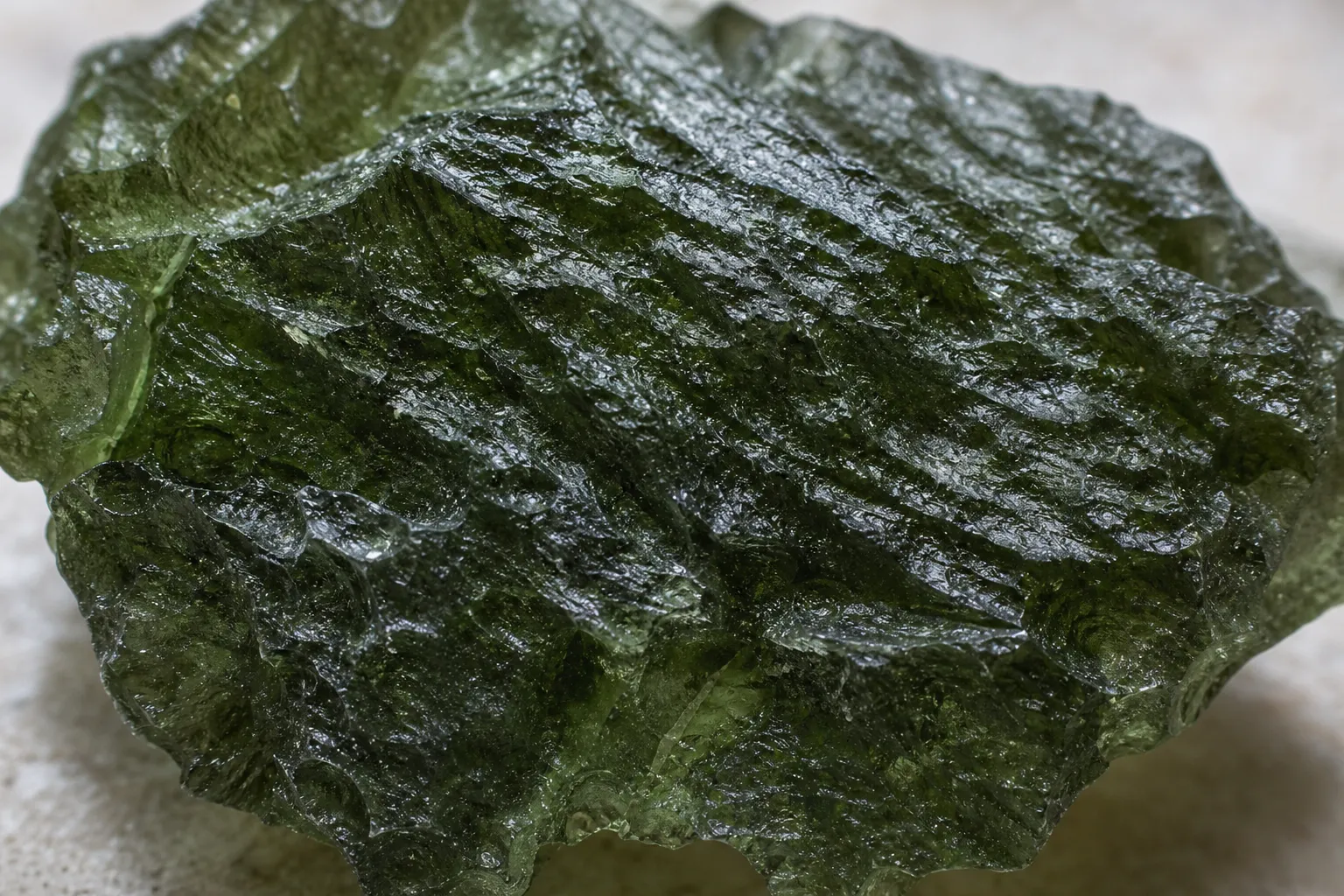
What collectors mean by “hedgehog” texture
Collectors use “hedgehog” for moldavite that looks unusually prickly or thorny: raised points, narrow channels, ridges, grooves, and an etched-looking surface that feels more dramatic than smoother splash forms.
In geological language, it is safer to call this a highly sculptured moldavite surface.
That distinction matters. “Hedgehog” is a collector nickname, not a formal scientific class like impact glass, tektite, schlieren, laminae, pores, or lechatelierite inclusions. It is useful because it describes what people see. It becomes risky only when it is treated as proof.
The Besednice locality in South Bohemia is strongly associated in collector language with dramatic moldavite surfaces. The stronger scientific support, however, is broader: moldavites are silica-rich impact glasses linked to the Ries event, they can be internally inhomogeneous, and sculptured moldavite surfaces are commonly interpreted through differential corrosion of chemically varied glass.
That supports the general mechanism. It does not fully document a separate, Besednice-only “hedgehog mechanism.”
The 14-million-year part is about the glass
Moldavites are generally connected with the Ries impact event in the Middle Miocene, with published discussions placing moldavite formation around 14.3 to 14.8 million years ago depending on the dating approach.
But that does not mean a Besednice hedgehog sat in acidic soil and eroded continuously for the entire time.
A more accurate reading is:
- the moldavite glass is roughly 14 million years old;
- its internal flow, pores, laminae, and chemical unevenness came from impact-related formation;
- its present surface may have been modified later by burial, exposure, corrosion, dissolution, abrasion, or transport;
- the exact timing and local chemistry of that surface modification are not fully demonstrated for every Besednice specimen.
The object can be ancient without every spike acting like a 14-million-year stopwatch.
Why chemical etching is plausible, but not literal
Moldavite is not perfectly uniform green glass. Studies describe small-scale inhomogeneity: schlieren, laminae, lechatelierite particles, pores, flow structures, and chemically varied glass domains. These features reflect the violent and rapid formation history of the glass.
That unevenness gives the chemical-corrosion explanation its footing.
If different zones of glass vary slightly in composition or structure, they may not weather at the same rate. Over time, a surface exposed to chemically active conditions can develop relief: some areas resist alteration better, while others dissolve or recess more easily.
In collector terms, the surface looks carved because the glass did not behave as one perfectly even material.
In geological terms, the ridges and grooves may be a secondary surface expression of internal inhomogeneity.
This is why “chemical etching” can be a useful phrase, as long as it is not made too literal. Natural surface alteration is not the same as a controlled acid bath. It is a broad description of glass interacting with water, soil chemistry, organic acids, pH variation, and other local environmental conditions over time.
The available evidence supports differential corrosion as a plausible explanation for sculptured moldavite surfaces. It does not prove the exact soil-acid pathway for every Besednice hedgehog.
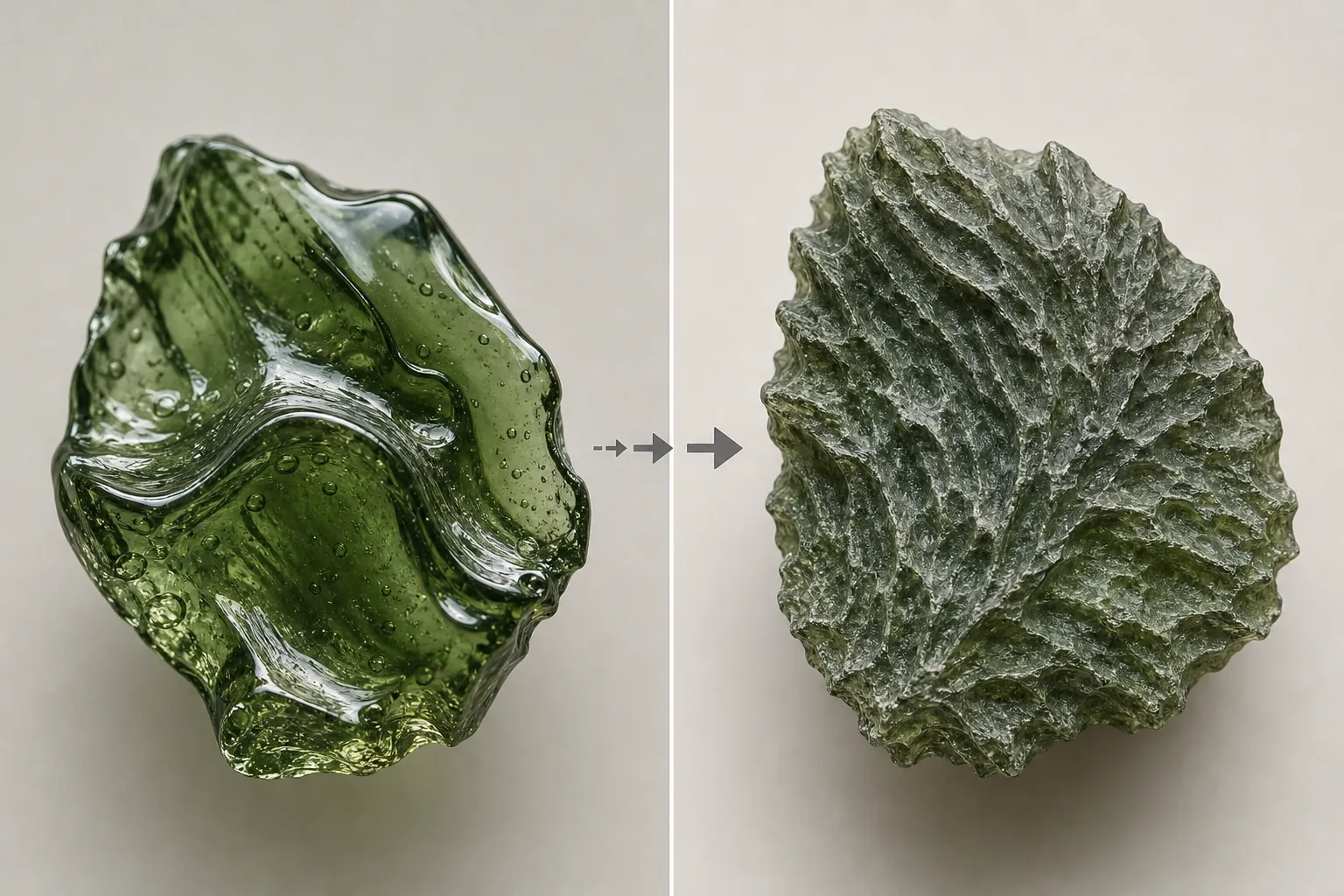
Primary formation vs. later surface sculpting
The cleanest way to understand Besednice moldavite texture is to separate two histories that are often blended together in sales descriptions.
Primary tektite formation
The original impact glass formed during the Ries event from terrestrial material under extreme conditions.
This created the glass body and its internal flow, laminae, pores, and chemical unevenness.
Internal inhomogeneity
Moldavite can contain chemically and optically different zones, lechatelierite inclusions, pores, and flow structures.
These differences may influence which surface areas later dissolve or resist weathering.
Later surface alteration
After formation, the surface may be modified by corrosion, dissolution, abrasion, burial, or exposure.
This is the likely category for sharp grooves, ridges, and etched-looking relief.
Collector nickname
“Hedgehog” describes a prickly, spiky appearance.
Useful for recognition, but not enough on its own to prove locality, origin, or history.
A hedgehog surface is not the same thing as primary tektite formation. The impact made the moldavite. Later alteration likely helped reveal or exaggerate the surface relief.
Those are not competing explanations. They are different chapters in the same object.
Where soil acidity fits
Soil acidity is a tempting explanation because it sounds direct: acidic conditions can contribute to chemical weathering, and glass surfaces can be altered by their environment.
In a broad sense, acidic or chemically active burial conditions may have contributed to moldavite surface corrosion. That is plausible.
The boundary is narrower than many collector descriptions suggest. Current source support is stronger for general differential corrosion and internal glass heterogeneity than for a measured, Besednice-specific soil-acidity recipe.
A careful version would be:
Acidic or chemically active local conditions may have helped shape later surface alteration, but the exact pathway for Besednice hedgehog forms is not settled by the visible scientific sources.
An overstated version would be:
Besednice hedgehogs were carved by acidic soil for 14 million years.
The first version fits the evidence. The second turns a plausible mechanism into a finished story.
What the texture can and cannot tell a collector
The hedgehog look can tell you that a specimen has a strongly sculptured surface. It may also be consistent with a known moldavite pattern: chemically varied glass weathering unevenly and producing grooves, ridges, and sharp relief.
That is already interesting. The texture is not just decoration; it may be a visible trace of material history.
But texture alone has limits.
A dramatic surface does not prove that a piece comes from Besednice. It does not prove that it is natural. It does not prove that it has never been altered, cleaned, damaged, or misrepresented. It also does not establish value without considering provenance, morphology, condition, weight, color, transparency, breakage, and documentation.
The word “etched” has the same problem. A naturally etched-looking surface and an artificially altered surface can both be described casually as etched. Without stronger context, the word describes appearance more than proof.
For this specific question, the practical takeaway is:
- “Hedgehog” is a visual descriptor, not a standalone authentication category.
- The surface fits a plausible pattern of differential corrosion and secondary sculpting.
- The Besednice-specific story needs locality-aware evidence, not just a sharp surface and a confident label.
- The 14-million-year number belongs to moldavite formation age, not necessarily uninterrupted surface erosion.
Common confusion: attractive texture, real texture, Besednice texture
“Nice texture” can mean different things.
A seller may mean visually attractive. A collector may mean deep grooves, intact relief, or a classic locality look. A geologist may ask whether the texture is primary, secondary, internal, surface-related, chemical, mechanical, or mixed.
For Besednice hedgehog moldavite, the most useful distinction is not “nice” versus “not nice.” It is whether the texture is being used as description or as proof.
As description, “Besednice hedgehog texture” is understandable: it points to a spiky, grooved, strongly sculpted surface associated in collector language with Besednice material.
As proof, it asks too much from one visual trait. Better support would include reliable provenance, consistency with known moldavite features, and careful handling of claims about locality or alteration.
The most defensible explanation
The most defensible explanation is that Besednice “hedgehogs” are moldavites whose dramatic surfaces may reflect secondary sculpting: later chemical corrosion or dissolution acting unevenly on an already inhomogeneous silica-rich impact glass.
The moldavite itself belongs to the roughly 14-million-year Ries impact context. The hedgehog surface is better treated as a later surface-alteration feature, not a simple record of continuous acid erosion.
That leaves room for the beauty of the texture without making it carry more certainty than the evidence allows. The spikes and grooves may be the visible meeting point of two histories: violent primary formation as impact glass, and slower post-formation weathering that exposed the glass’s internal unevenness at the surface.