Practical answer first
What Happens When Moldavite Breaks? Managing Metaphysical and Financial Loss
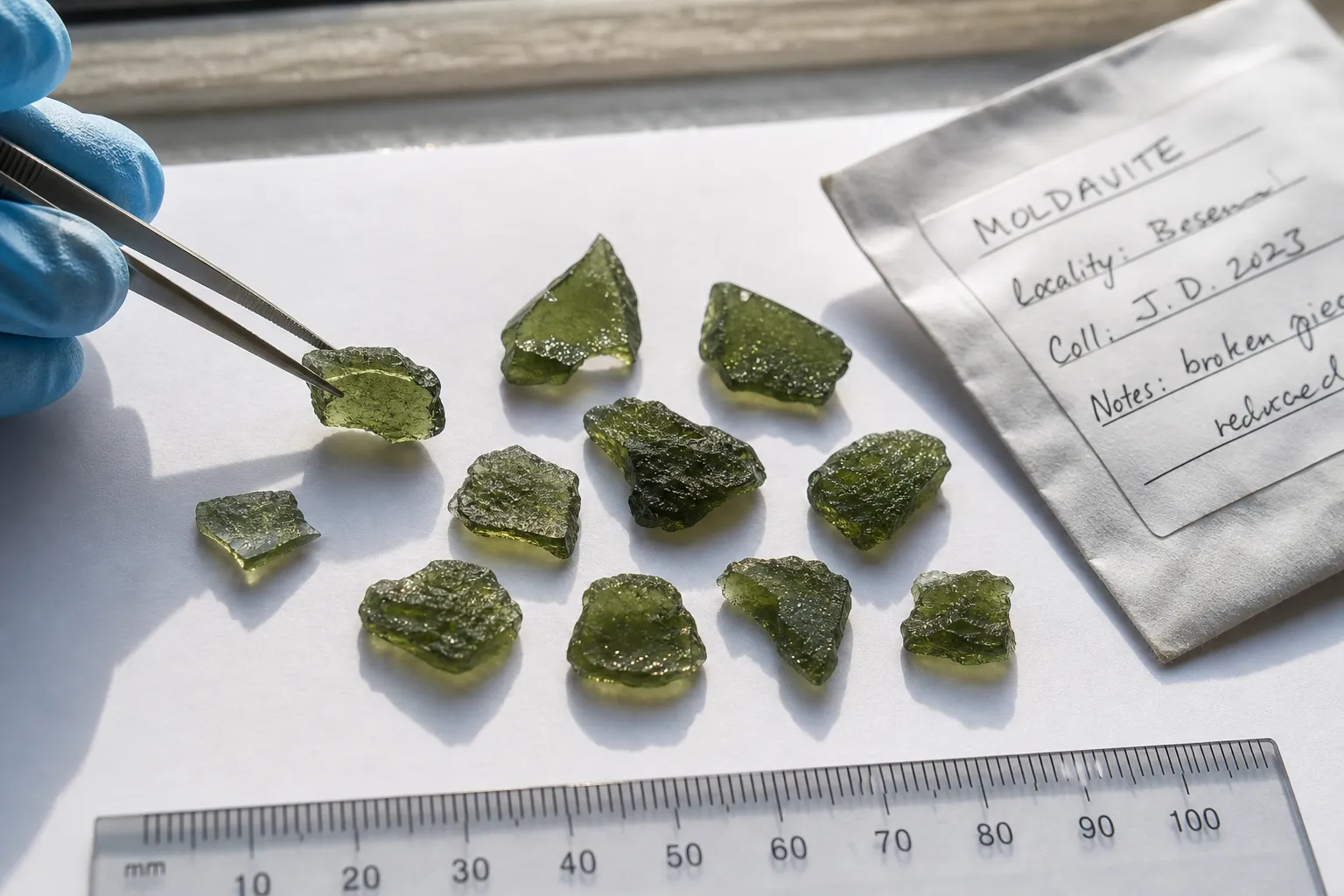
When moldavite breaks, the first event is physical: a piece of natural glass has chipped, cracked, split, or shattered. Broken moldavite does not automatically prove energy loss, bad luck, or spiritual failure. It does mean the object is no longer intact, may have sharp edges, and may have changed in value depending on its condition, documentation, setting, and buyer expectations.
The best first response is practical: stop wearing it, collect the fragments, photograph the damage, keep receipts or certificates, and avoid glue or polishing until you decide whether to keep, repair, document, or professionally assess it.
That answer may feel plain if the piece mattered to you emotionally or spiritually. But plain helps here. The break can be upsetting and symbolically important without becoming a factual warning sign.
broader context
Start with the main moldavite page
This narrower page makes more sense after the broader moldavite archive page.
What physically happens when moldavite breaks
Moldavite is described in gemological and geological sources as a natural glass and a tektite, not a typical crystalline mineral. That matters because a glassy material can look gemlike, be collectible, and hold personal meaning while still being vulnerable to impact, pressure, setting stress, or existing weak points.
A broken piece may appear as:
- A chip along an edge, ridge, or thin point
- A crack through part of the body
- A surface fracture that does not fully separate the piece
- Shattering into two or more fragments
- Damage in jewelry, where the moldavite loosens, breaks, or falls from its setting
The cause is not always obvious from sight alone. A fall onto tile, pressure from a ring setting, contact with keys, rough shipping, or a previous fracture can all play a role.
Natural moldavite can also vary internally. Research using X-ray micro-CT has documented pore and structural variation in studied moldavite samples. That does not mean every broken piece failed because of internal pores, and it does not allow anyone to diagnose your exact specimen from a photo. It simply supports a careful point: moldavite is not a perfectly uniform manufactured object.
Gem durability is also more than “hard” or “soft.” GIA separates hardness from toughness and other durability factors. Hardness is mainly about resistance to scratching. Toughness is about resistance to breaking, chipping, or cracking. A material may resist some scratches yet still break under a sudden blow.
So if your moldavite broke, that alone does not prove it was fake, and it does not prove you handled it carelessly. It means a glassy object met conditions it did not survive intact.
What to do immediately with broken moldavite
The first steps are about safety, evidence, and keeping your options open.
- Stop wearing it.
A chipped moldavite pendant or ring may have sharp edges. Continued wear can also worsen the damage or cause a fragment to fall out. - Collect every piece you can find.
Place fragments on a clean surface and move slowly. Small flakes can be easy to miss. - Wrap the fragments gently.
Use a soft cloth, tissue, small pouch, or padded container. If surface texture matters to you, avoid letting pieces rub against each other. - Photograph the damage before changing anything.
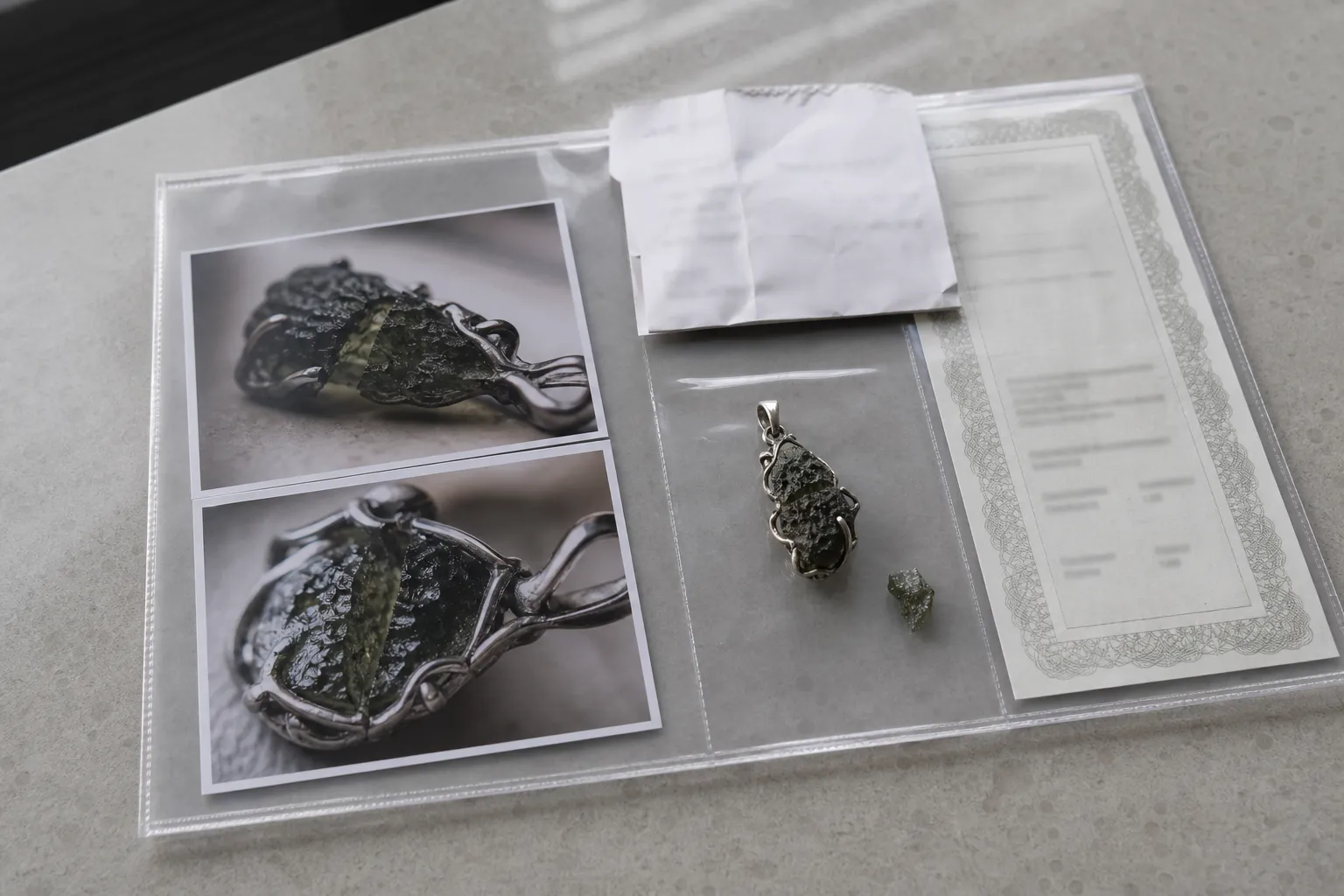
Take clear photos of the front, back, sides, close-ups of the break, and the jewelry setting if there is one. A ruler or coin can help show size. - Save documentation.
Keep the receipt, seller description, certificate, appraisal note, packaging, and any earlier photos. For collectible pieces, before-and-after records can matter. - Do not rush to glue it.
Adhesive may make the piece harder to evaluate, resell, reset, or repair later. If financial value matters, document it first and ask an appropriate professional before altering it.
These steps do not guarantee value recovery or a successful repair. They simply reduce avoidable loss. Once a piece has been glued, polished, drilled, or reset, some options may become harder to judge.
Does broken moldavite mean energy loss?
If moldavite is part of your spiritual practice, a break may feel like a sudden loss of connection, a completed cycle, a sign to pause, or simply an emotionally charged moment. That feeling belongs to your relationship with the object. It does not need to be mocked.
But scientific and gemological sources do not establish that moldavite loses energy when it breaks. They support moldavite’s identity as a natural glass or tektite and help explain durability. They do not confirm claims that cracked moldavite causes bad luck, spiritual harm, energetic backlash, or a required ritual response.
Physically
The object is damaged and may be unsafe to wear.
Financially
Its value may be affected, but the extent depends on condition, documentation, form, and market acceptance.
Symbolically
You may choose what the break means within your own belief system.
That last part gives you room. You may decide to retire the piece, keep the fragments in a pouch, place them somewhere meaningful, journal about the break, reset a larger fragment into new jewelry, or store it as a damaged collectible. Those are personal choices, not evidence-based requirements.
Be cautious of anyone turning your distress into urgency: “You must replace it,” “You must pay for a clearing,” or “A broken moldavite proves something bad is coming.” Current source material does not support those statements as factual claims.
How much financial loss should you expect?
There is no reliable fixed percentage for moldavite financial loss after breakage. A tiny chip on a bead, a clean split in a pendant, a shattered collector specimen, and a cracked stone in a custom ring are different situations. It would be misleading to say a broken piece is worthless, and equally misleading to promise that it keeps most of its value.
The value question may depend on:
- Whether it was a loose specimen, cabochon, faceted stone, bead, or set jewelry
- How large and visible the break is
- Whether all fragments are present
- Whether the original surface texture matters to the specimen
- Whether authenticity documentation exists
- Whether the piece can be safely reset or displayed
- Whether a future buyer accepts repaired or fragmentary moldavite
- Whether the setting has value apart from the stone
For asset protection, focus on preserving evidence rather than predicting a payout. Keep the fragments, photos, purchase record, and any certificate together. If it was recently purchased, contact the seller with a calm description and photos. If it was insured, ask the insurer what documentation they require; do not assume eligibility. If it was mounted in jewelry, a qualified jeweler may be able to comment on the setting and repair possibilities, but repair feasibility and value impact are case-specific.
The main risk-control rule is simple: do not make irreversible changes before documentation. Polishing down a chip, re-gluing fragments, drilling a broken piece, or replacing a setting may make emotional sense later. If financial value matters, it should not be the first move.
Repair, reuse, or retire?
Once the broken moldavite is safe and documented, you have three broad paths.
Repair or reset it
Repair or reset it if the fragments are large enough, the setting allows it, and a jeweler believes the result can be stable. This is usually more relevant for jewelry than for natural collector specimens, where original surface and form may matter.
Reuse the fragments
Reuse the fragments if you value the material more than the original form. A larger fragment might become a smaller pendant, a display piece, or a keepsake. Smaller fragments can be stored rather than worn.
Retire it as a meaningful object
Retire it as a meaningful object if the break changed your relationship with it. For some people, the right answer is not repair. It is preservation: wrap it, label it, keep the story with it, and stop asking the broken piece to function as daily jewelry.
None of these paths is automatically better. The right choice depends on whether your main loss is practical, financial, sentimental, or symbolic.
Common confusion about broken moldavite
If my moldavite shattered, was it fake?
Not necessarily. Moldavite’s identity as natural glass or tektite means breakage is possible. A break alone does not prove authenticity or fakery. If authenticity is in question, rely on documentation and qualified examination rather than the fact of breakage.
If it cracked while I was wearing it, does that mean it absorbed something?
That is a spiritual interpretation some people may choose, but it is not established by the available evidence. Physical causes such as impact, pressure, setting stress, or prior damage remain the more grounded explanation.
Is broken moldavite completely useless?
No. It may be unsafe as jewelry and may have reduced value, but fragments can still be documented, kept, displayed, reset, or treated as personal keepsakes. “Broken” is not the same as meaningless.
A calm final answer
When moldavite breaks, treat it first as a damaged natural glass object: stop wearing it, protect your hands, collect the fragments, photograph everything, and preserve documentation. After that, separate the three kinds of loss.
The physical loss is real. The financial loss is possible but cannot be calculated without context. The metaphysical loss is personal, not something the evidence can confirm as a mechanism.
A broken piece does not require panic. It asks for slower handling, better records, and a clear choice about what the object is to you now.