The “Hedgehog” Paradox: Is Your Besednice Real or Just Spiky Glass?
A spiky surface can make Besednice Moldavite worth a closer look, but it cannot prove the piece is real, and it cannot prove Besednice origin. The “hedgehog” look is useful as a first visual clue: dramatic, collectible, and easy to overread.
That is the paradox. The same surface that attracts collectors also gives sellers a powerful shortcut. Words like “deeply eroded,” “rare Besednice,” “depleted source,” “high value,” and “hedgehog texture” can describe a desirable specimen, but they can also dress up ordinary green glass.
The safer answer is simple: texture starts the question; provenance and material evidence answer it.
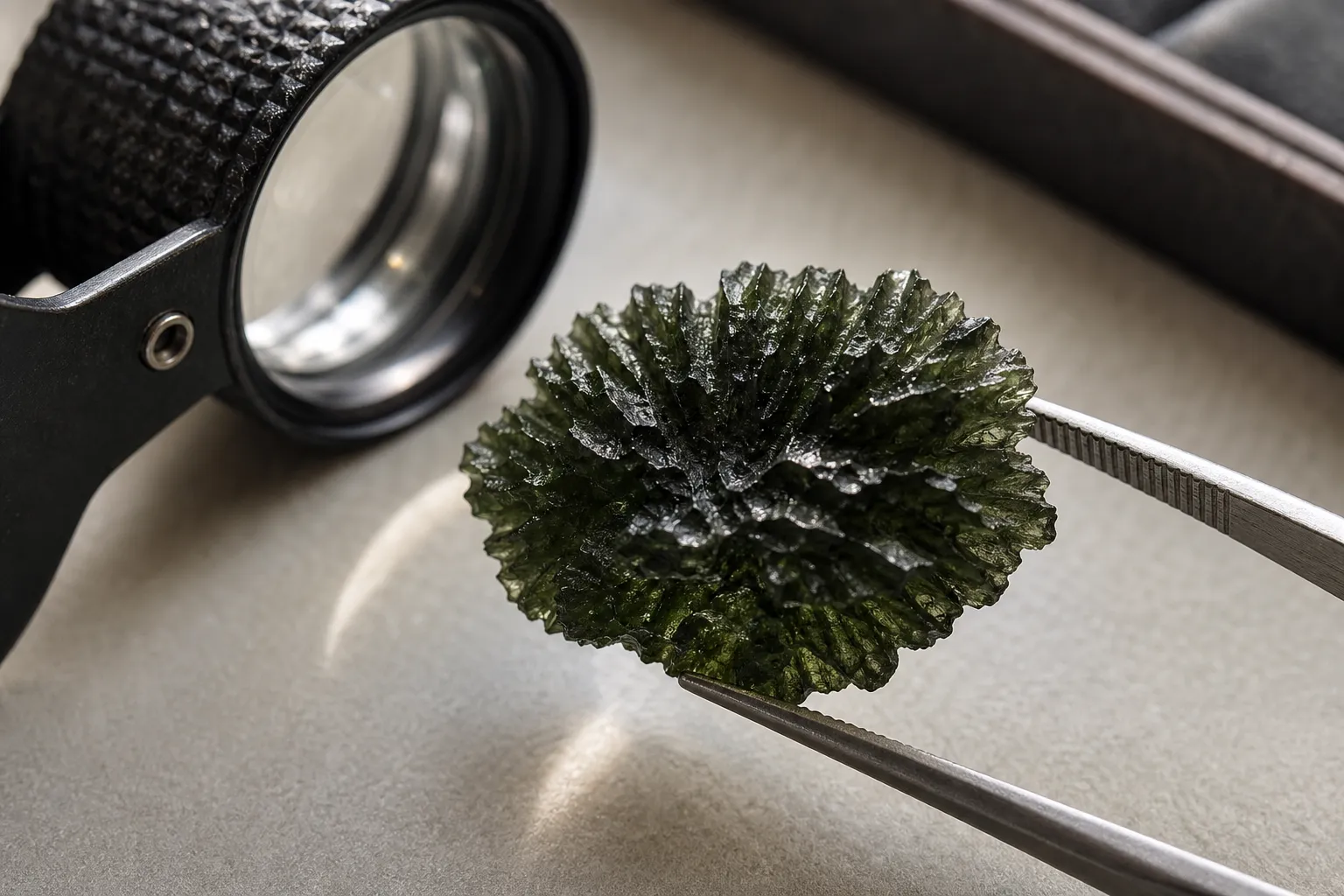
The hedgehog surface is a clue, not an authentication test
In collector language, “hedgehog texture” usually means a sharply sculpted, spiky, deeply etched-looking moldavite surface. It is often associated with the most dramatic Besednice-style specimens: rough, angular, and visually different from smoother moldavite pieces.
That surface language matters because collectors do care about form. A convincing hedgehog moldavite surface may show irregular relief, thin ridges, recesses, undercuts, and a natural-looking complexity that does not feel copied or repeated. But surface drama is not the same as identity.
Moldavite is a natural tektite: a terrestrial impact glass associated with the Central European strewn field and the Ries impact event. Its identity is a material and geological question, not just a surface-shape question. Weathering, breakage, burial conditions, and handling can all affect how a specimen looks from the outside. A spiky exterior, by itself, does not establish that the material is moldavite.
A useful way to separate the evidence:
Visual texture
Can help with whether the piece resembles a known collector style.
Cannot prove authenticity, exact locality, or age alone.
Provenance
Can help with whether the Besednice claim has a supporting history.
Cannot prove that the glass itself is genuine alone.
Professional identification
Can help with whether the material is consistent with moldavite.
Cannot establish the full collecting history without documentation alone.
So the hedgehog texture belongs in the first layer. It can justify closer inspection. It should not carry the whole claim.
Why “Besednice” raises the bar
“Besednice Moldavite” is not just a prettier way to say moldavite. In the market, it works as a locality label. The seller is making two claims at once: that the piece is moldavite, and that it comes from a specific locality associated with desirable surface character.
That is where many listings become too loose. A piece may be called Besednice because it has a hedgehog surface. A seller may imply that deeply eroded texture equals Besednice origin. A listing may add scarcity language to make the claim feel urgent. None of that is strong provenance by itself.
A locality claim needs its own support. Depending on the value of the specimen, that support might include older collection records, invoices, credible dealer history, locality-specific documentation, or independent review. Public geological references and locality databases can help confirm that Besednice belongs in the moldavite conversation, but they cannot prove that a loose specimen in a listing came from that locality.
Read the common sales terms this way:
- “Hedgehog texture” means the surface deserves inspection.
- “Besednice” means the locality claim deserves documentation.
- “Deeply eroded” means the surface should be checked, not accepted automatically.
- “Mining depletion” is scarcity language, not authentication evidence.
- “High value” means the evidence standard should go up, not down.
That is not cynicism. It is proportional caution. The more specific and expensive the claim, the more specific the evidence should be.
What fake-friendly spiky glass can imitate
A fake Besednice Moldavite does not need to copy every feature of real moldavite to fool a rushed buyer. It only needs to imitate the cues the buyer has learned to notice: green color, rough surface, spiky relief, and the right locality words.
A few patterns deserve attention.
Acid-etched glass
Acid-etched glass can produce roughness, pits, and a corroded-looking surface. That does not mean every deeply eroded-looking specimen is acid etched. It means “eroded-looking” is not enough.
Molded fake moldavite
Molded fake moldavite can look dramatic in a listing photo but feel suspicious if the relief appears repetitive, overly uniform, or too conveniently distributed. Natural surfaces tend to have uneven complexity; copied texture can look theatrical.
Photo-amplified texture
Photo-amplified texture is another problem. Harsh lighting, high contrast, wet surfaces, and selective angles can make ridges look sharper and deeper than they are. A listing built around one heroic macro image is weaker than one showing the piece from several angles in ordinary light.
Seller-story texture
Seller-story texture is less about the object and more about the words surrounding it. If the listing leans heavily on “rare Besednice hedgehog,” “depleted mine,” “investment grade,” or intense symbolic claims while offering little provenance, the language is doing too much of the work.
You cannot settle every case from a screen. But you can notice when the surface is being asked to prove everything.
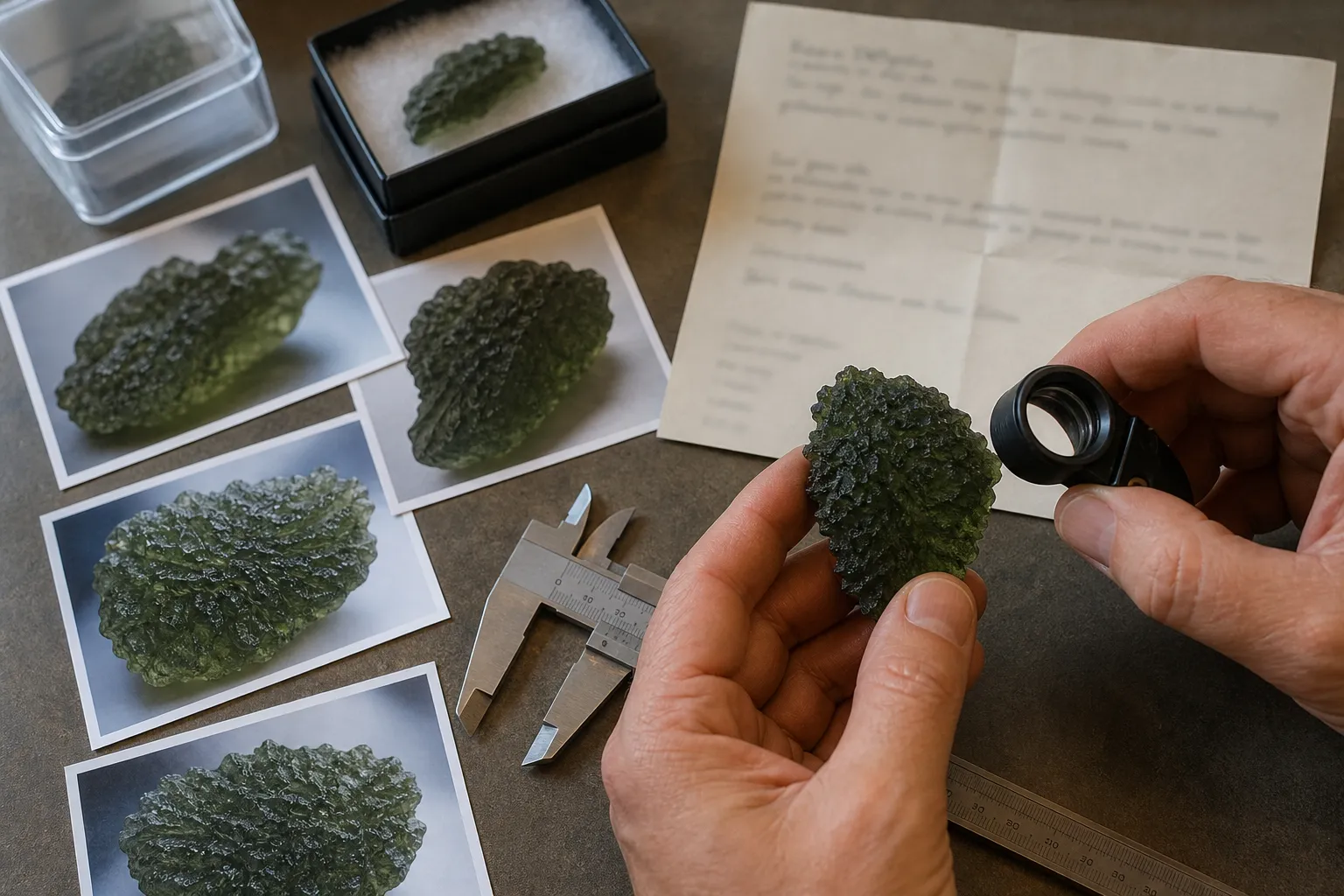
A practical screen before you treat it as real Besednice
The goal is not to declare a piece real or fake from photos. The goal is to decide whether the claim is supported enough to continue.
Start with the listing. Does it separate material identity from locality? A careful seller should be able to describe the piece as moldavite and explain why it is attributed to Besednice without treating the hedgehog surface as automatic proof.
Then look at the photos. A stronger listing shows front, back, side profile, close surface detail, and scale. If the piece is set in jewelry, the setting should not hide the important edges and surface transitions. Jewelry can contain genuine moldavite, but metalwork can also obscure the features you need to inspect.
Check for natural variability. You are not looking for “perfect roughness.” You are looking for warning signs such as repeated dimples, predictable ridges, overly clean spikes, or texture that looks stamped rather than developed.
Ask about provenance plainly:
- What supports the Besednice locality attribution?
- Is there documentation from a previous owner, dealer, or collection?
- Can the seller separate the moldavite claim from the Besednice claim?
If the answer is only “look at the hedgehog texture,” the evidence remains weak.
For expensive or disputed pieces, independent review becomes more important. Gemological examination can evaluate material features that photos cannot resolve. Scientific work on moldavite also shows that internal features, pore structures, flow textures, and material variability can be studied with specialized methods such as microscopy and imaging. That does not mean every buyer needs advanced laboratory work, and it does not mean a general study can authenticate a specific specimen. It simply shows why the real evidence is deeper than the spikes.
A proportional triage looks like this:
- Low-value curiosity piece: visual screening and seller reputation may be enough for your own risk tolerance.
- Premium Besednice claim: ask for provenance, clearer photos, and a coherent locality explanation.
- High-value or disputed specimen: do not let photos decide; seek independent gemological review.
- Listing built mostly on rarity, depletion, or emotional language: slow down and separate marketing from evidence.
Not every small stone needs a lab report. Not every dramatic surface deserves premium trust.
Be careful with “mining depletion” claims
Besednice mining depletion claims appear because scarcity sells. A seller may imply that the source is exhausted, that only old-stock material remains, or that a listed specimen must be valuable because the locality is hard to obtain.
The problem is not that scarcity can never matter in collecting. The problem is that scarcity is not specimen-level proof. Even if access to a locality is limited, that would not prove that a particular spiky green stone is genuine moldavite or that it came from Besednice.
For this page’s narrow question, “mining depletion” should be treated as sales context unless the seller provides independent support. A fake can borrow a scarcity story as easily as it can borrow a locality name.
When you see “Besednice mine depleted” beside a hedgehog-style specimen, translate it into the question that actually matters: what evidence supports this object’s material identity and locality attribution?
Where symbolic and collector language fits
Besednice Moldavite is sometimes discussed as more than a specimen. Listings may describe intensity, transformation, or personal meaning. That language belongs to cultural, symbolic, or collector interpretation. It does not authenticate the material.
A piece can be meaningful because of its form, locality story, or symbolism. But meaning does not verify origin. If a listing combines emotional language with rarity, urgency, and a high price while offering little evidence, that is a reason to slow down.
You can value the symbolism and still require documentation.
The safest answer to the hedgehog paradox
A hedgehog moldavite surface is meaningful as a visual and collector clue. It may be consistent with why Besednice pieces are sought after. But it is not standalone proof of real moldavite, and it is not proof of Besednice locality.
Treat the surface as the opening signal, not the conclusion. A stronger case needs credible provenance, careful visual review, and, for higher-value pieces, independent professional identification. Be especially cautious when a listing relies on “deeply eroded,” “rare,” “depleted,” “high value,” or emotionally charged language without showing the evidence chain behind the claim.
The short version: a real Besednice hedgehog specimen can be spiky, but spiky glass can be sold as Besednice. The difference is not in the nickname. It is in the evidence that remains after the sales language is removed.