Moldavite authenticity note
The Clarity Trap: Why "Flawless" Moldavite is Almost Certainly a Fake
A flawless-looking moldavite is not impossible, but it is a serious authenticity red flag—especially when the stone is faceted, glass-clear, bright green, and shows no visible bubbles, flow texture, schlieren, or threadlike internal features under magnification. This is one of the more damaging Gem Clarity Myths in the moldavite market: the idea that cleaner always means better. With moldavite, internal features often support the natural impact-glass story rather than weaken it. Still, no single visual cue proves authenticity or fakery on its own.
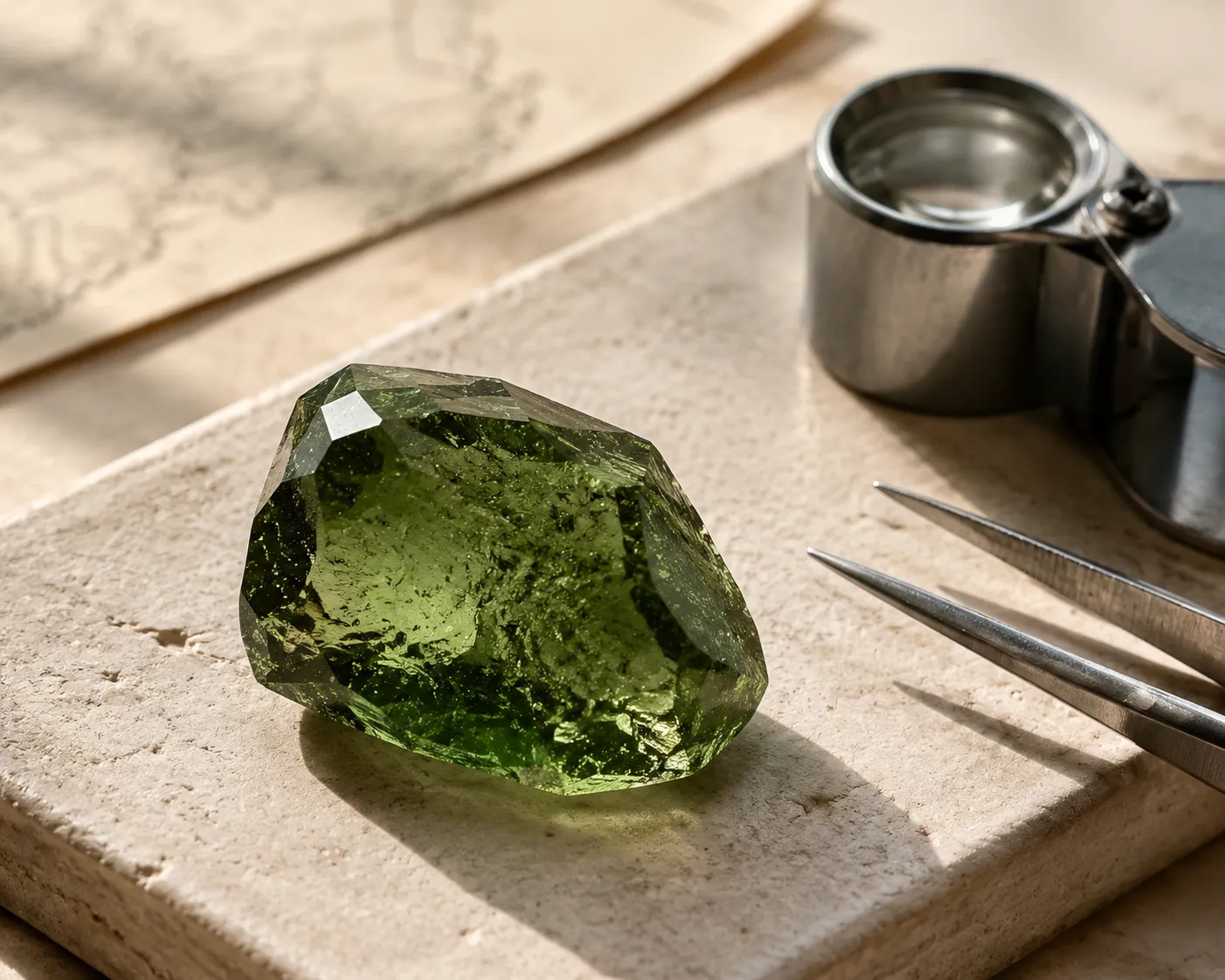
Why “flawless” means something different with moldavite
In many gemstone categories, clarity language is tied to value. A buyer sees words like “eye-clean,” “high clarity,” or “flawless” and assumes the material must be more desirable. That logic may work in parts of the faceted gem market, but it does not transfer cleanly to moldavite.
Moldavite is a natural tektite, or impact glass, associated with the Ries impact event and found mainly in Central European deposits. It did not grow slowly as a crystal in a stable geological setting. Its formation involved extreme heat, ejection, transport, and cooling. That history matters because natural moldavite commonly preserves traces of that process: bubbles, flow texture, streaking, silica-rich threads, and other irregularities.
Those features are not “flaws” in the usual clarity-chart sense. They are part of what separates moldavite from ordinary green glass.
This is where the phrase clean moldavite becomes tricky. Some genuine pieces are more transparent than others. A natural specimen can be attractive, translucent, and relatively open in color. But when a listing presents a faceted stone as perfectly clear, perfectly bright, and nearly free of internal activity, the buyer should pause. The concern is not that nature can never produce a cleaner-looking piece. The concern is that manufactured glass can also look clean, bright, and easy to facet.
A “flawless moldavite” claim often borrows prestige from diamond-like clarity language while ignoring moldavite’s own material identity. Moldavite is judged more responsibly by a combination of structure, internal evidence, surface character, provenance, and documentation—not by a generic gemstone clarity scale.
What bubbles, flow texture, and inclusions can actually suggest
The more useful clarity question is not “Is this moldavite perfectly clean?” It is: “Does this stone show features consistent with natural impact glass?”
Several internal features are commonly discussed in moldavite identification:
- Gas bubbles or internal voids: These may be tiny, stretched, scattered, clustered, or difficult to see depending on the cut, lighting, and angle.
- Flow texture and schlieren: Schlieren are streaky or swirled internal textures caused by differences within the glass. In moldavite, these can appear as layered, flowing, or optically uneven areas.
- Threadlike silica features: Some moldavite pieces show fine internal threads or wirelike features associated with high-temperature glass formation.
- Uneven internal activity: Natural moldavite may show subtle shifts in tone, tension-like effects, or irregular internal structure instead of uniform optical emptiness.
These features are useful because they fit moldavite’s known character as natural impact glass. They are not a casual guarantee. Artificial glass can contain bubbles. Some imitations may include deliberate internal effects. A genuine stone may also fail to show its details in a poor listing photo or under weak magnification.
So the better rule is not “real moldavite always has bubbles” or “fake moldavite never has inclusions.” Both are too simple. A more responsible reading is this: a moldavite candidate with convincing internal texture, appropriate formation features, and credible provenance is more plausible than a stone that looks like uniformly polished green glass.
This matters most with faceted moldavite. Faceting opens windows into the interior. If a faceted stone is large enough to examine and still appears optically blank—no bubbles, no threads, no flow, no internal texture—that absence becomes more meaningful than it would be in a dark rough piece whose interior is hard to inspect.
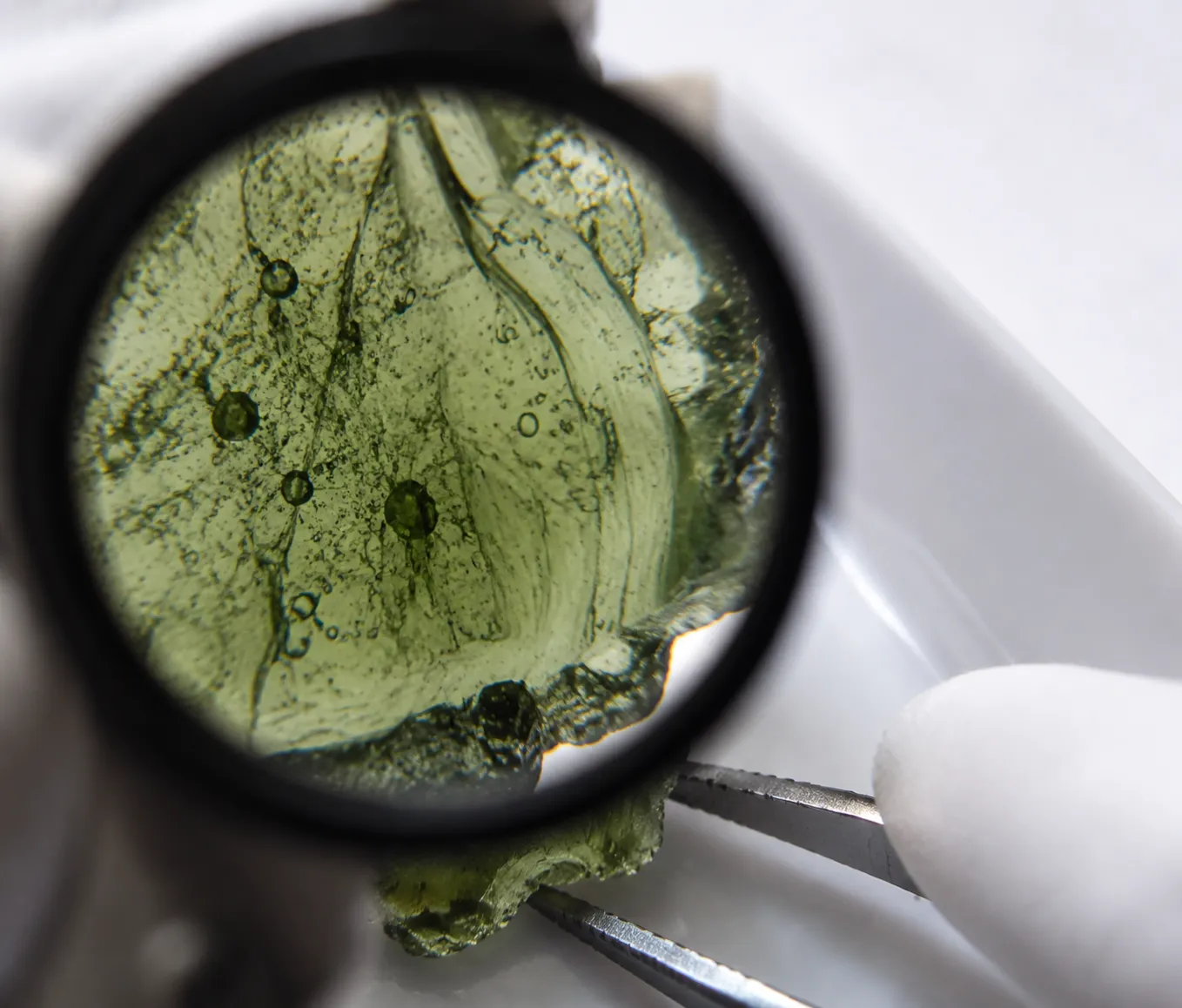
When clean faceted moldavite becomes especially suspicious
A clean faceted moldavite deserves closer inspection when several warning signs appear together. One sign alone may be inconclusive. The pattern matters.
The highest-risk presentation is a stone that looks like bright bottle-green glass: very clear, very shiny, very uniform, and unusually “perfect.” In buyer language, this is often described as wet-looking, oily-looking, or too shiny. Those phrases are not scientific tests, but they point to a real problem: imitation glass can photograph beautifully.
Faceted moldavite can be authentic. The issue is not faceting itself. The issue is a faceted stone that seems to have lost every trace of moldavite’s internal story.
A clean faceted specimen becomes more questionable when it is paired with:
- no visible bubbles or internal voids under magnification;
- no flow texture, streaking, or schlieren;
- no threadlike or silica-rich internal features visible from any angle;
- a very uniform bright green color that resembles bottle glass;
- a surface and polish that look overly simple or glassy;
- repeated identical shapes across multiple listings;
- unusually large pieces offered with weak documentation;
- vague origin language without a coherent provenance trail;
- a certificate that appears seller-issued and lacks specific observations.
None of these points is a final verdict. They are risk signals. A red flag means “do not rely on the listing claim alone,” not “the matter is settled from a photo.”
This is also where gemstone clarity charts can mislead buyers. A standard clarity chart is built around visible inclusions, magnification, and optical cleanliness. That framework can be useful for many gemstones, but it can distort moldavite buying. In moldavite, the features a chart might teach someone to avoid can be the very features that invite a more serious authenticity look.
Moldavite clarity standards are not diamond clarity standards. A glass-clear appearance is not automatically premium. Sometimes it is the trap.
What magnification, certificates, and provenance can and cannot do
A loupe or microscope can be useful for moldavite, especially with faceted pieces. Magnification may reveal bubbles, flow lines, internal streaks, threadlike features, and other glass inclusions that are not obvious in a product photo. It may also show whether the interior looks active and irregular or unusually empty and uniform.
For buyers, this is a practical first filter. If a seller claims a faceted moldavite is natural but cannot provide clear magnified images, that does not prove the stone is fake—but it weakens the claim. If the photos are distant, overlit, heavily saturated, or staged to make the stone look like flawless green glass, there is less evidence to evaluate.
Magnification has limits. A casual loupe check is not the same as a full gemological examination. Some natural features are subtle. Some require experience to interpret. Some imitations can include bubbles or streaks that confuse non-specialists. Visual inspection should be treated as one layer of evidence, not the whole case.
A stronger authenticity assessment usually combines:
- normal and magnified visual inspection;
- internal-feature assessment rather than generic clarity praise;
- provenance consistent with recognized moldavite occurrences;
- seller transparency about origin, weight, and setting;
- documentation tied to the specific stone;
- qualified gemological input for higher-risk or higher-cost purchases.
Certificates help only when they are meaningful. A seller-printed certificate with broad wording is weak evidence. It may repeat the seller’s claim rather than document an independent identification. A more useful document should come from a credible examiner and should reflect observations or tests performed on the specific stone being sold.
Provenance matters too, but it should not be treated as magic wording. Moldavite is associated with recognized Central European occurrences, especially Czech material in common collector language. A coherent origin explanation, clear photos, and consistent documentation give the buyer more to evaluate. A vague “Czech moldavite” claim, by itself, does not replace material evidence.
The same boundary applies to symbolic or spiritual language. Many people come to moldavite through transformation stories, energetic reputation, or personal meaning. Those interests may explain why someone cares about the stone, but they are not authenticity tests. A strong personal reaction or a seller’s energetic description does not show whether the object is natural moldavite. Authenticity rests on material evidence.
A short checklist for “flawless” moldavite claims
Use this as a narrow screen, not a final verdict.
A flawless or very clean moldavite claim deserves skepticism if:
- it is faceted and glass-clear with no visible internal activity;
- it looks like polished bright green bottle glass;
- the listing emphasizes “flawless” more than origin or structure;
- there are no magnified images;
- bubbles, flow texture, schlieren, or threadlike inclusions are absent in every view;
- the certificate is vague, self-issued, or disconnected from the specific stone;
- the seller cannot explain provenance beyond generic origin language.
A cleaner-looking stone becomes more plausible when:
- magnification still shows moldavite-like internal features;
- the color and texture are not unnaturally uniform;
- the seller provides clear images from multiple angles;
- documentation is tied to actual examination;
- provenance and material description are consistent and specific.
The practical answer is simple: “flawless” is not the compliment moldavite sellers sometimes make it sound like. For moldavite, an overly clean appearance can remove the very clues that help separate natural impact glass from ordinary green glass.
FAQ
Is clean moldavite always fake?
No. A cleaner-looking piece is not automatically fake. The concern rises when a faceted stone is marketed as flawless and shows no bubbles, flow texture, schlieren, threadlike features, or other internal activity under reasonable inspection.
Are bubbles in moldavite proof that it is real?
No. Bubbles can support the case for natural moldavite when they appear with other consistent features, but artificial glass can also contain bubbles. Bubbles are evidence to interpret, not proof by themselves.
Can faceted moldavite be authentic?
Yes. Faceted moldavite can be authentic. The red flag is not faceting. The red flag is a faceted stone that looks optically perfect, uniformly bright green, and internally empty while being sold as natural moldavite.
Is a certificate enough to trust flawless moldavite?
Not by itself. A certificate is only useful if the issuer is credible and the document reflects actual examination of the specific stone. For a flawless-looking faceted specimen, the certificate should not replace magnified images, provenance, and material evidence.
The safest conclusion is bounded: a flawless-looking moldavite is not physically impossible, but in the market it is often suspicious. Natural moldavite commonly carries internal signs of its impact-glass formation. When those signs are completely absent—especially in a clean faceted stone—the claim deserves careful checking before it deserves trust.