Bubble Trouble: Debunking the "Round Bubble" Myth in 2026
A round bubble inside moldavite does not automatically mean the stone is fake.
That is the direct answer. Moldavite bubbles are real internal features in natural moldavite, and the available geological and collector-facing material does not support the shortcut that “round equals fake” while “torpedo-shaped equals real.” Natural moldavite can contain spherical, flattened, elongated, clustered, or irregular gas inclusions.
Bubble shape can raise a question. It cannot, by itself, decide authenticity.
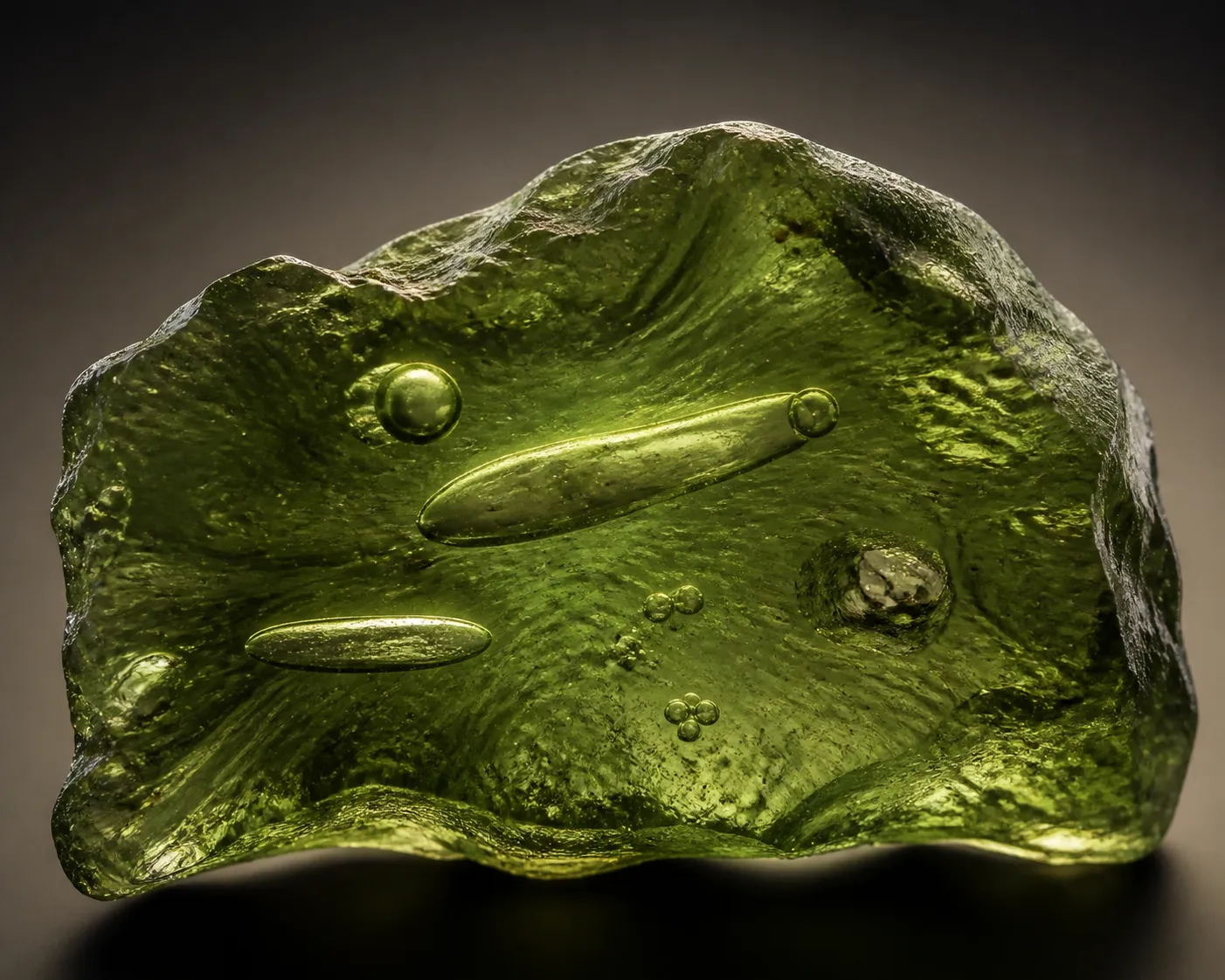
The round-bubble myth
The myth spread because it feels easy. A buyer sees a loupe photo, spots a round bubble, and wants a quick verdict: real or fake?
The problem is that moldavite is not that simple. Moldavite is a natural impact glass, commonly described as a tektite linked to the Central European strewn field. Like other natural glasses, it can show pores, gas inclusions, flow features, and silica-rich inclusions such as lechatelierite.
So the claim needs tightening:
- One round bubble: not enough to call a piece fake.
- Many identical round bubbles in a uniform pattern: worth checking more carefully.
- Elongated or “torpedo” bubbles: can fit natural moldavite, but they do not prove it is real.
- No visible bubbles: also not a final answer.
The better rule is simple: bubble shape is context, not proof.
What natural moldavite bubbles can look like
Natural moldavite bubbles are often described as gas inclusions or pores. Some are visible under a loupe. Others are too small, too deep, or too distorted by lighting and polish to read confidently from a photo.
Common forms include:
- Spherical bubbles: round or near-round bubbles can occur naturally.
- Elongated bubbles: often called torpedo bubbles by collectors; these may look stretched along flow or deformation lines.
- Flattened bubbles: lens-like voids rather than neat circles.
- Clustered bubbles: groups of small bubbles instead of evenly spaced single bubbles.
- Irregular pores: uneven shapes that shift depending on angle and magnification.
- Small bubbles near inclusions: some moldavite descriptions note small bubbles associated with lechatelierite or other internal features.
This variety is the point. Natural moldavite does not need every bubble to look worm-like or torpedo-shaped. At the same time, a glass imitation does not need every bubble to be perfectly round. There is visual overlap, which is why a single bubble shape is too weak to carry the whole authenticity call.
When round bubbles become more suspicious
Round bubbles matter more when they appear as part of a manufactured-looking pattern.
More caution is reasonable when you see:
- many bubbles with nearly identical size;
- bubbles spaced in an overly even way;
- a glossy green glass body with little convincing natural texture;
- repeated grooves or molded-looking surface details;
- beads, cabochons, or pendants that look too uniform across multiple pieces;
- vague origin claims paired with strong seller certainty;
- a low price, large quantity, or form that does not match the claimed rarity.
Even then, the language should stay careful. These are warning signs, not a final verdict. Natural moldavite can be cut, polished, damaged, etched, recarved, or photographed in misleading light. Some imitations can also look convincing enough that casual inspection is not enough.
A better question is not “Is this bubble round?” but “Does the whole specimen make sense?”
Look at how the bubbles relate to the glass body. Do they follow flow features? Are there schlieren-like internal streaks? Are there lechatelierite inclusions? Does the surface texture look natural for rough moldavite, or does it look artificially repeated? Do color, translucency, form, seller history, and documentation support the same story?
Why bubble shape can be misleading
Bubbles are three-dimensional features. A loupe view gives you only one angle.
A bubble that looks round from the front may look stretched from the side. A bubble near a polished surface may appear distorted. A cluster of tiny bubbles can look like one odd inclusion under weak magnification. Lighting, cutting style, fracture surfaces, and camera focus can all change what the viewer thinks they are seeing.
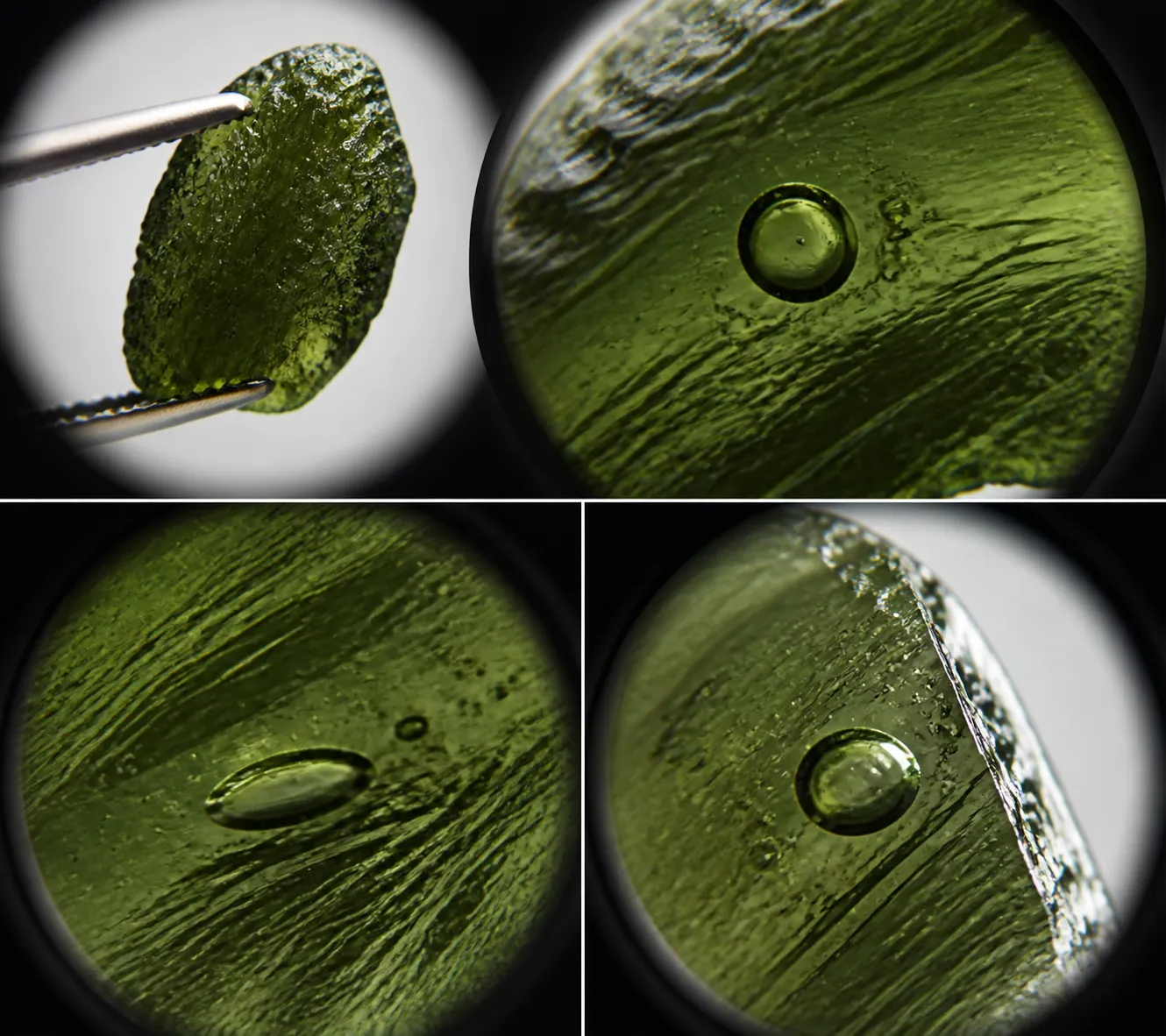
This is also why microscope videos can be useful but incomplete. Magnification shows more detail; it does not automatically make the interpretation correct. A loupe can reveal clues worth noticing, but it does not turn one visual feature into a reliable fake-verification method.
The same applies to carved forms. A round bead, sphere, cabochon, or pendant shape is not the same thing as an internal round bubble. The outer form may have been cut or polished long after the glass formed. A round polished object can be real, fake, altered, or simply too processed for easy visual judgment.
What bubbles can and cannot tell you
Moldavite bubbles can help you notice whether a specimen looks natural, manufactured, altered, or inconsistent. They may support suspicion when the pattern is too uniform. They may support plausibility when seen alongside other features associated with natural moldavite.
But bubbles alone cannot:
- prove moldavite is real;
- prove moldavite is fake;
- confirm Czech origin;
- validate a certificate;
- make a cheap pendant, bracelet, bead strand, or bulk lot trustworthy;
- replace professional testing when the purchase matters.
For practical authenticity screening, bubble shape belongs beside other clues: surface texture, internal flow features, lechatelierite, color, transparency, cutting style, seller behavior, documentation, and, for higher-value purchases, appropriate gemological evaluation.
Man-made green glass can have bubbles. Natural impact glass can have bubbles. The difference is not the mere presence of bubbles; it is the full material context.
A calmer checklist for reading moldavite bubbles
Use this as a first-pass filter, not a guarantee.
Less concerning on its own
- one or a few round bubbles;
- mixed bubble sizes and shapes;
- elongated or flattened bubbles among other features;
- small bubbles near natural-looking inclusions;
- irregular distribution rather than factory-even spacing.
Worth checking more carefully
- many identical round bubbles;
- bubble patterns that look too regular;
- a piece with no convincing natural surface or internal features;
- highly uniform beads, pendants, or “bulk moldavite” with vague origin claims;
- seller language that treats one bubble photo as final proof.
Stronger context clues to compare with bubbles
- lechatelierite inclusions;
- schlieren or flow-like internal streaking;
- surface sculpture that does not look mechanically repeated;
- consistency between form, color, transparency, and claimed locality;
- cautious documentation instead of exaggerated certainty.
The safest conclusion from a bubble photo is often: “This is interesting, but not enough.”
So, are spherical bubbles in moldavite natural?
Yes. Spherical bubbles in moldavite can be natural.
A single spherical bubble is compatible with natural moldavite. Many uniform spherical bubbles in a piece that also looks molded, overly glossy, mass-produced, or poorly documented may raise concern.
That distinction is the whole issue. The internet myth says: round bubbles mean fake. The more accurate answer is: round bubbles need context.
Moldavite authenticity is not a one-feature puzzle. Bubbles are part of the story, but they are not the whole story. If the specimen is expensive, unusually large, unusually cheap, heavily marketed, or difficult to inspect, do not rely on bubble shape alone. Treat moldavite bubble authenticity as a pattern question, not a verdict from one tiny circle in the glass.