No-touch moldavite practice
Sound Bath Frequency Resets: Clearing Energy Without Touching the Stone
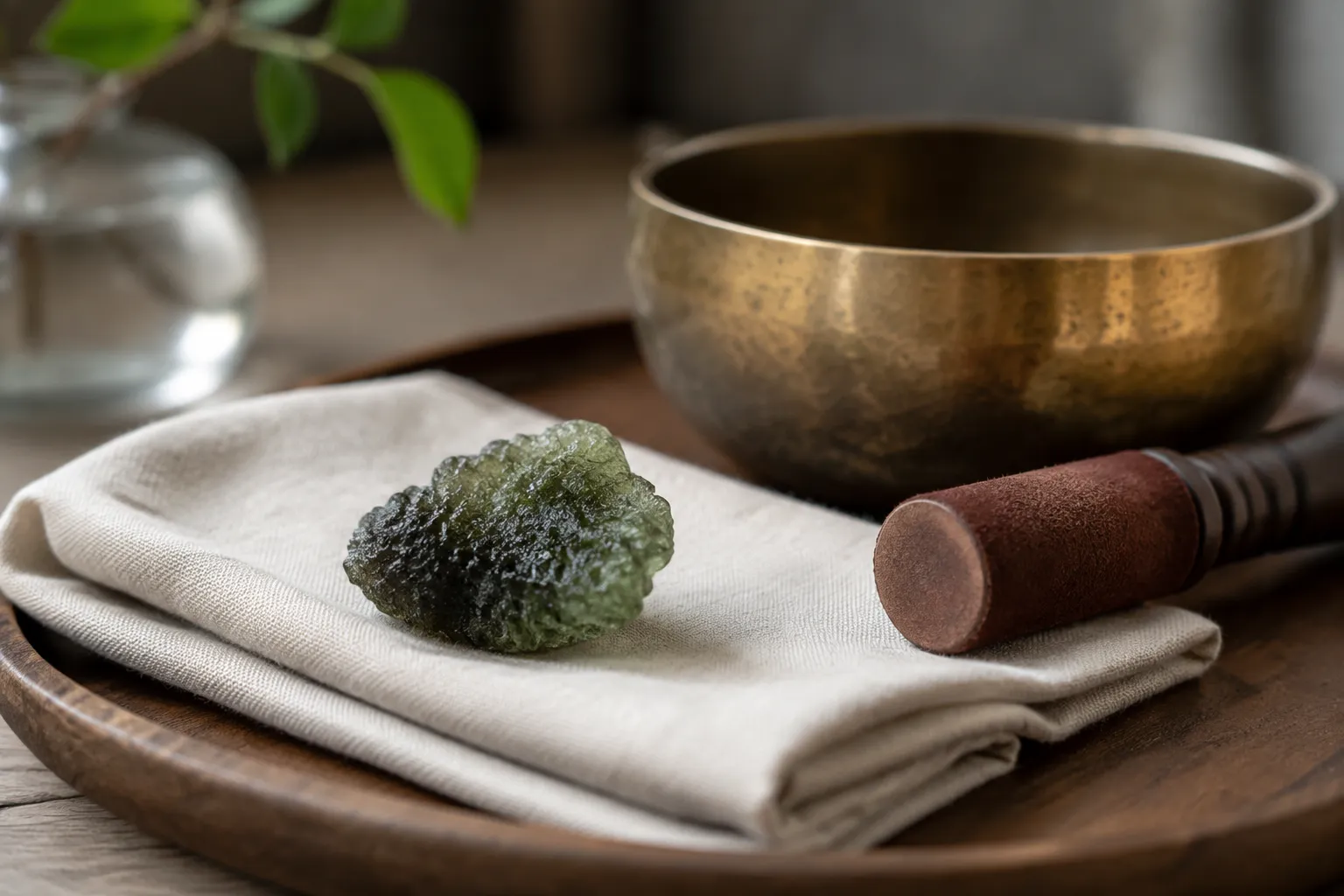
A moldavite specimen can be given a quiet ritual reset without water, salt, smoke, sunlight, rubbing, or extra handling. A sound bath frequency reset is best understood as a no-touch, intention-based practice: place the moldavite on a soft cloth or stable tray, use gentle sound from singing bowls, tuning forks, chimes, voice, or a low-volume recording, then let silence close the session.
That is the useful answer. The limit is just as important: reliable sources can support moldavite as a real gem material and describe sound baths as immersive sound practices. They do not show that sound objectively clears, charges, repairs, or materially changes moldavite.
broader context
Moldavite context note
This narrower page makes more sense after the broader moldavite archive page.
The no-touch sound bath reset
Moldavite is an impact glass and a collectible tektite; it is also used by many people as a spiritually symbolic stone. Keep those layers separate. The specimen is a physical object. The “reset” belongs to personal practice.
For a simple sound bath reset for moldavite:
- Place the stone first. Set the moldavite on a soft cloth, felt pad, shallow tray, or display cushion. If you use a singing bowl, keep the stone nearby rather than inside the bowl.
- Choose one sound source. Singing bowls, tuning forks, chimes, voice, or a moderate speaker recording can all fit the ritual. The tool matters less than keeping the session steady and calm.
- Use plain intention. A simple line is enough: “I am letting this piece return to neutral in my practice.” That frames the reset as symbolic crystal clearing, not a measurable alteration.
- Play gently. Let the sound move through the space. With tuning forks near moldavite, activate the fork and hold it nearby; do not tap it against the stone.
- Close with silence. After one to three short rounds, stop. Some practitioners may describe the stone as feeling lighter, calmer, or ready to store, but that is a felt sense within the ritual.
A non-invasive clearing ritual does not become stronger because it is louder, longer, closer, or more complicated.
Why sound appeals to cautious moldavite owners
No touch moldavite clearing is useful when the owner wants to leave the specimen physically undisturbed. Sound does not require soaking, burying, salting, smoking, sunning, or repeated handling.
That restraint fits many moldavite pieces. Some are small and textured. Some are set in jewelry. Others are kept for provenance, display, or collector interest. A sound bath reset works around the stone rather than on it.
For a spiritual reading, the session may feel like a cleanse or charge. For a gemological reading, the tektite has simply rested on a stable surface while sound occurred nearby. Both descriptions can coexist if they are not treated as the same kind of claim.
Singing bowls, tuning forks, and safe placement
A singing bowl for moldavite should be a nearby sound source, not a container. Placing the stone inside a vibrating bowl is unnecessary and can add avoidable movement. A better setup is simple: bowl on its cushion, moldavite on a separate cloth or tray.
If you use tuning forks, keep them in the surrounding space. Do not strike the fork against the specimen. Do not hold it close to the ear. The point is a soft acoustic frame, not contact.
| Setup choice | Better use for a no-touch reset | What to avoid |
|---|---|---|
| Singing bowl | Bowl on cushion; moldavite nearby on cloth | Putting the stone inside a vibrating bowl |
| Tuning fork | Activated nearby without touching the specimen | Striking the fork against the stone |
| Chimes or gong | Soft, brief tones in the room | Loud, sharp, or startling sound |
| Recording | Moderate speaker volume in the space | High-volume headphones or speakers near ears |
If the arrangement makes you worry about the stone rolling, sliding, or being struck, simplify it.
What “frequency” can mean here
“Frequency” has two meanings in this topic. In ordinary sound, it refers to vibration rate and pitch. In crystal-practice language, “high frequency” often means a symbolic or energetic quality.
That difference is where overclaiming begins. Specific numbers such as 528 Hz or 432 Hz, chakra-note systems, clockwise motion, grids, and multi-tool ceremonies may be meaningful inside someone’s personal practice. The available evidence does not show that moldavite requires a specific note, number, direction, or sequence to be reset.
For this page, “frequency reset” should be read as ritual vocabulary. You are using sound, attention, and a pause to mark a transition: from newly received, heavily handled, emotionally loaded, or unsettled to quiet and ready for your next use.
That is enough without turning symbolism into proof.
Sound bath safety limits
Sound baths are commonly described as immersive sound experiences using instruments such as singing bowls, gongs, tuning forks, voice, and chimes. They are often associated with meditation or relaxation settings. Still, sound exposure is not equally comfortable for everyone.
Keep the volume easy to remain with. Avoid intense or prolonged sound, and do not place bowls, tuning forks, gongs, speakers, or headphones close to the ear. Stop if sound causes pain, ringing, dizziness, migraine symptoms, sensory overload, panic, or distress.
Use extra caution around children, pets, and people with tinnitus, migraines, sound sensitivity, seizure disorders, or sound-triggered distress. If anyone in the space seems uncomfortable, end the session or move it elsewhere.
Intensity is not evidence of a better reset. Loudness can create discomfort; it does not prove deeper clearing.
Common confusion around sound cleansing moldavite
The main confusion is thinking the sound must physically “do something” to the stone for the ritual to count. It does not. A sound bath frequency reset can be meaningful as personal spiritual practice even when no material change is claimed.
Another confusion comes from moldavite marketing. Because moldavite is often described as intense or transformational, some sellers and practitioners frame it as needing stronger or more elaborate clearing. That is interpretation and marketplace language, not proof that the stone needs special acoustic treatment.
A third confusion is mixing cleansing and charging. In many crystal communities, “cleansing” means releasing unwanted energy, while “charging” means refreshing a stone for use. These are belief-based categories. If you use both words, keep them modest: the session is a personal reset around the stone.
The cleanest wording is: “I use sound to mark a reset around my moldavite.”
When to skip this method
Skip the sound bath reset if the sound feels unpleasant, if people or animals nearby are distressed, or if the setup makes the specimen physically vulnerable. A no-touch method should not introduce movement, unstable placement, or sharp volume.
Also skip it if you are trying to authenticate the stone. Sound does not verify whether moldavite is genuine. Authenticity depends on specimen traits, provenance, and appropriate gemological judgment.
And avoid presenting the practice as producing health, emotional, neurological, detox, or body-level outcomes. Keep it in the realm of personal meaning, attention, and symbolic care.
Short version
Place the moldavite on a cloth. Put the singing bowl on its cushion or hold the tuning fork nearby. Set a simple intention. Play gentle sound for a short time. Let silence settle. Notice whether the specimen feels ready to return to your altar, pouch, display box, or jewelry rotation.
The evidence supports moldavite as a real material, sound baths as a recognizable sound-based practice, and cautious limits around sound exposure. It does not prove that sound objectively clears energy from moldavite. If you choose this method, use it as a quiet, non-invasive clearing ritual with spiritual restraint.