Low-contact crystal care
Selenite Charging Plates: The Ultimate Zero-Risk Cleansing Tool
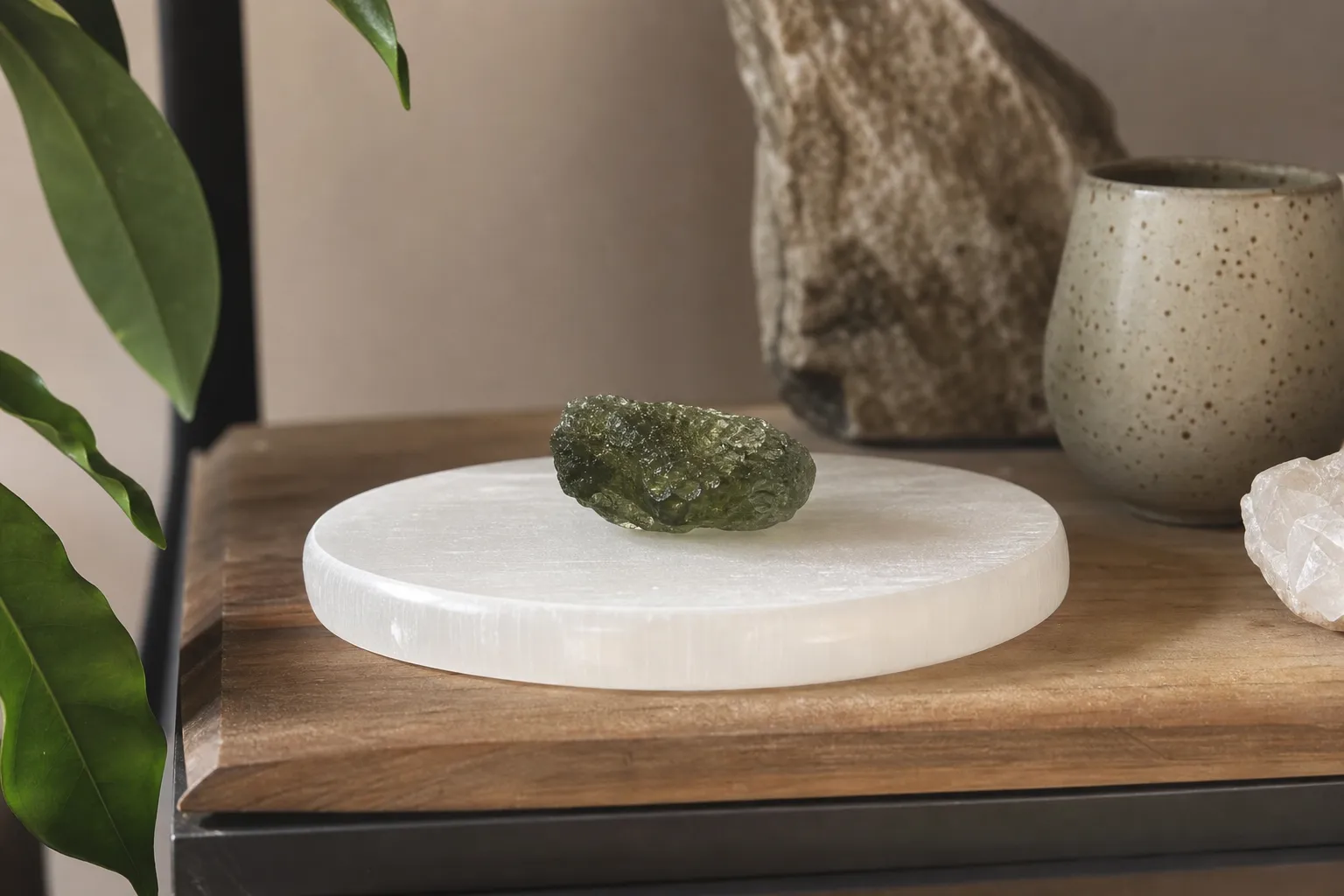
A selenite charging plate is best treated as a low-contact ritual surface, not as a verified energy device. If you use moldavite or other crystals and want a cleansing routine that avoids water, salt, smoke, heat, direct sunlight, and repeated handling, the plate gives you one simple place to rest the stone.
That is the practical value behind the “zero-risk” language. It does not mean risk disappears. A plate can chip, collect dust, scratch a delicate surface, or sit somewhere unstable. It means the routine can be lower-risk than methods that add moisture, residue, heat, abrasion, or extra movement.
broader context
Start with the main moldavite page
This narrower page makes more sense after the broader moldavite archive page.
What a Selenite Charging Plate Can Mean
In crystal-community language, a selenite charging plate is often described as a surface for clearing, charging, or resetting other stones. Those words belong to spiritual and personal practice. They can describe intention, ritual rhythm, and meaning, but they should not be presented as confirmed physical effects.
For this page, the useful question is narrower: can a selenite charging plate reduce unnecessary contact with moldavite or another valued crystal while still supporting a familiar ritual? Yes. Instead of rinsing the stone, burying it in salt, passing it through smoke, leaving it in sun, or moving it through several steps, you place it on a dedicated surface and leave it alone.
That matters because many problems begin with handling. Stones get dropped while being moved from bowl to cloth to windowsill. Edges rub against other objects. Oils, ash, salt, grit, or cleaning residue can become part of a routine that was meant to feel gentle. A plate simplifies the sequence: one clean location, one placement, one removal.
For moldavite, that simplicity is especially appealing. Moldavite is often valued for its natural surface texture, shape, and provenance. Whether you approach it as a tektite specimen, a spiritual object, or both, repeated unnecessary handling rarely adds anything useful. A plate lets the ritual happen around the piece instead of acting aggressively on it.
The Lower-Risk Routine
Keep the routine plain:
- Use a dry plate on a flat, stable surface.
- Place only one or a few stones so they do not crowd each other.
- Avoid stacking heavy pieces on delicate crystals.
- Keep the plate away from spills, smoke residue, heat, direct sun, and busy edges.
- Treat overnight charging as symbolic timing, not as a measurable guarantee.
- Pick the stone up once, deliberately, instead of checking it repeatedly.
That is enough. A selenite plate for moldavite does not need added salt, water, incense, candles, sunlight, or a complicated grid to answer this question. Those additions may belong in someone’s wider practice, but they also add more ways for a stone or plate to be knocked, marked, dampened, heated, or contaminated.
The useful shift is from “what can I do to the crystal?” to “how little can I do while still keeping the ritual?” In that practical handling sense, the plate works as a safer alternative for crystals than many action-heavy cleansing routines.
What Changes the Risk Level
A plate routine stays lower-contact only when the setup stays simple. The risk rises when the plate becomes part of a crowded altar, display tray, or multi-step cleansing station.
Placement
A plate near a sink, candle, humid bathroom, incense bowl, windowsill, or busy desk has a different risk profile from one on a dry shelf. Until a reliable care source supports a specific exposure, the conservative choice is to keep valued specimens away from moisture, grit, ash, heat, and accidental impact.
Surface condition
“Contactless clearing” is often used loosely, but the stone still touches the plate if you place it on top. What people usually mean is no water bath, no salt burial, no rubbing, no brushing, no smoke pass, and no repeated manual action. If the plate has rough edges, chips, dust, or decorative grooves, it is not a neutral resting surface.
The stone itself
A tumbled quartz point, a fragile cluster, a carved piece, and a natural moldavite specimen do not invite the same handling. Shape, surface texture, weight, and collector value all change the best choice. If a piece has delicate projections, soft matrix, glued settings, metal parts, or unknown treatment, placing it beside the plate may be better than placing it directly on top.
Expectation
If the goal is a quiet ritual marker, the plate fits well. If the goal is an externally verified crystal-cleansing effect, this article cannot provide that. The available source set for this page does not include public references confirming energetic outcomes, practitioner interviews, long-form firsthand routines, or independent testing.
Where People Misread “Cleansing” and “Charging”
The common mistake is treating community vocabulary as material fact. In crystal circles, “cleansing,” “charging,” and “clearing” can mean resetting intention, ending one use period, preparing an object for meditation, separating a new purchase from its prior context, or creating a pause before handling it again. Those meanings are cultural and personal.
They are not the same as cleaning a surface, removing residue, sterilizing an object, changing mineral structure, or confirming an energetic outcome. A selenite charging plate may be part of a ritual cleansing practice, but it should not be described as physically cleaning a stone unless actual cleaning steps and reliable material-care sources are being discussed.
Another confusion is assuming “selenite” automatically makes the routine safe. The plate format is the safer part of the practice, not permission to ignore ordinary care. A flat surface can still damage or be damaged if it is dirty, unstable, overloaded, wet, or used with stones that scrape against each other.
Commercial language can blur this line. Product pages often speak confidently about charging, cleansing, amplification, or energetic reset. That may reflect market convention or belief-based practice, but it should not be used as evidence. Without stronger non-commercial sources, those descriptions are best treated as examples of how people talk about the object.
The cleanest wording is this: a selenite charging plate can be used as a dedicated, low-contact ritual surface. It may support a personal belief-based cleansing or charging practice. Its strongest practical advantage is reducing exposure to methods that involve more handling, moisture, residue, heat, smoke, sunlight, abrasion, or movement.
What This Article Can and Cannot Verify
Can answer
This page can answer the handling question. If you want a gentle ritual for moldavite or another crystal, a plate-based routine is simpler and less intrusive than many common cleansing methods. That answer rests on ordinary handling logic, not on proof of energy transfer.
Cannot verify
This page cannot verify crystal cleansing effects. Because the supplied research material contains no citable public sources, no mineral-reference links, no practitioner interviews, and no long-form firsthand reports, any claim that the plate changes a stone’s energy or reliably changes a person’s experience must remain belief-based.
The same boundary applies to detailed selenite properties sourcing. Strong statements about mineral identity, softness, water sensitivity, solubility, fragility, or cleaning methods should be supported before publication by reputable mineralogy, geology, museum, university, or educational sources. Without those sources here, the practical advice stays conservative: keep the plate dry, clean, stable, and away from conditions that add avoidable risk.
That boundary is not a weakness. It is the point of a careful leaf page. The answer is yes, a selenite charging plate can be a lower-risk ritual surface, especially for overnight charging routines. The limit is that the spiritual meaning belongs to the practitioner, while material-care claims need better support than crystal-commerce language usually provides.
A Practical Boundary for Moldavite Owners
If you own moldavite, keep the practice quiet and minimal. Do not turn the plate into a testing ground for every cleansing idea you have seen online. Do not add water because another method mentioned water. Do not add salt because another stone routine used salt. Do not leave the piece in a hot window because “charging” sounds solar. Do not pass the plate through smoke and then press a textured specimen into the residue.
Use the plate as a boundary object: this is where the stone rests when you want a reset moment. That small habit can be enough. It keeps the ritual clear without pretending to confirm what the available material cannot confirm.
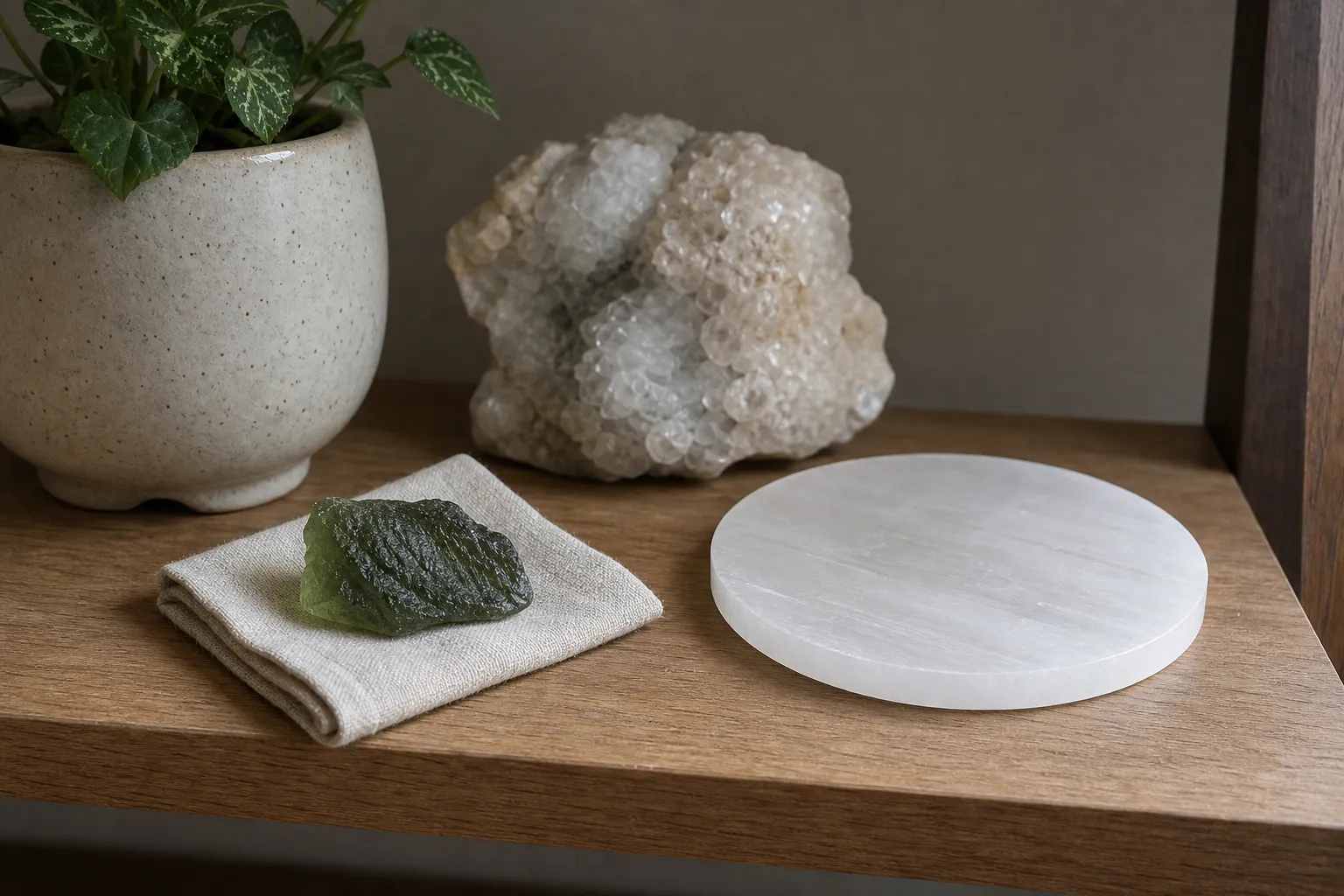
For a delicate, unusually shaped, or especially valued piece, you can place the stone beside the plate rather than on it. In ritual terms, many practitioners would still understand that as proximity-based clearing. In handling terms, it reduces contact even further.
The simple rule: if the routine adds contact, residue, heat, moisture, pressure, or confusion, it is moving away from the reason a plate was useful in the first place.
Quick Answers
Is a selenite charging plate truly zero-risk?
No. “Zero-risk” is shorthand for lower-risk compared with more invasive routines. A plate can still break, scratch, collect debris, or be used carelessly. Its advantage is that it helps you avoid many contact-heavy methods.
Can I leave moldavite on a selenite plate overnight?
Yes, if the setup is dry, stable, clean, and unlikely to be disturbed. Treat the overnight timing as a ritual preference, not as a verified measure of cleansing or charging.
Does a selenite plate confirm crystal cleansing effects?
No. The available source packet for this page does not verify crystal-cleansing effects. The plate can be described as a belief-based ritual tool and a practical low-contact surface, not as a confirmed energetic mechanism.