Broken pendant decision guide
What to Do With the Shards of a Broken Moldavite Pendant
If your pendant broke, gather the broken moldavite shards carefully first. Then choose one of four simple paths: keep them, repurpose them, return them to the earth as a personal gesture, or wrap and dispose of them safely.
You do not have to treat the break as an omen, a required ritual moment, or proof that the stone did something unseen. Still, a broken moldavite pendant can feel personal. It may have been a gift, a daily piece, a travel object, or something you associated with change. The best next step respects both sides: the fragments are small glassy pieces that may have sharp edges, and your attachment to the pendant may be real even if no outside source can prove a spiritual meaning.
broader context
Moldavite context note
This narrower page makes more sense after the broader moldavite archive page.
Start by Containing the Shards
Before deciding what the break means, deal with the fragments as small, fragile pieces.
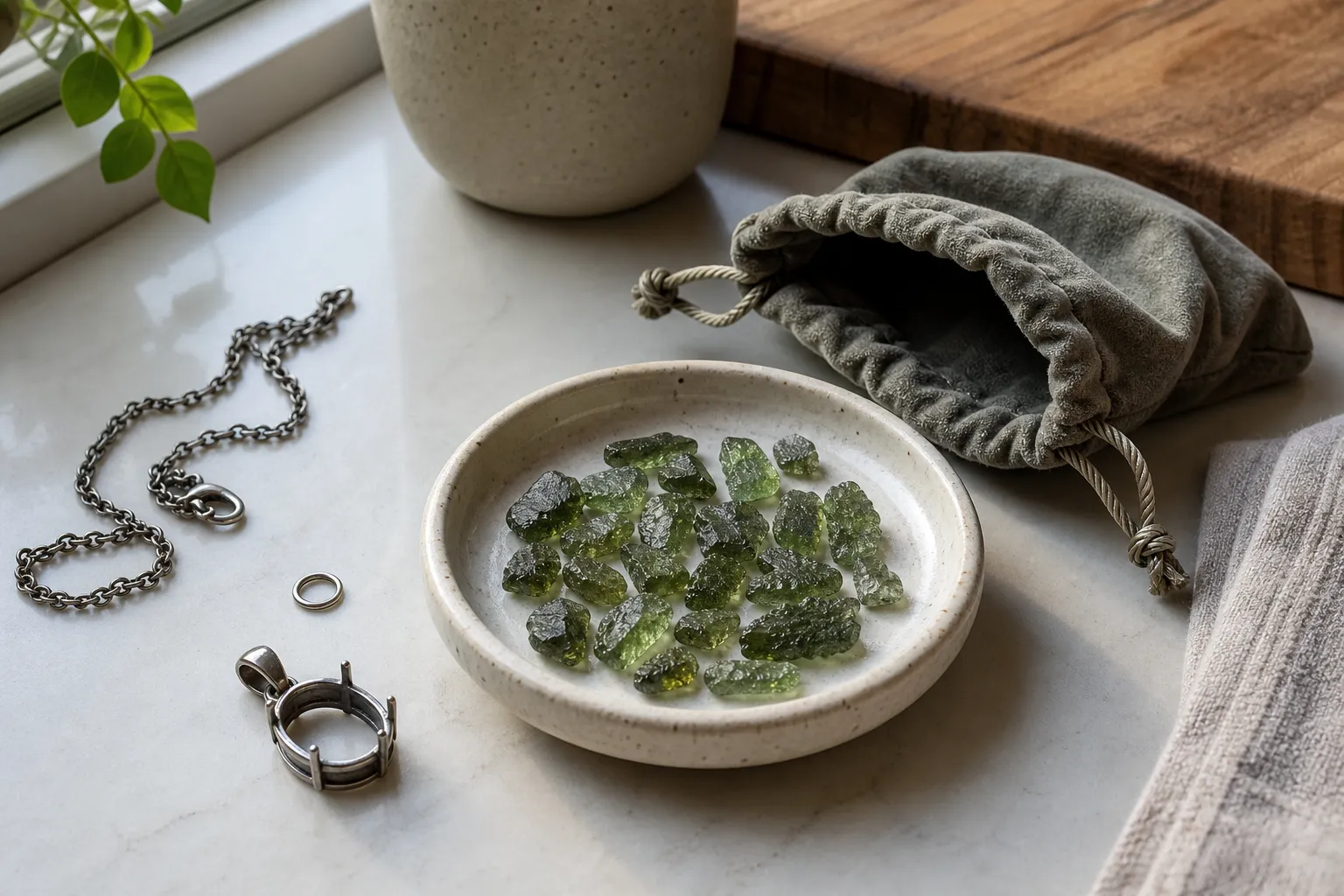
Place the shards on a clean surface where they will not be knocked off. If they are tiny, use a folded piece of paper, a soft cloth, or a shallow dish to keep them together. Avoid rubbing them between your fingers, carrying them loose in a pocket, or leaving them somewhere they can be brushed onto the floor.
Use a closed container around children or pets
A pouch, jar, lidded box, envelope, or jewelry bag is enough for temporary storage.
Separate stone from metalwork
Save the setting, chain, jump ring, or wire separately for a jeweler, reuse, or disposal.
The point is not to create a special protocol. It is simply to keep sharp or fragile fragments contained while you decide. Do not rush to glue, wrap, or force pieces back together just to recreate the pendant quickly. A rushed repair can make the object harder to handle later.
For now, you are only creating a pause: the shards are gathered, contained, and no longer scattered.
If You Want to Keep the Shards
Keeping shards in a pouch is the simplest choice if the pendant still feels connected to you. A soft pouch keeps the fragments together without putting them on display. This works well if you are not ready to discard or bury them but do not want to keep looking at them.
Pouch
Best when you want the fragments together, private, and out of daily view.
Dish
Best when the pendant can become a visible, non-wearable keepsake.
Jar or box
Best when you want protection, optional labeling, and a reversible decision.
Keeping shards in a dish works better if you want the pendant to become a small still-life object rather than jewelry. Choose a shallow dish, tray, or small bowl that will not be moved often. This turns the broken pendant into a non-wearable moldavite keepsake: visible, contained, and no longer expected to function as a pendant.
A jar or small box is the middle path. It protects the pieces, lets you label them if you want to remember the pendant, and keeps the decision reversible. If you later choose to reset the fragments, return them to earth, or let them go, you will not have to search for scattered pieces.
Repurposing moldavite shards can also be modest. You might place them in a display vial, add them to a memory box, keep them with the original chain, or include them in a private altar-like arrangement if that fits your personal practice. Repurposing does not need to imply a new function or promised effect. It can simply mean the piece is no longer wearable but still worth keeping.
If one shard is large enough and you want jewelry again, set it aside for a jeweler to inspect. Do not assume every fragment can be drilled, wrapped, glued, or reset. Thin edges and irregular breaks can make repair a separate practical question.
If Returning It to Earth Feels Right
Some readers look for returning moldavite to earth because keeping the fragments feels unfinished. That language can be meaningful, but it should stay symbolic. The available material for this page does not establish that burying moldavite shards is required, traditional, spiritually superior, or necessary for closure.
A small symbolic version
A symbolic burying ritual can be very simple: choose a quiet place, place the pieces in the soil, and mark the action with a private sentence such as, “This pendant was part of a chapter I am done carrying in this form.” That is personal meaning-making, not a claim that the stone will create a result for you.
If you choose burying, keep the act small and considerate. Do not bury shards where someone else may dig, garden, or walk barefoot. Avoid public land, shared planters, parks, protected areas, or any place where leaving objects would be inappropriate. A private planter or garden space you control is usually more sensible than making the act dramatic.
You can also return the pendant to earth without leaving fragments behind. For example, place the closed pouch or container on soil for a short moment, say goodbye to the wearable form, and then keep or dispose of the shards afterward. That preserves the symbolic gesture without leaving small glassy pieces outdoors.
Returning to earth is optional. If it helps you mark a transition, use it lightly. If it feels forced, a pouch, dish, box, or careful disposal is still a complete answer.
If You Want to Let It Go
Careful shard disposal is valid, especially if the pendant now feels like clutter, stress, or a reminder you do not want to keep revisiting.
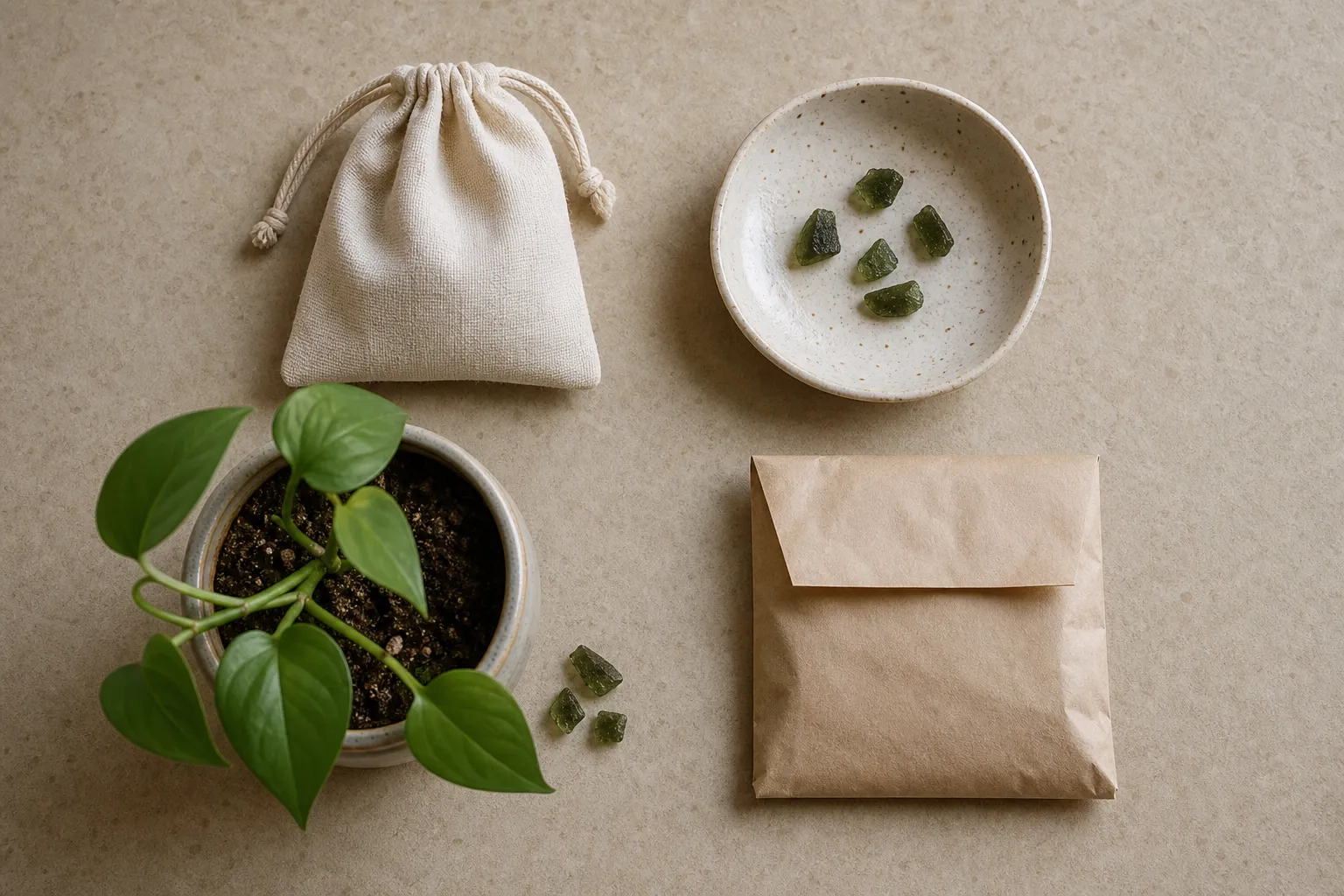
Wrap the fragments before putting them in the trash so they are not loose. A folded paper packet, taped envelope, small box, or wrapped cloth can keep the pieces from scattering. If the shards are very small, double-containment is sensible: paper first, then a bag or box.
You can separate the emotional goodbye from the physical disposal. Hold the wrapped shards for a moment, acknowledge that the pendant mattered, and then let it go. The wording can be ordinary: “I liked this piece. It broke. I am allowed to be done with it.”
Disposal can feel wrong if you have been told that moldavite must be handled through one specific ritual path. Based on the material available for this page, there is no basis for presenting one required method. Keeping, burying, repurposing, and disposing are all different ways to answer the same question. The right choice depends on your attachment, your home, and whether the fragments still have a place in your life.
Reframing a Broken Pendant Without Overreading It
A break can invite interpretation, especially when the object already carried personal or spiritual meaning. It is easy to turn the pendant into a message: a warning, a completed chapter, a sign to move on, or proof that something unseen happened.
A steadier approach is psychological reframing. Here, that simply means allowing the break to become a symbol if it helps you organize your feelings, without treating the symbol as an objective fact.
A grounded personal frame
“I choose to see the break as closure” leaves room for your own agency.
A claim that asks too much
“The stone broke because my transformation is complete” asks more from the event than the available material can support.
You might frame the break as closure: the pendant belonged to a chapter that is ending, and the shards give you a physical way to acknowledge that. Or you might frame the break as transition: the piece no longer works as jewelry, but it can become a keepsake, a dish object, or something you return to the earth. Both readings are personal meanings, not universal rules.
If the break brings up grief, guilt, anxiety, or regret, do not force an immediate answer. Put the shards in a pouch or box, wait a few days, and notice whether you feel drawn to keep, repurpose, bury, or discard them. A pause is often the cleanest choice when the object still feels charged.
What Changes the Best Choice?
The right option depends less on moldavite itself and more on your situation.
If the shards are sharp, tiny, or likely to be lost
Containment comes first. Use a pouch, jar, dish, envelope, or box instead of leaving them loose.
If the pendant has sentimental value
Keep the pieces for now. A reversible choice is useful when the break happened recently.
If the object feels emotionally complete
A symbolic burying ritual or careful disposal may be enough. You do not need to preserve every meaningful object forever.
If you want a wearable piece again
Save the larger fragments and the old setting separately. Treat repair or resetting as a jewelry question.
If ritual language feels meaningful
Keep it personal. Returning moldavite to earth can mark an ending, but it should not be framed as a requirement or guaranteed result.
If ritual language does not fit you
Skip it. A clean container and a calm decision are enough.
Common Confusion Around Broken Moldavite Shards
Confusing a break with proof
A broken pendant proves that a pendant broke. It does not, from the evidence available here, prove a curse, omen, energetic completion, or spiritual failure.
Assuming burying is always most respectful
It can be respectful if it fits your values and setting, but keeping the shards in a pouch or dish can be just as respectful. Respect comes from intention and careful handling, not from following one fixed script.
Thinking disposal means rejection
Letting the fragments go may simply mean the wearable object has reached the end of its place in your life. You can appreciate what it represented without keeping every piece of it.
Fearing the wrong choice
This page does not have evidence to support the claim that doing the “wrong” thing will create a consequence. A better question is: Which option is physically sensible, emotionally honest, and not based on fear?
A Simple Decision Path
If you are still unsure what to do with moldavite shards, use this short path:
- If the pieces are sharp or loose, place them in a pouch, jar, dish, envelope, or box first.
- If you feel attached, keep them temporarily and decide later.
- If you want the pendant remembered, turn the fragments into a non-wearable keepsake.
- If the break feels like an ending, choose a small symbolic gesture such as returning it to earth.
- If you feel done with the object, wrap the shards and dispose of them carefully.
- If fear is driving the decision, pause before choosing a ritual or interpretation.
The broken pendant does not have to become a crisis or a grand sign. It can be handled as a real object with small sharp fragments and also as a personal object that deserves a thoughtful ending. The best answer is usually quiet: contain the shards, choose whether they still belong with you, and let the meaning stay personal rather than forced.