Grounding pairings
Nervous System Regulation: The Best Grounding Stones to Pair with Moldavite
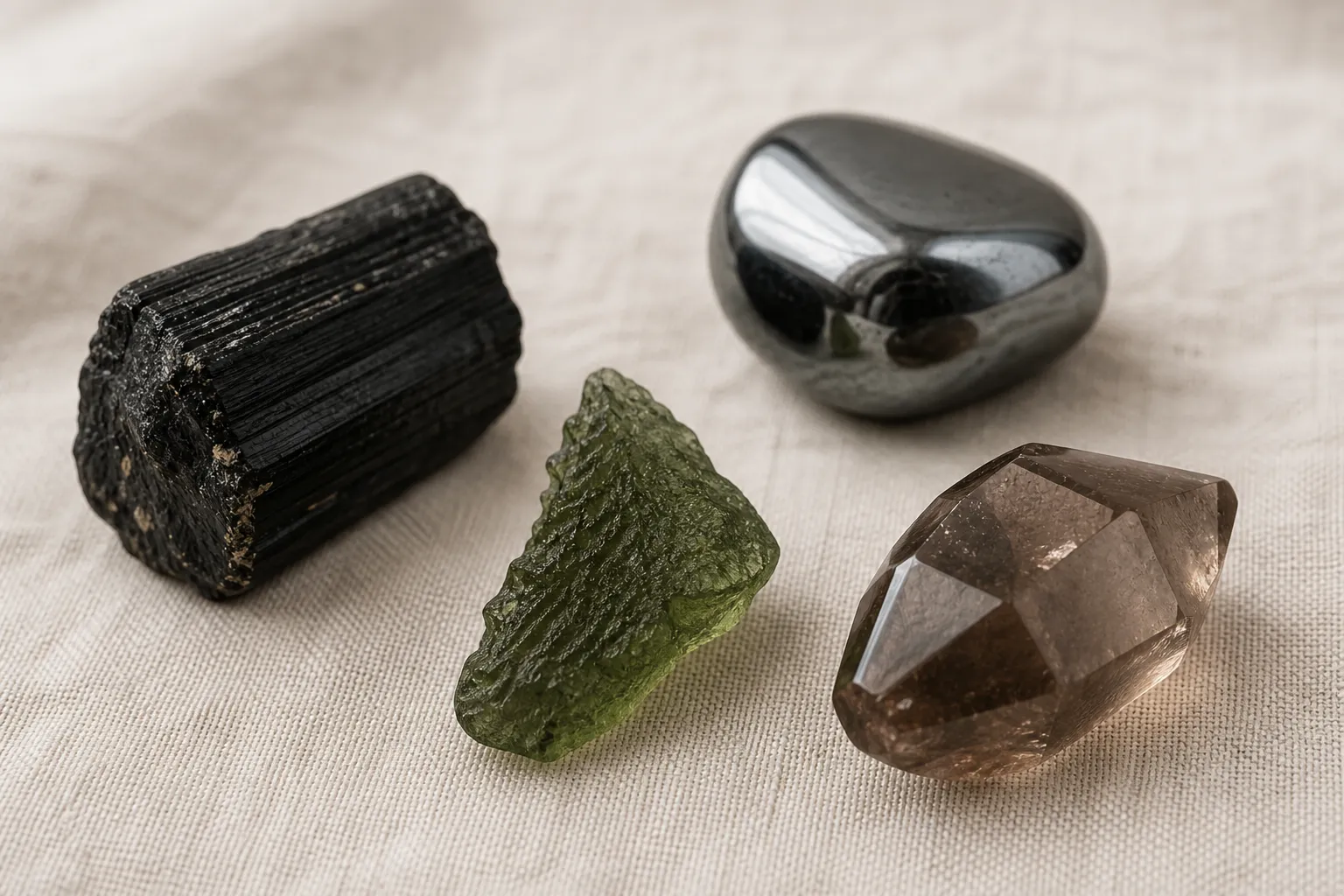
If Moldavite feels too fast, buzzy, expansive, or hard to settle after meditation, the most useful grounding stones to pair with it are usually black tourmaline and hematite. Smoky quartz can work as a softer closing stone when you want a gentler landing after the session.
The key is to keep the promise narrow. A nervous system regulation pairing is crystal-practice language, not a medical finding. There is no solid public evidence that Moldavite, black tourmaline, hematite, or smoky quartz directly changes the nervous system or stimulates the vagus nerve. What can be useful is the practice built around the stones: shorter sessions, slower breathing, tactile focus, body awareness, and a clear stopping point.
broader context
Moldavite context note
This narrower page makes more sense after the broader moldavite archive page.
The most useful Moldavite grounding pairings
For a calmer Moldavite ritual, keep the pairing simple: one Moldavite piece, one grounding stone, a short time limit, and a clear exit. Adding more stones often makes the practice feel more symbolic, but not necessarily steadier.
Pairing
Best use in a Moldavite ritual
Better way to frame it
Moldavite + black tourmaline
When Moldavite feels overstimulating, scattered, or “too open”
A symbolic and tactile anchor
Moldavite + hematite
When you want a heavier, more body-focused cue
A physical object for attention and pacing
Moldavite + smoky quartz
After meditation, journaling, or emotionally charged reflection
A softer closing stone in crystal practice
Moldavite and black tourmaline
Black tourmaline is the clearest first choice for many people searching for grounding stones for Moldavite. In mineral terms, much of what is sold as black tourmaline is associated with schorl, a tourmaline-group mineral. In crystal culture, it is often described with protective, stabilizing, earthy language.
For this page’s question, the useful part is not that black tourmaline “does” something to the body. It is that the stone changes the center of the ritual. Moldavite is often described by users as fast, intense, or opening. Black tourmaline is described as dense, boundary-like, and grounding. Holding both can help the session feel less like endless expansion and more like: come back to the room.
A simple Moldavite black tourmaline pairing
- Hold Moldavite briefly instead of leaving the session open-ended.
- Hold black tourmaline in the other hand or place it close by.
- Bring attention to breath, feet, chair, hands, and the physical room.
- End before the “buzzy” feeling becomes the whole experience.
That makes black tourmaline a ritual anchor, not a clinical technique.
Moldavite and hematite
Hematite is the better choice when you want something more physical and weighty. Mineral references identify hematite as an iron oxide mineral; its metallic look and heavier hand-feel help explain why crystal users often place it in the grounding category.
A Moldavite hematite pairing works especially well when the issue is loss of body awareness. Some users describe intense Moldavite experiences as floaty, too open, ungrounded, or hard to bring back into ordinary tasks. Hematite can give the ritual a practical counterweight because it is easy to notice in the hand.
Make the practice more concrete
- Sit rather than lie down.
- Keep both feet on the floor.
- Use hematite to mark the end of the session.
- After putting Moldavite down, hold hematite alone for a minute.
- Notice ordinary sensations: temperature, pressure, contact, breath, and posture.
That keeps hematite in a useful role: a tactile cue for calming and body awareness.
Moldavite and smoky quartz
Smoky quartz belongs in this answer, but it should not overtake black tourmaline or hematite. In Moldavite pairing culture, smoky quartz is often used as an anchoring or integration stone, especially after meditation. It may suit readers who find black tourmaline too stark or hematite too heavy.
The safest role for smoky quartz is post-session decompression. Instead of using it to intensify the Moldavite session, use it as a closing object:
- Put Moldavite down.
- Hold smoky quartz.
- Breathe normally.
- Look around the room.
- Write one or two grounded observations instead of chasing a bigger interpretation.
This keeps the practice centered on steadiness rather than escalation.
What changes the best answer?
The best grounding stone depends less on the stone’s reputation and more on what is happening during the Moldavite session.
Mentally fast or scattered
Black tourmaline is the cleaner symbolic match. It is the pairing most readers expect when they search for Moldavite grounding stones, and its crystal-culture meaning is strongly tied to boundaries and protection.
Floaty or hard to return
Hematite may be more useful because it feels physically definite. Its weight and texture make it a better object for returning attention to the hand, the chair, the floor, and the present room.
Manageable, but lingering
Smoky quartz may be the better closing companion. Use it after Moldavite rather than alongside it if your goal is to come down gently.
Timing matters too
- Before Moldavite: the grounding stone sets a slower intention.
- During Moldavite: the grounding stone gives the hands a contrast.
- After Moldavite: the grounding stone creates a clean ending.
For readers who tend to overdo Moldavite work, the “after” position may be the most practical. It stops the ritual from becoming endless.
Session length matters even more. If ten minutes with Moldavite leaves you overstimulated, the answer may not be a stronger stone pairing. It may be a three-minute session, skipping Moldavite that day, or shifting to ordinary grounding: walking, eating, washing dishes, stretching, or talking to someone safe.
Where “vagus nerve” language gets misunderstood
The vagus nerve is real, and health sources often discuss it in relation to stress physiology, breathing, rest-and-digest functions, and body regulation. That does not mean a crystal pairing stimulates the vagus nerve.
This is the main confusion around “nervous system regulation” in crystal content. A routine may include reasonable calming elements—slow breathing, body awareness, gentle attention, a quieter environment—and then slide into saying the stone caused the effect. The evidence does not support that leap.
A more accurate way to think about a Moldavite relaxation practice
- The stone can be a ritual object.
- The hand sensation can give attention somewhere to land.
- The pairing can remind you to slow down.
- The breathing, pacing, posture, and stopping point are the more credible calming elements.
- If the language becomes a health-outcome claim, it needs stronger support than crystal culture provides.
This distinction lets you keep the ritual if it is meaningful to you, without turning it into a health promise.
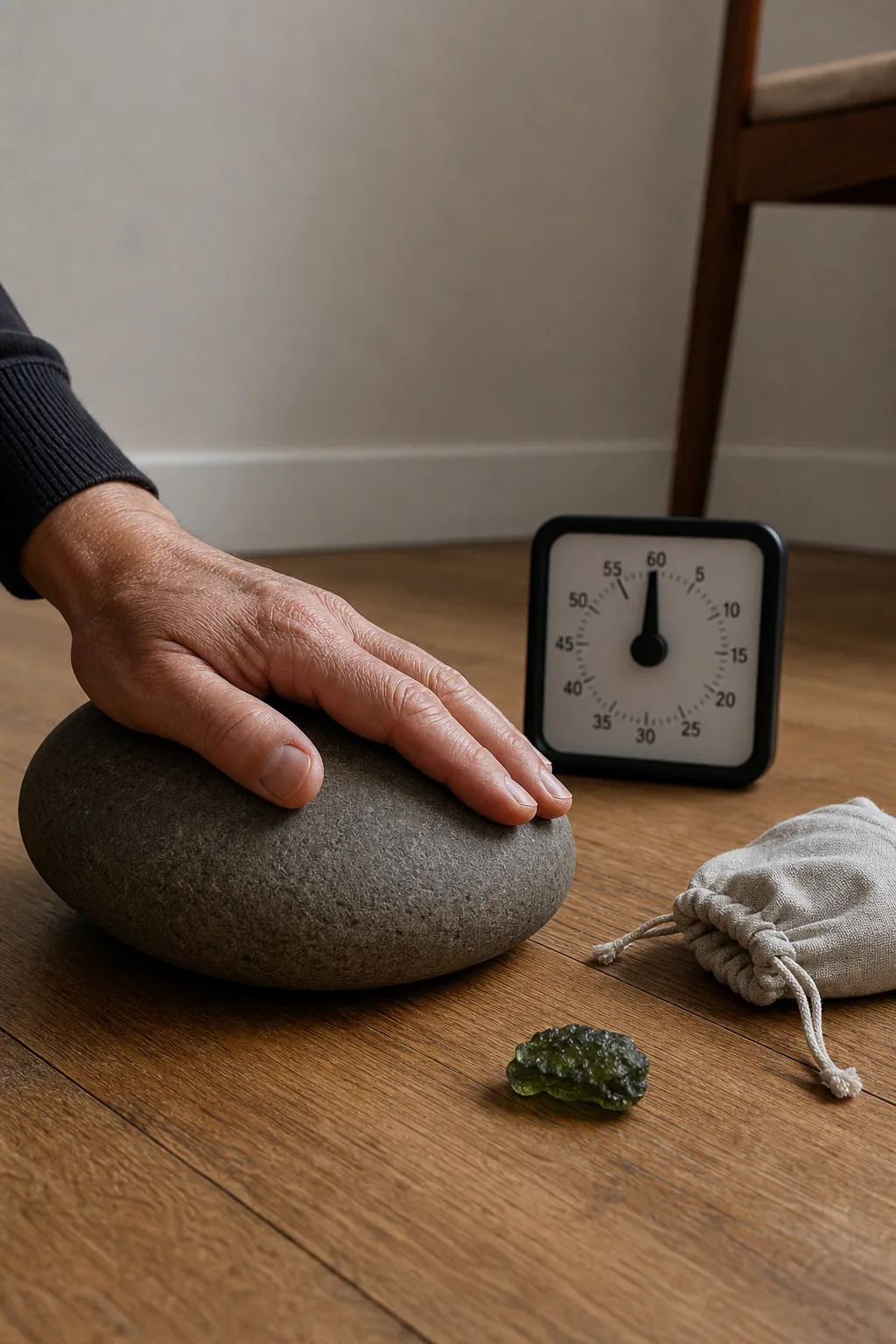
A calmer Moldavite ritual
A good grounding ritual is usually plain. It does not need a grid, a complicated placement system, or a long list of metaphysical results. For this specific question, a stripped-down version is better.
Try this
- Choose one grounding stone. Pick black tourmaline for boundaries, hematite for body focus, or smoky quartz for closing.
- Set a short limit. Two to five minutes is enough if Moldavite tends to feel intense.
- Use the grounding stone as the main physical cue. Notice temperature, edges, texture, and weight.
- Keep breathing ordinary and unforced. Do not turn the session into a performance.
- Orient to the room. Name what you see, hear, and physically feel.
- End deliberately. Put Moldavite away first, then hold the grounding stone alone for a brief closing.
- Do something normal afterward. Drink water, step outside, eat, stretch, or write one grounded sentence.
A grounded sentence is not “This stone changed my nervous system.” It is more like: “I am sitting at my desk, my feet are on the floor, and I am done for today.”
If Moldavite repeatedly leaves you feeling panicky, unable to sleep, disconnected, or distressed, do not keep intensifying the crystal practice to fix the experience. Pause the Moldavite work and use ordinary support. If the distress is persistent or disruptive, seek appropriate medical or mental-health care.
The evidence boundary for Moldavite grounding stones
Moldavite has a real geological identity: it is a natural glass associated with a meteorite-impact context in central Europe. Black tourmaline, hematite, and smoky quartz also have mineral identities that can be described through mineral references. Those facts matter for authenticity and collector literacy.
But geological identity is not the same as a physiological effect.
The available source picture supports these careful claims
- Moldavite and the grounding stones are real materials with describable mineral or geological identities.
- Crystal culture commonly frames black tourmaline, hematite, and smoky quartz as grounding companions.
- Readers often use words like intense, buzzy, overwhelming, anchoring, stabilizing, and integrating when describing Moldavite pairings.
- Relaxation practices can include breath, attention, body awareness, and deliberate slowing.
- The available evidence does not show that Moldavite pairings directly affect the nervous system or the vagus nerve.
So the best answer is narrow: pair Moldavite with black tourmaline if you want the strongest cultural grounding symbol, with hematite if you want a more physical body-awareness cue, and with smoky quartz if you want a gentler post-meditation landing. Let the stone support the ritual. Let the “regulation” language stay with the actual calming behaviors: breathing, pacing, orienting, shortening the session, and knowing when to stop.
Quick FAQ
Is black tourmaline or hematite better with Moldavite?
Choose black tourmaline if Moldavite feels mentally fast, scattered, or too expansive. Choose hematite if you want a stronger body-awareness cue and something more physically weighty in the hand.
Can Moldavite and grounding stones regulate the nervous system?
They are better understood as ritual objects and tactile reminders. The more credible calming parts are the breathing, pacing, posture, session length, and body awareness around the stones.
Should I use smoky quartz with Moldavite?
Smoky quartz is best as a closing stone after Moldavite meditation, especially if you want a softer landing. It is not the strongest first answer for grounding, but it can be a useful post-session companion.