Crystal pairing guide
The Lithium Anchor: Why Lepidolite is the Essential Pairing for 2026
If you are asking why Moldavite and Lepidolite are so often discussed together, the direct answer is simple: Lepidolite gives Moldavite’s intense reputation a softer counterweight.
In crystal culture, Moldavite is often described as fast, disruptive, buzzing, or overwhelming, especially by beginners. Lepidolite is described very differently: quieter, steadier, and associated with pause or emotional settling. Its mineral identity matters here too, because Lepidolite is a lithium-bearing mica. That gives the phrase “lithium anchor” a factual root, but only as a metaphor.
Lepidolite does not deliver lithium to the body, change anxiety in a clinical sense, or function as a nervous-system intervention. In this pairing, Moldavite represents movement; Lepidolite represents the cue to slow the story down.
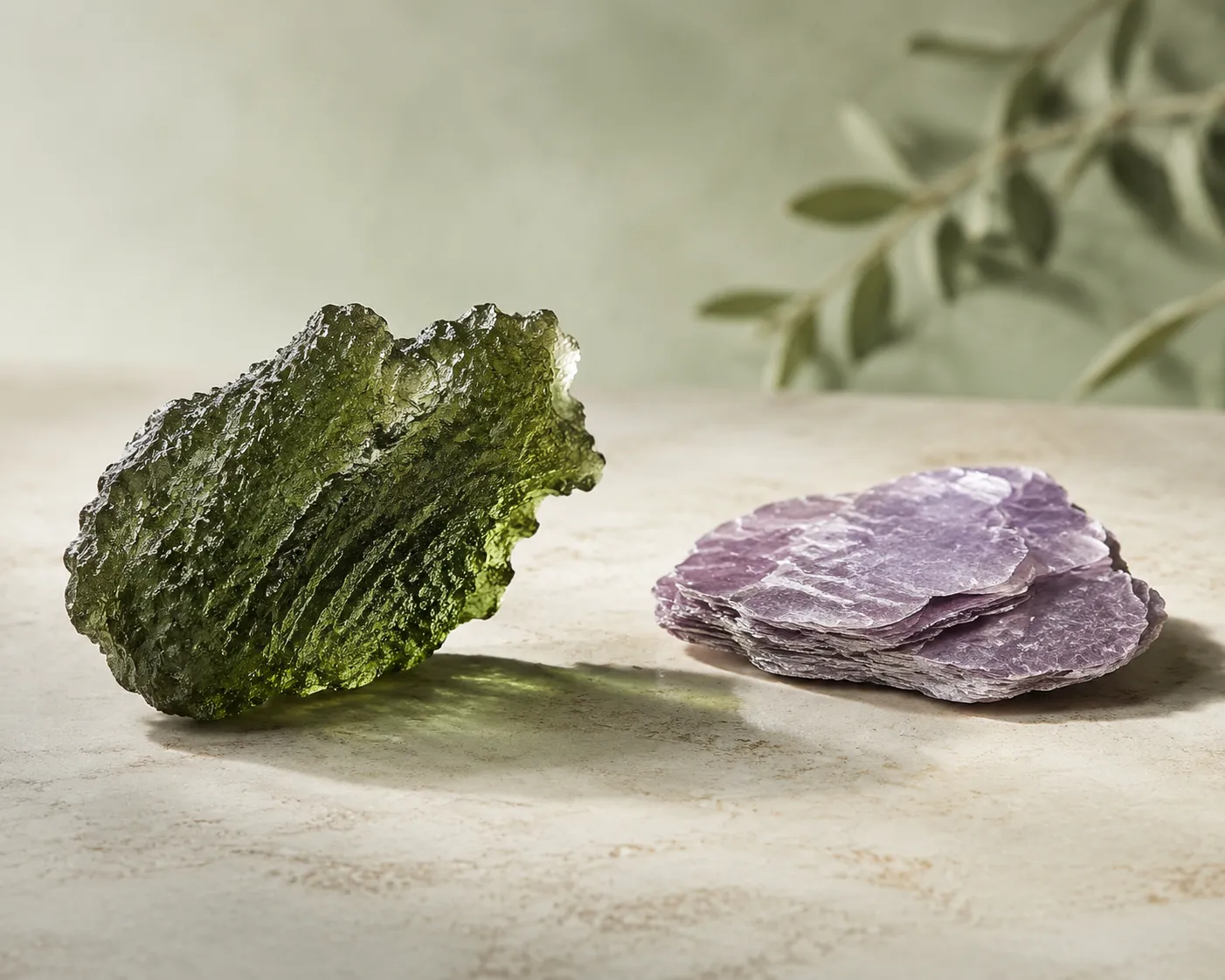
Why Lepidolite Makes Sense Beside Moldavite
Moldavite already carries a dramatic identity. Geologically, it is a tektite: a natural glass associated with impact processes. In the crystal world, that origin story has become symbolic language. Moldavite is commonly framed as a catalyst, an accelerant, or a stone that brings change to the surface quickly.
That is exactly why many readers look for a companion stone. They are not always trying to make Moldavite “stronger.” Often, they want the experience to feel more workable, less scattered, or less emotionally loud.
Lepidolite fits that role because its symbolism is not based on amplification. It is quieter. Mineralogical descriptions place Lepidolite among lithium-bearing mica minerals, often discussed in relation to pegmatites and lithium resources. That lithium association is the narrow basis for calling it a “lithium anchor” in a crystal-symbolic context.
The important boundary is that mineral lithium is not the same thing as prescribed lithium, and holding Lepidolite is not a way of using lithium medically. The anchor language is metaphorical: Lepidolite’s mineral identity gives crystal users a grounded symbol for slowing down, softening intensity, and giving the Moldavite narrative a gentler landing.
A clean way to understand the pair
- Moldavite symbolizes disruption, speed, awakening, or sudden change.
- Lepidolite symbolizes pause, integration, and emotional pacing.
- Together, they create a crystal pairing for readers who want transformation language without turning every session into escalation.
That is why Lepidolite can be more useful than simply reaching for a stronger or more dramatic companion stone.
The “Lithium Anchor” Is Symbolic, Not Medical
The phrase “lithium anchor” is useful only if it stays in the right lane.
Lepidolite’s connection to lithium is real as mineralogy. Related lithium mica names, including polylithionite and trilithionite, also appear in mineral discussions, which is why readers sometimes run into the term “lithionite” when exploring Lepidolite chemistry.
But that mineral fact should not be stretched into a health-outcome claim. A crystal containing lithium in its structure does not mean the body absorbs lithium by holding it, wearing it, meditating with it, or placing it near a bed. It also does not make Lepidolite equivalent to any clinical use of lithium.
In this article, “lithium anchor” means
- a mineralogically informed metaphor, because Lepidolite is lithium-associated;
- a symbolic counterweight, because it is culturally linked with calm and softness;
- a ritual cue, because holding it can remind someone to slow down and observe their state;
- not a clinical tool, prescription substitute, or reliable emotional mechanism.
This distinction matters because search phrases like “Moldavite anxiety relief” or “nervous system regulation crystals” can blur ritual language with health language. A safer way to describe the pairing is to say that Lepidolite may serve as a self-soothing reminder or reflective object for people who already use crystals symbolically.
That is different from saying it changes anxiety, regulates physiology, or produces a guaranteed emotional result.
When Lepidolite Is the Right Moldavite Pairing
Lepidolite is not automatically the right companion for every Moldavite user. It becomes the most coherent choice when the goal is to soften the Moldavite-overwhelm narrative rather than intensify it.
If the goal is amplification
Lepidolite may not be the obvious first choice. Clear Quartz is often framed in crystal culture as an amplifier. For someone who already experiences Moldavite as too fast or too stimulating, amplification may be the wrong direction.
If the goal is grounding or protection symbolism
Stones such as Smokey Quartz or Black Tourmaline are more common contrasts. They are usually described as earthy, stabilizing, or protective. Lepidolite is different. It is less about “blocking” or “shielding” and more about softening the pace.
If the goal is heart-centered gentleness
Rose Quartz may be the more familiar symbolic pairing. Lepidolite overlaps with softness, but its identity is less romantic and more connected with transition, composure, and mental quiet in contemporary crystal language.
If the goal is mystical expansion
Readers may compare Moldavite with Labradorite, Lapis Lazuli, or other stones linked with intuition-style language. Those pairings belong to a different lane. Lepidolite is not about opening more doors. It is about not being swept through every door at once.
So the Moldavite and Lepidolite pairing is not “the strongest” pairing. It is the pairing for people who suspect that stronger is not what they need.
How to Work With Moldavite and Lepidolite Without Overbuilding It
A practical approach should stay simple. The more elaborate the ritual becomes, the easier it is to imply certainty where there is none.
For most readers, the cleanest way to use Moldavite and Lepidolite together is as a short, intentional check-in:
-
Keep the session brief.
Five to ten minutes is enough for a symbolic pairing. There is no need to force a long session, sleep with the stones, or build a demanding routine.
-
Give each stone a role.
Moldavite can represent the change, question, or transformation being noticed. Lepidolite can represent the pause before reacting to it.
-
Use touch as a cue, not a mechanism.
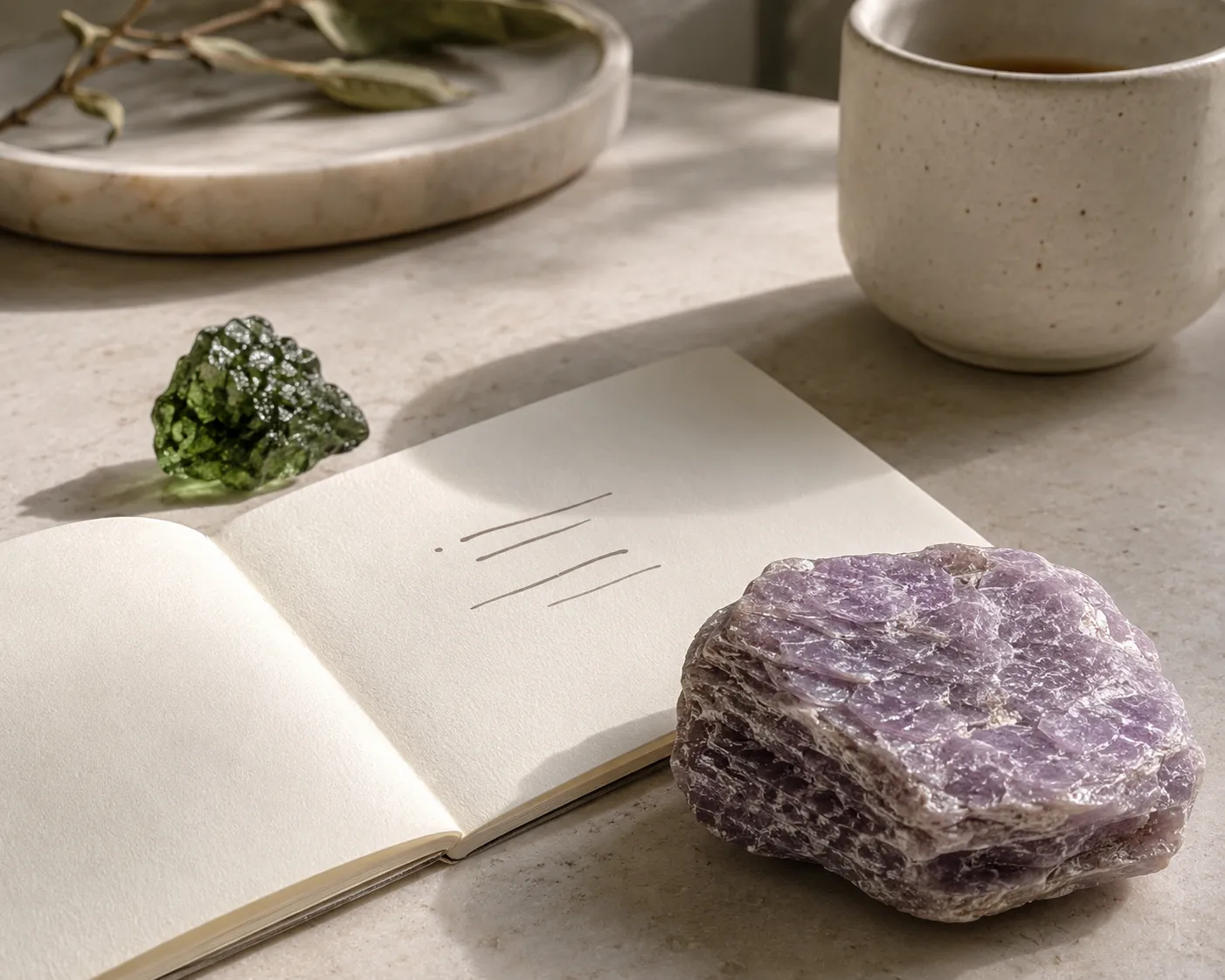
Holding Lepidolite while Moldavite is nearby can be treated as a tactile reminder to breathe slowly, soften the shoulders, or notice what is happening internally. The stone is not doing clinical work; the practice is giving attention a physical focus.
-
Journal the contrast.
A useful prompt is: “What feels like movement, and what feels like anchoring?” This keeps the pair grounded in reflection rather than prediction.
-
Stop if it feels wrong for you.
Crystal work does not need to be endured. If a session feels unpleasant, overstimulating, or emotionally messy, shortening or skipping it is reasonable.
This is especially relevant for beginners who search for a calming Moldavite pairing after reading intense Moldavite experiences online. The goal is not to prove those stories or reproduce them. The goal is to create a calmer frame around a stone that already carries a dramatic reputation.
Common Confusion Around Moldavite, Lepidolite, and Anxiety Language
The biggest confusion is the idea that because Lepidolite is associated with lithium, it must function like lithium in a medical context. That is not the right comparison. Lepidolite’s lithium belongs to mineral structure and geology, not to an at-home health intervention.
A second confusion is the belief that Moldavite objectively causes overwhelm. A more careful statement is that Moldavite is widely described that way in crystal communities. The overwhelm narrative is culturally important, but it is not the same as a verified physical property.
A third confusion is treating “nervous system regulation” as interchangeable with feeling calmer during a ritual. They are not the same. A reader may use a stone as a reminder to slow down, breathe, or reflect. That can be meaningful as a personal practice, but it should not be presented as evidence that the crystal is regulating the nervous system.
There is also a pairing misconception: some readers assume every Moldavite combination should push the energy higher. That is why Clear Quartz appears so often in pairing discussions. But the Moldavite and Lepidolite pairing answers a different need. It is not about more intensity. It is about containment.
If anxiety, panic, destabilizing mood changes, or distress are persistent, severe, or interfering with daily life, consider qualified mental-health support. A symbolic practice can sit beside ordinary self-care, but it should not carry the weight of a health decision.
Quick Checklist: Is Lepidolite the Right Pairing?
Lepidolite is probably the right Moldavite companion if:
- you are drawn to Moldavite but do not want to intensify the experience;
- you want a calming Moldavite pairing rather than an amplifier;
- you like the symbolism of lithium-bearing mica and understand it metaphorically;
- you prefer short Moldavite sessions with reflection instead of elaborate rituals;
- you want a crystal pairing that emphasizes integration, pause, and emotional pacing;
- you use “anxiety relief” loosely to mean self-soothing, not a clinical result.
Lepidolite may be less relevant if your goal is manifestation, psychic-style expansion, cleansing rituals, or a dramatic energetic contrast. In those cases, other stones may match the symbolic language more closely, though they carry the same evidence limits.
The clearest reason to pair Moldavite and Lepidolite is not that Lepidolite “controls” Moldavite. It is that Lepidolite changes the tone of the practice. Moldavite brings the mythology of impact, speed, and transformation. Lepidolite brings the lithium-associated symbol of slowing, softening, and returning to center.
That is the value of the lithium anchor: not a promise, not a medical mechanism, and not a guarantee of calm, but a more disciplined way to work with one of the most overstated pairings in modern crystal culture.