Rare tektite storage
Smart Storage Solutions: UV and Humidity Control for Rare Tektites
For rare moldavite and other tektites, smart eco-friendly storage is less about buying a high-tech case and more about reducing avoidable risk. The practical answer: keep specimens in stable indoor conditions, limit direct sunlight and UV-heavy display, separate pieces so glass surfaces do not rub, cushion them with clean inert materials, and use humidity monitoring as an early-warning tool rather than a moldavite-specific target.
Moldavite is a natural glass. That makes ordinary collector risks—abrasion, chipping, dust, repeated handling, unstable display materials, and environmental swings—more relevant than any unsupported promise of perfect “climate control.” A home setup can be thoughtful and low-waste, but it should not be described as museum-grade preservation.
broader context
Broader moldavite archive
This narrower page makes more sense after the broader moldavite archive page.
What “smart” storage means for moldavite
The smartest storage choice is usually the one that removes common risks with the least fuss, waste, and handling.
Moldavite is identified mineralogically as a tektite: a natural glass formed through impact-related processes. That matters because storage advice should start with the object’s material reality, not with general gemstone habits or crystal-market packaging claims. A faceted quartz, a metal meteorite, and a naturally sculpted moldavite specimen do not all need the same handling logic.
Core priorities for home collectors
- Stable placement: keep specimens away from windowsills, heaters, vents, damp corners, kitchens, bathrooms, garages, and hot attics.
- Light reduction: display selectively, avoid direct sun, and store pieces closed when they do not need to be viewed.
- Physical separation: do not let tektites knock against each other, harder minerals, jewelry findings, or loose tray walls.
- Low-risk contact materials: choose clean, stable, non-abrasive materials that are not sticky, strongly scented, dyed, crumbling, or visibly degrading.
“Eco-friendly” should not mean using any recycled or natural-looking material without checking whether it is suitable. Fragrant wood boxes, unknown foams, rough paper, and dyed fabrics can create problems. A durable box used for years, lined with appropriate reusable cushioning, is often a better choice than repeated disposable packaging upgrades.
UV control: reduce exposure without inventing thresholds
No reliable source establishes a precise UV exposure limit for moldavite. That boundary matters. Still, conservation-informed storage commonly treats light as something to manage because exposure is cumulative for many collection materials, and UV can be an avoidable stressor in display environments.
Practical UV-limiting choices
- Avoid direct sunlight.
- Keep display cases away from bright windows and heat sources.
- Turn display lights off when the case is not being viewed.
- Store most specimens in drawers, boxes, or cabinets.
- Rotate display thoughtfully rather than leaving every valuable piece exposed all year.
This is not a claim that moldavite fails at a specific exposure level. It is a cautious habit for natural glass collectibles and geological specimens. It also helps protect labels, mounts, adhesives, and packaging components, which may be more light-sensitive than the tektite itself.
Collectors sometimes ask whether UV-filtering acrylic, coated glass, or special display cases are necessary. The evidence does not support a universal requirement. A UV-filtering barrier may be useful for a display-heavy collection, but it does not make harsh placement safe. A simple closed drawer or specimen cabinet may protect a piece better than a clear case sitting in a sunlit room.
Humidity awareness, not precision climate control
Humidity is where storage marketing can get slippery. Conservation sources discuss relative humidity because many materials respond poorly to extremes or repeated fluctuations, and passive buffers such as silica gel can be useful in defined enclosure systems. But there is no moldavite-specific RH target in the available evidence, and no proof that every moldavite owner needs active climate control.
A better phrase is humidity awareness for moldavite.
For most collectors, the goal is stable indoor storage: a normal living space that avoids dampness, condensation, rapid temperature changes, and direct airflow from heating or cooling equipment. If a room is uncomfortable for books, paper labels, photographs, or delicate collectibles, it is probably not the best place for rare moldavite either.
A small temperature or humidity monitor can be useful, especially for valuable or frequently displayed specimens. Treat it as a trend tool. It can show whether a room or cabinet swings sharply through the seasons. It cannot prove that a specimen is protected indefinitely, and a consumer sensor should not be confused with professional conservation equipment.
Passive humidity products also need context. Silica gel and similar materials can buffer moisture inside an enclosure when properly chosen, conditioned, and monitored. That does not mean every sealed box should be filled with desiccant. Poor monitoring, over-drying, and questionable enclosure materials can create their own problems for labels, mounts, adhesives, or mixed collections. For a clean moldavite specimen stored alone in a stable room, avoiding major swings is usually more useful than chasing a narrow number.
Physical protection matters more than most smart-case marketing admits
Rare tektite handling risks are often ordinary: a piece can be scratched by grit, chipped by another specimen, dulled by repeated rubbing, or dropped during rearrangement. Moldavite-specific abrasion research on natural river transport should not be treated as a direct model for home storage, but it does reinforce a basic point: moldavite is a physical glass object with a surface history. Abrasion is real and worth preventing.
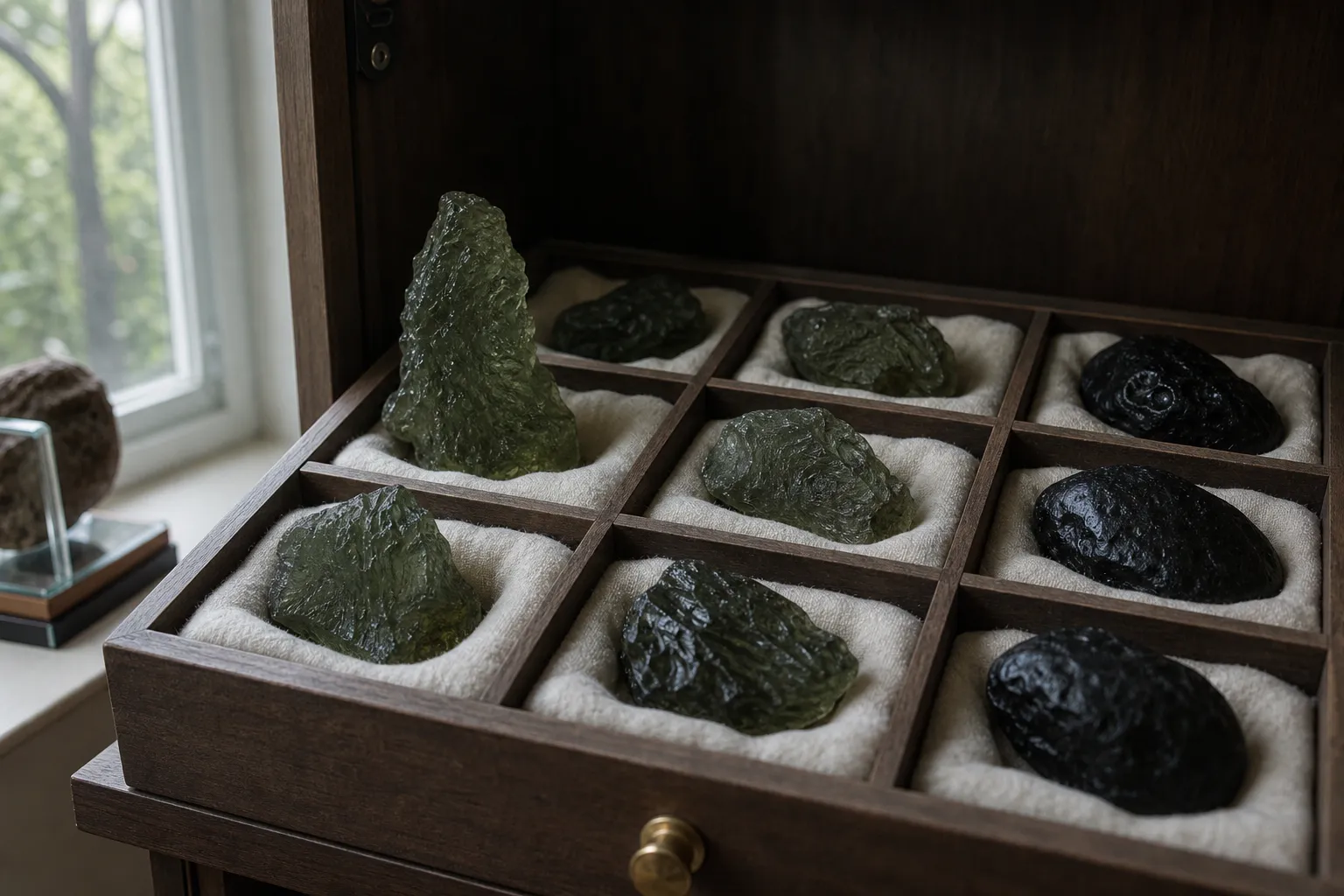
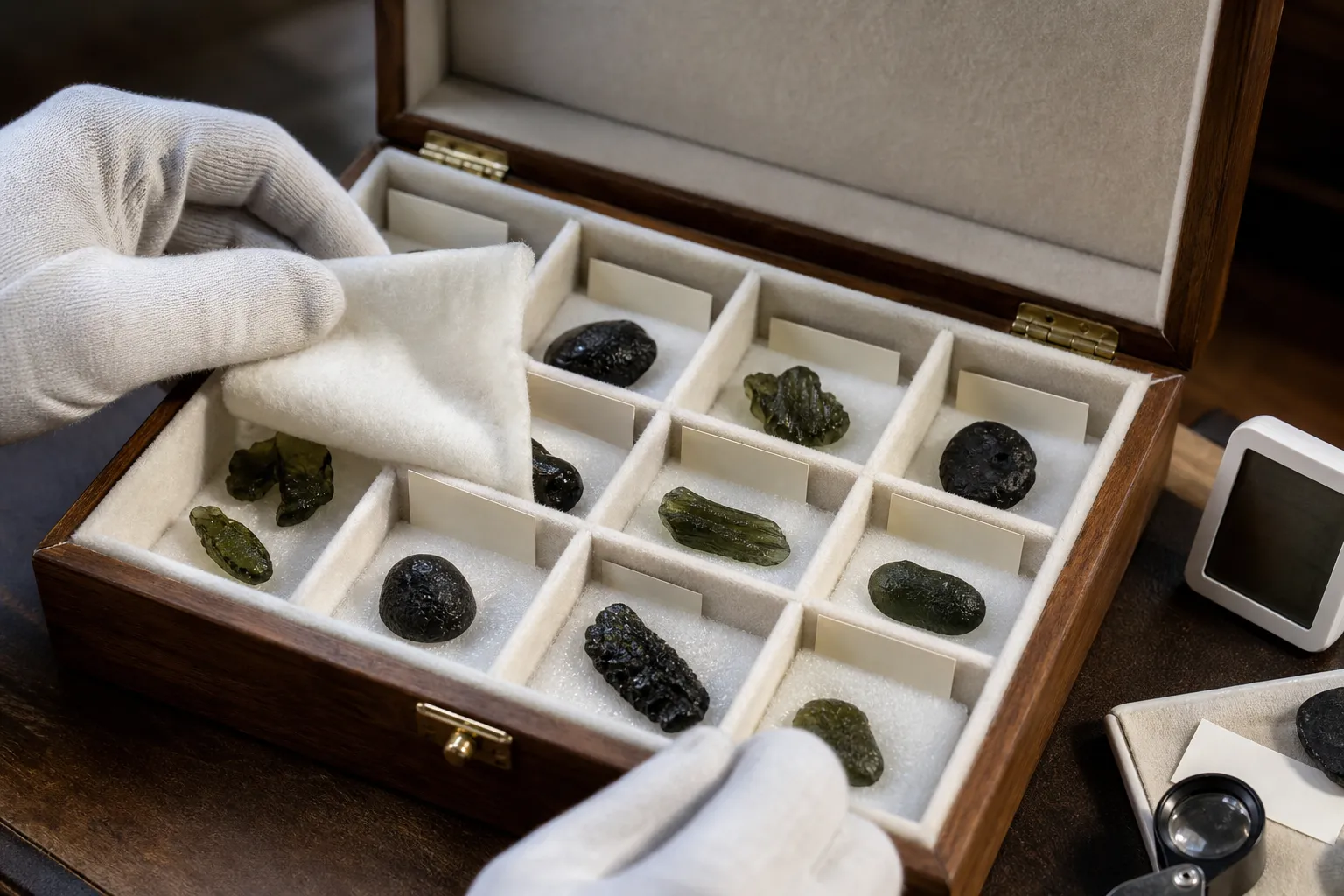
Separate rare moldavite specimens instead of piling them into one pouch, bowl, or tray. The sculpted texture that makes a specimen desirable can also create high points that catch, knock, or rub. Small boxes, divided trays, labeled vials, or individual compartments reduce contact. For larger or more sculptural pieces, gentle support is better than a tight fit that presses on fragile edges.
Good cushioning should be clean, soft, and stable. Avoid mystery foam, colored craft felt that sheds dye, sticky adhesives, fragrant liners, brittle old plastic, and rough paper in direct contact with delicate surfaces. Cushioning should stop movement, not wrap the specimen so tightly that it must be handled excessively every time it is viewed.
Dust control belongs in the same conversation. Dust is not only cosmetic; gritty particles can become abrasive during cleaning or handling. A closed box, drawer, cabinet, or case reduces dust buildup. If a rare or unusually fragile piece needs cleaning beyond very gentle dust removal, ask a qualified conservator or reputable mineral and tektite specialist before attempting coatings, polishing, or restoration work.
The enclosure around the tektite matters too
A case or box can reduce dust and handling, but it can also create a small stagnant environment. Museum display-case research discusses how emissions from construction materials, adhesives, coatings, and furnishings can concentrate inside enclosed spaces. Home collectors do not need to become display-case engineers, but the lesson is useful: the materials inside a sealed container should not be ignored.
Be cautious with storage that smells strongly of fresh paint, varnish, glue, perfume, rubber, or plasticizer. Decorative wooden boxes, newly glued liners, soft vinyl pouches, dyed fabrics, and foams that yellow or crumble may be fine for casual objects, but they are not ideal contact environments for rare natural glass specimens and their labels.
A practical smart eco-friendly tektite storage setup might include
- A durable outer box, drawer, or cabinet that can be reused for years.
- Individual inert containers or compartments.
- Gentle cushioning that prevents movement without sticking or shedding.
- Stable labels kept with the specimen but not scraping against it.
- A simple inventory note or photograph so pieces are not repeatedly handled just to identify them.
Labeling is part of preservation. If a collector has to open every packet and turn every specimen over to remember source, weight, or purchase history, the storage system is creating extra handling. Clear labels and basic records reduce disturbance.
Where “climate control” becomes overkill
The phrase “climate control” sounds reassuring, but home storage has limits. Museums may use monitored rooms, controlled cases, passive buffers, pollutant management, and professional risk assessment. A home shelf, even a carefully chosen one, is not the same system.
Useful limits for rare tektite collectors
- Do not chase exact RH numbers that moldavite-specific sources have not established.
- Do not assume a sensor prevents damage; it only reports conditions.
- Do not trust a “premium” case if it uses questionable liners, adhesives, or unknown plastics.
- Do not seal a specimen into a container with strong odors or deteriorating materials.
- Do not use oils, coatings, consolidants, or cleaning treatments as storage shortcuts.
A better strategy is steady placement, reduced light, inert separation, and periodic checks. Look for failing foam, dust buildup, loose mounts, condensation, strong odors, insects, label fading, or specimens shifting in their compartments. Monitoring displayed tektites does not require panic; it only requires enough attention to catch a storage problem early.
The sustainability angle also favors restraint. Conservation discussions increasingly recognize that tight environmental control can carry energy and carbon costs when the object does not require it. For a home collector, the greener and more realistic choice is usually passive risk reduction: better placement, fewer display hours, reusable inert supports, and stable indoor storage rather than powered devices running without a clear need.
A compact home setup for rare tektites
Use this as a bounded checklist, not a product prescription:
- Choose the location first. Pick a stable interior room over a bright window, damp basement, hot attic, or HVAC blast zone.
- Separate each specimen. Use compartments, vials, or individual boxes so moldavite pieces do not rub or knock together.
- Cushion gently. Support high points and fragile edges with clean, stable, non-abrasive materials.
- Limit light. Store most pieces closed; display selected specimens away from direct sun and unnecessary bright lighting.
- Keep records outside the handling loop. Use labels, photos, and notes so you do not need to unpack pieces repeatedly.
- Monitor only what you can act on. A reading is useful if it helps you move a case, change a room, or notice seasonal swings.
- Inspect the enclosure. Replace failing foam, smelly liners, dusty trays, or unstable packaging before they become part of the risk.
That is smart eco-friendly storage in the practical sense: fewer disposable upgrades, less over-handling, fewer harsh display conditions, and more attention to the actual object.
The bottom line
Rare moldavite and other tektites do not need theatrical storage claims. They need calm, stable, low-abrasion care. Treat moldavite as natural glass: keep it separated, cushioned, labeled, and away from unnecessary UV, dust, pollutants, and environmental swings. Use sensors and humidity buffers as tools, not as proof of museum-level protection.
The evidence supports risk reduction, not exact moldavite-specific UV or RH rules. That boundary helps collectors avoid overbuying “premium protection” accessories while still taking the material seriously. For unusually valuable, damaged, or fragile specimens, the next step is not a more dramatic device; it is advice from a qualified conservator or reputable mineral and tektite specialist.