Sleep boundary
The Midnight Warning: Why You Should Never Sleep with Moldavite
Sleeping with Moldavite is not a practice I’d recommend by default—especially under your pillow, beside your bed, or worn against your body overnight.
Not because moldavite has been shown to cause insomnia, vivid dreams, astral travel, or any specific sleep effect. It has not. The better reason is more ordinary: sleep is sensitive to expectation, stimulation, discomfort, and mental arousal. If moldavite already feels “intense” to you, or if you go to bed wondering what it might do, the stone can become part of a more activated bedtime state.
So the midnight warning is practical, not supernatural: keep your sleep space boring, calming, and low-pressure. Use moldavite when you are awake, grounded, and able to notice your response without turning your bed into an experiment.
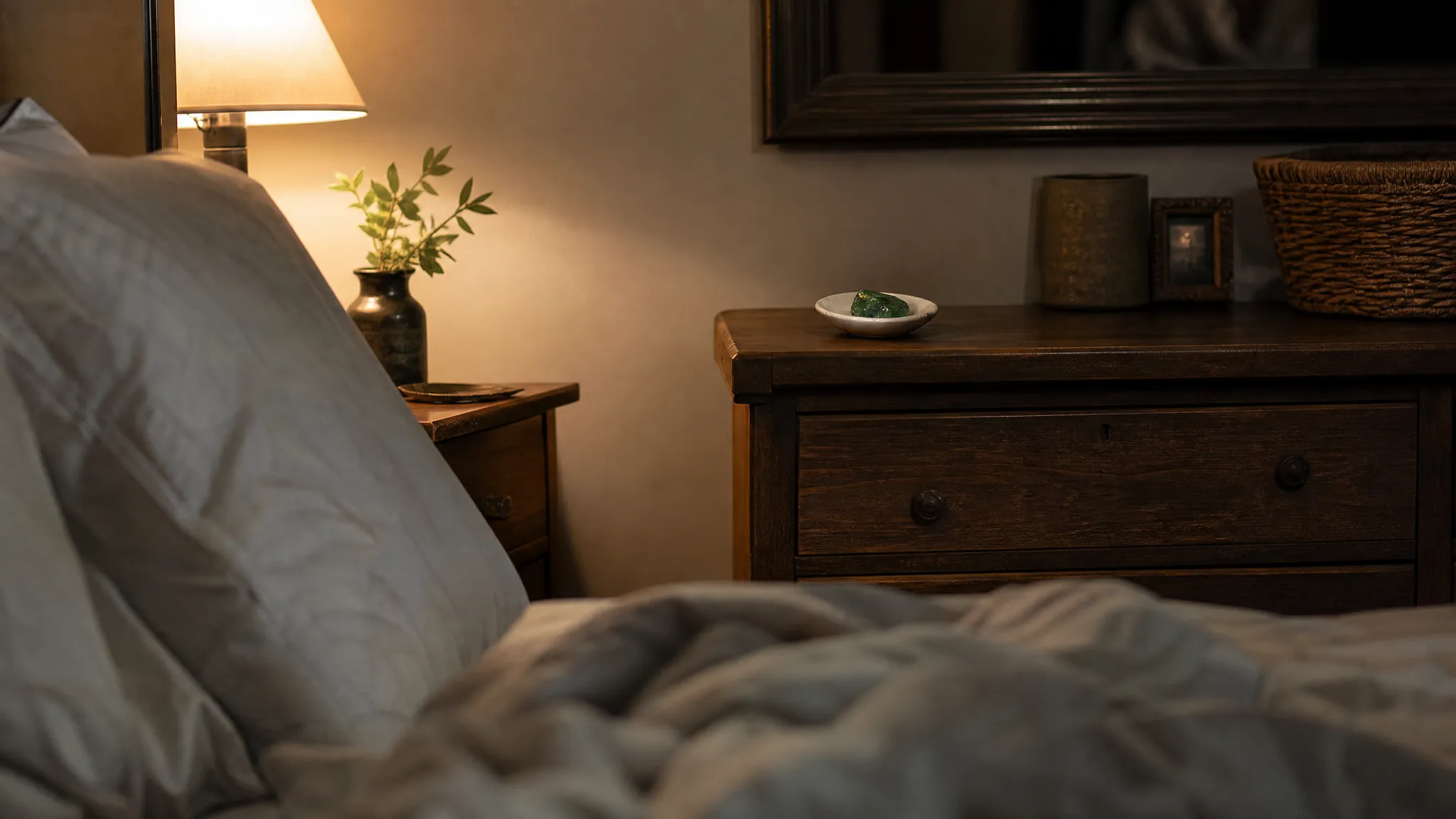
The real issue is not the stone alone
Moldavite has a verifiable material identity. Gemological sources describe it as a natural tektite: a type of natural glass associated with impact events. Materials research can look at its texture, pores, structure, and glassy character. Those are grounded claims.
But “moldavite kept me awake,” “moldavite gave me vivid dreams,” or “moldavite caused astral travel” belong to another category. They are personal, cultural, or metaphysical claims unless direct sleep research supports them. The available sources for this page do not show that sleeping with moldavite produces those outcomes.
That distinction matters because moldavite has a strong reputation in crystal communities. People often approach it with anticipation: transformation, intensity, emotional release, strange dreams, energetic pressure, rapid change. Even if you do not fully believe those claims, the reputation can shape the bedtime experience. A person who places moldavite under the pillow may not be simply “sleeping near a stone.” They may be waiting for something to happen.
That waiting can be enough to disturb rest.
General sleep guidance points toward regular routines, a restful environment, and less stimulation before bed. In that context, moldavite at night becomes a sleep-hygiene question: does this object help your mind settle, or does it make the room feel charged?
If it makes you alert, curious, tense, spiritually “on,” or overly focused on dreams, move it out of the bedroom.
Why moldavite under the pillow is the worst placement
The most common search is also the least helpful placement: moldavite under pillow.
There are three practical problems with it.
Too intimate
First, it puts the object in the most intimate part of your sleep space. You are not displaying it across the room; you are placing it beneath your head, where you may remember it as you settle down. If you already associate moldavite with powerful change, the placement can become a mental prompt.
Too watchful
Second, it can turn sleep into monitoring. Instead of letting the night be ordinary, you may start noticing every dream fragment, wake-up, body sensation, or restless moment. The next morning, the whole night may get filtered through one question: “Was that moldavite?” That loop can be more disruptive than the object itself.
Too uncomfortable
Third, a hard object under a pillow is simply not a sleep-friendly idea. Even if the stone is small, the pillow area should support comfort, not symbolic intensity or hidden objects that might shift, press, or distract.
A clearer boundary is better: if you are trying to protect stable sleep, do not put moldavite under your pillow. If you want to work with it, use it before bedtime, then put it away outside your sleep zone.
Moldavite beside the bed can still be too close
Moldavite beside the bed sounds less dramatic, but it can carry the same problem. The nightstand is where many people keep the things they mentally “take into sleep”: phone, water, alarm, journal, medication, jewelry, or symbolic objects. If moldavite sits there as a charged item, it may remain part of your pre-sleep attention.
This is especially relevant if you are searching because of something you already felt: a restless night, vivid dreams, anxiety, repeated waking, or a sense that the room felt too active. That does not prove moldavite caused it. But it does tell you the placement is not neutral for you.
Try a simple reset
- Move moldavite out of the bedroom for a week.
- Keep your bedtime routine otherwise as consistent as possible.
- Reduce obvious sleep disruptors, such as late caffeine, late scrolling, emotional conversations, or irregular bedtimes.
- Notice whether your sleep feels easier without turning the test into a ritual.
This is not a scientific experiment. It is a low-pressure household decision. The goal is not to prove that moldavite has a sleep effect; the goal is to remove one possible mental trigger from a space that should feel simple.
If you sleep well with moldavite across the room and feel no concern, there is no need to invent fear. But if you are already wondering whether it is “too much,” that question itself is a good reason to move it.
Vivid dreams, insomnia, and astral travel claims need careful language
Crystal communities often connect moldavite with vivid dreams, insomnia, strange sensations, rapid inner change, or astral travel. Those phrases are real search language, and they reflect how people describe their experiences. They should not be mocked. They also should not be upgraded into facts.
“Moldavite and vivid dreams” is best treated as an anecdotal association. Some people may report stronger dream recall after placing a meaningful object near the bed. That experience may be interpreted spiritually by the person having it. It may also be influenced by expectation, stress, sleep timing, waking more often, journaling, or paying closer attention to dreams.
“Moldavite and insomnia” needs even more caution. Insomnia is not just “one bad night.” Sleep difficulty can include trouble falling asleep, trouble staying asleep, early waking, unrestful sleep, and daytime effects. Many factors can contribute: schedule, stress, caffeine, alcohol, screen use, medications, health conditions, noise, temperature, light, and life changes. A crystal should not become the default explanation for a persistent sleep problem.
“Moldavite astral travel claims” belong in the realm of personal metaphysical interpretation. If someone says they had an out-of-body-like experience after sleeping near moldavite, that may be meaningful to them. But this page should not present astral travel as a demonstrated effect of moldavite. It is a cultural and spiritual claim, not a gemological or sleep-science conclusion.
A useful wording distinction
- “Moldavite feels too intense for me at night” is a personal boundary.
- “I prefer not to use moldavite in dream work” is a personal practice choice.
- “Moldavite causes insomnia” is a causal claim the available evidence does not support.
- “Moldavite triggers astral travel” is a metaphysical claim, not a sleep-science conclusion.
You can honor the language without surrendering the boundary.
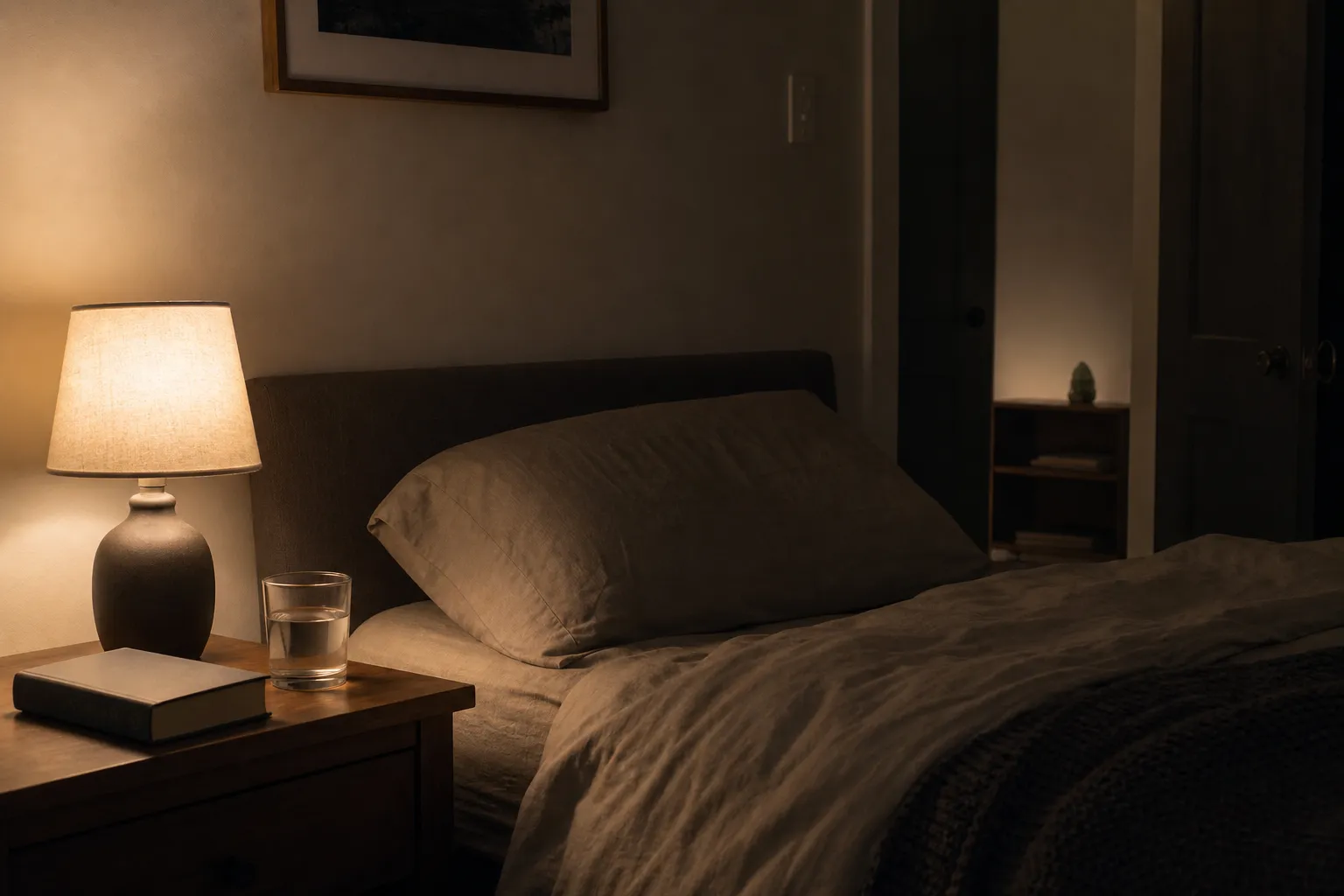
Bedroom feng shui and sleep hygiene point to the same practical move
Bedroom feng shui crystals are often discussed in terms of energy flow, harmony, and the feeling of a room. Sleep hygiene uses a different vocabulary: darkness, quiet, comfort, routine, timing, reduced stimulation, and environmental consistency.
These frameworks are not the same kind of evidence, but they can lead to a similar decision: the bedroom should feel like a place where your body does not have to perform.
If moldavite in the bedroom makes the space feel dramatic, charged, watchful, or “too alive,” it is probably not serving the room’s sleep function. You do not have to prove anything beyond that. A sleep space can be arranged around calm.
If you still want moldavite in your life, the answer is not necessarily to avoid it completely. The better move is to stop making the bed the testing ground. You might:
- keep moldavite in a workspace, altar area, or living room;
- wear it during the day rather than overnight;
- use it briefly during meditation, journaling, or reflection while fully awake;
- store it away before your bedtime routine begins;
- place it outside the bedroom if you associate it with intensity.
That gives the stone a defined role without letting it occupy the hours when your nervous system should be downshifting.
When the answer changes
“Never sleep with moldavite” is intentionally firm because it protects the most vulnerable scenario: someone who is already sleep-sensitive, suggestible at night, anxious about crystal effects, or actively hoping for an intense experience.
But the answer has nuance.
If you sleep deeply, feel no mental charge around moldavite, and keep a specimen across the room as ordinary decor, the concern is probably not the stone itself. The main question is whether the object changes your bedtime state. If it does not, this page does not need to manufacture alarm.
If you are new to moldavite, though, do not start by sleeping with it. New owners often bring more expectation to the piece. They may have read claims about transformation, vivid dreams, or energetic acceleration. Bedtime is the worst moment to test an object surrounded by that much suggestion. Begin with daytime handling instead.
If you are already struggling with sleep, do not make moldavite the center of the explanation. Move it out of the room if that helps you feel calmer, but also look at ordinary variables: caffeine timing, light exposure, screens, stress, irregular schedules, alcohol, room temperature, noise, and unresolved worry. If sleep problems are persistent, severe, sudden, or affecting daytime life, consider speaking with a qualified health or mental health professional.
A simple bedtime rule for moldavite
Use this rule:
If moldavite makes you more aware, more expectant, more emotionally stirred, or more focused on what might happen during the night, do not keep it under your pillow, beside your bed, or on your body while sleeping.
That rule does not require fear. It does not require rejecting spiritual practice. It simply keeps sleep separate from intensity.
Moldavite can remain meaningful without becoming a midnight object. Let it belong to waking hours, reflection, collection, geology, symbolism, or intentional practice. Let the bed belong to rest.