Beginner pacing note
The Gradual Frequency Integration Strategy for Beginners
A small green moldavite specimen can arrive with heavy language attached to it: frequency, activation, magnetic pull, overstimulation, sudden change. A gradual frequency integration strategy is a cautious beginner routine for easing into moldavite by limiting wearing time, noticing personal comfort, and keeping spiritual-use language separate from proven mechanism.
The direct answer: begin with short, low-pressure contact, take breaks, keep the rest of your day ordinary, and adjust only by comfort. This is not a validated energetic protocol. It is a pacing framework for beginner moldavite use when the available page evidence does not support firm claims about magnetic fields, predictable reactions, or required thresholds.
broader context
Start with the main moldavite page
This narrower page makes more sense after the broader moldavite archive page.
What “Frequency Integration” Means Here
In moldavite communities, “frequency” often means perceived intensity, symbolic charge, or the feeling that a specimen has a strong presence. That is spiritual-use terminology. It should not be treated as a measured property or as proof that the stone is doing something specific to the body.
“Integration” is also best kept simple. Here, it means giving yourself time to decide whether wearing the specimen feels welcome, distracting, emotionally loaded, or neutral. You observe your own response without turning it into universal moldavite law.
That distinction matters because moldavite carries several layers at once. It is impact glass, a collectible tektite, an authenticity-sensitive market object, and a symbolic stone in spiritual circles. A beginner can respect the symbolic layer without letting it override collector judgment or personal pacing.
A Gentle Wearing-Time Framework
No usable source supplied for this page establishes a verified moldavite wearing-time threshold. Any schedule should therefore be treated as optional pacing language, not a rule. The point is not to find the correct number of minutes; the point is to avoid forcing intensity because community frequency language makes intensity sound like success.
| Stage | Wearing Time | What to Notice | When to Pause |
|---|---|---|---|
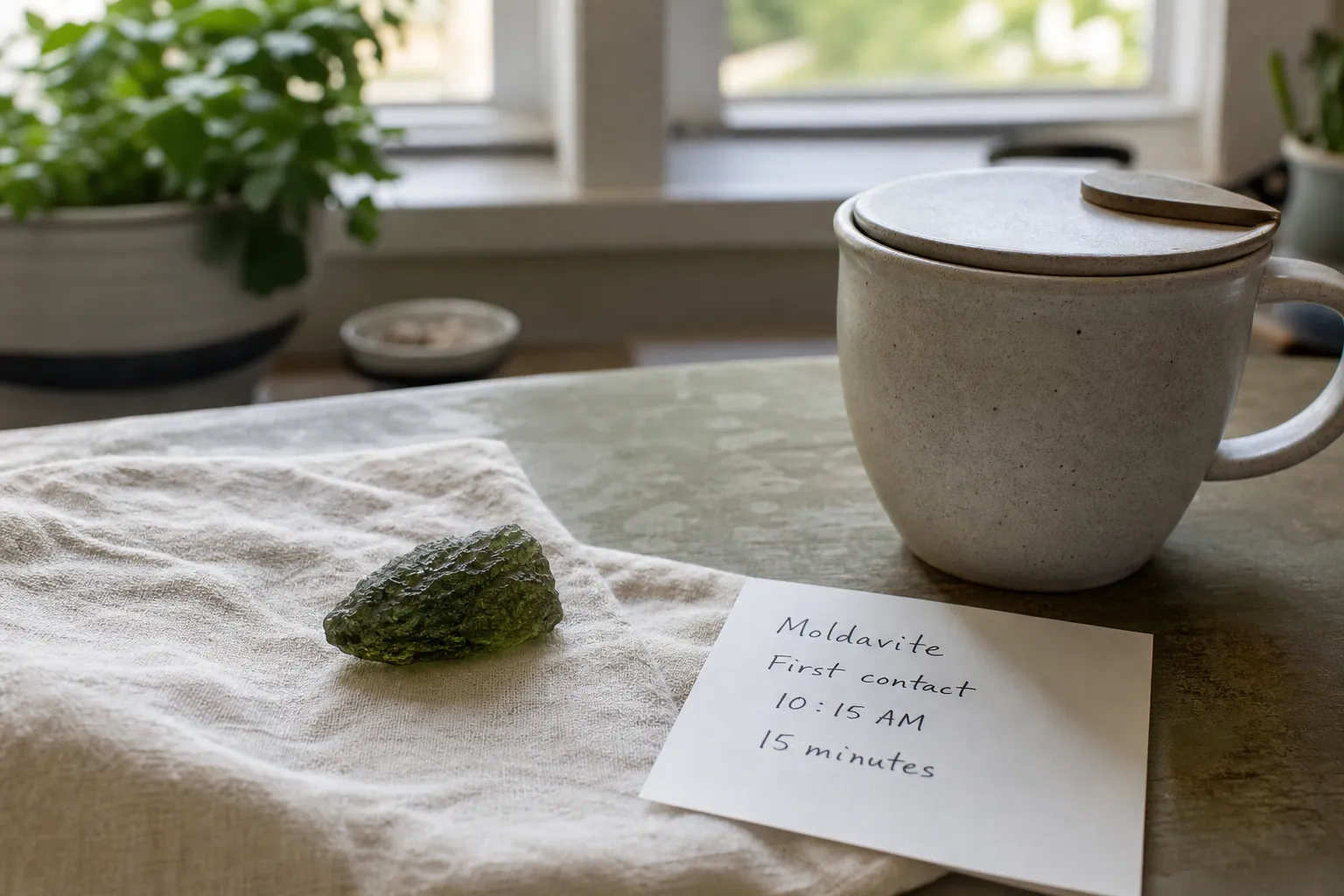
| First contact | A few minutes | Is the piece comfortable to hold or wear? | If the experience feels pressured or distracting |
| Short wear | 10–20 minutes | Does it fit an ordinary day without drama? | If you keep monitoring yourself anxiously |
| Light routine | 30–60 minutes | Is it still a simple accessory or meditation object? | If the routine starts to feel compulsive |
| Normal use | Longer, by preference | Does wearing it feel neutral, meaningful, or unnecessary? | If you are chasing a promised result |
These times are examples, not verified limits. One person may prefer to hold a specimen briefly and never wear it. Another may wear a pendant for a morning and notice nothing unusual. Neither outcome proves or disproves moldavite’s symbolic meaning; it only tells you what feels tolerable and useful in your own practice.
For a beginner, the steadier rule is this: shorten the contact before you intensify the story. If a pendant feels too present, remove it, set it aside, and return later if you want to. That is a practical adjustment, not evidence of a universal sensitivity pattern.
How to Self-Monitor Without Overreading
Avoiding overstimulation is a reasonable beginner concern, but the term needs restraint. This page does not verify moldavite overstimulation as a measurable effect. Here, “overstimulation” simply means the practice feels like too much: mentally preoccupying, emotionally loaded, physically uncomfortable as jewelry, or intrusive in your day.
A useful self-check has three parts.
Separate the setting
A new pendant can feel noticeable because it is new, because the chain is uncomfortable, because the story around it is intense, or because you are paying unusual attention to yourself. Do not assign every sensation to moldavite.
Keep variables ordinary
If you begin wearing moldavite while also changing sleep, caffeine, stress, meditation, or other routines, it becomes easier to build a story around the stone. The strategy works better when the only new variable is the specimen and the wearing time stays modest.
Write plain notes
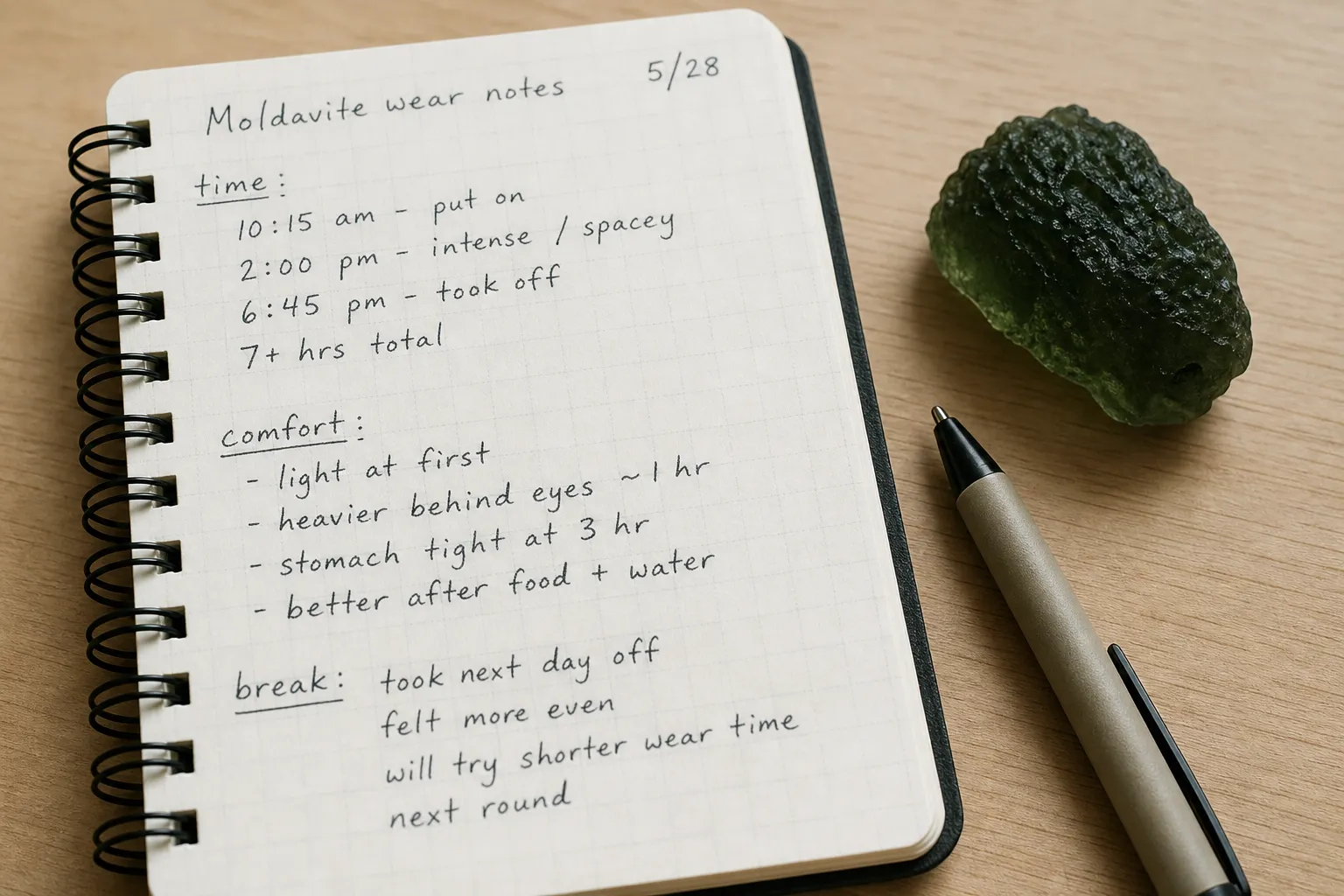
“Wore the pendant for 20 minutes; felt distracted; removed it” is more useful than “the stone rejected me” or “my field shifted.” Plain notes protect the symbolic layer from becoming a claim it cannot support.
Meaning can still be personal. If moldavite helps you mark a period of reflection, change, or restraint, that meaning can be held as interpretation. It does not need to become a guaranteed effect.
The Magnetic Field Question
The phrase “magnetic field” appears in some crystal and energy conversations, but this page cannot support a claim that moldavite creates, changes, cleanses, or interacts with a person’s magnetic field in a verified way. No supplied source supports electromagnetic, physiological, psychological, or safety conclusions about moldavite use.
For this article, magnetic field terminology should be treated as community language unless stronger evidence is added later. If a seller, social post, or informal guide says moldavite has a special field effect, a beginner should not treat that as an established property. It may be part of the spiritual vocabulary around the stone, but it is not a substitute for evidence.
That does not mean you must abandon symbolic language. It means the language should stay proportional. You can say, “I experience this specimen as intense,” or “I prefer shorter wearing time.” You should not turn that into a broad mechanism about magnetic influence, wellness outcomes, or predictable transformation.
This boundary also helps with authenticity judgment. A real moldavite specimen should not be accepted as genuine because it “feels magnetic,” “buzzes,” or seems intense. Authenticity belongs to specimen traits, provenance, seller transparency, and, when needed, appropriate expert evaluation. Feeling is not an authentication method.
When to Slow Down, Stop, or Reframe
The gradual strategy is most useful when it gives you permission to stop. Beginner moldavite use should not become a test of endurance. If the practice feels uncomfortable, distracting, emotionally pressured, or too tied to promised outcomes, reduce contact or set the piece aside.
Slow down if you notice any of these patterns:
- You are increasing wearing time because intensity feels like progress.
- You are interpreting ordinary mood shifts as definite moldavite effects.
- You feel anxious about removing the specimen, as if taking a break means failure.
- You are letting the stone’s story override sleep, work, relationships, or practical judgment.
- You are relying on unsourced moldavite claims instead of comfort and common sense.
None of these points proves the stone is causing anything. They simply show that the routine is no longer gentle. A gradual approach should reduce pressure, not add another pressure system.
Stopping can also be neutral. If moldavite does not feel meaningful, comfortable, or interesting after a few short attempts, there is no rule that says you must continue. A collector may value the specimen for its impact history or form. A spiritually curious reader may decide the symbolism is not personally useful. Both outcomes fit within the limits of this page.
A Simple Beginner Routine
Choose one moldavite item: a pendant, ring, loose specimen, or small piece you can handle comfortably. Do not combine it with several new practices and then try to identify one cause for every sensation. Start on a calm day when you do not need the stone to prove anything.
For the first session, hold or wear it briefly. Notice the physical facts first: weight, texture, chain comfort, setting, edge feel, and whether the jewelry sits well. Then notice the interpretive layer: does it feel symbolically important, distracting, pleasant, neutral, or overhyped?
Afterward, take a break. The break is part of the routine, not a sign that something went wrong. If you return to the specimen, extend wearing time slowly only if the previous session felt ordinary enough to repeat. If it did not, keep the next session shorter or leave more time between sessions.
A practical rhythm might be short contact, rest, short contact again, then optional longer wear. The better rule is preference over pressure. Moldavite does not need a forced schedule to be taken seriously as a collectible or symbolic object.
Common Confusions Beginners Should Avoid
Assuming one official definition
One common confusion is treating “frequency integration” as if it has one official definition. It does not, at least not from the supplied material for this page. The phrase is best read as community frequency language: a way people talk about pacing their relationship with a stone.
Treating discomfort as proof of strength
Another confusion is assuming discomfort means the specimen is unusually strong. Discomfort may come from expectation, jewelry fit, personal stress, or the story you have absorbed around moldavite. The cautious response is not to intensify the claim. It is to reduce the wearing time and observe more plainly.
Using intensity as a quality signal
A third confusion is using intensity as a quality signal. A moldavite piece should not be judged authentic, superior, rare, or more valuable because a wearer describes a strong reaction. Collector literacy depends on better anchors: documented origin where available, physical inspection, seller transparency, and caution around exaggerated market language.
Mistaking caution for proof
The last confusion is thinking a gradual routine makes the practice evidence-backed. It does not. The routine is careful because the evidence is limited. That is the point.
The Boundaries of This Strategy
This page does not establish medical, psychological, electromagnetic, or safety conclusions about moldavite. It does not verify detox language, magnetic field effects, predictable sensitivity patterns, or guaranteed spiritual outcomes. No visible public references were supplied for those claims, so they stay outside the factual center.
What the strategy can support is narrower and more useful: if you are new to moldavite and drawn to the spiritual language around it, begin gently, keep wearing time modest, take breaks, and let comfort set the pace. Use “frequency” as a symbolic term if it helps you organize the experience, but do not treat it as measured evidence.
A beginner does not need certainty to act carefully. Start small, observe plainly, and keep impact science, authenticity, and personal meaning separate. That is enough for a responsible first step with moldavite.