Bounded ritual reflection
The Over-Optimization Backlash: Returning to Intuitive Rituals
A moldavite ritual can become so carefully arranged that the specimen almost disappears behind the system: the timing, the prompts, the cleansing sequence, the rule about what should be felt. The appeal of intuitive rituals is that they loosen that pressure. When an over-optimized spiritual routine starts to feel rigid, tiring, or detached from bodily sensations, a more flexible practice can feel like a return to contact rather than performance.
That does not mean intuitive spiritual rituals produce specific outcomes, and it does not mean moldavite has a guaranteed effect on a person’s life. The narrower answer is more useful: intuitive rituals may feel appealing because they give readers permission to notice what is actually happening, remove rigid dogmas from a personal practice, and keep symbolic meaning from turning into another productivity system.
broader context
Broader moldavite archive
This narrower page makes more sense after the broader moldavite archive page.
Why over-optimized spiritual routines can feel hollow
A moldavite piece is an object first: impact glass with specimen traits, provenance questions, and collector context. Spiritual interpretation may sit beside that material reality; it should not erase it. The same distinction matters in ritual practice. A routine can begin as a way to pay closer attention, then slowly become a checklist that demands the “right” sensation, mood, or transformation story.
Over-optimized spiritual routines often borrow the shape of measurement. A person may track how long they sit with a stone, how many signs appear afterward, how often a certain feeling arrives, or how closely the practice matches advice found elsewhere. Structure can help some readers feel settled. The strain begins when structure becomes a test of worth, sincerity, or spiritual progress.
That is where spiritual routine fatigue can enter the picture. Here, it is not a diagnosis or a documented trend claim. It is plain language for the feeling that a practice has become mentally heavy, emotionally pressured, or disconnected from why it began. A reader may still care about moldavite, symbolism, and inner reflection, while feeling that the routine around them has become too tight.
The backlash is not necessarily against discipline. It is against ritual that behaves like a control system. When every step must be optimized, the person may stop asking simpler questions: Am I present? Am I grounded enough to continue? Is this helping me observe my life, or am I chasing a story because I think I should?
A less dogmatic ritual approach gives those questions room.
What intuitive rituals return to
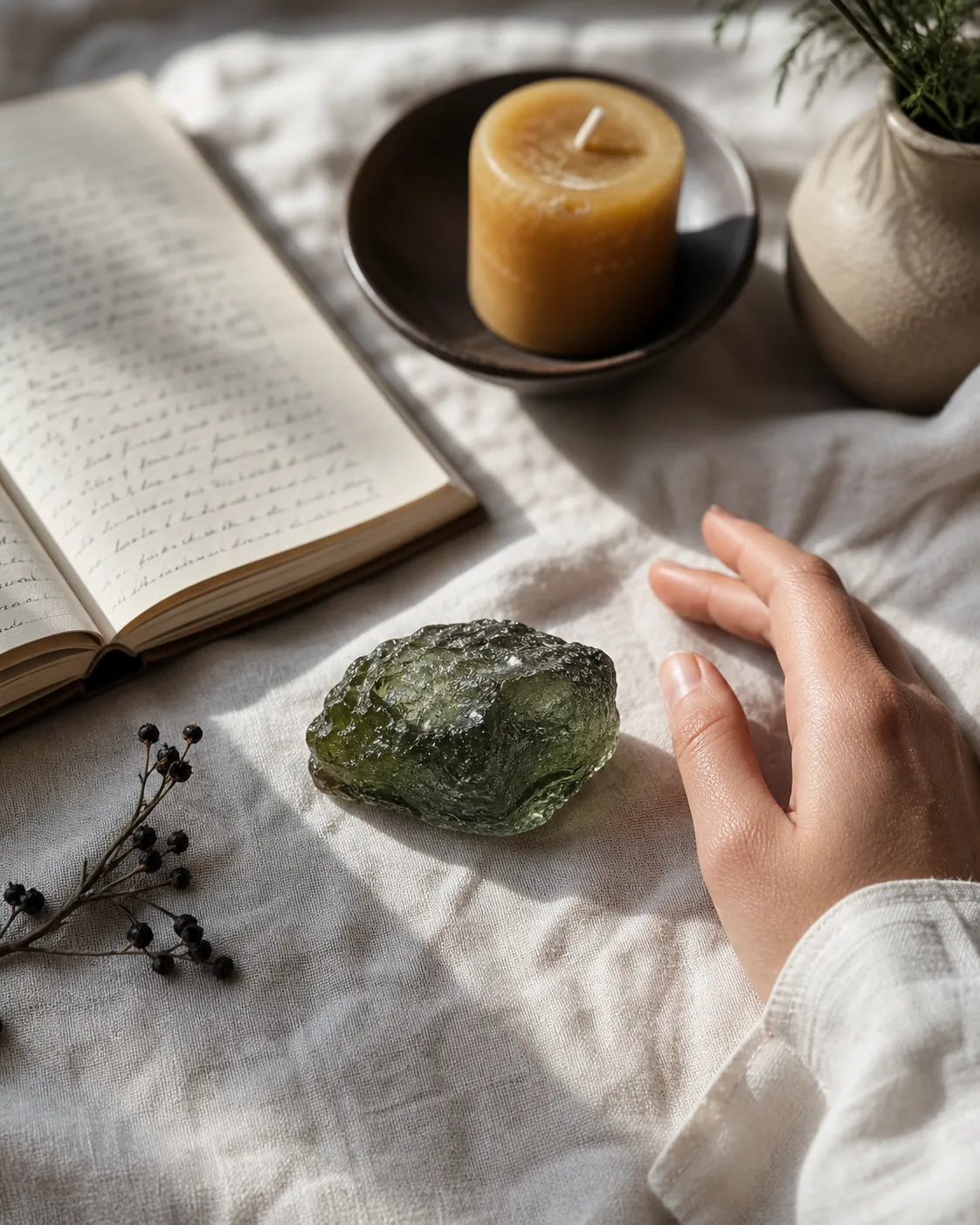
Intuitive rituals are not rule-free chaos. A better description is flexible spiritual routines that leave space for observation, adjustment, and personal meaning. They may still include a moldavite specimen, a quiet place, a journal, a candle, or a short period of reflection. The difference is that the ritual is not treated as a machine with guaranteed output.
In a body-aware ritual, the reader pays attention to bodily sensations without turning them into proof. Warmth, restlessness, calm, tension, distraction, or no noticeable sensation at all can be treated as information about the present moment. They should not be inflated into certainty about authenticity, destiny, health, or spiritual rank.
This matters for moldavite because the stone often attracts intense transformation language. That language can be meaningful as symbolism, but it becomes unstable when treated as evidence. A person might hold a specimen and feel moved, unsettled, focused, or indifferent. Those experiences can belong to reflective life. They do not authenticate the stone, prove a metaphysical claim, or establish a universal effect.
Returning to intuitive rituals is therefore less about abandoning ritual and more about changing the authority structure. Instead of asking, “Did I follow the exact formula?” the reader asks, “What is appropriate today?” Instead of treating someone else’s sequence as a command, the reader uses a flexible ritual approach that can be shortened, softened, paused, or skipped.
That is the practical appeal: intuitive ritual practice can keep meaning present without surrendering judgment.
The conditions that change the answer
When structure is not the problem
Intuitive rituals are most useful as an editorial concept when the reader is already feeling compressed by rules. If a structured practice feels calm, voluntary, and clear, there may be no need to change it. The problem is not structure itself. The problem is structure that becomes coercive, especially when it tells the reader to ignore discomfort, chase dramatic sensations, or accept spiritual claims without scrutiny.
When the object is a specimen
The person’s relationship to the object matters. If moldavite is being approached as a collector specimen, authenticity and provenance should remain separate from ritual impressions. A genuine interest in symbolic meaning does not replace inspection, seller transparency, or careful collector literacy. Feeling something during a ritual is not an authentication method.
When the practice feels destabilizing
The person’s state matters too. If a practice feels distressing, destabilizing, or compulsive, the better move is not to intensify it. Stop, simplify, and seek appropriate support when health, mental health, crisis, or safety concerns are present. Ritual should not be used as a substitute for qualified care.
When community language gets forceful
Community language also matters. Some readers encounter moldavite through dramatic stories, strict instructions, or claims that imply a person must be ready for upheaval. Without strong source support, this page cannot treat those claims as evidence. At most, they can be understood as part of the symbolic atmosphere around the stone. A reader does not need to accept every dogma attached to an object in order to relate to it meaningfully.
The aim sets the limit
The reader’s aim is the final limit. If the aim is reflection, an intuitive ritual can stay simple: hold the specimen, notice the body, write one honest sentence, and stop before the practice turns performative. If the aim is proof, prediction, health outcome, or certainty, intuitive ritual is the wrong tool. It cannot carry that burden.
Common confusion: intuition is not certainty
The most common misunderstanding is to treat intuition as a higher form of certainty. That is not the position this page can support. In a bounded ritual context, intuition is better understood as a mode of attention. It may help a reader notice preference, reluctance, curiosity, fatigue, or resonance. It should not be used to bypass evidence.
For moldavite readers, this distinction is important. A person may feel drawn to a particular specimen. That feeling can be part of their collecting story, but it does not settle authenticity. A shorter ritual may feel more honest than a complicated one. That can be a reasonable personal adjustment, but it does not prove that shorter rituals are universally better. A person may sense that certain transformation language feels too forceful. That can be a valid boundary, while still remaining a personal reading.
Removing rigid dogmas does not mean removing discernment. It means refusing to let borrowed rules outrank direct observation, material caution, and personal limits. A less dogmatic ritual still benefits from ordinary clarity: know what object you are handling, avoid exaggerated claims, keep spiritual interpretation separate from factual judgment, and stop when the practice no longer feels grounded.
There is also a quieter confusion around bodily sensations in rituals. Some readers may think that a strong sensation means the ritual is working, while a subtle or absent sensation means failure. That creates another optimization loop. A body-aware approach is gentler: sensation is noticed, not graded. Nothing has to peak.
A restrained way to practice without overbuilding it
For readers who want a practical frame, the simplest version is enough. Place the moldavite where it can be handled safely. Before beginning, name the purpose in ordinary language: reflection, quiet, gratitude, release, curiosity. Keep the purpose modest. Avoid turning it into a demand for a dramatic result.
Let the ritual be brief. Hold the specimen or sit near it. Notice the body: breath, posture, tension, ease, impatience, numbness, warmth, or nothing obvious. If a sensation appears, do not force an explanation. If no sensation appears, do not manufacture one. The ritual can still be complete.
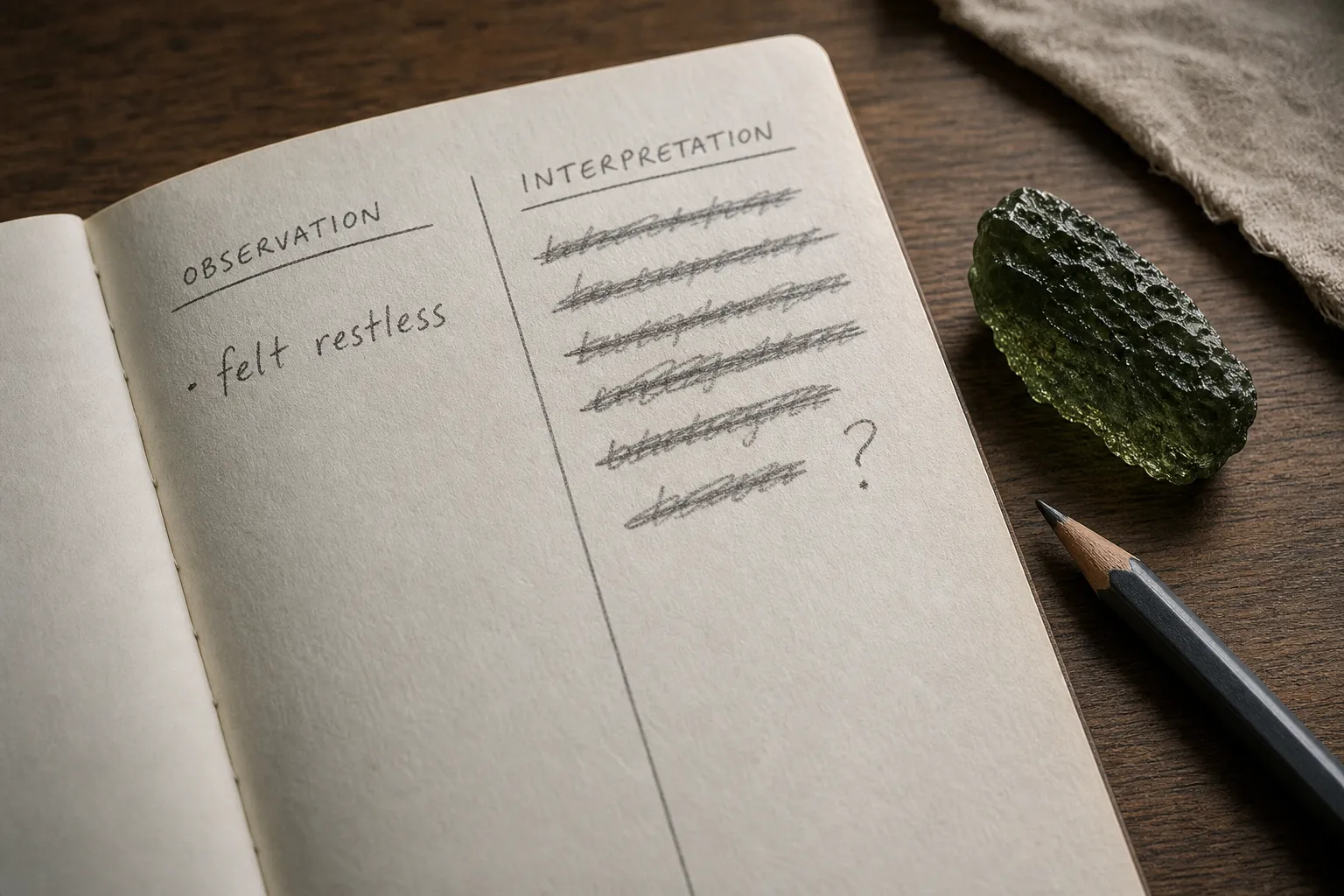
A short written note may help some readers separate observation from interpretation. “I felt restless” is an observation. “This proves the stone is changing my life” is a much larger claim. The first can belong in a reflective ritual practice. The second asks for certainty the page evidence does not provide.
The final step is permission to stop. Over-optimized spiritual routines often make stopping feel like failure. Intuitive rituals make stopping part of the method. If the practice feels strained, repetitive, or emotionally loaded, ending it may be the most grounded choice.
This is not a universal prescription. It is a restrained structure for readers who feel buried under structure.
Where the evidence boundary sits
The available research packet for this page did not provide usable public sources, firsthand reports, terminology references, scientific literature, or cultural documentation that could support broad factual claims. That means this article cannot responsibly state that there is a documented trend toward intuitive rituals, that moldavite causes particular bodily sensations, or that any ritual style produces reliable spiritual, emotional, or physical outcomes.
What the page can do is answer the reader’s narrow question as bounded editorial reflection. If a moldavite practice has become too optimized, intuitive rituals may feel appealing because they return attention to the person, the body, the object, and the meaning being made in that moment. They reduce the pressure to perform spiritual progress. They also leave room for collector judgment: provenance before certainty, specimen traits before seller language, and symbolic meaning without inflated claims.
The useful boundary is simple. Use ritual language for reflection. Use evidence for authenticity. Use professional support for health, mental health, crisis, or safety concerns. Do not ask a stone, a routine, or a sensation to do all three jobs.
FAQ
Are intuitive rituals better than structured rituals?
Not always. Some readers may feel steadier with structure, while others may feel more honest with flexibility. The better question is whether the ritual still supports attention without becoming rigid, pressured, or detached from bodily sensations.
Can bodily sensations prove that moldavite is affecting me?
No. Sensations can be noticed as part of personal reflection, but they should not be treated as proof of a moldavite effect, an authenticity signal, or a guaranteed spiritual outcome.
What is the safest boundary for a flexible ritual approach?
Keep the practice modest, stop if it feels distressing, and do not use ritual as a replacement for appropriate medical, mental health, crisis, or safety support. For moldavite specifically, keep symbolic interpretation separate from authenticity and provenance judgment.