Moldavite Provenance
The Isotope Fingerprint: How Strontium Traces the Source
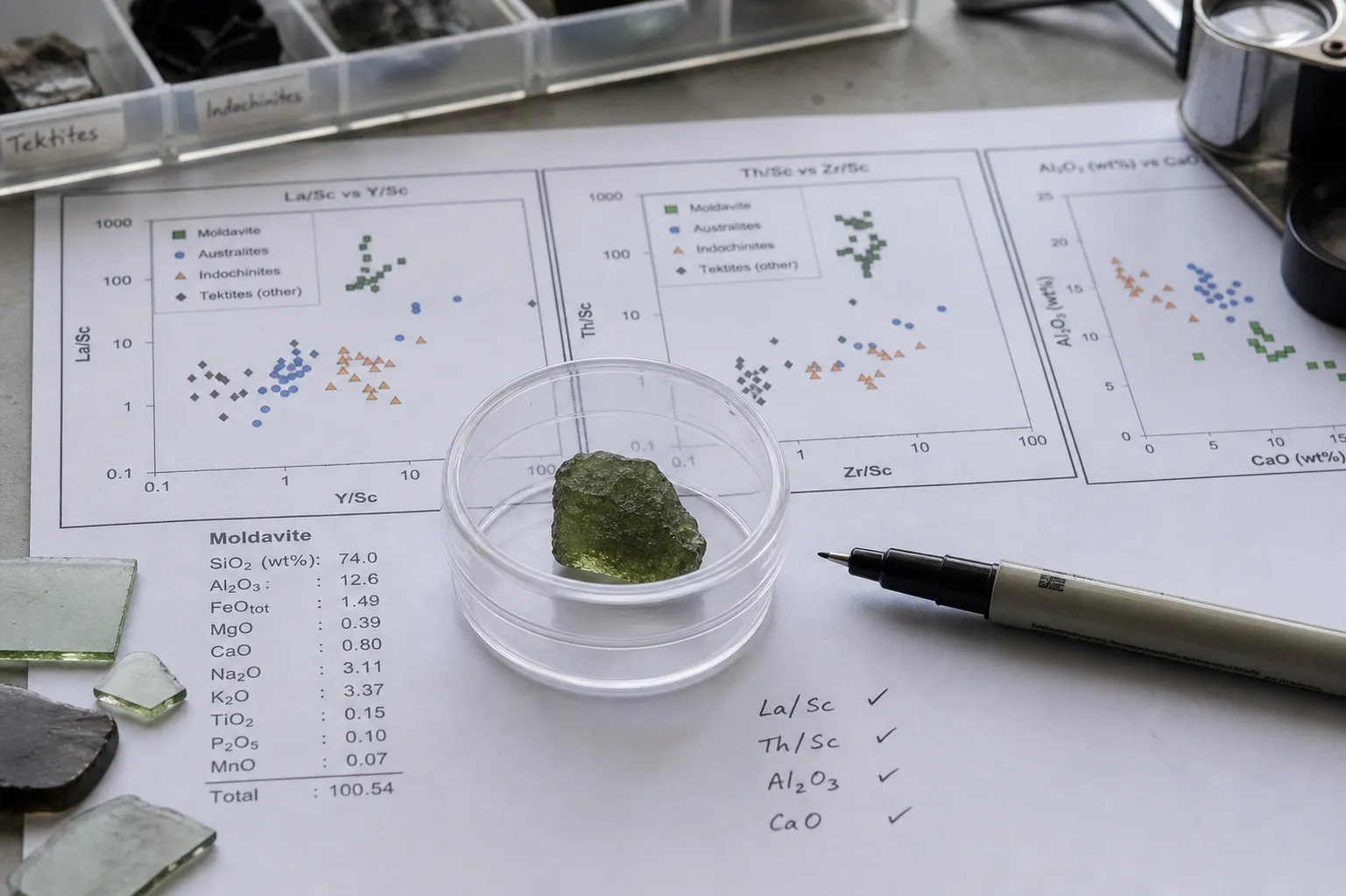
Isotope Analysis can help with moldavite provenance by comparing a specimen’s chemistry with known geological reference patterns. Strontium isotopes are useful because they may carry a “source signal” from the rocks involved in the event that formed tektite glass. When the sample, method, and comparison data are appropriate, a strontium pattern may support or weaken a proposed moldavite origin.
That is the answer—and the limit. A strontium result is not an origin stamp. It does not, by itself, confirm that a green stone is moldavite, name a selling location, certify value, or settle every authenticity question. It is one piece of evidence in a wider provenance study.
broader context
Moldavite context note
This narrower page makes more sense after the broader moldavite archive page.
What Strontium Isotopes Add
Moldavite is usually discussed as a tektite: natural glass linked to an impact event, not a crystal grown slowly in a pocket or vein. So the provenance question is not only “Where was this bought?” It is closer to: “Does the material fit the geological story being claimed for it?”
Strontium can occur in rocks and minerals, and different source materials may carry different isotope ratios. In provenance testing, the point is not that one strontium number belongs neatly to one place. The point is that isotope patterns can sometimes reflect source materials and geological history.
For a moldavite reader, the useful question is:
Does this specimen’s measured isotope pattern fit the proposed moldavite source context when compared with suitable reference material?
That comparison is the whole point. A number on a report has limited meaning without reference datasets, method notes, and other geochemical observations. The same applies when Nd isotopes, or neodymium isotopes, appear beside Sr isotopes. Neodymium may add another source-tracing angle, but it does not remove the need for context.
A matching result can be supportive. A mismatched result can be a warning sign. Neither should be treated as a standalone verdict.
Why the Reference Set Matters
A common misunderstanding is to imagine isotope testing as a simple pass-or-fail scan: measure the ratio, get “moldavite” or “not moldavite,” and close the case. That is not how this kind of evidence should be read.
Strontium isotope patterns become useful only when the comparison is useful. The result needs to be measured under appropriate laboratory conditions and compared with credible references for the material class and proposed origin. Without that layer, the measurement may be real but under-explained.
A careful interpretation depends on several things
- The analyzed material should be the glass itself, not residue, surface contamination, or an altered edge.
- The reference material should be relevant to moldavite and tektite geochemistry, not just a broad mineral category.
- The conclusion should describe uncertainty instead of turning one isotope value into an identity label.
- The result should be read beside other evidence, such as physical features, glass character, trace-element data where available, and documented collection history.
This is why provenance testing is different from a casual “lab verified” sales phrase. A useful report should make clear what was tested, which method was used, what comparison was made, and what conclusion the evidence can actually support. Some lab results are useful for composition; others may be narrower than a collector expects.
A strontium pattern becomes a strong clue only when the surrounding evidence lets it be interpreted.
What Isotope Testing Cannot Do by Itself
Isotope geochemistry can sound precise, which makes it easy to overstate. In moldavite discussions, the overstatement often appears as a promise that one laboratory number can confirm origin, authenticity, or value. The more accurate reading is narrower.
Isotope testing cannot carry every part of a specimen’s story. It should not be treated as a guarantee that a stone came from a specific field, dealer, collection, estate, or locality. It also should not be used as a shortcut for appraisal.
Geological provenance and collector-market provenance overlap, but they are not the same thing. A geological question asks whether the material is consistent with a source context. A market question may ask who owned it, where it was collected, whether paperwork is reliable, or whether a sales description is fair. Strontium isotopes may help with the first question. They do not automatically solve the second.
There is also a source limit for this page: no public, citation-ready references were supplied with the research package. This article should therefore be read as a bounded conceptual explanation, not a cited technical review. For buying, selling, publication, or formal authentication claims, the stronger route is to examine the actual laboratory report and compare it with authoritative tektite and isotope geochemistry references.
The core boundary is simple: isotope analysis may support provenance interpretation, but it does not replace the full chain of evidence.
How to Read a Strontium Result
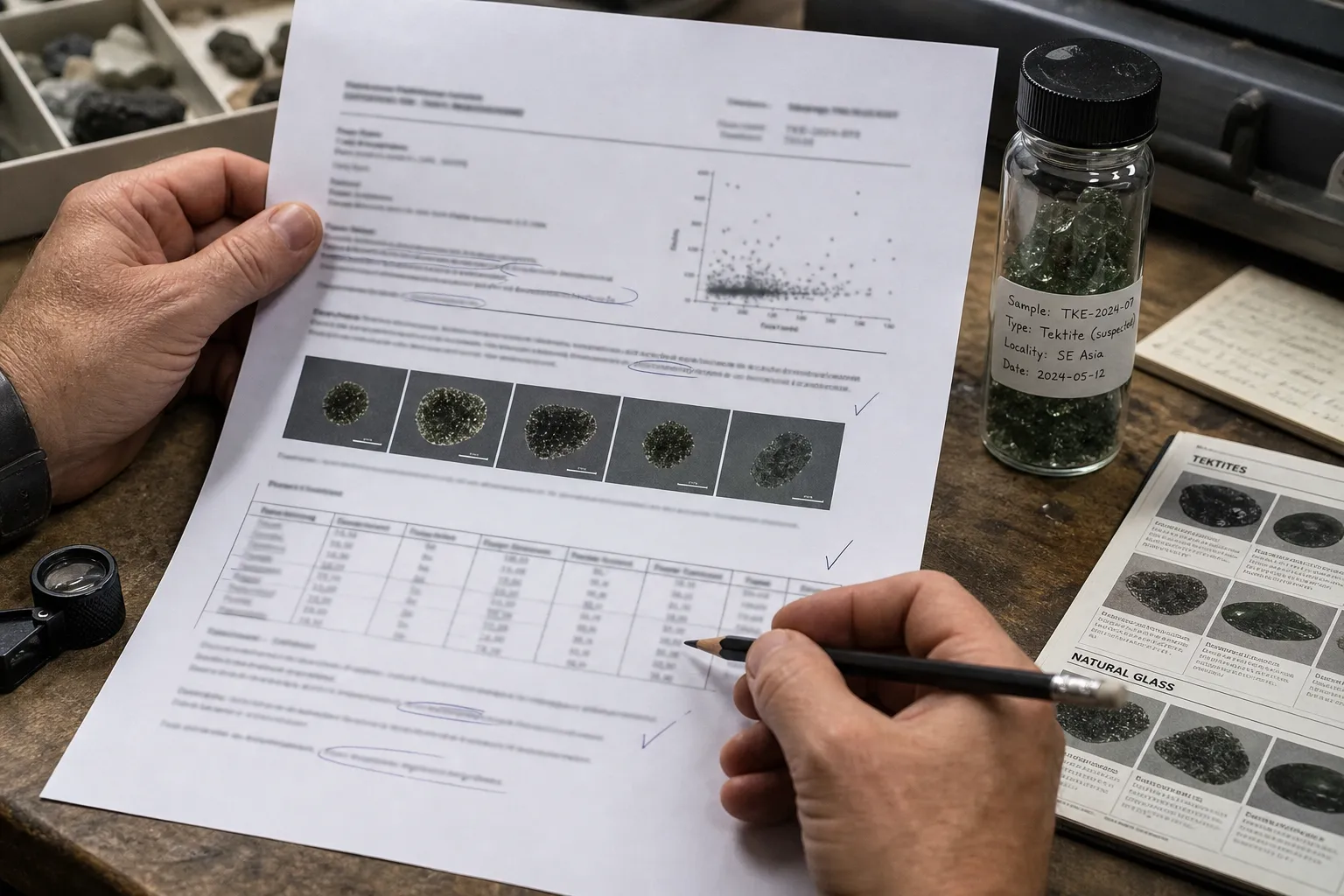
If a report mentions strontium isotopes, the first question should not be “Does this prove it?” A better question is: “What does this result support, and what does it leave open?”
Start with the sample
Was the actual glass analyzed? Was the tested area described? Were limitations noted?
Look at the comparison
A strontium isotope ratio needs a reference frame, not just a bare number.
Read the conclusion
Careful wording may be consistent, inconsistent, or limited by the available comparison set.
This page is not a laboratory method guide, but the basic reading issue is straightforward: the test must match the material question being asked.
A report that compares the specimen with relevant tektite or moldavite references is more informative than a bare number. Careful scientific wording may say a result is consistent with a proposed origin, inconsistent with another explanation, or limited by the available comparison set. Overconfident retail language often erases those limits. For moldavite, where market claims can be loud, that distinction matters.
The practical skill is not becoming an isotope geochemist. It is recognizing whether a test is being presented as evidence or as theater.
Where Neodymium Fits
Strontium gets attention because its isotope patterns can carry source information, but it is not the only isotope system used in provenance studies. Neodymium isotopes can also help with geological source tracing because they may preserve a different part of the source-material story.
For moldavite provenance, neodymium does not replace strontium. It may add another angle. If strontium and neodymium evidence point in a compatible direction, the interpretation may be more informative than either result alone. If they do not fit neatly together, the conclusion may need more careful review.
More measurements do not automatically create certainty. They improve the evidence only when the measurements are reliable, the references are appropriate, and the interpretation stays restrained.
A useful way to think about it: strontium isotopes may sketch part of the source fingerprint; neodymium isotopes may add another layer. The sketch still needs context before anyone should treat it as a conclusion.
Practical Takeaway
For moldavite provenance, strontium isotope analysis is best understood as a supporting tool. It may help trace geological origin when the sample is properly measured and compared with suitable reference data. It may also help separate a serious provenance discussion from a vague sales claim.
But it is not a single-test answer to every authenticity concern. A green glassy specimen does not become confirmed moldavite simply because isotope language appears in paperwork. A real laboratory number still needs method context, comparison data, and a careful conclusion.
The best reading posture is neither dismissive nor dazzled. Isotope geochemistry can be genuinely relevant to tektite provenance, including moldavite discussions. The mistake is treating that relevance as a shortcut. Strontium patterns can help trace the source; they do not erase uncertainty, replace reference work, or turn market language into geological evidence.
If you are evaluating a specimen, look for the narrow claim the evidence actually supports. “Consistent with a proposed geological origin” is meaningful. A claim that bundles source, value, and authenticity into one guaranteed answer is asking isotope testing to carry more than it can.