Specimen storage note
Eco-Friendly Padded Boxes: How to Store Brittle Tektites Safely
A pitted moldavite surface can look tougher than it is when it meets a hard drawer edge, a loose lid, or another specimen in the same tray. The practical answer is narrow: an eco-friendly padded display box can be a sensible lower-risk choice for brittle tektites when it keeps the specimen still, separates it from hard contact, and gives you enough product detail to check material claims such as FSC wood or recycled Kraft.
That is the useful limit. A padded box should not be treated as proof of complete chipping prevention, archival safety, certified environmental performance, or suitability for every tektite shape. The better goal is not “no chips ever.” The better goal is fewer avoidable impacts.
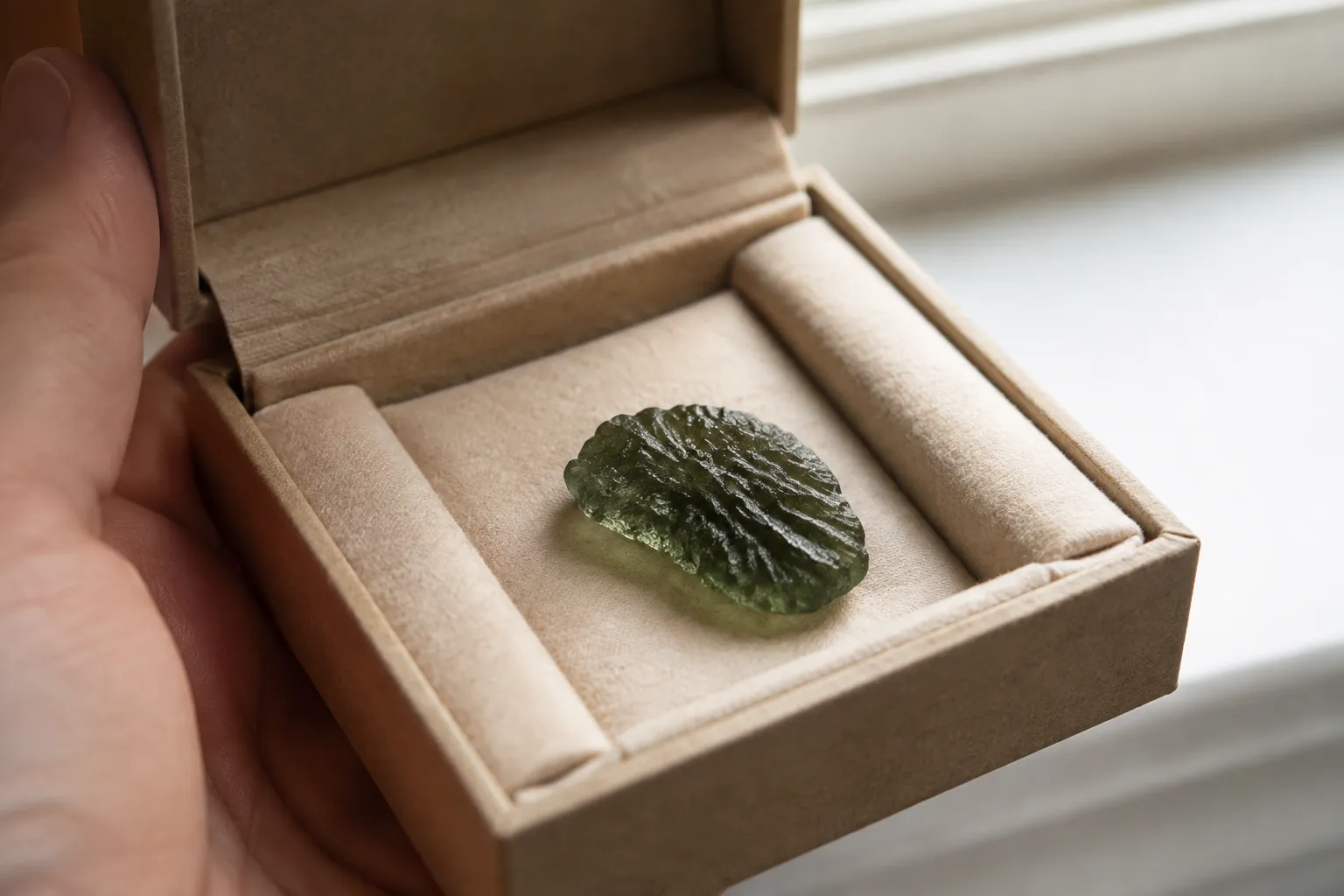
broader context
Broader moldavite archive
This narrower page makes more sense after the broader moldavite archive page.
What a Padded Tektite Display Box Can Realistically Do
A tektite storage box helps most when it solves three ordinary problems: movement, contact, and careless handling. A small specimen that slides inside an oversized case can still strike the sides. A display box with hard interior edges can still create pressure points. A lid that closes too low can become the nearest hard surface to a raised ridge.
For brittle tektite handling, the most practical box holds the specimen without squeezing it. The padding should support the piece gently enough that thin edges, high ridges, and natural surface texture are not forced against a hard backing. A shallow padded mineral display may suit a flatter fragment; a deeper box may suit a raised or irregular piece. The question is fit, not just softness.
“Padded” should stay specific. Padding may reduce direct hard-surface contact and limit shifting when the box is moved carefully. It does not prove drop protection, crushing resistance, or long-term material compatibility unless the maker provides credible product details. Seller language about chipping prevention is best read as a design intention, not a guaranteed result.
Choosing an Eco-Friendly Box Without Overreading the Label
“Eco-friendly” is a broad market phrase. For this page, treat it as a claim to check, not as a quality proven by appearance. FSC wood, recycled Kraft, recycled paperboard, plastic-free packaging, and low-waste language can all appear in product descriptions, but each term needs context.
An FSC wood display box should make clear what part of the product the claim applies to. Is the wood itself described that way, or only the outer packaging? Is the claim tied to this box, the manufacturer, or a general brand statement? If the description is vague, the sustainability signal stays weak.
A recycled Kraft display box raises similar questions. Recycled Kraft may refer to the outer paperboard, an insert, a sleeve, or shipping material. It does not automatically describe the padding, adhesive, window film, hinge, dye, or lining. That does not make the box useless. It means the environmental claim should remain modest unless product-specific details are supplied.
Padded interior
Less direct contact with hard surfaces
Complete chipping prevention
Snug compartment
Less sliding during careful movement
Protection from drops or crushing
FSC wood claim
A wood-sourcing claim worth checking
That every component is lower-impact
Recycled Kraft claim
Possible reduced use of new paper fiber
Archival compatibility or full material disclosure
Clear display lid
Less handling during viewing
Safe clearance for raised specimens
For eco-friendly specimen storage, this separation matters. A box can be better than a loose drawer and still fall short of conservation-grade storage. A box can use recycled Kraft and still have padding that is not described clearly enough for long-term compatibility claims. Keep the claim matched to the evidence you can see.
Fit Matters More Than Decorative Padding
The safest-looking box is not always the better tektite display box. Thick padding can help if it stabilizes the specimen without pressure. It can also cause trouble if it lifts the piece too close to the lid, traps it in a tight recess, or invites you to press the specimen into place.
Start with the shape of the tektite. Moldavite and moldavite-like specimens often draw attention because of texture, translucency, and irregular form; those same traits make fit more complicated than it is for a smooth cabochon or standard jewelry insert. A jagged edge, thin lip, or raised ridge should not become the pressure point.
A reasonable fit test is visual and gentle. Place the specimen on the padding without forcing it into a slot. Close the lid slowly while watching for clearance. If the lid touches the specimen, or if the insert visibly compresses around one edge, choose a deeper box or a different support style. The display should hold the object; it should not make the object conform to the box.
For smaller pieces, separate compartments are usually more sensible than a shared padded tray. If two impact glass specimens can touch when the box tilts, the padding is not doing enough. If a single specimen rolls when the box is moved, the compartment is too loose or the insert shape is wrong. Reducing chipping risk often comes down to eliminating small, repeated contacts.
The box should also be easy to open. A tight clasp, stiff lid, or awkward pull tab can increase handling mistakes. A practical padded tektite display lets you view the specimen without prying, shaking, or turning the box upside down.
Common Confusion About “Safe,” “Eco,” and “Display”
The word “safe” can become too large in storage language. Here, it means lower-risk under careful use. It does not mean drop-proof, pressure-proof, humidity-managed, chemically verified, or suitable for every specimen over indefinite storage.
The word “eco” can also drift. A recycled Kraft display box may fit a lower-waste preference, but the phrase does not automatically cover glue, foam, fabric, coating, ink, window material, shipping fill, or disposal options. An FSC wood display box may be attractive and durable, but the wood claim should be checked rather than inferred from a rustic look.
Display creates its own misunderstanding. A box that looks good on a shelf may invite more frequent handling. If the main goal is preserving edges and surface detail, the display should reduce touching, not create a reason to open the box every day.
For spiritually curious readers, this is also where symbolic meaning and physical care need to stay separate. A specimen may carry personal significance, but meaning does not change the handling risk of glassy material. Impact science before interpretation.
Storage also does not answer authenticity. A good tektite storage box does not verify provenance, locality, or whether a specimen is genuine moldavite. It can help protect a piece you have chosen to keep; it cannot make seller language more reliable. Specimen traits and provenance still need their own scrutiny.
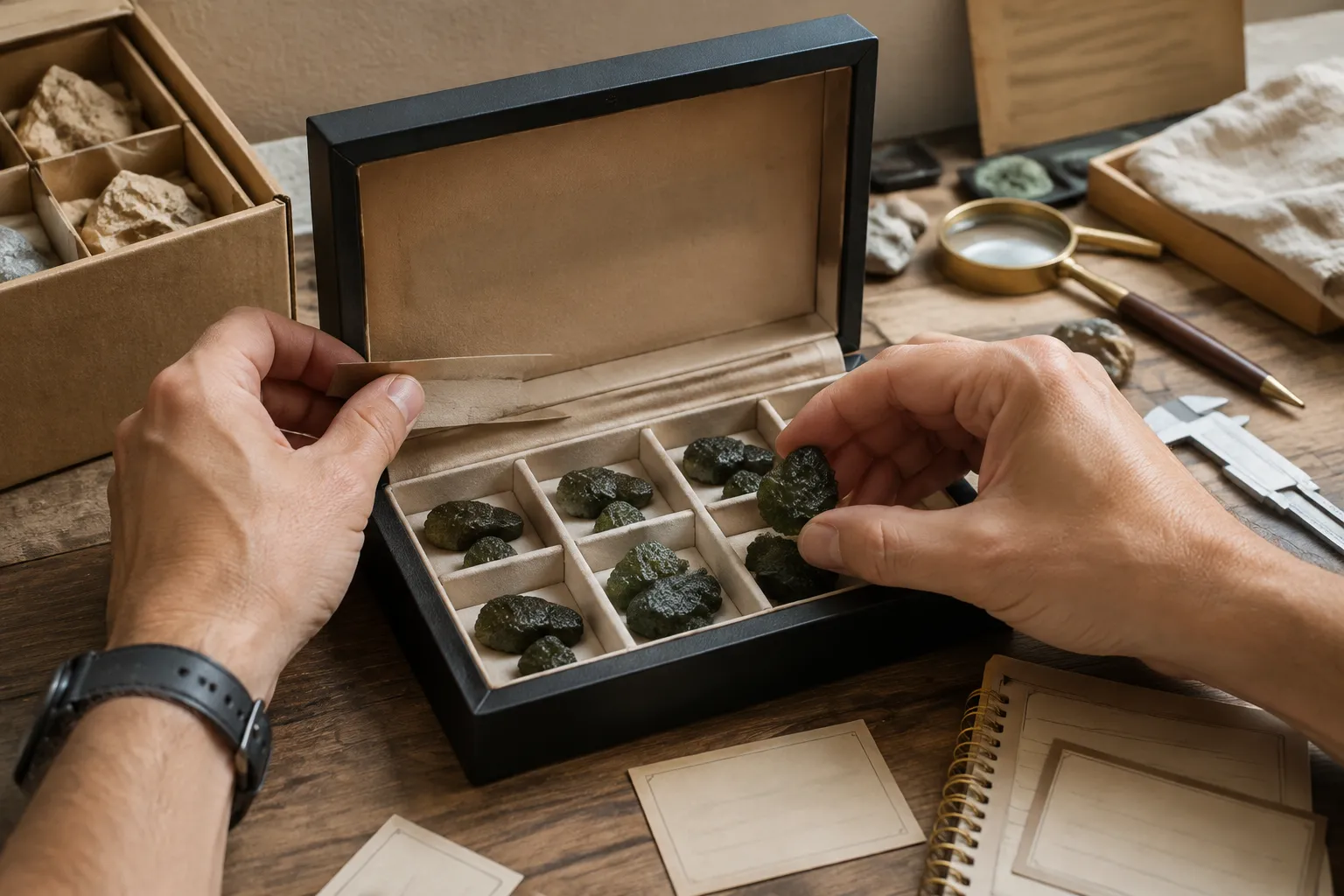
A Cautious Setup for Storing Brittle Tektites
Use the box as part of a simple handling routine, not as a substitute for care.
Before placing the specimen inside, check the interior with your fingers and eyes. Look for exposed staples, hard seams, rough glue lines, loose grit, sharp paperboard corners, or a lid that descends into the specimen space. If any hard part can touch the tektite during normal opening or closing, the box needs adjustment or replacement.
Set the specimen down once, with the broadest stable area resting on the padding. Avoid pressing delicate edges into foam or felt. If the piece has a raised face you want to display, make sure the lid clearance remains generous. A transparent lid is useful only if it does not become the closest hard surface.
Move the closed box as though the specimen could still shift. Keep it level. Do not stack heavy objects on it. Do not use a display box as shipping protection unless the product is specifically designed and documented for shipping; display storage and mailing protection solve different problems.
For home storage, place the box where it will not be repeatedly bumped, pulled from a crowded drawer, or exposed to routine clutter. If the specimen is especially thin, sharply edged, already chipped, or unusually valuable to you, be more conservative about tight fit and casual handling. When evidence is limited, caution should carry more weight than appearance.
What to Verify Before Buying
Use this checklist before choosing an eco-friendly padded display box:
- The compartment is sized so the specimen cannot slide freely.
- The lid has visible clearance above the highest point of the tektite.
- The padding supports the piece without forcing sharp edges into place.
- The interior has no exposed hard points, grit, staples, or rough seams.
- Multiple specimens are separated so they cannot touch.
- The box can be opened and closed without shaking or prying.
- The display design reduces handling rather than encouraging constant removal.
- The seller explains what “FSC wood” or “recycled Kraft” applies to.
- Sustainability language is product-specific, not only broad branding.
- The product does not promise complete chipping prevention.
This checklist cannot turn a storage choice into a verified conservation method. It can keep the purchase anchored to observable features.
When a Padded Display Box Is Not Enough
An eco-friendly padded display box is not the right answer for every tektite. If a specimen has very thin projections, unstable fractures, a shape that cannot rest without pressure, or a high personal value, ordinary display storage may be too casual. If the surrounding area is damp, dusty, unstable, or handled by many people, the box may reduce one kind of contact while leaving other concerns unresolved.
The available material for this page does not support specific claims about ideal foam chemistry, felt compatibility, adhesive behavior, long-term archival safety, or environmental performance. That absence matters. A careful buyer can still choose a lower-waste, padded option, but the language should stay proportional: less sliding, less hard contact, less unnecessary handling.
For ordinary collector use, the strongest practical choice is a box that fits the specimen calmly and makes restraint easy. Keep provenance before certainty, physical handling before display aesthetics, and symbolism separate from material care. A padded box can help you store brittle tektites with more care. It cannot remove the need for careful judgment.
FAQ
Is an eco-friendly padded display box enough for moldavite?
It can be enough for ordinary display storage if the specimen fits without pressure, cannot slide freely, and has lid clearance. It is not enough if the piece is very thin, unstable, already damaged, or too raised for the box.
Does recycled Kraft make a display box archival-safe?
No. Recycled Kraft describes a paper material claim, not a full storage-safety claim. It does not automatically tell you about adhesives, padding, coatings, dyes, window film, or long-term compatibility.
Should brittle tektites be stored together in one padded tray?
Only if each specimen has its own compartment and cannot touch another piece when the box tilts. Shared trays are risky when impact glass can roll, knock edges, or rub against another specimen.
Can a padded box prove a specimen is genuine moldavite?
No. Storage and authenticity are separate questions. A tektite display box can help reduce handling contact, but provenance, locality, seller evidence, and specimen traits still need their own review.