Why Moldavite Triggers the "Flush" During Night Meditation (And How to Adapt)
If Moldavite feels stronger at night—heat in the face, tingling, pulse awareness, emotional pressure, buzzing, or sudden wakefulness—the careful answer is this: the Moldavite Flush can be a very real subjective experience, but it is not a medically established Moldavite-specific condition.
Night meditation can make body sensations louder. The room is quiet. Attention narrows. Breathing may shift. Expectation is high. The body is already close to the sleep threshold. In that setting, ordinary arousal, relaxation, and body-awareness changes can feel dramatic.
So the useful response is not to push harder. Lower the intensity: practice earlier, shorten the session, keep Moldavite nearby rather than on your body, breathe normally, ground through the room, and protect sleep.

broader context
Start with the main moldavite page
This narrower page makes more sense after the broader moldavite archive page.
Why the Moldavite Flush can feel stronger at night
A sensation that feels interesting in the afternoon can feel overwhelming before bed.
At night, fewer outside signals compete for attention. You may notice heartbeat, skin warmth, breath rhythm, stomach movement, facial flushing, or small muscle twitches more clearly because there is less else to track.
Meditation also changes how you notice the body. This is where interoception matters: it means awareness of internal body states. During still meditation, sensations that were already present can become more vivid. A warm face may become “heat.” A normal pulse may become “energy moving.” A breath change may feel like activation.
That does not make the experience fake. It means sensation, attention, meaning, and interpretation are interacting.
There is also a sleep-timing problem. Sleep asks the body to downshift. A charged Moldavite session may ask for focus, symbolic meaning, emotional openness, and alert attention. Even if the practice feels spiritually calm, it may leave you in a state closer to bright stillness than sleepiness.
Meditation is not always one simple relaxation response. Depending on the person, method, breath pattern, and moment, it may feel calming, activating, or mixed: peaceful but awake, physically still but mentally bright, emotionally open but too alert for sleep.
That mixed state explains many nighttime Moldavite Flush reports better than a simple claim that the stone itself is producing body heat.
What may be happening in the body
People use “Moldavite Flush” to describe a cluster of sensations, not one single measurable event. Common reports include:
- facial warmth or flushing
- tingling, buzzing, or prickling
- pulse awareness
- pressure in the chest, head, hands, or throat
- sudden clarity or emotional intensity
- restlessness
- wakefulness after the session
A cautious body-side explanation involves the autonomic nervous system, which helps coordinate heart rate, breathing, digestion, arousal, and recovery. Its sympathetic branch is linked with alertness and readiness. Its parasympathetic branch is linked with rest, digestion, and settling. Meditation can influence this balance in different ways.
A flush-like episode may involve several overlapping patterns:
Alerting response
You feel more awake, your pulse becomes more noticeable, or the session feels exciting.
Settling response
The body softens, warmth spreads, digestion becomes noticeable, or emotion comes closer to the surface.
Mixed state
The body is quiet, but the mind is bright and focused.
Attention amplification
The sensation may not be new; you may simply be perceiving it more strongly.
Expectation and meaning
Moldavite has a strong reputation in crystal communities, and that reputation can heighten what you watch for.
This does not establish that Moldavite directly causes flushing, insomnia, nervous-system changes, or heat. The stronger evidence is about meditation, attention, body awareness, and autonomic activity in general—not crystal-specific causation.
Still, this frame is useful. It lets you adapt the practice without dismissing your spiritual language.
The practical question is: does the experience feel meaningful and manageable, or is it too stimulating for the sleep window?
When the nighttime setup becomes too much
Here, “physiological overload” is not a diagnosis. It simply means the practice is asking more from your body than feels comfortable before sleep.
Nighttime Moldavite meditation is more likely to feel overcharged when several of these are present:
You meditate in bed. The body receives mixed signals: sleep, ritual, focus, and intensity in the same place.
The stone is on your body. Holding Moldavite at the chest, forehead, throat, or palm may keep attention locked onto sensation.
The session runs long. A mild warm-up can become a peak experience if you stay with it past your comfort point.
The breath becomes forceful. Deep, fast, or highly controlled breathing can be stimulating for some people near bedtime.
The intention is emotionally loaded. Asking for major insight or life change right before sleep can keep the mind active.
You keep checking for signs. Monitoring for the flush can make small sensations feel central.
You are stressed or sleep-deprived. A body already near its limit may respond more sharply to stillness and attention.
This is why “meditation before sleep” is not automatically calming. For some people, a simple breath practice helps them settle. For others, especially with emotionally charged objects or strong expectations, meditation becomes an attention task that keeps the system awake.
The goal is not to defeat the Moldavite Flush. It is to lower the intensity enough that the experience does not take over your night.
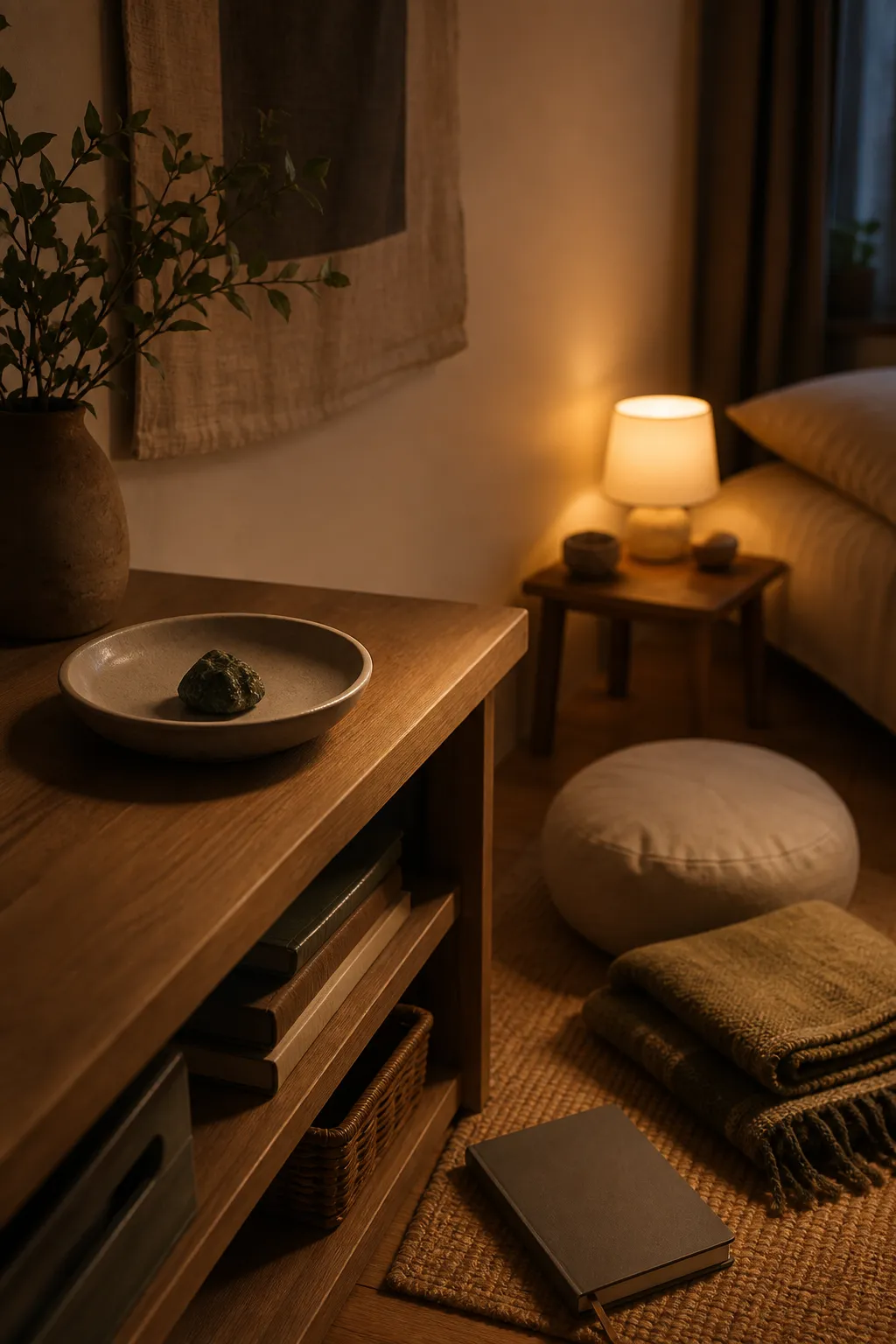
How to adapt without turning it into a struggle
Change one or two variables at a time. If you change everything at once, you will not know what helped.
Move the session earlier.
Try Moldavite meditation in the afternoon or early evening instead of right before sleep. If the flush appears, you have time to settle afterward.
Shorten the contact window.
A five-minute session may be more useful than a long one if your body escalates quickly. Stop while the sensation is still manageable, not after it peaks.
Keep Moldavite nearby, not on the body.
If holding the stone makes the flush stronger, place it on a table, windowsill, or meditation surface. You keep the symbolic presence without making the stone the center of every body signal.
Avoid intense breathwork before bed.
Use normal, easy breathing. If you notice yourself controlling the breath too much, let it return to a natural rhythm.
Use eyes-open grounding.
If warmth, tingling, or alertness rises quickly, open your eyes and orient to the room. Notice the wall, the floor, a lamp, the texture of a blanket, or the feeling of your feet. This brings attention outward instead of deeper into sensation tracking.
Separate Moldavite practice from the bed.
If your bed becomes associated with activation, move the practice to a chair or cushion. Keep the bed boring and sleep-related. If Moldavite becomes linked with wakefulness, remove it from the bedside for a while.
Restart with daytime sessions if needed.
If night practice repeatedly leads to alertness, return to shorter daytime Moldavite sessions. That does not mean you are “not ready.” It may simply mean the timing is wrong for your body.
A useful rule: if the flush makes you curious, warm, and steady, observe it gently. If it makes you restless, frightened, nauseated, painfully tense, or unable to sleep, scale down or stop.
Common confusion: real does not mean Moldavite proved it
Many readers get stuck between two extremes.
One says the Moldavite Flush must be a confirmed external energy effect because the sensation is vivid. The other says that if physiology is involved, the experience is “just in your head.”
Neither frame is careful enough.
A sensation can be real, meaningful, and body-shaped at the same time. Meditation can increase awareness of internal signals. Expectation can influence what receives attention. Symbolic objects can change the emotional tone of a practice. Nighttime can make all of this stronger.
That combination is enough to explain why a Moldavite session may feel unusually intense without claiming that the stone has been scientifically shown to produce a specific autonomic effect.
This distinction also helps with fake Moldavite anxiety. A flush is not a reliable authenticity test. Real Moldavite can feel calm for one person and intense for another; a fake piece could still become the focus of expectation, ritual, and body awareness. Authenticity is better judged through material features, provenance, surface texture, inclusions, and seller reliability—not whether your face became warm during meditation.
The same caution applies to faceted Moldavite, cleansing rituals, and “activation” language. These topics may matter in collecting or spiritual practice, but they do not turn a nighttime body response into proof of causation. Treat the flush as a signal to adjust pacing, not as an authenticity meter.
When to stop instead of adapting
Mild warmth, tingling, or alertness can often be handled by shortening the session and moving it earlier. But some experiences should not be spiritually re-labeled and ignored.
Pause the practice and consider speaking with a qualified health professional if sensations are severe, recurrent, painful, frightening, or persistent—especially if they include chest pain, fainting, severe palpitations, breathing difficulty, neurological symptoms, intense panic-like episodes, ongoing nausea, or insomnia that continues beyond the session pattern.
That boundary does not cancel the meaning you may attach to Moldavite. It simply keeps interpretation from overriding basic care. Stronger is not always better.
A gentler nighttime version
If you still want Moldavite in your evening routine, make the practice deliberately low-intensity:
- Sit somewhere other than bed.
- Place the Moldavite nearby rather than holding it.
- Set a short timer, such as five minutes.
- Breathe normally.
- Use a simple intention: “steady, clear, and gentle.”
- If warmth or tingling rises, notice it once, then feel your feet or the chair.
- Stop before the sensation peaks.
- Put the stone away from the sleep area afterward.
This turns the practice from escalation into pacing. You are not blocking the experience; you are giving your body less to process near sleep.
The cleanest answer: the Moldavite Flush may feel stronger at night because stillness, attention, breath, expectation, emotional meaning, and autonomic arousal can converge right when the body is supposed to downshift. Honor the experience if it matters to you, but do not let intensity become the measure of success. For sleep meditation, gentler is usually the wiser experiment.