Biometric Astral Tracking: How 2026 Smart Wearables Validate Out-of-Body Data
Biometric Astral Tracking can make an out-of-body or astral report easier to place in time, but it cannot prove that consciousness left the body. In 2026, a smart ring, watch, or other wearable may help you compare a vivid experience with heart rate variability, peripheral temperature, movement, and sleep timing context. That can answer practical questions: Did it happen near sleep onset? After a brief awakening? During a restless segment? Around an unusual HRV trend or temperature shift?
That kind of record can support personal reflection. It does not validate the metaphysical event in a scientific sense, and correlation is not proof.
The distinction matters because a strong experience can feel more convincing when an app shows a restless window, a temperature deviation, or a low overnight HRV reading. The data may be meaningful to your journal, but it is still body-state data interpreted through consumer algorithms.
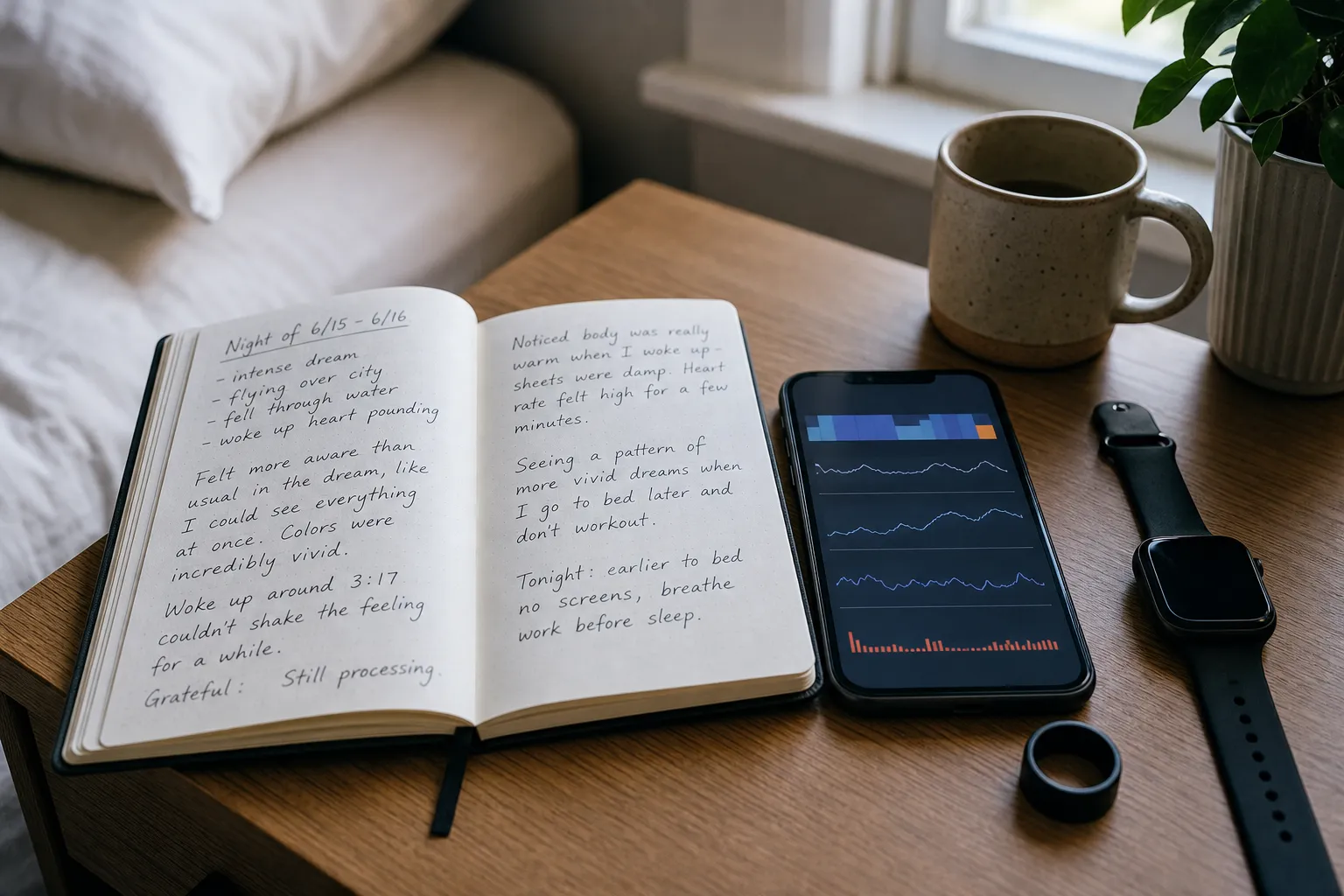
broader context
Moldavite context note
This narrower page makes more sense after the broader moldavite archive page.
What wearables can actually record around an astral report
Consumer sleep technology does not record “astral travel.” It records signals from the body and turns those signals into summaries. Depending on the device, that may include heart rate, heart rate variability, peripheral temperature, movement, breathing-related estimates, oxygen-related estimates, and app-labeled sleep stages.
For a spiritually curious user, the most useful role is timestamping.
A wearable may help you notice that a reported out-of-body experience happened:
- shortly after sleep onset;
- near a period the app marked as wakefulness, light sleep, or a REM-like window;
- during fragmented sleep;
- after a temperature deviation from your usual baseline;
- near a change in overnight HRV trends;
- after travel, alcohol, intense emotion, irregular sleep, or a stressful day.
That turns a vague note into a clearer one. Instead of writing only, “I left my body at 3 a.m.,” you might write: “I woke at 3:12 a.m. after a vivid floating sensation. The wearable marked wakefulness around that time, with elevated heart rate and lower HRV than my recent baseline.”
That is a better record. It is not a verdict.
Sleep-technology guidance generally treats consumer trackers as useful for observing patterns, while also noting their limits. Sleep-stage labels, HRV scores, and readiness-style summaries depend on sensors, algorithms, device fit, context, and manufacturer processing choices. A wearable can contextualize out-of-body wearable data. It cannot certify what the experience was.
HRV, peripheral temperature, and hypnagogic timing
The three data points most often brought into Biometric Astral Tracking are heart rate variability, peripheral temperature, and sleep or hypnagogic timing. Each can add context. Each can also mislead if treated like a hidden spiritual detector.
Heart rate variability trends
Heart rate variability is the variation in timing between heartbeats. Many consumer wearables estimate it through optical pulse sensors at the wrist or finger. In more controlled settings, ECG measures the heart’s electrical activity directly, while PPG estimates pulse-related changes through light. That ECG versus PPG difference matters because PPG-based readings can be affected by movement, contact pressure, sensor position, skin and circulation factors, and missing or noisy intervals.
For astral experience tracking, HRV is most useful as a trend, not as a single score. One low number after a vivid night does not prove stress, spiritual intensity, illness, or an out-of-body event. It may reflect poor sleep, late food or alcohol, emotional arousal, sensor artifact, a loose fit, or normal night-to-night variation.
If your overnight HRV pattern repeatedly shifts on nights when you report intense hypnagogic imagery or out-of-body sensations, it may be worth noting. The cautious interpretation is simple: your body-state pattern and your reported experience occurred near each other. The HRV value does not validate the metaphysical interpretation.
Peripheral temperature changes
Peripheral temperature is usually measured at the skin, often from a finger or wrist area. It can shift with sleep timing, circulation, room conditions, bedding, menstrual or hormonal patterns, alcohol, ambient temperature, and sensor contact.
A temperature deviation near an astral report may be interesting, especially if it appears alongside restless sleep or unusual timing. But peripheral temperature changes are broad signals. They do not identify hypnagogia, detect an out-of-body transition, or separate a spiritual interpretation from ordinary sleep physiology.
A useful journal line would be: “Peripheral temperature was above my recent baseline, and the experience happened after a restless segment.” That keeps the observation intact without making it carry more meaning than it can support.
Hypnagogic state clues
Hypnagogic shifts are transitional experiences around falling asleep. People may report imagery, floating sensations, body distortion, voices, flashes, vibrations, or a sensed presence during these border states. These experiences can feel powerful and may become part of spiritual practice.
Wearables, however, do not directly identify hypnagogia. They may estimate sleep onset, wake periods, movement, and broad sleep-stage windows. They can help you ask, “Was this experience close to sleep onset or a brief awakening?” They cannot say, “This was definitely hypnagogia,” and they cannot say, “This was definitely astral projection.”
That is one of the main astral experience tracking limits: the device may show timing around the threshold, but the inner content still comes from your report.
Why a biometric match is not proof
The common misunderstanding is treating a biometric coincidence as a ruling. A vivid out-of-body experience followed by a low HRV score can feel like confirmation. A temperature spike can feel like a marker. A sleep app labeling the period as REM can feel like an explanation. None of those pairings proves the metaphysical claim.
There are a few reasons:
- Consumer trackers estimate sleep from indirect signals. Most rings and watches infer sleep-related states from movement, heart rate patterns, HRV, temperature, and other available data. They are useful, but not exact.
- Algorithms shape the result. Two devices may process similar signals differently. One may smooth data across a longer window; another may emphasize a different part of the night.
- HRV measurement artifacts happen. Movement, poor contact, pressure on the sensor, and gaps in pulse detection can affect the reading.
- Subjective experience and biometric state are different categories. A wearable can record measurable body signals. It cannot observe the location of consciousness, the reality of a nonphysical environment, or the meaning of a spiritual encounter.
This does not make the experience meaningless. It means the type of validation has to be named carefully. Wearable data can support the statement, “Something in my sleep-wake pattern or body-state record lined up with the time I reported this.” It cannot support the stronger claim, “The device confirmed that my consciousness traveled outside my body.”
A responsible way to journal out-of-body wearable data
The best use of Biometric Astral Tracking is a restrained journal method. The aim is to preserve the experience, compare it with sleep timing context, and avoid overreading one metric.
Experience time
Record clock time, if known, or “near sleep onset,” “middle of night,” “upon waking.” Do not conclude exact metaphysical timing from it.
Subjective report
Record floating, vibration, presence, visual scene, body separation, fear, calm, or clarity. Do not treat the report as objective proof of travel.
Sleep context
Record app-estimated sleep, wake, restlessness, or sleep-stage window. Do not treat it as exact hypnagogic or REM identification.
HRV context
Record overnight HRV trend compared with your recent baseline. Do not turn one number into a verdict.
Temperature context
Record peripheral temperature deviation from your usual range. Do not treat it as a direct astral marker.
Possible confounders
Record stress, alcohol, late meals, travel, unusual bedtime, intense meditation, or feeling physically off. Do not use those factors as a reason to dismiss the experience automatically.
Reflection
Record personal meaning, symbols, emotional tone, and follow-up questions. Do not turn reflection into a scientific conclusion beyond the data.
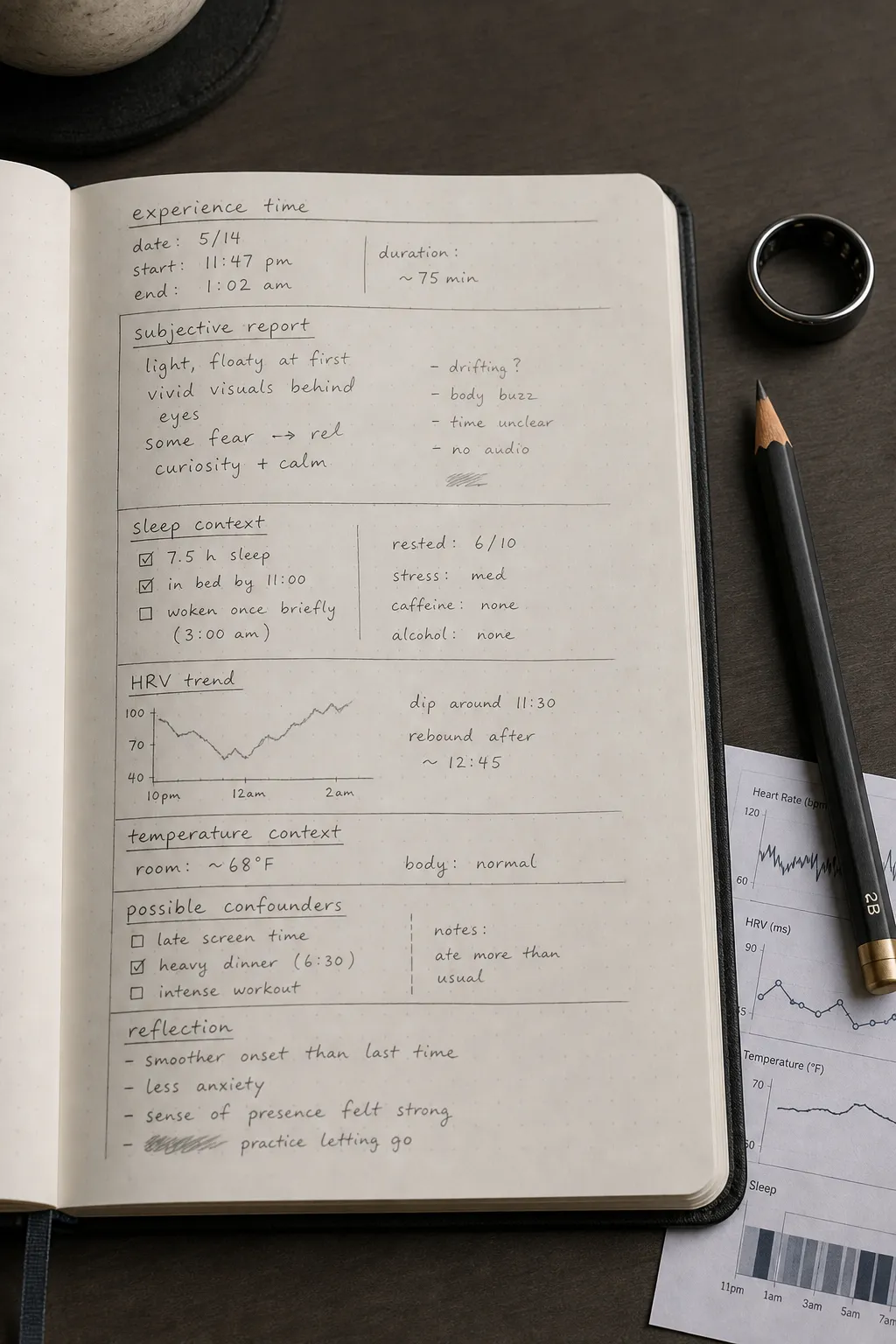
One useful habit: write the subjective report before opening the app. Then add the biometric data afterward. That reduces the chance that a score reshapes your memory of the experience. If you check the app first, an unusual HRV reading or sleep label may lead you to exaggerate, minimize, or reinterpret what you remember.
For patterns, compare similar nights over time. If you only examine the most dramatic nights, you may build a story from selective attention. A balanced journal includes ordinary nights, vivid dream nights, meditation nights, poor sleep nights, and nights with no unusual experience. That wider context makes it easier to see whether a wearable pattern is distinctive or simply part of normal variation.
When the answer needs more caution
Be more cautious when the data is sparse, noisy, or emotionally loaded.
If the device was loose, the battery was low, the sensor shifted, or the app shows gaps, do not lean heavily on that night’s HRV or temperature pattern. If you were awake and moving, PPG-based readings may be less stable than resting or sleep readings. If you compare two devices, expect differences in HRV, sleep-stage, and recovery-style summaries.
The answer also changes when the experience is distressing or paired with concerning physical events. If someone reports fainting, seizure-like episodes, severe panic, repeated sleep paralysis with major distress, neurological symptoms, injury risk, or persistent sleep disruption, it should not be interpreted only through astral language or wearable data. That situation deserves support from an appropriate professional.
Privacy also belongs in the answer. Sleep and body-derived data can reveal routines, stress patterns, sleep disruption, intimate habits, and health-adjacent inferences. A journal that combines spiritual notes with timestamps, sleep records, and physiological trends may be more sensitive than it first appears.
Practical boundaries include:
- share screenshots only with intention and consent;
- review app permissions before connecting third-party services;
- avoid uploading intimate spiritual notes into tools you do not trust;
- consider whether cloud storage, coaching platforms, or social features are necessary;
- keep only the level of data you actually use.
This is not legal advice. It is a basic privacy principle: the more personal the experience, the more carefully you should handle the biometric record around it.
What Biometric Astral Tracking should mean in practice
Biometric Astral Tracking is best understood as reflective tracking, not metaphysical verification. It can help you notice whether reported out-of-body experiences cluster around sleep onset, fragmented sleep, unusual overnight HRV trends, peripheral temperature changes, or wake-after-sleep periods. It can support a clearer journal and reduce vague memory reconstruction.
It should not become a personal courtroom where every HRV score, sleep-stage label, or temperature shift is forced into a spiritual conclusion. It is also not the same as a biometric visa tracking system, biometric entry-exit system, or identity surveillance infrastructure. Here, the term refers to personal wearable context around subjective experience.
The most balanced answer is this: 2026 smart wearables can help validate the timing and bodily context of an out-of-body report for personal reflection, but they cannot validate the out-of-body claim itself.
That boundary is not a dismissal. It is what keeps the practice honest. You can honor the experience, record the data, look for patterns, and still leave room for uncertainty. For many readers, that may be the most grounded form of validation available: not proof, not ridicule, but a careful record of what was felt, when it happened, and what the body was doing nearby.