Direct answer
Why Traditional Smudging Stains Your Raw Crystal
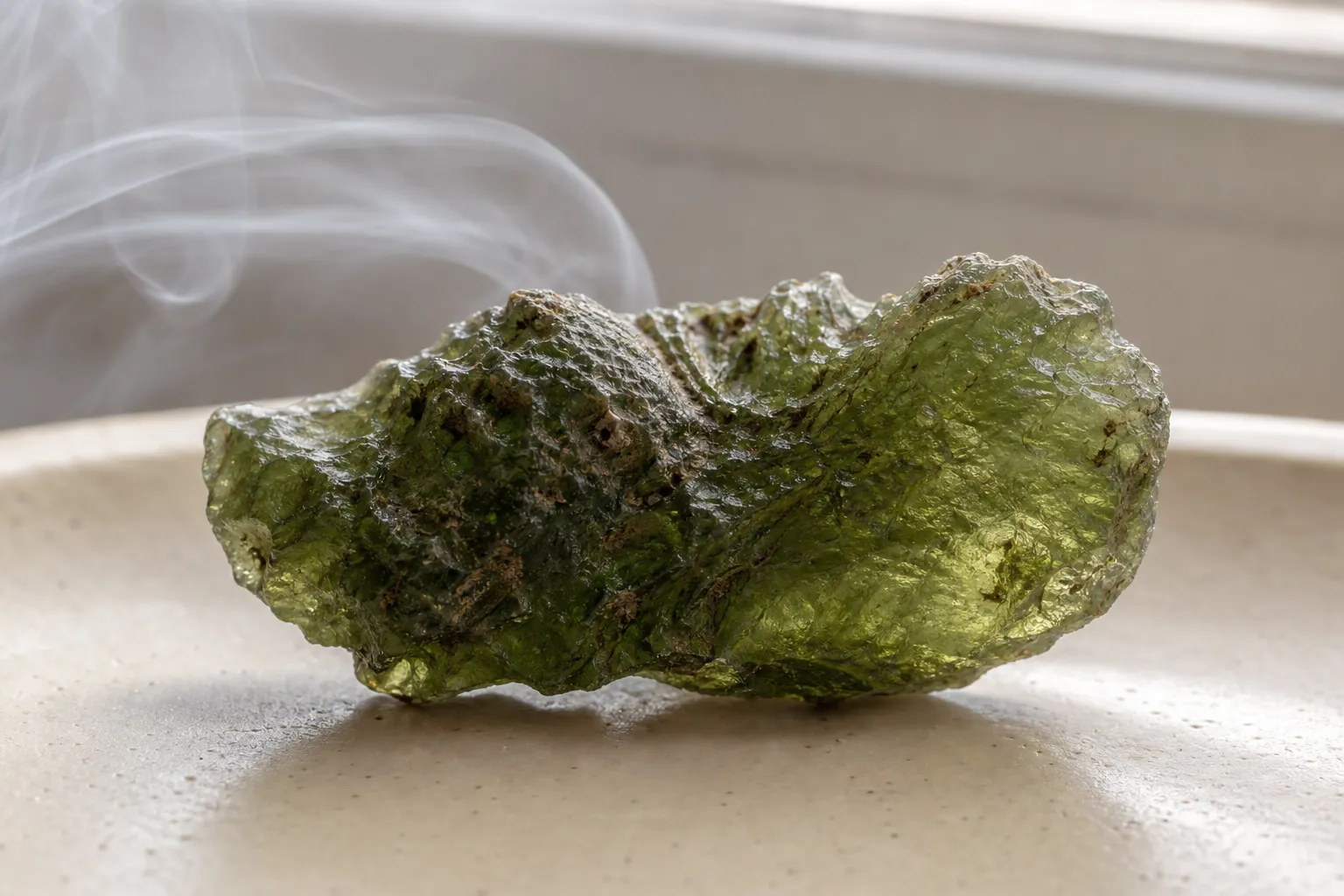
Traditional smoke-based moldavite smudging can leave visible residue on a raw crystal, but “stain” is often too strong as a first assumption. Smoke from white sage, palo santo, incense, resins, or mixed clearing materials may settle as a faint film, gray-brown mark, dark speck, or oily-looking deposit. On rough moldavite, that surface residue can look like discoloration even when it has not been shown to be a permanent change.
The practical issue is simple: smoke carries particles and condensates, and raw crystal texture gives them places to catch. A polished surface is easier to inspect and wipe evenly. A raw, pitted, ridged, or grooved piece is less forgiving.
broader context
Start with the main moldavite page
This narrower page makes more sense after the broader moldavite archive page.
The Short Answer for Raw Moldavite
Yes, moldavite smudging can create stain-like marks on a raw crystal, especially when the stone is held in dense smoke or exposed repeatedly. The more careful answer is that those marks should be treated as possible surface residue unless there is better evidence that the moldavite itself has been permanently altered.
That distinction matters for collectors. Raw moldavite often has natural grooves, tiny recesses, uneven relief, and dark-looking surface variation already. When smoke passes over the stone, residue may collect in low points. Under bright light, the result may appear as dulling, patchiness, darkening, or a thin smoky film.
This does not mean every white sage or palo santo ritual will mark a stone. The appearance depends on the smoke source, distance from the ember, airflow, exposure time, surface texture, handling oils, and how often the ritual is repeated.
If surface condition matters to you, avoid holding raw moldavite directly in a heavy plume. If the ritual matters to you, let the smoke move around the piece rather than coating it.
Why Smoke Can Look Like a Stain
“Stain” can describe several different things: a true material change, a removable film, soot-like residue, trapped dust, or a shift in how the surface reflects light after handling.
For raw crystal smudging stains, the most realistic concern is visible residue on a textured surface. Smoke is not just air. Depending on what is burned and how it burns, it may carry fine particles, scent-bearing compounds, and residue that can settle onto nearby objects. When people talk about “smoke oils on crystals,” they are usually describing an oily-looking film or lingering scent, not a confirmed chemical diagnosis.
The burn material can change how the residue appears. White sage, palo santo, incense, resin-heavy blends, and other clearing materials do not all burn the same way. Some produce lighter smoke; others produce heavier, darker, or more fragrant smoke. That does not prove one material permanently stains moldavite more than another. It does support a cautious rule: if the smoke leaves visible residue on bowls, shells, cloth, walls, or nearby surfaces, do not assume a raw crystal will stay visually unchanged.
Distance matters too. Passing a stone briefly through a dispersed plume is different from holding it close above a smoldering bundle, stick, or ember. Repetition also matters. One brief exposure may leave no obvious trace. Repeated smoke-based clearing may build a film that becomes easier to notice.
When the Risk Is Higher
A stain-like mark is more likely when several conditions overlap:
- The moldavite is raw, ridged, creased, or deeply textured.
- The smoke is dense, dark, or very close to the stone.
- The session is long rather than brief.
- The same piece is exposed repeatedly over time.
- The burned material leaves residue on nearby objects.
- The stone is handled with oily fingers before or after smoke exposure.
- The owner wants the surface to stay pristine for display, resale, or collection review.
The point is not that traditional smudging stains every raw crystal. It is that raw moldavite gives residue more places to sit. Once a dark speck settles into a groove, it may read as a stain even if it is only surface material.
There is also a difference between ritual tolerance and collector tolerance. Some owners may not mind a slight visual change if the piece remains meaningful to them. A collector focused on surface condition may care much more. In that setting, even a removable film can become a problem because aggressive cleaning can create its own risk.
Common Confusion Around Clearing and Surface Marks
A common misunderstanding is that “natural” smoke must be harmless to every crystal surface. Natural materials can still produce residue. The fact that white sage or palo santo is used in clearing rituals does not, by itself, answer how smoke behaves on raw moldavite.
The opposite mistake is assuming that any mark after smudging means the crystal has been permanently changed. That may also go too far. Without careful examination, it is more accurate to describe the mark as visible residue, dulling, discoloration, or a stain-like appearance.
There is a language boundary here. “Smudging,” “clearing,” “smoke cleansing,” and “moldavite clearing rituals” describe why someone uses smoke. The care question is narrower: does this practice put visible material onto this surface? Spiritual meaning and surface behavior should not be collapsed into the same claim.
Commercial or casual crystal-care language can blur that line. A claim that a bundle “clears everything safely” is not evidence that raw moldavite will stay clean. A claim that a stone “must” be smoked directly is also not surface-care evidence. For this page, the useful question is observable: will smoke leave residue where the stone can catch it?
A More Careful Way to Use Smoke Around Raw Moldavite
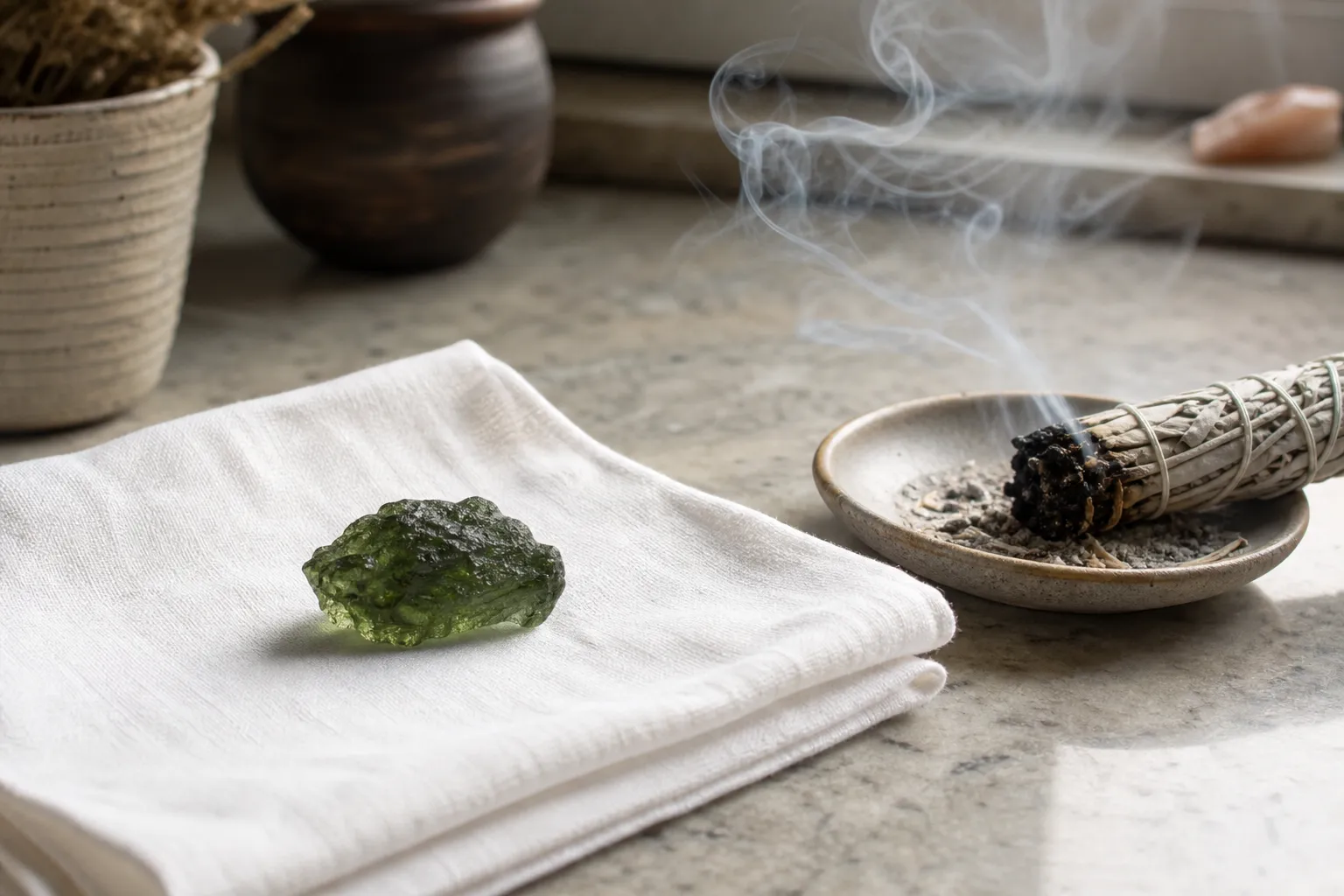
If you want to keep a raw crystal visually clean, keep smoke indirect. Let the smoke move through the space around the stone instead of placing the moldavite in the densest part of the plume. Use a short exposure rather than a long one. Do not rest the crystal on ash, charred wood, burned herbs, resin, incense powder, or any surface already coated in smoke residue.
If appearance matters, inspect the stone before and after any ritual under the same lighting. Many raw moldavite pieces already have shadows, dark recesses, natural variation, or dust in crevices. Without a consistent before-and-after view, it is easy to blame smudging for a mark that was already there, or to miss a new film because the light changed.
Avoid turning cleaning into a second problem. The current source set does not support a verified stain-removal method for moldavite smoke residue. That means this page should not prescribe solvents, abrasive scrubbing, soaking routines, heat, ultrasonic cleaning, or strong chemical cleaners as safe fixes. If the piece is valuable, fragile, unusually delicate, or important for collection purposes, use conservative handling and seek qualified gem, mineral, or conservation care advice before attempting anything forceful.
For everyday owners, the practical rule is simple: if you would be upset by a new dark speck, do not put raw moldavite in direct smoke. Use distance, brevity, and placement as your controls.
What the Evidence Does and Does Not Support
The available reference set for this page does not include usable public mineralogy sources, conservation guidance, culturally careful sources on smudging terminology, or attributable firsthand tests of smoke exposure on raw moldavite. That limits how strong the answer can be.
What can be said responsibly
- Smoke may leave visible residue that looks like staining.
- Raw or textured crystal surfaces may be harder to wipe clean than smooth surfaces.
- Dense, close, repeated smoke exposure is more likely to leave a visible film than brief, indirect exposure.
- White sage, palo santo, incense, and similar clearing materials should not be assumed residue-free.
- Ritual language does not prove material safety or a guaranteed spiritual result.
What should not be claimed
- That smudging permanently stains every raw moldavite piece.
- That white sage, palo santo, or smoke oils chemically damage moldavite.
- That any specific cleaning method is verified safe for removing moldavite smoke residue.
- That smoke clearing guarantees a spiritual effect.
- That a mark on raw moldavite can be diagnosed from appearance alone.
The honest answer is not “never smudge moldavite” or “smoke is always harmless.” It is this: direct traditional smudging can create visible residue on a raw crystal, and the rougher, closer, heavier, and more repeated the exposure is, the more cautious you should be.
Bottom Line
If your raw moldavite has a surface you want to preserve, treat moldavite smudging as a residue risk rather than a guaranteed stain disaster. Keep smoke indirect, avoid dense exposure, and do not assume that clearing language answers the material-care question.
White sage, palo santo, and other smoke-based rituals may be meaningful to some readers. Meaning does not make a raw crystal surface immune to film, soot-like deposits, or stain-like discoloration.
For a raw piece, the safest visual rule is simple: clear around the stone, not onto it.