Spotting 2026 Fakes: Using Handheld XRF Analyzers for Trace Element Verification
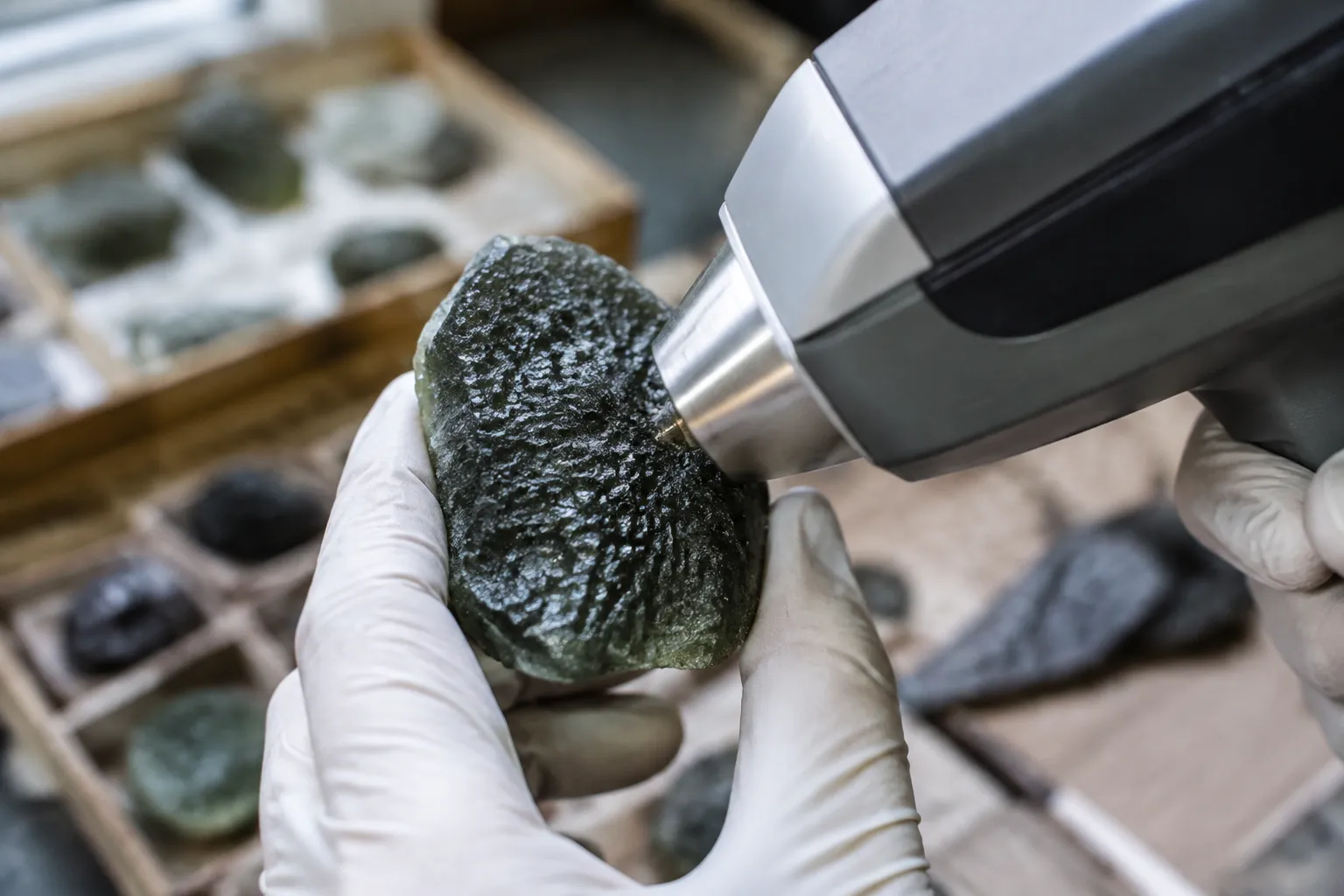
A Handheld XRF Analyzer can screen a suspected fake moldavite by producing a non-destructive reading of elemental patterns at the tested surface. If that reading conflicts with the comparison context, it may give a collector a concrete reason to pause and investigate the seller's description more closely.
The direct answer
It cannot authenticate moldavite on its own, establish locality, prove provenance, or determine value. A compatible reading is not a certificate of genuineness, and an unusual reading is not automatically a fake verdict. Natural moldavite composition varies, while portable XRF results depend on calibration, matrix effects, surface condition, measurement geometry, and the instrument's available element coverage.
Its useful role is narrower: an analyzer can turn a general suspicion into a specific question for further examination.
broader context
Broader moldavite archive
This narrower page makes more sense after the broader moldavite archive page.
What XRF Screening Can Contribute
Moldavite is a natural impact glass, or tektite, formed during an impact event rather than through ordinary volcanic processes. That history makes composition relevant to authenticity discussions, but composition is only one part of the assessment.
Portable X-ray fluorescence, commonly called XRF, measures characteristic X-rays emitted from material exposed to the instrument's X-ray source. In collector terms, it offers an elemental screen without cutting or otherwise destroying the specimen. Depending on the instrument configuration and measurement conditions, the result may include major elements and some trace elements.
A screen can be useful when it addresses a defined concern:
- Does the material show an elemental pattern that deserves closer investigation?
- Is the result stable enough to compare with a suitable reference context?
- Does the reading conflict with how the object has been represented?
- Is the uncertainty too high to treat the specimen as verified?
The analyzer does not pronounce on the specimen. It supplies one observable piece of information to consider alongside surface texture, overall form, documented ownership history, seller disclosures, and, where appropriate, laboratory characterization.
A suspicious elemental pattern is a reason to investigate. It is not the conclusion.
Why SiO2, Iron, and Zirconium Need Context
Collector searches often focus on SiO2 content, trace iron and zirconium, or the possibility of synthetic lead glass. These terms reflect a reasonable desire for an instrumental answer to a difficult market question. The available evidence for this page does not establish numerical thresholds or a dependable pass-or-fail range for those materials or elements.
Natural moldavite has compositional variation. One reading cannot show that a specimen came from a particular locality, and a familiar result for one element does not settle authenticity. The meaningful comparison depends on the reference material, the specimen, and the way the measurement was made.
Portable XRF has limitations of its own. Calibration affects how the instrument translates its signal into a reported result. Matrix effects describe how the material's overall composition can influence the measured signal for a particular element. A glassy, irregular, weathered, coated, or uneven surface may not behave like an idealized reference material. Position, angle, and the area presented to the instrument can also affect the sampled result.
A value described as “high,” “low,” or “missing” should therefore remain attached to its measurement conditions. The analyzer model, calibration or operating mode, surface condition, specimen shape, and element coverage all affect what the result can reasonably mean.
The current research does not establish a verified handheld-XRF signature for synthetic lead glass. It also does not establish dependable collector cutoffs for silica, iron, zirconium, lead, or instrument detection limits. Claims that one value proves a glass is artificial, or proves an impact-glass origin, go beyond the available support.
Screening Is Different From Authentication
The market often encourages quick categories: real or fake, local or imported, valuable or worthless. An XRF result does not answer all of those questions at once.
Elemental screening concerns the material measured. Authentication is the broader judgment of whether the object is what it has been represented to be. Provenance concerns its documented history and claimed source. Value is a market judgment shaped by factors beyond composition, including condition, size, visual character, locality claims, documentation, and collector demand.
These categories can inform one another, but they are not interchangeable.
Question
What a handheld XRF result may contribute
What it cannot settle alone
Does the specimen deserve closer examination?
It may reveal an inconsistency or uncertainty worth pursuing.
Whether the specimen is genuine moldavite.
Does the composition fit a claimed origin?
It may provide comparison data when suitable references exist.
Geographic provenance or locality.
Is the object a fake?
It may raise or lower concern about the material claim.
A final authenticity conclusion.
What is it worth?
It may add limited material information to a larger review.
Market value or collectibility.
Two mistakes are common. A broadly compatible result may be treated as proof, while a surprising result may be treated as disproof. Both responses overlook natural variation and the analytical limits of portable instruments.
A careful collector note would say that the result raises a question because it does not align with the comparison context used. It should not present the reading as a complete authenticity judgment.
A Practical Way to Read the Result
Treat an XRF result as the beginning of a review rather than its endpoint. The immediate decision is usually whether confidence should remain, decrease, or be deferred.
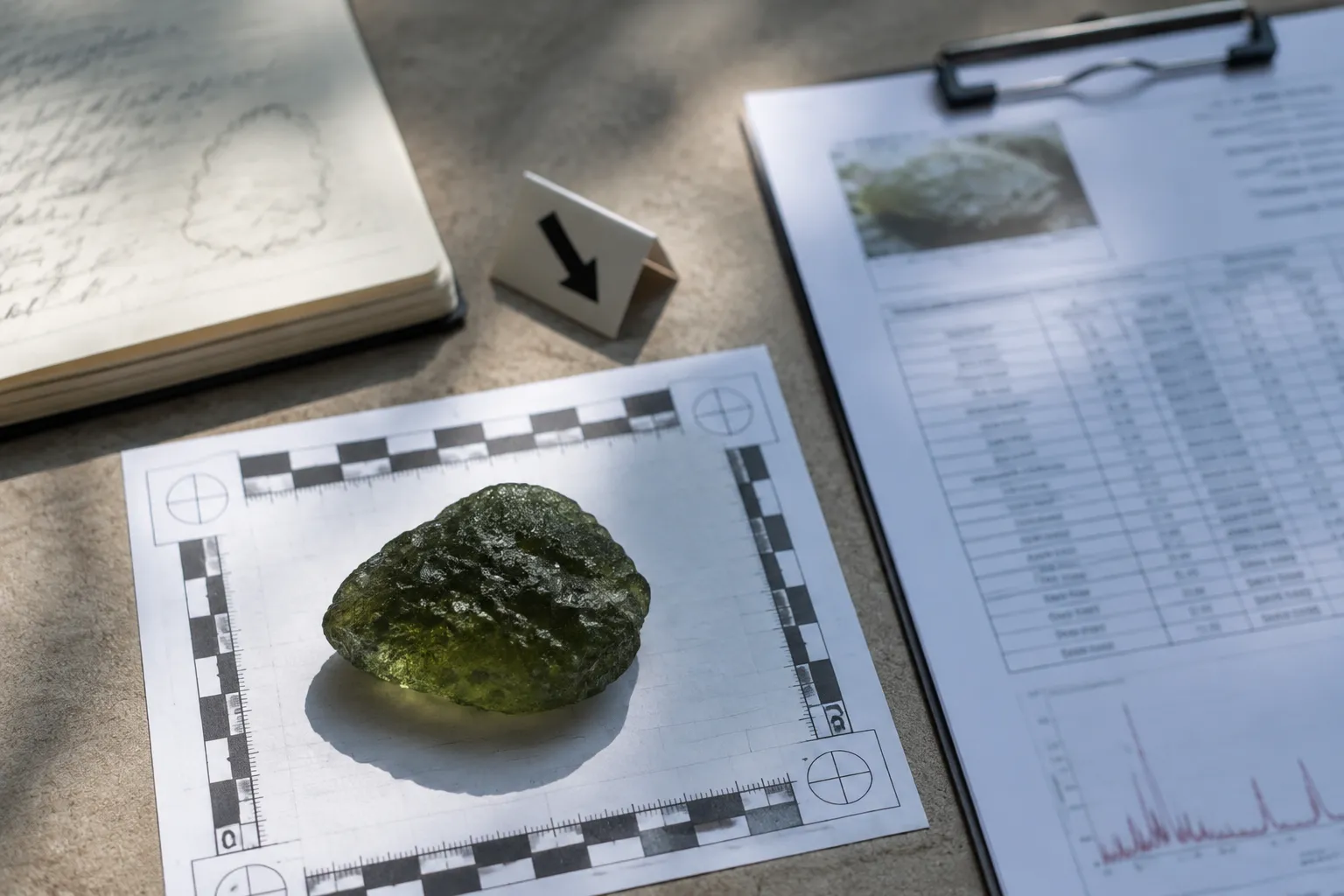
Record what was actually measured. Keep the instrument output, the stated calibration or mode if available, and an image of the exact surface tested. Without that context, a result becomes difficult to interpret later.
A useful distinction is:
No obvious concern from the screen
The reading did not show an immediate inconsistency within the comparison context used. That does not authenticate the specimen.
A result that warrants further examination
The elemental pattern may be unexpected; readings may change across surfaces; the surface may be difficult to measure; or the reference comparison may be uncertain. Preserve that uncertainty rather than turning it into an accusation.
A conclusion supported by broader evidence
A stronger assessment requires more than a handheld reading. Depending on the question, it may involve credible provenance records, closer inspection of specimen traits, comparison with well-documented material, or laboratory characterization suited to the claim.
Mounted, polished, repaired, coated, or otherwise altered specimens deserve particular caution. The analyzer measures the material presented to it under specific conditions; it does not automatically account for every layer or alteration affecting the surface.
Instrument handling also has to remain within its proper boundary. Handheld XRF devices involve radiation-related operating requirements. Follow the exact model documentation, trained-operation requirements, and applicable local rules. This page does not provide exposure or operating procedures, and a manufacturer manual is not independent evidence that a device can authenticate moldavite.
When Laboratory Characterization Matters More
Portable XRF versus laboratory characterization is not simply a choice between convenience and accuracy. The methods may address different levels of question.
A handheld analyzer can be useful when the immediate decision is whether a specimen deserves more scrutiny. It is portable, non-destructive, and capable of producing an elemental screen in a collector-facing setting. That may be enough to withhold confidence in a questionable item while additional evidence is gathered.
Laboratory characterization becomes more relevant when the claim carries greater stakes or requires stronger support: a confident origin assertion, a disputed authenticity question, a high-value transaction, or a composition claim that needs methods suited to the material. The available evidence does not validate a universal handheld-XRF authentication workflow for moldavite, so a collector should be cautious about anyone presenting one as a complete solution.
This does not make XRF useless. It defines its value correctly.
A well-documented specimen with plausible traits and credible history may remain more persuasive than an isolated instrument number. An XRF result that creates a clear inconsistency may still matter, even though it does not establish the specimen's status by itself. Specimen traits before seller language; provenance before certainty.
The Collector Takeaway
A handheld XRF analyzer can provide useful trace-element screening for suspected fake moldavite. It may identify an inconsistency, support a decision to withhold confidence, and give further examination a clearer starting point.
The limits are part of the result. Moldavite elemental composition varies, and portable XRF readings depend on calibration, matrix effects, instrument configuration, surface condition, and measurement conditions. The current evidence does not support numerical cutoffs for SiO2, iron, zirconium, lead, or a conclusive synthetic-lead-glass profile.
Use the reading as a screening record, not an authenticity certificate. The stronger collector judgment comes from the full picture: the impact glass itself, its documented history, the quality of the comparison, and the uncertainty that remains.