Moldavite experience boundary
Navigating the “Moldavite Flush”: Somatic Responses to High-Frequency Minerals
The Moldavite Flush Response is a crystal-culture phrase, not a medical or mineralogical category. People use it to describe reported sensations such as warmth, tingling, emotional intensity, dizziness, nervousness, or heart palpitations while handling or wearing moldavite. Those experiences may feel meaningful, but the available material for this page does not support saying that moldavite produces a measurable body effect, triggers a detox process, or changes the nervous system.
A safer reading is: someone noticed a sensation around moldavite and interpreted it through the language of crystal practice. If the sensation is intense, persistent, or medically concerning, treat it first as a body symptom, not as evidence that a stone is “doing” something.
That distinction matters because moldavite sits between several kinds of language. Collectors talk about it as a natural tektite. Crystal communities often frame it through transformation symbolism. Sellers may use phrases like “extreme high-frequency energy.” A reader searching for the reported moldavite flush response may be trying to make sense of a real sensation, but the explanation still needs to stay separate from the experience itself.

broader context
Broader moldavite archive
This narrower page makes more sense after the broader moldavite archive page.
What “Moldavite Flush” Usually Means
In moldavite communities, “flush” is usually a loose descriptive term. It may refer to warmth in the face or chest, a prickly feeling in the hands, restlessness, lightheadedness, a sudden emotional wave, or the sense that the stone feels “too strong” at first contact. The phrase blends body language, spiritual interpretation, and market vocabulary.
It is not a diagnosis. It is not a recognized physiological pattern. It is not a confirmed effect that can be assumed from owning or touching moldavite.
A useful way to read the phrase is through three layers:
Sensation
What someone says they felt, such as warmth, tightness, tingling, racing thoughts, or palpitations.
Meaning
How they interpret it, such as emotional significance, symbolic transformation, overstimulation, or anxiety around a powerful object.
Evidence
What can be supported, which is limited here to reported interpretations rather than established effects caused by moldavite.
Those layers should not be collapsed into one claim. “I felt something while holding moldavite” is a personal report. “Moldavite caused a physical reaction in my body” is a much stronger statement. “Moldavite’s extreme high-frequency energy reset my body” goes further still, and this page does not have evidence to support that kind of mechanism.
Why the Same Moment Can Feel So Different
A reported flush can feel real to the person having it. The careful question is not whether someone is allowed to describe their own body. The question is what that description can responsibly be said to mean.
Expectation can shape the experience. Moldavite has a strong reputation in crystal spaces, and someone who has already heard that it is unusually intense may notice ordinary body cues more sharply. Setting can also matter: a quiet ritual, a dramatic seller description, a social media story, or the excitement of acquiring a new specimen can all change how a person monitors and interprets sensations.
Physical state matters too. Fatigue, stress, caffeine, dehydration, anxiety, crowded environments, and existing health concerns can all make warmth, shakiness, dizziness, or palpitations more noticeable. None of these possibilities proves what happened in a specific case. They simply show why it is too narrow to attribute reported somatic reactions to moldavite itself.
The stone can still carry personal meaning. Someone may decide that the timing marked a moment of reflection, grief, change, or heightened attention. That symbolic reading belongs in the meaning layer. It should not be presented as a confirmed bodily effect.
More grounded
“I noticed a strong body sensation while using moldavite, and I personally read it as significant.”
Less grounded
“Moldavite produced a proven physical reaction in my body.”
The first sentence keeps experience and interpretation visible. The second turns a subjective report into a claim about cause and mechanism.
When Heart Palpitations Are Part of the Story
Heart palpitations need a firmer boundary because people may use that phrase for fluttering, racing, pounding, skipped beats, or unusual awareness of heartbeat. In moldavite communities, those sensations are sometimes folded into the flush narrative. That is where the interpretation should slow down.
If someone feels palpitations while holding or wearing moldavite, the safest reading is not “the stone is working.” It is “this is a body signal with many possible explanations.” The presence of moldavite in the moment does not establish cause. The experience may be coincidental, stress-related, expectation-shaped, environment-related, or connected to something that deserves medical evaluation.
A practical boundary
This does not mean every brief flutter is an emergency. It means the stone should not become the explanation that blocks attention to the body. Chest pain, fainting, shortness of breath, severe anxiety, persistent palpitations, or any symptom that feels alarming should be handled as a health concern rather than assigned to moldavite language.
You can still note that the timing felt symbolically charged. You can still step away from the stone if the association feels overwhelming. But the practical next step should stay grounded: pause the session, reduce stimulation, notice whether symptoms continue, and seek appropriate medical evaluation when symptoms are serious, persistent, or unusual for you.
The Limits of “Extreme High-Frequency Energy” Language
Moldavite high-frequency language is common in spiritual and sales spaces. It often works as mood, metaphor, branding, or belief vocabulary. It may signal that a community treats moldavite as intense, fast-moving, disruptive, or transformational. It does not establish a measurable energy mechanism.
The phrase can sound precise while remaining undefined. “High frequency” may be used spiritually without explaining what is being measured, by what method, under what conditions, or compared with what baseline. When attached to body sensations, it can make unverified moldavite response patterns sound more certain than they are.
A careful reader can translate the phrase without accepting every implication. In community descriptions of moldavite, “high-frequency” often means something closer to “experienced or marketed as intense.” It does not need to be repeated as the reason someone felt heat, tingling, anxiety, or palpitations.
The same caution applies to moldavite sales vocabulary. If a listing or post suggests that intense bodily reactions are expected, necessary, cleansing, or proof of authenticity, that is not a reliable standard. A strong sensation does not verify a stone. A lack of sensation does not disprove one. Authenticity belongs to material examination and provenance, not to whether the buyer feels flushed.
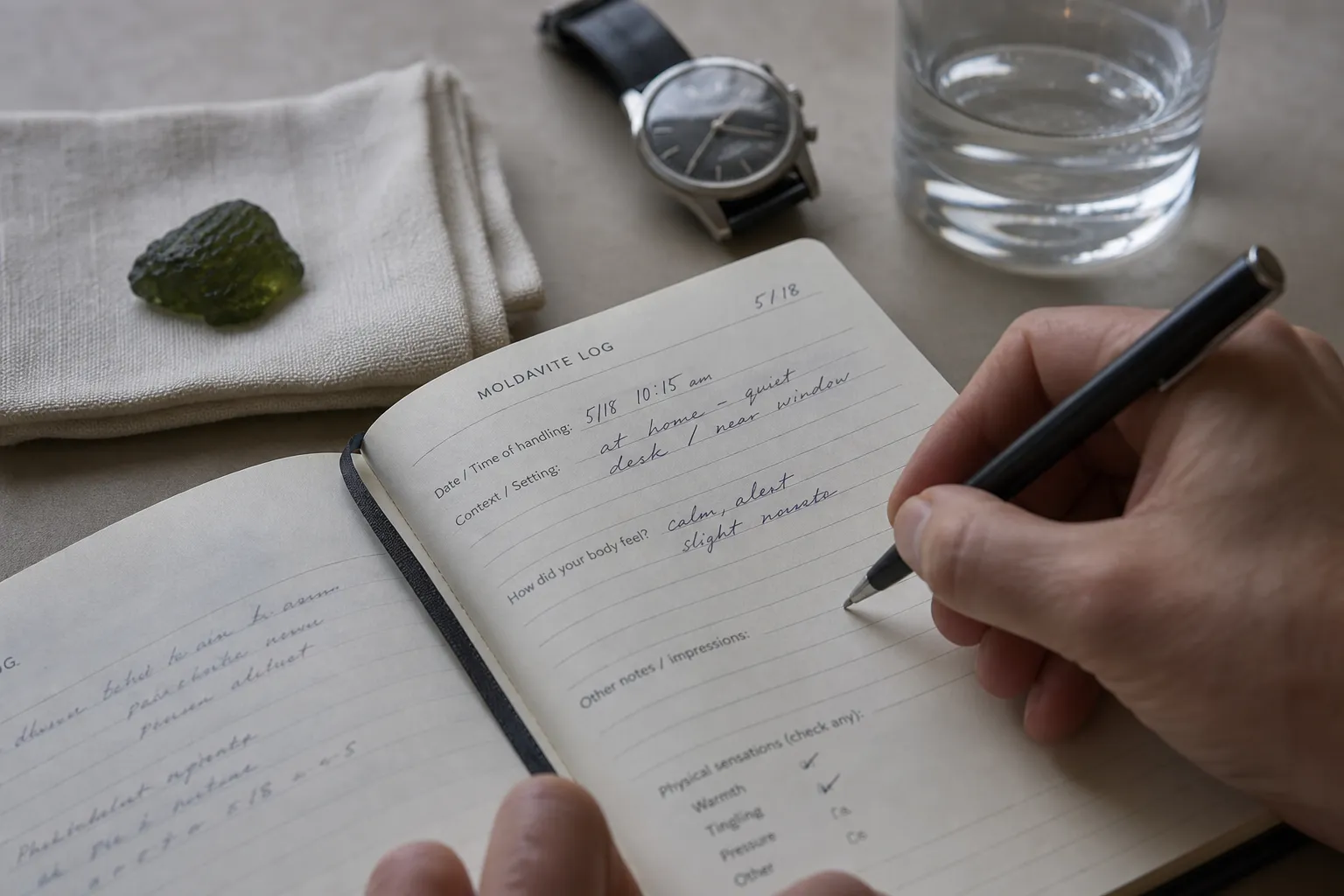
How to Navigate a Reported Moldavite Reaction
The most useful response is neither dismissal nor exaggeration. Treat the sensation as information, but do not rush to make it a conclusion.
Start with the plain description. What happened? Was it warmth, pressure, tingling, a racing heart, emotional unease, dizziness, or something else? How long did it last? Did it happen once, repeatedly, or only after reading intense claims about moldavite? Was anything else present: stress, caffeine, lack of sleep, a crowded shop, a meditation session, or fear that the stone might be “too much”?
Then separate action from interpretation. If the sensation is mild and passes quickly, a person may choose to pause, put the stone down, or avoid turning the moment into a dramatic rule. If the sensation is distressing or involves concerning symptoms, the next step should not be a deeper energetic explanation. It should be attention to health and safety.
A restrained personal record can note:
- what you were doing when the sensation started
- whether you had read or heard strong claims beforehand
- whether the sensation continued after removing the stone
- whether similar sensations happen in non-crystal contexts
- whether symptoms were intense enough to need medical attention
This kind of note-taking does not prove or disprove a moldavite response. It simply prevents one charged moment from becoming a fixed belief too quickly.
It also protects the symbolic side of the experience. When every sensation is immediately labeled as evidence of “extreme high-frequency energy,” there is less room for quieter questions: Was I anxious? Was I excited? Did the object carry meaning because of its story, rarity, cost, texture, color, or reputation? Did the moment invite reflection without needing to become a health claim?
What This Page Can and Cannot Say
This page can say
The Moldavite Flush Response is a reported term used around moldavite experience language. People describe bodily sensations in that context. Those descriptions should be handled carefully, especially when they involve palpitations or other symptoms that could matter medically.
This page cannot say
Moldavite causes flushing, dizziness, anxiety, heart palpitations, detox, or any measurable physiological effect. The source set available for this article does not provide usable public references or authoritative support for those claims.
Padding the answer with weak links, commercial claims, or scattered social posts would make the topic look more certain than it is.
That does not make the topic useless. It makes the boundary clearer. The reported moldavite flush response is best read as a cultural and personal interpretation phrase unless stronger evidence becomes available. It may describe what someone thinks happened around moldavite. It should not replace medical interpretation, authenticity testing, or careful self-observation.
For a reader deciding what to do next, the practical answer is simple: take the sensation seriously without automatically taking the moldavite explanation literally. Pause use of the stone if the association feels uncomfortable. Treat severe or persistent symptoms as health symptoms. Keep personal meaning personal, and keep causal claims modest.
Short Answers to Common Follow-Up Questions
Is the Moldavite Flush Response proof that my moldavite is real?
No. A reported body sensation is not a reliable authenticity test. Moldavite authenticity should not be judged by whether someone feels warmth, tingling, emotional intensity, or palpitations.
Does no reaction mean moldavite is not meaningful?
No. Within crystal-culture language, people may interpret moldavite differently, but the absence of a sensation does not prove anything about the stone’s value, authenticity, or symbolic meaning.
Should I keep wearing moldavite if it makes me feel unwell?
If wearing or holding it is associated with discomfort, it is reasonable to stop and observe what happens. If symptoms include chest pain, fainting, shortness of breath, severe anxiety, persistent palpitations, or anything that feels concerning, treat that as a health matter rather than a moldavite milestone.