Moldavite authentication boundary
The “Angel Chime” Test: Risky Rituals for Rare High-Tension Stones
Short answer: Angel Chime Moldavite is not a verified gemological category, and a ringing sound is not reliable proof that a piece is genuine moldavite. The evidence reviewed for this page does not support dropping, tapping, or listening for a clear “angel chime” as a way to confirm origin, quality, value, or special properties.
Moldavite is a natural impact glass, and individual pieces can contain varied internal features. Stressing a rare specimen to get a sound is a poor tradeoff: the result tells you little, while the impact or contact can damage the piece. Treat the Angel Chime test as ritual, collector, or marketplace language—not as authentication.
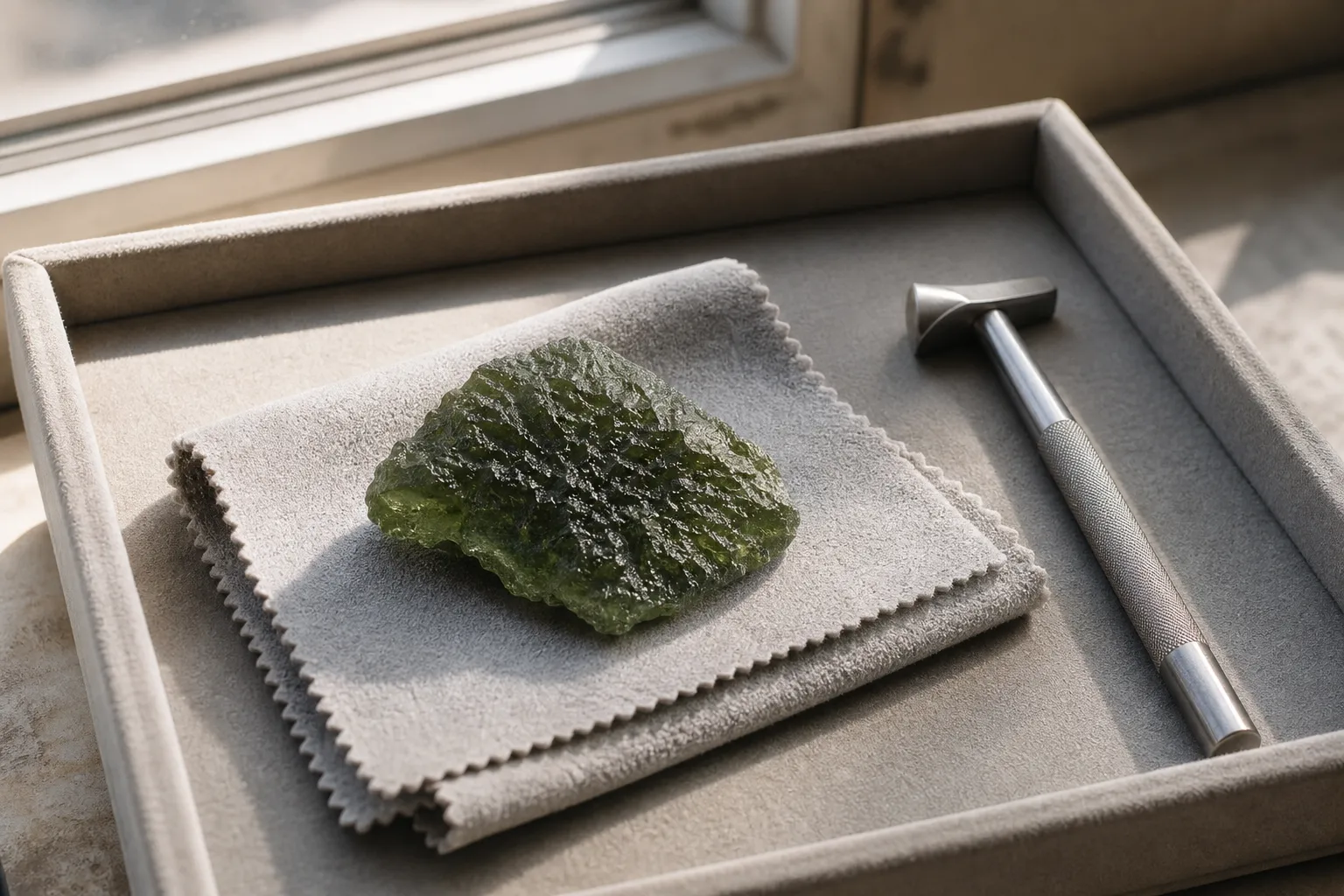
What “Angel Chime Moldavite” seems to mean
“Angel Chime Moldavite” appears to be a search phrase or cultural label, not a technical name. It usually points to the idea that some moldavite pieces make a delicate, bell-like sound when tapped, suspended, or dropped, and that the sound means something about authenticity or quality.
That claim has a weak foundation.
The moldavite-specific research reviewed here discusses internal structure, pores, bubbles, flow textures, strain-related observations, and laboratory imaging. It does not define “Angel Chime Moldavite,” and it does not describe a consumer sound test for identifying real moldavite.
A ring is also not unique to moldavite. A brief historical note in Nature described how some hard, compact stones can sound when struck, with tone affected by form and structure. That comparison is useful only as a reminder: many hard objects can produce sound under the right conditions. It does not mean moldavite should be struck, and it does not make a ringing stone moldavite.
The word “angel” belongs to symbolic or ritual language. It may be meaningful to a person’s relationship with a piece, but it does not turn a sound into a diagnostic feature.
Why a chime is not a moldavite authenticity test
An authentication method needs a reliable link between what you observe and what the material actually is. The Angel Chime test does not have that link.
Ordinary variables can change the sound of a small object
- Size and thickness
- Shape and edge geometry
- Whether it is loose, mounted, held, or suspended
- Where and how it is contacted
- Surface condition
- Cavities, cracks, or repairs
- The hardness of the object touching it
That means a ring is not a fingerprint.
For moldavite, the better-supported material facts point away from casual sound testing. A 2014 study in Materials used X-ray micro-computed tomography and optical microscopy to examine moldavite samples. It reported variation in pore size, pore shape, pore distribution, flow textures, and strain-related observations. It also showed that different methods reveal different internal features.
That matters because moldavite can be internally complex. It does not mean that complexity can be safely or reliably heard by tapping a specimen. The research supports controlled, non-destructive examination when internal structure matters—not listening for a chime at home.
A clear tone might come from a compact shape. A dull sound might come from how the piece is held. A lack of ringing might reflect geometry rather than falseness. A ringing sound might come from another glassy or hard material. None of those outcomes gives a collector reliable proof.
So the practical conclusion is narrow but firm: a moldavite sonic test is not a reliable authenticity test.
The problem with tapping or dropping moldavite
The riskiest version of the Angel Chime claim is the idea that someone should drop moldavite or strike it to prove something. That turns an unverified belief into a destructive test.
Moldavite is glassy material formed in an impact context. The available moldavite research supports caution around internal variation: pores, bubbles, flow features, and strain-related observations can occur, and samples may differ noticeably. Those facts do not let anyone predict exactly how a specific piece will respond to impact. They do make stress-testing a bad verification habit.
A pendant, bead, carving, or raw specimen may already have thin edges, natural pits, surface etching, hidden fractures, repaired areas, or mounting stress. A drop test adds impact. A tap test concentrates force at one point. Even if the piece survives, the test has not proved authenticity; it has only shown that the object tolerated that one event.
That is the central problem with risky moldavite testing: the possible benefit is weak, while the downside is real. You may chip an edge, open a fracture, loosen a setting, or damage a specimen that would have been better preserved.
If the question is “Should I drop moldavite to hear whether it rings?” the answer is no. The evidence reviewed here gives no reason to do that, and the result would not solve the authentication problem.
“Internal tension” cannot be diagnosed by ear
The phrase “internal tension” often makes the Angel Chime story sound more technical. It suggests that a ringing or non-ringing piece is revealing hidden stress, purity, or structural truth. That is where the claim becomes especially misleading.
Moldavite research does discuss internal features and strain-related observations, but in controlled characterization work using specialized methods. It does not propose that a buyer can identify internal tension by tapping a specimen and listening.
Supported in a limited scientific context
Moldavite can contain internal pores, flow textures, and strain-related features.
Not supported by the reviewed evidence
A person can hear those features accurately through a casual chime test.
The first statement is supported in a limited scientific context. The second is not supported by the evidence reviewed for this page.
A pendant can sound different from a loose fragment. A thin piece can behave differently from a thicker nodule. A suspended object can ring more freely than one held between fingers. Those differences do not create a moldavite verification standard.
If “internal tension in moldavite” is being used to justify striking, dropping, or stress-testing a piece, treat the language with caution. It borrows a scientific tone, but the proposed test is not backed by moldavite-specific evidence.
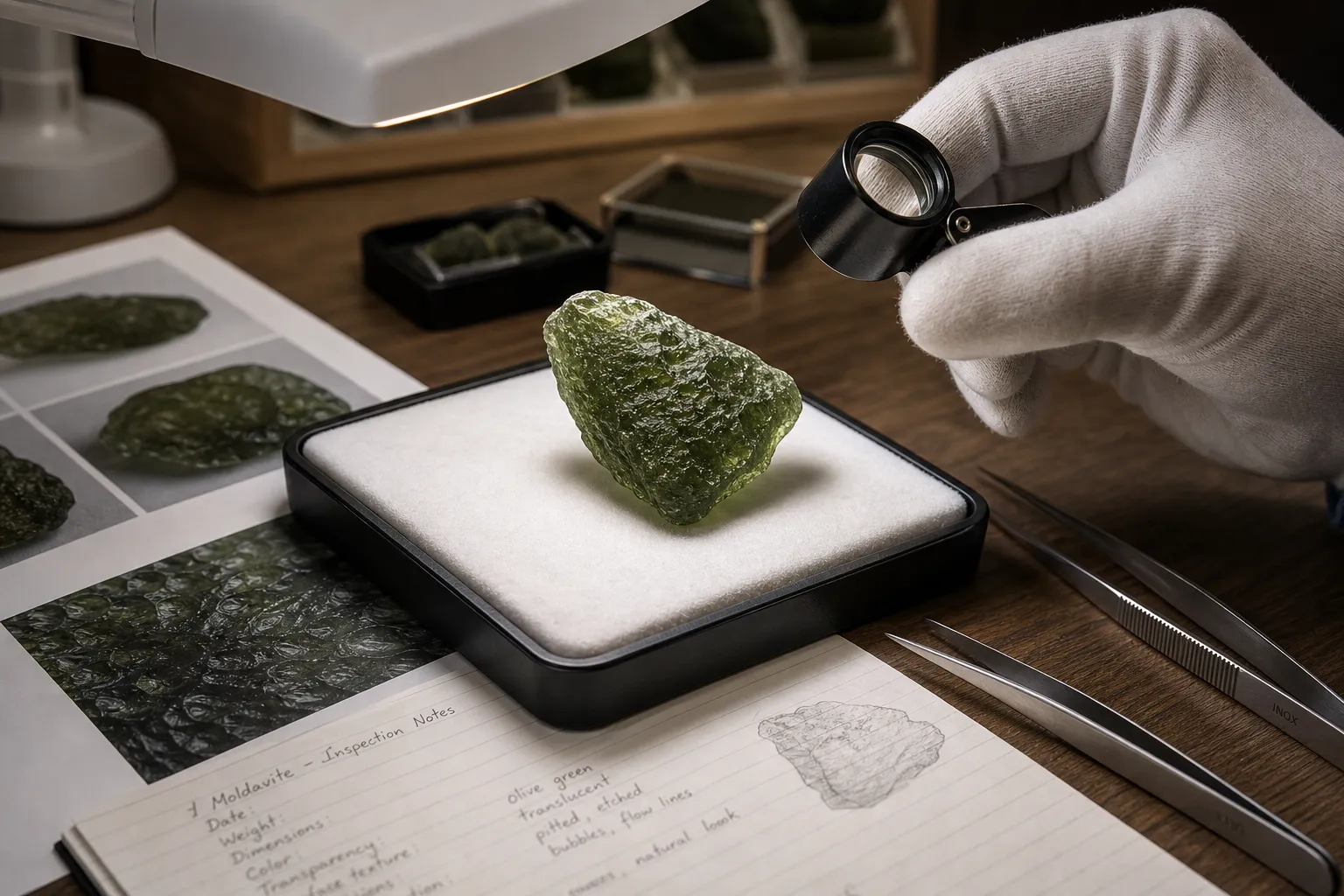
What to do instead if you are unsure
This is not a full moldavite authentication guide, but the boundary is clear: do not replace verification with a sound ritual.
A more careful path is non-destructive
- Preserve the piece; do not drop, strike, heat, scrape, or pressure-test it.
- Keep seller information, locality claims, invoices, and photographs.
- Inspect under good light for visible features, damage, coatings, or suspicious uniformity, without treating any single feature as final proof.
- For a valuable, rare, or disputed piece, seek qualified non-destructive assessment from a relevant gemological, geological, or conservation-minded source.
- Be cautious with listings that use sound, vibration, or dramatic ritual language as proof.
The goal is not to remove symbolic meaning from moldavite. Someone may enjoy describing a piece as having a beautiful chime. That is personal language. The problem begins when that language is used to authenticate, rank, or sell the specimen.
Where the Angel Chime claim may still fit
There is one harmless use: description. If someone says a piece has an “angel chime” because they like the sound, the phrase is poetic. If a collector casually says “ringing stone” to describe a clear tone, that is not the same as making an authenticity claim.
The meaning changes when the phrase is used as proof.
Based on the current source picture
- “Angel Chime Moldavite” is not a validated technical category.
- A ringing sound does not prove authenticity.
- A dull sound does not prove a piece is fake.
- Dropping moldavite is not a responsible verification method.
- Tapping can still stress thin, fractured, mounted, or rare pieces.
- Internal structure is better approached through non-destructive assessment, not sound folklore.
Bottom line
The Angel Chime test is best treated as an unverified ritual or marketplace claim, not a moldavite authentication method. Moldavite can have complex internal features, but serious examination relies on controlled, non-destructive methods—not casual ringing, tapping, or dropping.
If you already own a piece, preserve it. If you are considering a purchase, do not pay more because a seller says it “chimes.” A rare stone should not have to survive a risky performance to prove what it is.