Moldavite authenticity
Paper Promises: Why Certificates of Authenticity (COA) Are Worthless Without Physics
A moldavite Certificate of Authenticity is not proof by itself. It is a trust signal: a written claim that someone says the stone is what the label says it is.
That claim becomes useful only when it is tied to the exact specimen, a credible trail of sourcing or ownership, and some form of physical verification. Without those anchors, even a polished COA can be copied, reused, vaguely worded, or separated from the stone it was supposed to describe.
That is why Fake Certificates can feel persuasive. They borrow the look of authority while leaving the material question unanswered.
For a moldavite buyer, the rule is simple: paper can support evidence, but it cannot replace it.
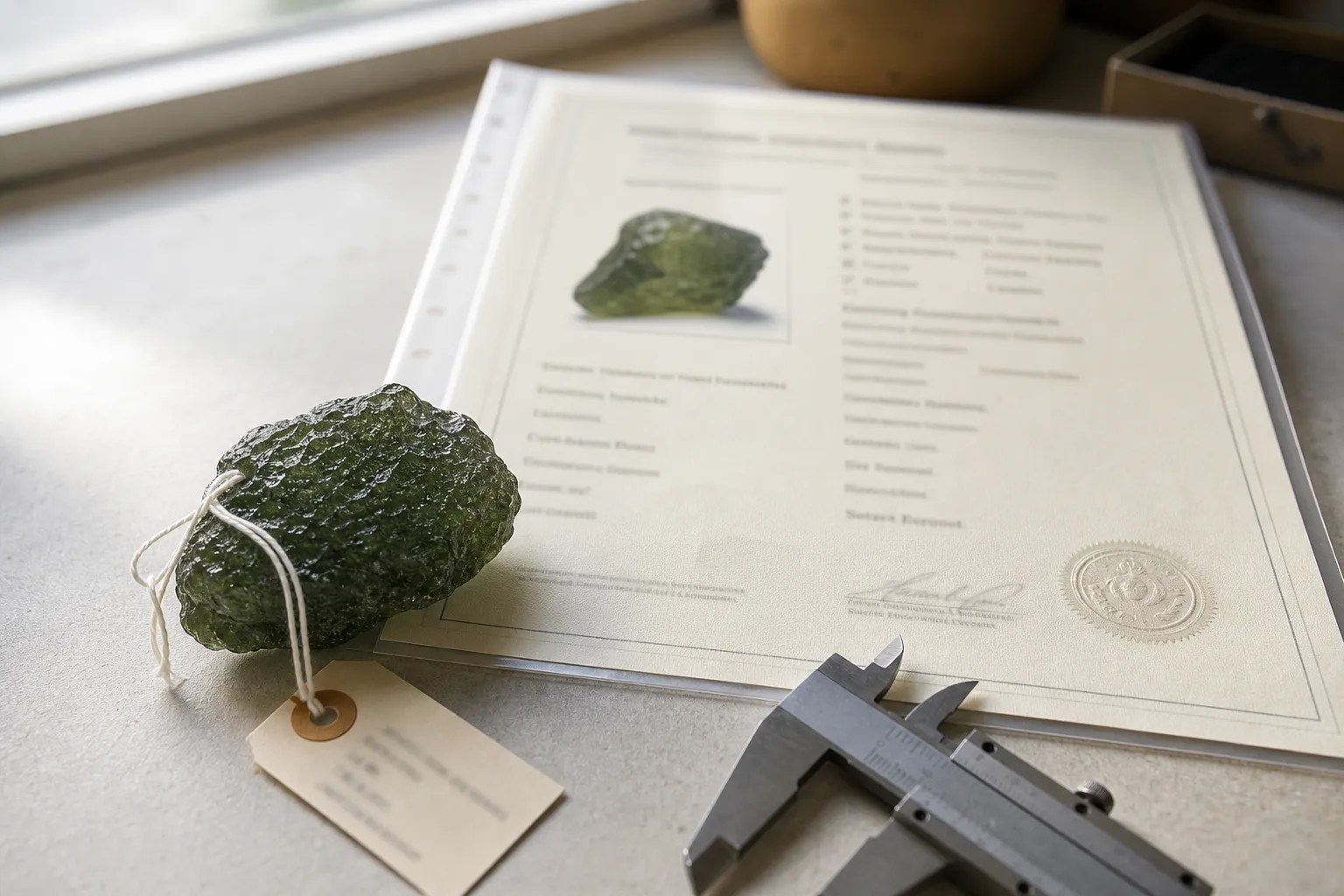
What a COA can actually tell you
A Certificate of Authenticity can be useful, but only in a limited way. At best, it records that a seller, dealer, lab, platform, or issuer made a claim about an item at a particular time.
A stronger COA may include:
- weight
- dimensions
- photos of the exact piece
- an item or invoice number
- seller or issuer identity
- a date
- a stated origin or sourcing note
- a route for checking the certificate later
Those details help you compare the paperwork against the stone in front of you.
That is not the same as proving moldavite authenticity.
A useful certificate should answer three plain questions:
- What exact object does this document describe?
“Natural moldavite pendant” is weak. A specific photographed pendant with weight, size, and item number is stronger. - Who is making the claim?
A real issuer, seller identity, or verification route matters more than a decorative seal. - What supports the claim?
“Authentic” by itself is a printed guarantee. A document that explains what was examined, how it was linked to the item, and how the claim can be checked is more useful.
Even then, the COA remains supporting paperwork. It does not become the stone. It does not carry the stone’s physical properties. It does not prevent a mismatch, swap, copy, or vague attribution.
Paper authenticity is not object authenticity
One common mistake is treating the certificate and the moldavite as the same evidence problem. They are not.
A document can be genuine while the object is questionable. A document can be fake while the object is genuine. A real document can be attached to the wrong item. A vague document can be so broad that it cannot be meaningfully checked against anything.
Verifying the paper only tells you something about the paper. It does not automatically verify the object.
A COA may have a logo, signature, stamp, serial number, QR code, and careful wording. Those features may make it look official, but they do not answer the physical question: does the object itself support the claim being made about it?
For moldavite, that question belongs to the specimen and its context: observable characteristics, consistency with the listing, traceable sale information, and any credible independent verification available.
This page is not claiming that one visual cue, one test, or one certificate style can settle moldavite identification. The narrower point is more practical: a COA without object-level evidence should not be treated as proof.
When a certificate becomes more useful
A certificate becomes more valuable when it is hard to detach from the exact stone it describes. The issue is not that paperwork is always useless. The issue is that paperwork needs anchors.
Clear photos of the exact piece
Makes it harder to reuse the same certificate for another stone.
Weight, size, shape, and setting details
Helps show whether the document matches the item.
Invoice or transaction link
Connects the COA to a real sale event.
Named issuer or seller
Gives the buyer something checkable beyond a stamp.
Specific provenance notes
Helps explain where the item is said to have come from.
Independent verification option
Gives the claim a route outside the seller’s own wording.
None of these anchors is perfect alone. Photos can be copied. Serial numbers can be invented. Provenance can be incomplete. A seller can be sincere and still provide weak documentation.
Together, though, these details create friction against misleading certificates. They make the claim easier to check and harder to recycle.
The weakest COA is one that could sit next to hundreds of similar stones and still seem to apply. A stronger COA is one that would look obviously wrong if attached to a different piece.
Why “looks official” is a poor test
Many certificates use the same visual language: gold seals, borders, cursive signatures, stamp-like graphics, QR codes, laboratory-style phrasing, and phrases such as “guaranteed genuine.”
Those elements may feel reassuring. They are not evidence by themselves.
A paper promise works because it reduces uncertainty. Buying moldavite can feel confusing, especially for new buyers who have seen warnings about imitations, vague listings, and inflated claims. A COA gives the buyer something concrete to hold.
That is exactly why it should be read slowly.
Ask what the certificate actually says, not what it implies. “Certified authentic” sounds strong. “Natural moldavite” sounds strong. “Guaranteed” sounds strong. But if the document does not say who checked it, what was checked, how the item is tied to the document, and how the claim can be checked later, much of that strength is visual.
This is where COA fraud and misleading certificates become difficult for ordinary buyers to evaluate. The problem is not always an obviously fake-looking document. Sometimes the problem is vagueness: formal-looking paper with very little checkable information.
You do not have to accuse anyone to notice that the paperwork is thin.
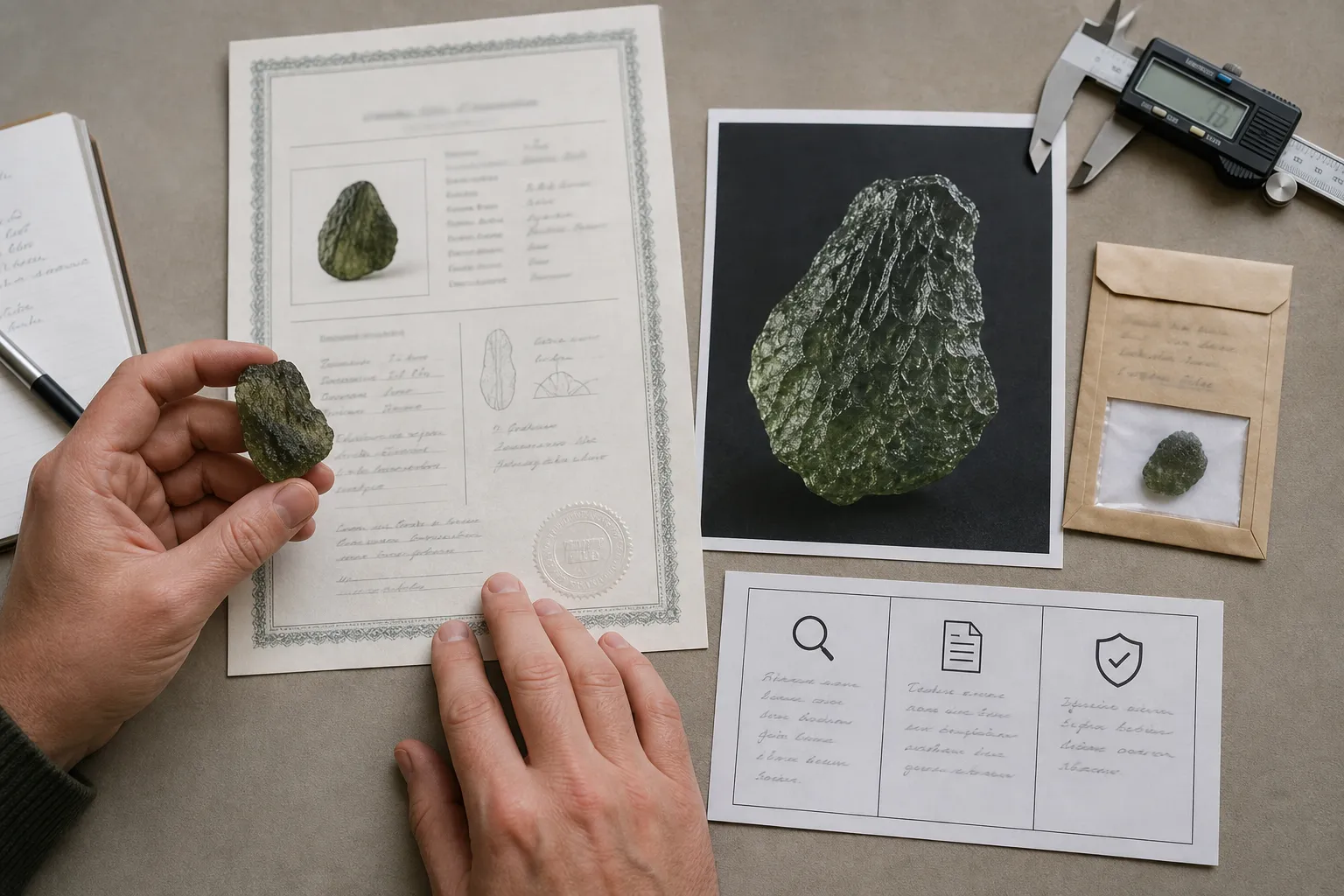
A three-part check for a moldavite COA
Before giving much weight to a certificate, run it through a simple check.
1. Does the certificate match this exact object?
Compare the paperwork to the item itself.
Does the weight match? Do the dimensions make sense? Is the shape identifiable? If the stone is set in jewelry, does the certificate describe the setting, or only a loose stone? Are there photos of the actual specimen, or only a generic image?
A certificate that cannot be matched to the object is weak, even if it looks polished.
2. Can the issuer be checked?
A certificate is stronger when the issuer is identifiable and reachable.
A name without a verification route is limited. A logo without a source is limited. A QR code that leads to a generic page, sales page, or dead link is limited.
This does not mean every moldavite purchase requires a formal laboratory report. It means the buyer should understand who is making the claim and whether that claim can be traced back to them.
3. Is there evidence beyond the seller’s assertion?
Seller transparency matters, but a seller’s own certificate is still self-issued paperwork unless other details support it.
Useful support may include consistent product photos, matching invoice details, clear return terms, documented sourcing claims, and a realistic route for independent review.
The key is consistency. The paperwork, listing, seller explanation, and object should tell the same story. If the certificate says one thing, the listing says another, and the stone is described only in broad terms, the COA is doing more decorative work than evidentiary work.
What a COA cannot do
A certificate cannot rescue a poorly documented purchase. It cannot turn vague provenance into solid provenance. It cannot prove that a stone is moldavite just by using the word. It cannot show that the object has not been swapped after the document was made. It cannot make an opaque sale transparent.
It also cannot settle every technical question a buyer may have. Exact moldavite identification, geological locality, and laboratory methods belong in specialist resources with appropriate evidence.
For this question, the safer reading is straightforward: a certificate is a claim awaiting support.
That support may be strong, moderate, or weak. A detailed document tied to a specific specimen and backed by a verifiable issuer deserves more attention than a generic printed guarantee. But neither should be treated as magic paper.
What to ask before trusting the paperwork
If a seller presents a COA, do not dismiss it automatically. Ask better questions:
- Does this certificate correspond to this exact stone?
- Is there a photo, weight, item number, or invoice that links them?
- Who issued the certificate?
- Can the issuer or certificate number be checked?
- What does the certificate actually claim?
- Is the claim supported by anything outside the certificate itself?
- Does the seller provide specific provenance information, or only broad reassurance?
If most of those answers are unclear, the certificate should carry little weight. That does not automatically mean the stone is fake. It means the paperwork has not done the job buyers often assume it has done.
For moldavite, where visual appeal, collector interest, and story often overlap, that distinction matters. A buyer may be drawn to the story of a piece, but the story should not outrun the evidence.
Bottom line
A COA is not worthless because paper is always dishonest. It is worthless when it floats free of the object, the issuer, and the physical evidence.
Treat certificates as supporting documents, not final proof. The real question is not whether the certificate looks official. The real question is whether it is specific, traceable, consistent, and connected to the moldavite itself.
If the physics and provenance are missing, the paper is only a promise.