Specimen form, belief language, and authenticity limits
Raw vs. Polished Metaphysical Tools: Understanding Energetic Purity
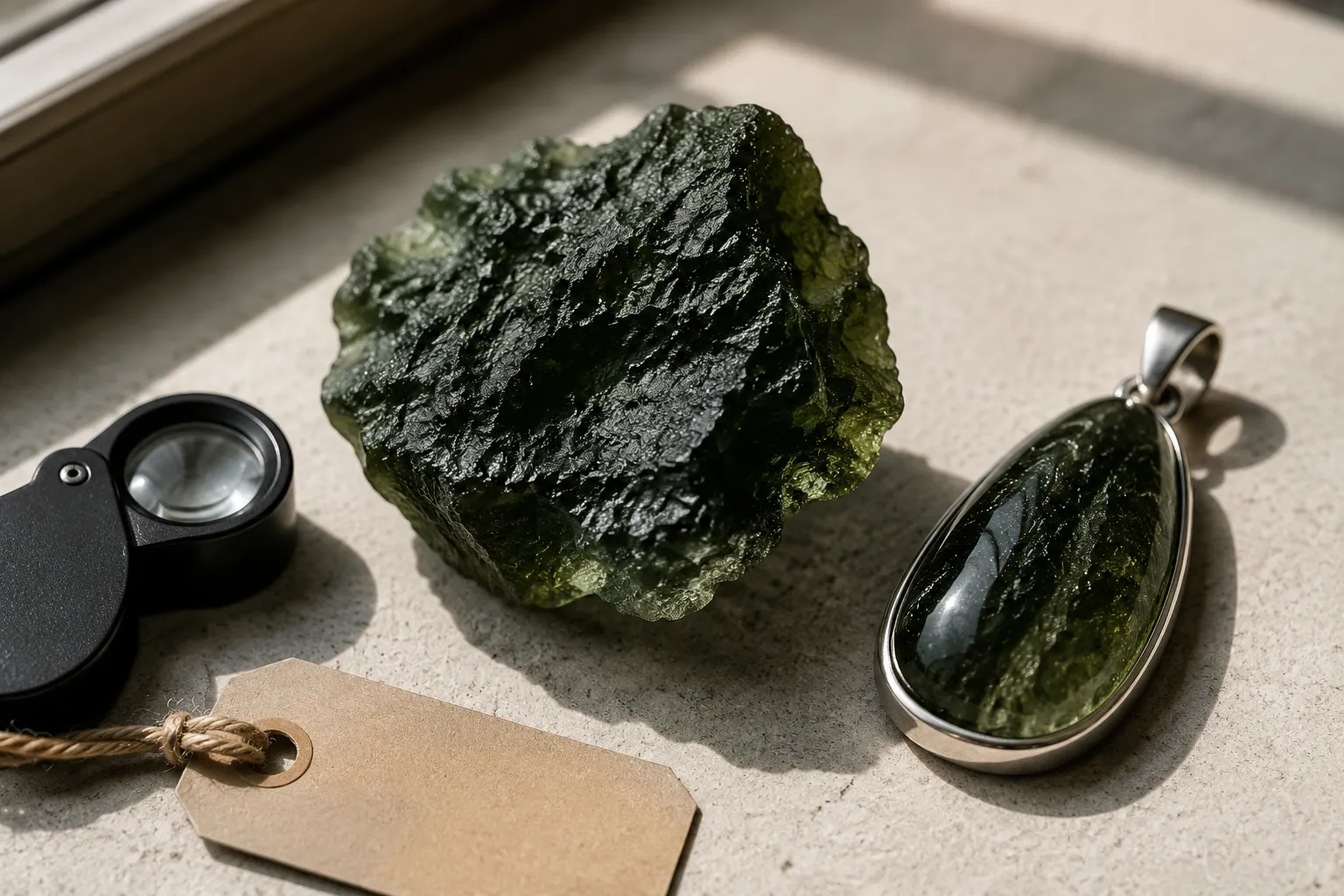
A rough moldavite surface can look closer to the field: uneven glass, small pits, fractured edges, and a shape that has not been softened for jewelry or handling. That is why many buyers use authentic rough specimen to describe the form they want. The phrase needs separating, though. Raw does not mean authentic by itself. Polished does not mean fake. And “energetic purity” is belief-based language, not a surface feature that can be confirmed by looking at texture.
The practical answer is simple: choose raw if the less-finished form matters to your symbolism, collecting preference, or specimen study; choose polished if comfort, wearability, or a finished tool shape matters more. For authenticity or fake identification, treat appearance as a first screen only. It can raise questions. It cannot settle the identity of the material.
broader context
Moldavite context note
This narrower page makes more sense after the broader moldavite archive page.
What Raw and Polished Actually Change
Raw pieces keep more of the irregular surface people expect from rough material. In a moldavite context, that may mean uneven edges, folds, pits, ridges, glassy areas, matte areas, and a shape that does not look mechanically regular. Some readers call this a natural geometric structure when a specimen has branching edges, angular breaks, or textured surfaces that feel less controlled by finishing.
That language is useful only when it stays in its lane. A rough-looking surface is observable. Calling it “more pure” is an interpretation. The first belongs to specimen inspection; the second belongs to metaphysical belief, practitioner preference, or market language.
Polished, tumbled, or carved pieces have been worked for appearance, touch, symmetry, or use. A polished moldavite pendant, bead, palm stone, or carved tool may be easier to hold and less abrasive against skin or fabric. It may also remove or soften surface detail that collectors like to inspect. The change is physical: roughness is reduced, edges are rounded, and the object may look more uniform.
That does not make the material false. It means the original exterior is no longer fully available for inspection.
Is the piece raw or polished?
You can observe texture, edge softness, shape regularity, and signs of carving or tumbling.
Form alone cannot confirm complete treatment or handling history.
Is it authentic moldavite?
You can observe visual cues that support or challenge the description.
Form alone cannot confirm definitive identity from photos or casual inspection.
Is it energetically pure?
You can observe personal belief, ritual preference, and symbolic meaning.
Form alone cannot confirm a measurable difference between raw and polished forms.
The distinction matters because sellers often place “raw,” “natural,” “authentic,” and “pure” close together. They are not the same claim.
Energetic Purity Is Practice Language
In metaphysical crystal culture, energetic purity often means a tool is believed to carry less human alteration, less handling history, or a stronger connection to its original form. Some practitioners prefer raw pieces because the irregular surface feels more direct, less designed, or less domesticated. That preference can be meaningful inside a personal practice.
It should not be used as an authentication test.
A rough specimen can still be misidentified, altered, misrepresented, or sold without adequate provenance. A polished piece can still be genuine material that has simply been shaped for jewelry, display, handling, or a specific tool format. The energetic purity belief may guide how someone relates to the object, but it does not answer the material-identity question.
This is especially important with moldavite because the object draws two kinds of attention. Collectors may care about tektite identity, locality claims, surface features, and documentation. Spiritually curious readers may care about symbolic meaning, intensity, or ritual use. Those can coexist; they should not be collapsed into one certainty.
A careful sentence would be: “I prefer raw moldavite because its irregular surface better fits my practice.”
A weaker sentence would be: “Raw moldavite is always more authentic and energetically pure.”
The first describes preference. The second overclaims.
Raw Does Not Equal Authentic
Irregular surfaces can feel persuasive because they seem harder to manufacture neatly. Rough contours, uneven edges, small cavities, and glassy texture variations are worth noticing, especially when a piece is being compared with overly perfect shapes or suspiciously uniform batches.
Still, visual cues only raise questions. They do not finish fake identification.
A piece may look rough because it is naturally irregular, because it was broken, because it was artificially textured, or because the lighting emphasizes certain surfaces. Without qualified gemological, mineralogical, laboratory, or reputable seller documentation, the cautious conclusion is limited: the object appears rough or unpolished, but its identity and history are not fully established from appearance alone.
That is where authentic rough specimen becomes useful but risky. It contains three separate claims.
Authentic
The material is being claimed as genuine, which needs stronger support when trust or value matters.
Rough
The surface appears unpolished, broken, natural-looking, or minimally finished.
Specimen
The object is being viewed as a collected material piece, not only as a metaphysical tool.
A seller may use all three words together. A buyer should separate them before deciding what the phrase really supports.
For moldavite, conservative fake identification means looking for mismatches and then stopping short of a final verdict unless stronger verification exists. If a surface looks too uniform, if every piece in a batch appears nearly identical, if the color or shape does not fit the seller’s story, or if a listing leans heavily on energetic claims while offering little material information, slow down. Those are reasons for scrutiny, not a complete conclusion.
The better question is not “Can I authenticate this from one feature?”
It is “Does this feature support the story, challenge it, or require better documentation?”
Polished Does Not Equal Fake
Polished, tumbled, and carved pieces often face the opposite suspicion. Because they have smoother surfaces and more regular shapes, buyers may assume they are less natural, less pure, or more likely to be imitation. That assumption is too broad.
Polishing changes the exterior. It can remove or soften the rough surface that collectors may want to examine. It can also make a piece easier to set in jewelry, hold in the hand, carry in a pouch, or use where sharp edges would be inconvenient. A shaped object is not automatically false; it is an object whose surface has been worked.
The tradeoff is inspection. A polished bead or cabochon may offer fewer visible clues than a rough fragment because the surface has been smoothed. That makes provenance, seller transparency, and documentation more important, especially when the object is expensive or the claim is specific.
Metaphysically, some readers feel that polishing interrupts the natural form. Others see shaping as part of making a tool usable. Neither position confirms a measurable energy change. They are different ways of assigning meaning to alteration.
Visible surface character
Raw keeps more irregular texture available to inspect.
Polished may hide or reduce the original exterior.
Handling comfort
Raw may feel sharp, fragile, or uneven.
Polished is usually easier to hold, wear, or place.
Symbolic “untouched” quality
Raw better matches naturally occurring forms.
Polished may feel more human-shaped or intentional.
Practical tool use
Raw may be less convenient for daily carry.
Polished may fit jewelry, grids, pockets, or smooth contact.
Authenticity confidence
Roughness can be one clue, not a conclusion.
Polishing is not evidence of fakery.
The point is not to rank one form above the other. The point is to avoid borrowing certainty from the wrong category.
What Should Actually Affect Your Choice
If you are choosing between raw and polished metaphysical tools, start with use rather than marketing language.
For display, study, or collector interest, raw may be more satisfying because the surface remains visibly complex. If you want to examine irregularities, compare textures, or keep the object closer to a specimen format, rough material has practical appeal.
For daily carry, jewelry, or repeated hand use, polished may be more practical. A smoother surface can be less distracting, less sharp, and easier to incorporate into a wearable or portable object. That says nothing final about metaphysical strength. It says the tool has been finished for use.
For spiritual symbolism, the decision is personal. Some practitioners prefer raw forms because they associate less alteration with energetic purity. Others prefer polished forms because the tool feels settled, intentional, or easier to work with. The honest framing is practitioner preference, not material fact.
For authenticity, neither surface category is enough. Raw and polished pieces both require the same cautious question: what supports the seller’s claim? Useful support may include clear provenance, consistent material description, seller accountability, and, where identity or value matters, qualified verification.
Keep the categories separate
- Raw vs polished is a form and surface question.
- Authentic vs fake is a material identity and evidence question.
- Energetic purity is a belief, symbolism, or practice-language question.
When those stay separate, the decision becomes easier to make without overclaiming.
Common Confusion Around “Natural” and “Pure”
The word “natural” often does too much work in crystal listings. It may mean unpolished, minimally shaped, visually irregular, collected rather than manufactured, or simply styled to look earthy. Those meanings are not interchangeable.
A raw-looking object may preserve naturally occurring forms, but that does not confirm its identity. A polished object may have lost its original surface, but that does not mean the underlying material is false. A carved tool may be highly altered in shape while still being made from the material claimed. Surface history and material identity are related questions, not the same question.
“Pure” has a similar problem. In metaphysical settings, it may refer to a feeling, ritual idea, lack of alteration, lack of mixed materials, or seller language that makes one item sound superior. Unless the claim is tied to a specific, verifiable material description, read it as interpretive language.
That does not make the term useless. It means it belongs in the right place. A reader can say, “I use energetic purity to describe the kind of tool I prefer.” A listing should not turn that into a guaranteed property of raw material.
A Conservative Inspection Checklist
Use this as a sorting tool, not as a final authentication method.
- Look at the surface: Is it rough, polished, carved, tumbled, or mixed?
- Separate form from identity: Does the description support material identity, or only describe appearance?
- Treat energetic purity as belief language: Is the claim presented as personal symbolism or as a factual guarantee?
- Notice overconfident wording: Does the listing imply raw always means authentic or polished always means fake?
- Ask what exists beyond visuals: Is there provenance, documentation, or a seller willing to answer material questions clearly?
- Avoid single-feature judgments: One pit, ridge, bubble, shine, chip, or color impression should not carry the whole conclusion.
- Raise the evidence standard when stakes are higher: If price, provenance, or authenticity matters, casual inspection is not enough.
This checklist cannot authenticate moldavite. It can help keep the question honest.
Bottom Line
Raw vs polished metaphysical tools are best compared by separating surface, identity, and belief. A raw moldavite specimen may preserve more irregular texture and natural-looking structure, which can matter to collectors and to people who prefer less altered forms. A polished piece may be easier to wear, hold, or use, while still requiring the same authenticity caution as any other item.
Energetic purity is not something this page evidence can verify. Fake identification should also remain conservative: visual cues can raise questions, but they do not settle the case alone. Inspect the specimen traits, ask for stronger provenance when it matters, and keep spiritual meaning clearly marked as interpretation.