Bounded Crystal Practice
How to Build a Sacred Geometry Grid for Dimensional Exploration
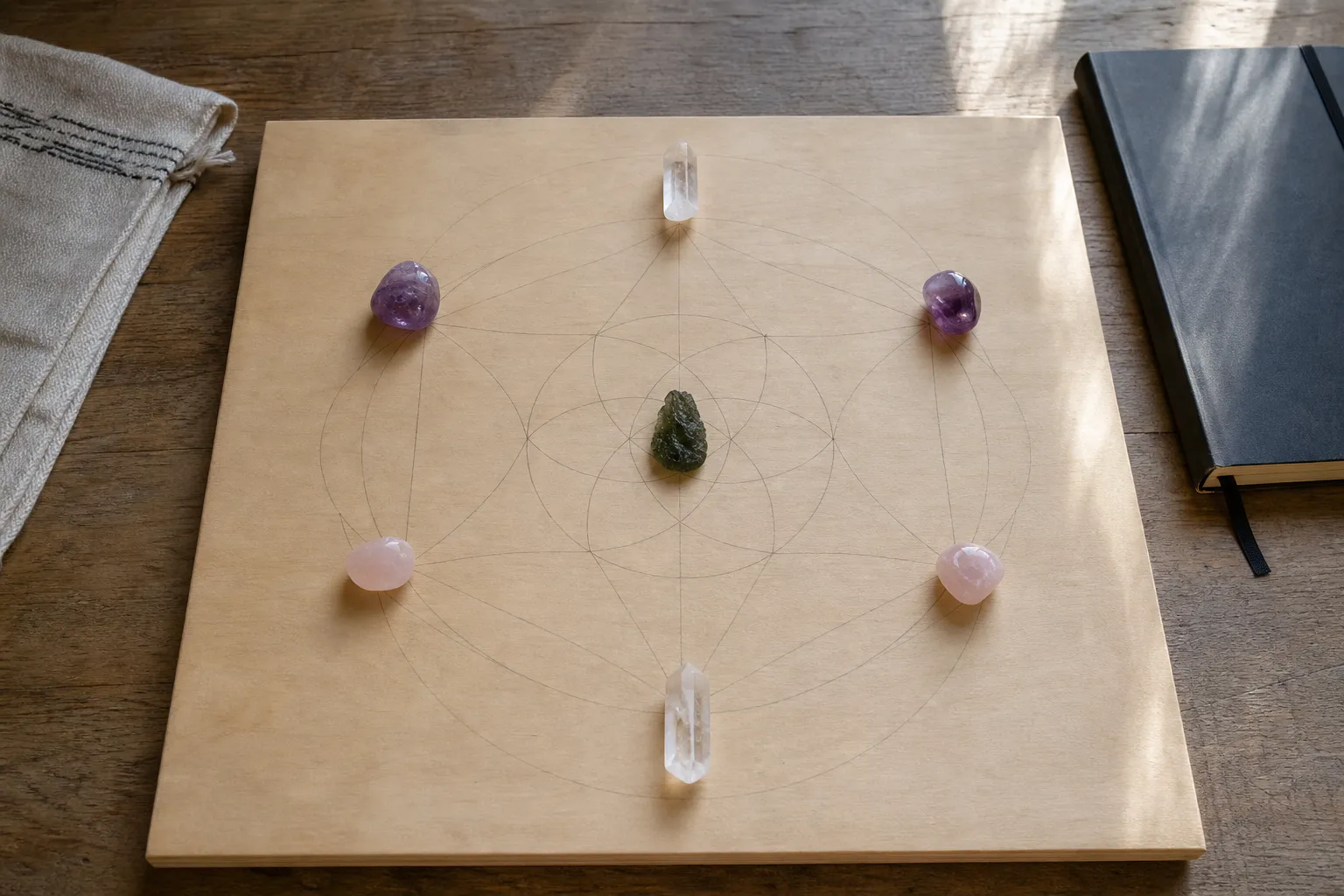
A small moldavite piece carries enough drama before any ritual language is added: etched green glass, irregular surface, and an impact history held in a physical specimen. To build a Sacred geometry crystal grid for dimensional exploration, choose a stable base, place one center stone, arrange a simple geometric pattern, set an inward intention, sit with the layout in meditation, journal what you notice, and close the practice deliberately.
Treat the grid as a symbolic meditation aid, not as evidence that a portal has opened or that a measurable field has changed. “Dimensional exploration” works best here as contemplative language for exploring perception, memory, intuition, and meaning while staying grounded in the room.
broader context
Start with the main moldavite page
This narrower page makes more sense after the broader moldavite archive page.
Build the Grid Without Overcomplicating It
Start with the physical arrangement. A grid that slides, crowds, or feels too elaborate will pull attention away from the practice. Use a flat table, cloth, wooden board, printed sacred geometry grid base, or hand-drawn pattern on paper. The base does not need to be rare or expensive. Its job is to give the stones a visible structure.
For a moldavite-centered practice, place moldavite at the center only if you are comfortable using it that way. If the piece is valuable, fragile, newly purchased, or still uncertain in authenticity, keep it beside the grid as a focus object instead. Provenance and specimen care matter more than ritual drama.
A practical seven-step layout
- Choose the grid base. Select a clean, flat surface or a sacred geometry pattern you can follow without strain.
- Choose the center stone. Use moldavite, clear quartz, smoky quartz, amethyst, or another stone with personal meaning. The center stone represents the theme of the session.
- Add anchor stones. Place four to six stones around the center to create stability. They can mark directions, phases, or qualities such as clarity, patience, courage, and rest.
- Arrange the pattern. Use a circle, triangle, hexagon, spiral, or flower-like layout. Keep it simple enough that you remember why each placement is there.
- Set an intention. Phrase it as an inward inquiry, not a demand on reality: “I am reflecting on what change feels like when I do not rush it.”
- Meditate with the grid. Sit nearby, breathe normally, soften your focus, and notice sensations, thoughts, images, or resistance without forcing an experience.
- Close the practice. Thank the practice in your own words, remove the stones from the outside inward, and record any impressions before storing the pieces.
This is enough. A crystal grid for meditation does not become more meaningful because it is crowded with stones or heavy language. The structure is a container for attention.
Choose Stones as Symbols, Not Proof
Moldavite has a real geological identity as a tektite, but the meanings people attach to it belong to interpretation. That distinction matters when it becomes the center stone in a dimensional exploration practice. The specimen can be physically inspected, documented, and compared for authenticity; the inner experience around it cannot be verified in the same way.
If you use moldavite, treat it as a focal symbol for impact, disruption, change, and the strange beauty of natural glass. Those associations fit the way many spiritually curious collectors approach the stone, but they should not be stretched into claims that moldavite causes transformation or opens dimensional portals. The physical stone and the symbolic reading are different kinds of evidence.
Supporting stones can be chosen by color, texture, personal association, or visual balance. Clear quartz is often used in contemporary crystal-grid language as a clarifying or amplifying symbol. Darker stones are often chosen as grounding symbols. Purple stones may be used for contemplation or imagination. These are belief-based associations, not established mechanisms.
Center
Moldavite or a non-fragile focus stone.
Inner Ring
Three clear or pale stones for attention, breath, and witness.
Outer Ring
Four darker or steadier stones for body, room, time, and return.
Open Space
Visible gaps between stones so the grid stays readable.
The open space is part of the practice. It reminds the practitioner that not every impression needs interpretation.
Set an Intention for Dimensional Exploration
“Dimensional exploration” can easily become inflated language. In a bounded practice, it does not mean proving another dimension, creating a passageway, or producing a guaranteed altered state. It means using symbolic structure to explore layers of attention: the body in the room, the emotional tone of the moment, the images that arise, and the meaning you assign to change.
Useful intentions are specific but not forceful. Avoid commands such as “open a portal” or “show me the answer.” They push the session toward expectation and can make ordinary thoughts feel artificially significant. A better intention leaves room for uncertainty:
- “I am observing what transition feels like without forcing a conclusion.”
- “I am reflecting on the part of me that wants change and the part that resists it.”
- “I am using this grid as a symbolic map for perspective, not as proof of an external event.”
- “I am staying present, curious, and able to stop.”
That last line matters. If the practice becomes distressing, confusing, or physically uncomfortable, stop. Do not use fasting, sleep deprivation, substances, isolation, or risky behavior to intensify the session. A symbolic crystal grid practice should not replace appropriate medical, mental health, legal, financial, safety, or emergency support.
Meditate With the Grid
Once the grid is built, sit where you can see it without hunching or straining. Let the geometry do less, not more. The pattern gives your attention a route: center, inner stones, outer stones, open space, then back to the body.
A short session is usually more coherent than a long one. Begin with three slow breaths. Look at the center stone and name the intention silently. Let your gaze move along the geometric pattern. If you are using a circle, follow the perimeter. If you are using a triangle, pause at each point. If you are using a hexagon, notice the balance between repetition and direction.
Some practitioners describe spatial energy fields as part of their metaphysical vocabulary. On this page, that phrase is safest as a metaphor: the felt sense of attention extending across the room, not a measurable field. You may notice warmth, emotion, memory, boredom, calm, or nothing unusual at all. None of these proves that the grid is working or failing. They are observations.
If visual images arise, keep them in symbolic language. A doorway may suggest readiness, hesitation, grief, curiosity, or simply an image your mind produced. Dimensional portals symbolism can be meaningful without being treated as physical evidence.
A gentle sequence
- Look at the center stone and repeat the intention once.
- Trace the pattern with your eyes without touching the stones.
- Notice the body: feet, hands, breathing, jaw, shoulders.
- Ask one reflective question, such as “What am I trying to cross?”
- Sit quietly for a few minutes.
- End before the practice feels strained.
The grid is not a test. It is a structured pause.
Journal What Happened Before Interpreting It
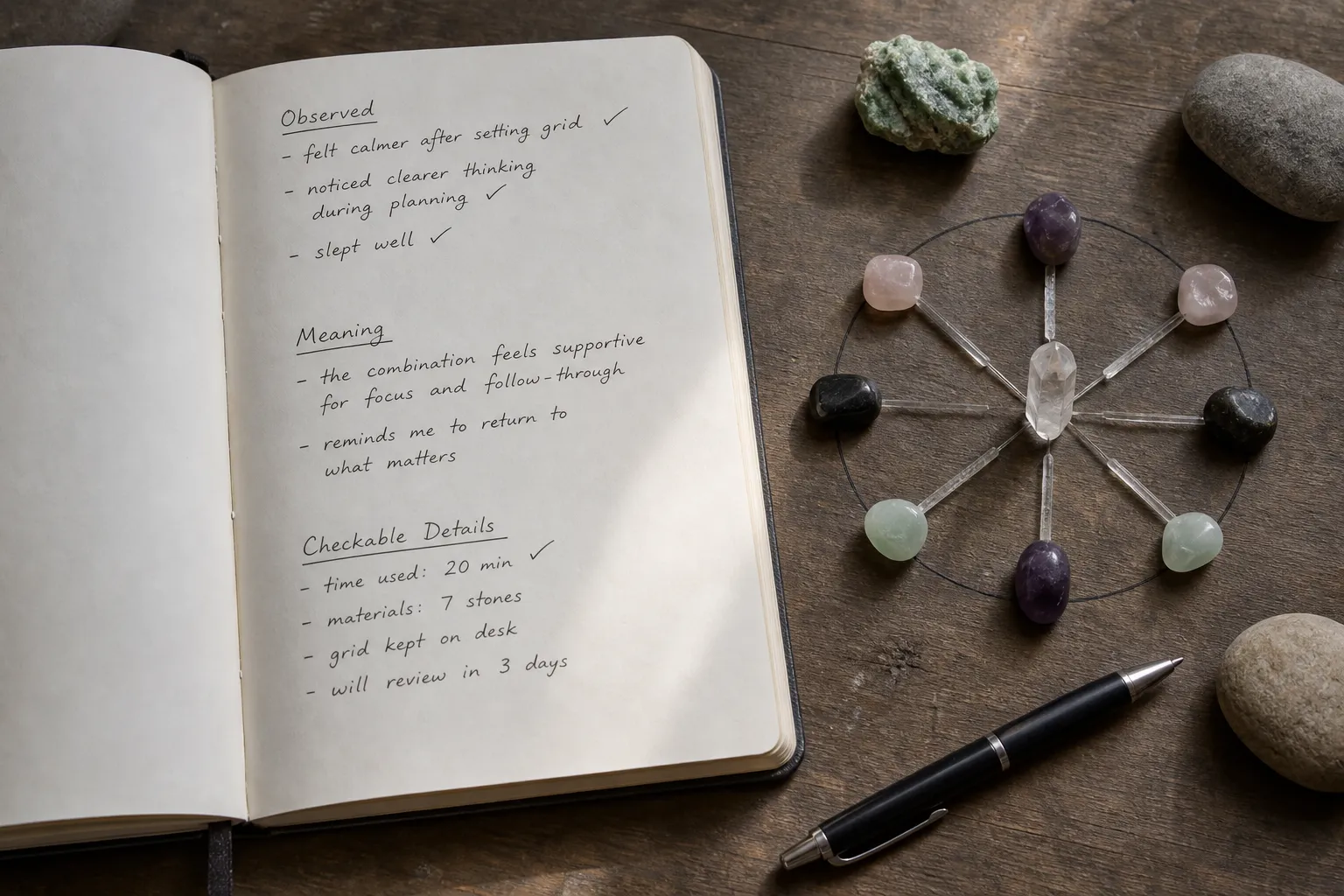
Journaling helps separate experience from conclusion. After meditating with a crystal grid, write down what happened in plain language before assigning meaning. This keeps the session from becoming a story that outruns the evidence.
What I noticed: A memory came up
Possible meaning: I may be revisiting an old transition
What I can actually verify: I remembered a specific event
What I noticed: The center stone drew my attention
Possible meaning: The intention felt active
What I can actually verify: I kept looking at the center
What I noticed: I felt restless
Possible meaning: I may need a shorter practice
What I can actually verify: My body felt unsettled
What I noticed: I imagined a doorway
Possible meaning: It may symbolize choice or threshold
What I can actually verify: It was an image during meditation
This format is plain, but it protects the value of the practice. You can honor an impression without turning it into proof. You can notice a pattern over time without claiming the stones caused it.
For moldavite collectors, journaling can also include a specimen note: where the piece came from, what documentation came with it, whether the surface features match what you expect from a tektite, and how you are storing it. That is collector literacy, not ritual technique. It keeps the physical object from disappearing under spiritual language.
Close the Crystal Grid Practice
Closing a crystal grid practice is not about sealing a portal. It is about ending the ritual container so ordinary attention can return. This is especially useful when the session used intense language around thresholds, dimensions, or transformation.
Begin by naming the end: “This practice is complete.” Touch the table or floor. Notice the room. Drink water if you want to. Then remove the outer stones first and the center stone last. If moldavite was used, handle it carefully and store it where it will not chip, scratch softer materials, or become confused with lower-quality pieces.
If the grid brought up emotional material, keep the next step ordinary. Wash a cup, step outside, message a friend, or write one sentence about what you are taking forward. Do not escalate the session by immediately rebuilding the grid, searching for stronger sensations, or treating every impression as a sign.
A grounded close might be:
- “I recognize this as a symbolic practice.”
- “I keep what is useful and release what is unclear.”
- “I return to the room, the body, and the day.”
That language is simple because the boundary is simple. The grid helped hold attention for a time. Then it ended.
What This Practice Can and Cannot Claim
A sacred geometry grid can be built as a meditative arrangement of physical objects. It can help organize intention, attention, and reflection for people who already find crystal symbolism meaningful. It can also give moldavite a quieter context than hype-driven transformation claims, especially when the stone is treated as both collectible impact glass and personal symbol.
The current evidence available for this page does not support stronger claims. It does not establish that a grid creates measurable spatial energy fields, opens dimensional portals, changes physical reality, guarantees insight, or reliably produces altered states. Those ideas may appear in spiritual language, but they should remain belief-based and symbolic here.
The most defensible version of dimensional exploration is inward: a practice of noticing thresholds in perception, identity, memory, and choice. The geometry gives those reflections a shape. The stones give them a focus. Moldavite, if used, brings impact history and symbolic intensity into the center without becoming proof of an outcome.
Build the grid carefully. Use the language honestly. Let the experience be meaningful without making it larger than the page evidence.