Bounded Ritual Practice
Releasing Control: A Metaphysical Fire Ritual
A releasing control ritual can stay simple: write down the grip you are trying to loosen, use fire as a careful symbol, name one belief you are willing to stop feeding, and close with one ordinary action. If you light a candle or burn paper, the flame is optional. It is not proof that anything has been completed spiritually, emotionally, or metaphysically.
For moldavite readers, that boundary matters. Moldavite has a real material identity as impact glass; the meanings people attach to it belong to interpretation. This ritual may be personally meaningful as a reflective practice, but it is not a sourced tradition, clinical method, or guaranteed energetic result.
broader context
Broader moldavite archive
This narrower page makes more sense after the broader moldavite archive page.
The Smallest Safe Form of the Ritual
Use this metaphysical fire ritual when you want a contained way to mark the difference between control and choice. The point is not to force a result. The point is to make one inner attachment visible enough to meet it with care.
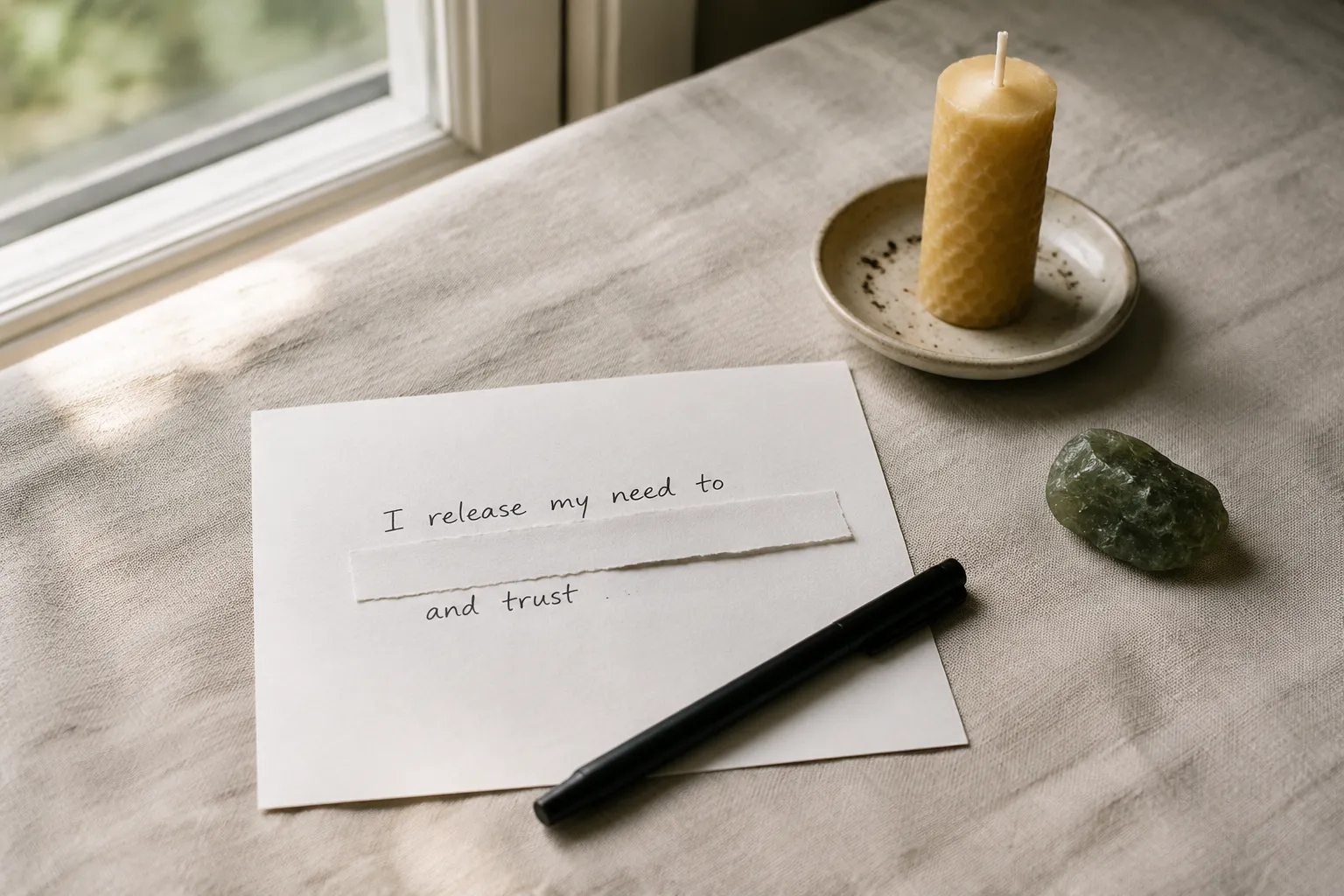
You need a quiet place, paper, a pen, and either a candle, a fire-safe container, or a non-burning substitute. If moldavite is part of your personal practice, place the specimen nearby as a symbolic witness rather than as a tool that causes release. Keep the glass, the geology, and the symbolism in their own lanes.
1. Choose one control pattern
Write one sentence beginning with, “I notice I am trying to control…” Keep it specific. A narrow sentence is easier to work with than a sweeping life statement.
2. Name the cost without drama
Add one line: “This costs me…” You might name tension, rigidity, overplanning, silence, resentment, or another personal observation. Do not turn it into a diagnosis.
3. Write the releasing vow
Use plain language: “I am willing to stop feeding the belief that…” This can support abandoning limiting beliefs without claiming that a belief disappears because paper is burned.
4. Choose the fire element
Light a candle, hold the paper near the flame without burning it, or burn the paper only if the setting is safe. The fire element can also be imagined, drawn, or represented by an unlit candle.
5. Close the practice
Say one grounded sentence: “I will practice one less-controlling action today.” Write that action down before leaving the space.
That is enough. A symbolic burning ritual does not become stronger because it is smokier, more expensive, or more elaborate.
If You Burn Paper, Keep Fire Literal
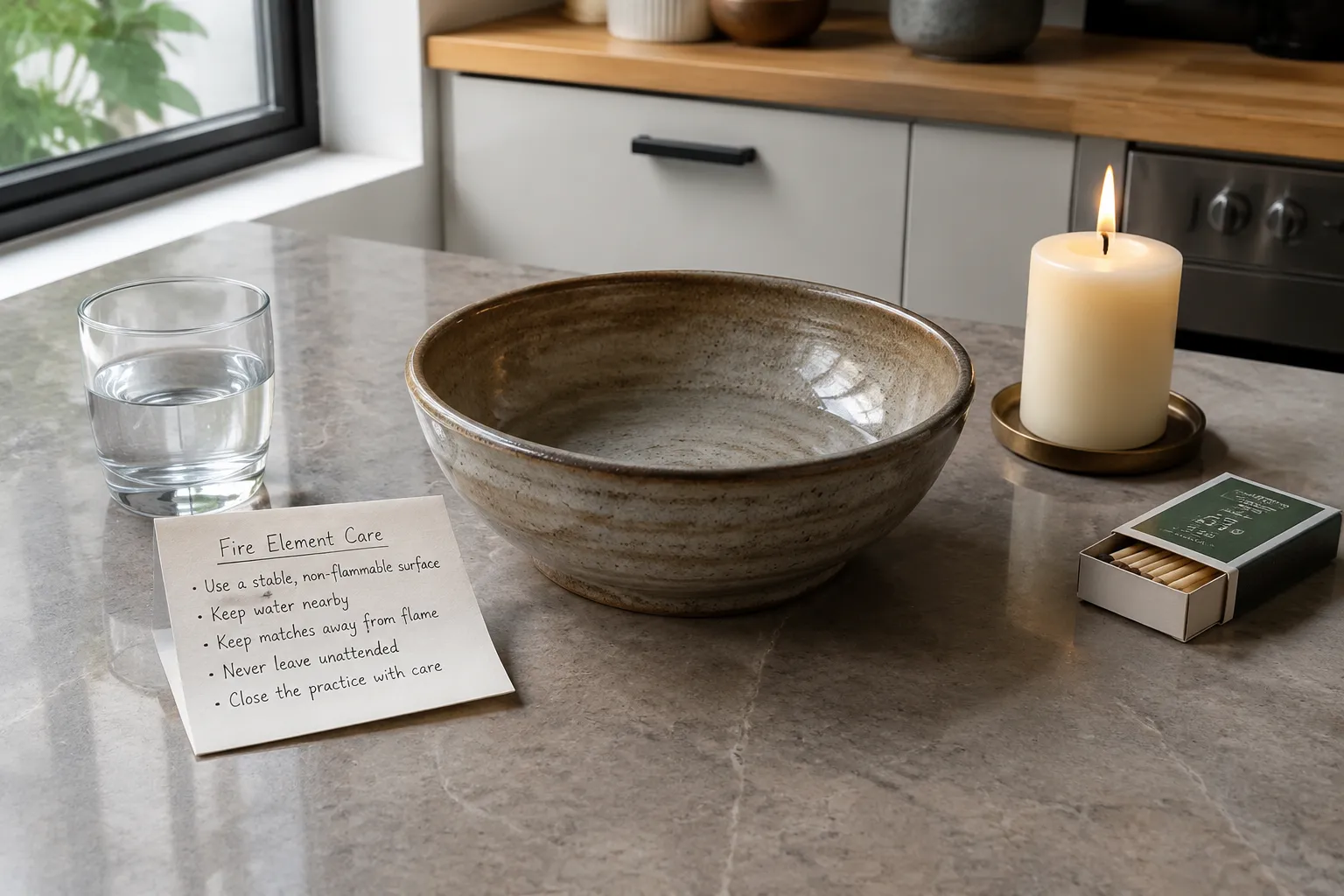
Fire imagery can feel charged, but actual flame is not symbolic once it is lit. If the releasing control ritual involves burning vows, paper, smoke, ash, matches, or candles, the physical setup matters more than the ritual language.
Use a fire-safe container on a stable, heat-resistant surface. Keep water nearby. Clear away fabric, dried plants, loose paper, hair, sleeves, curtains, oils, alcohol, and anything else that can catch or spread flame. Do not inhale smoke. Do not burn coated paper, plastic, herbs, unknown materials, or anything that creates irritating fumes. Never leave a candle or burning paper unattended.
If you are indoors, tired, distracted, in shared housing, around children or pets, or unsure about the surface beneath the flame, do not burn anything. The ritual can still work as a reflective fire practice when the fire is represented rather than used. Tear the paper into small pieces. Fold it and place it in the trash. Run a finger around an unlit candle. Draw a flame over the written sentence. Imagine the sentence losing its grip.
Those substitutes are not weaker in any evidence-based sense, because this page is not claiming that flame creates a measurable spiritual result. The meaningful part is the deliberate pause, the written statement, and the chosen next action. Fire is optional.
What to Write for Releasing Control
The best wording is specific enough to be honest and modest enough to be believable. A vow that tries to reorganize your whole life in one line often creates pressure. A smaller vow gives the ritual a cleaner edge.
Instead of writing, “I release all control forever,” write, “I am willing to loosen my grip on how this conversation must go.” Instead of “I abandon all limiting beliefs,” try, “I am questioning the belief that uncertainty means failure.” Instead of “I surrender completely,” try, “I will leave one part of this situation undecided tonight.”
This is also where moldavite symbolism can stay bounded. If you associate moldavite with impact, disruption, or transformation, you may use the specimen as a reminder that change can have texture and pressure. But do not make the stone responsible for the vow. A tektite can be collected, inspected, described, and interpreted; it should not be made into proof that the ritual has changed an outcome.
A practical releasing statement can follow this pattern
- “I notice I am trying to control…”
- “The belief underneath that may be…”
- “I am willing to stop rehearsing…”
- “One action I can take without forcing the result is…”
The last line matters. Without it, symbolic vows burning can become a dramatic moment with no ordinary follow-through. The closing action should be small: wait before replying, ask one direct question, leave a plan unfinished for an hour, stop checking for a response, or choose one boundary you can actually keep.
When This Ritual Is Not the Right Tool
A ritual for releasing control is not a substitute for practical decision-making, emergency support, mental health care, legal advice, medical care, or qualified help when those are needed. It should not be used to pressure yourself into tolerating harm, ignoring danger, staying silent, or accepting a situation that requires action.
It is also not a test of spiritual strength. If burning the paper feels frightening, perform the ritual without flame. If the wording makes you feel trapped, rewrite it. If the practice turns into rumination, stop and do something ordinary: drink water, open a window, step away from the objects, or return to the issue later.
The ritual is least useful when the word “release” becomes a way to bypass responsibility. Releasing control is not the same as abandoning judgment. It does not mean refusing to plan, pretending you do not care, or letting someone else define what happens next. In a grounded version, control is the clenched demand that reality must obey your preferred script. Choice is the next action you can take without pretending to own the whole outcome.
This distinction keeps the practice from becoming exaggerated. The ritual may be meaningful as symbolism or reflection. The available material for this page does not support medical, psychological, cultural, historical, or guaranteed metaphysical claims about it.
Common Confusion Around Fire, Vows, and Moldavite
Fire as the active agent
In ritual language, flame can feel like a threshold: something is marked, consumed, or made visible through disappearance. Here, that remains symbolic language. The fire element is a focus point, not evidence that a hidden mechanism has completed a release.
A vow as a contract
For this practice, the vow is better understood as a sentence of intention. You can revise it. You can decide it was too broad. You can repeat the ritual later with clearer wording. The paper is not more authoritative than your ongoing judgment.
Moldavite as proof
Because moldavite is often marketed with intense transformation claims, readers may be tempted to combine the stone, fire, and surrender language into a single certainty. That is too much certainty for the evidence here. Moldavite’s collector reality begins with specimen traits, provenance, and authenticity questions; its spiritual meaning is an interpretive layer.
Intensity as sincerity
A ritual does not need to feel extreme to be sincere. A quiet intention setting ritual with an unlit candle, one sentence, and one follow-up action may be more responsible than a smoky burning session in the wrong place. The container matters, both physically and emotionally.
A Clean Closing Sequence
After the paper is burned, torn, folded, or set aside, give the ritual a definite ending. Do not keep reopening the statement while waiting for a feeling of completion. Closure is a chosen boundary, not a sensation you have to chase.
- Extinguish the candle or confirm that no ember remains.
- Dispose of ash only when fully cool.
- Put the moldavite or any ritual object back in its ordinary place.
- Wash your hands or touch a cool surface.
- Write one sentence: “The next controllable action is…”
That last sentence returns the ritual to real life. If the issue is a message, the action might be waiting until morning. If the issue is a decision, it might be naming the next piece of information you need. If the issue is a relationship pattern, it might be choosing one sentence you will say plainly instead of rehearsing five versions.
The ritual ends there. Do not keep asking it to prove itself.
Practical Limits to Keep in View
This page offers an editorial ritual structure, not a documented lineage or sourced ceremonial authority. No public references, verified firsthand reports, or authoritative sources were supplied for cultural origin, psychological mechanism, spiritual effect, or historical tradition. That absence does not make the ritual useless; it means the claims around it must stay modest.
A releasing control ritual can help you pause, write, symbolize, and choose a next action. It can give shape to a private moment of reflection. If you work with moldavite, it can sit beside the practice as part of your personal symbolic language, while its geological and authenticity questions remain separate.
The strongest version is not the most dramatic one. It is the one that uses safe materials, honest wording, and a clear ending. Keep impact science before interpretation, and keep interpretation within its bounds.