Lucid dreaming practice
Upgrading the MILD Technique: Integrating Cognitive Protocols with Mineral Resonance
Yes, MILD Technique Crystals can fit into a lucid-dream practice—but only if the crystal stays in the right role. The useful integration is not “the stone makes lucid dreaming happen.” It is: the crystal becomes a symbolic anchor, tactile reminder, or bedside cue while the MILD protocol does the cognitive work.
MILD, or mnemonic induction of lucid dreams, depends on intention, memory, and rehearsal. You prepare yourself to remember, during a later dream, that you are dreaming. A crystal can make that intention easier to return to, especially if ritual objects already feel meaningful to you. “Mineral resonance” can belong to your spiritual or symbolic language, but it should not be treated as established sleep science.

broader context
Broader moldavite archive
This narrower page makes more sense after the broader moldavite archive page.
The clean way to combine crystals with MILD
A crystal-supported MILD practice works best when the stone marks the beginning of the routine, not when it replaces the routine.
“The next time I am dreaming, I will remember to recognize that I am dreaming.”
That sentence matters more than the mineral. The mental rehearsal matters more than the object. The crystal’s role is to help you pause, focus, and repeat the same intention consistently.
A simple version
- 1 Choose one crystal. One object keeps the cue clear. Too many stones can make the practice feel scattered.
- 2 Pair it with one intention. Keep the wording about recognizing the dream state, not about the crystal causing the dream.
- 3 Use touch or placement as the reminder. Hold the stone briefly, place it near the bed, or touch it after a natural night waking.
- 4 Rehearse the recognition moment. Imagine noticing something dreamlike and remembering, “I am dreaming.”
- 5 Put the crystal down and sleep. The ritual should close. If it keeps you overly engaged, it is no longer helping the MILD sequence.
This keeps the practice aligned with MILD cognitive affirmations: intention, prospective memory, and mnemonic rehearsal before sleep.
Where the crystal can help
The strongest case for crystals in this context is not mineral causation. It is consistency.
Many people struggle to repeat an abstract mental routine. A physical object can make the practice easier to start because it gives the hand and eye something familiar to return to. In that narrow sense, crystals as symbolic anchors can support:
Attention
The object marks a deliberate pause before sleep.
Repetition
The same object cues the same intention each night.
Association
Over time, the crystal becomes linked with the act of remembering.
That is similar to using a dream journal, a bedside note, or a repeated phrase. The difference is that a crystal may carry personal meaning for someone who already works with mineral symbolism.
If you use language such as “resonance,” “frequency,” or “stone energy,” keep it in the symbolic lane. You may experience a stone as grounding, vivid, intense, or clarifying. Those are personal practice descriptions. They are not the same as evidence that a mineral changes REM timing, sleep stages, dream recall, or lucid-dream frequency.
A crystal-integrated MILD routine
This routine keeps the crystal layer useful without letting it take over.
Before sleep
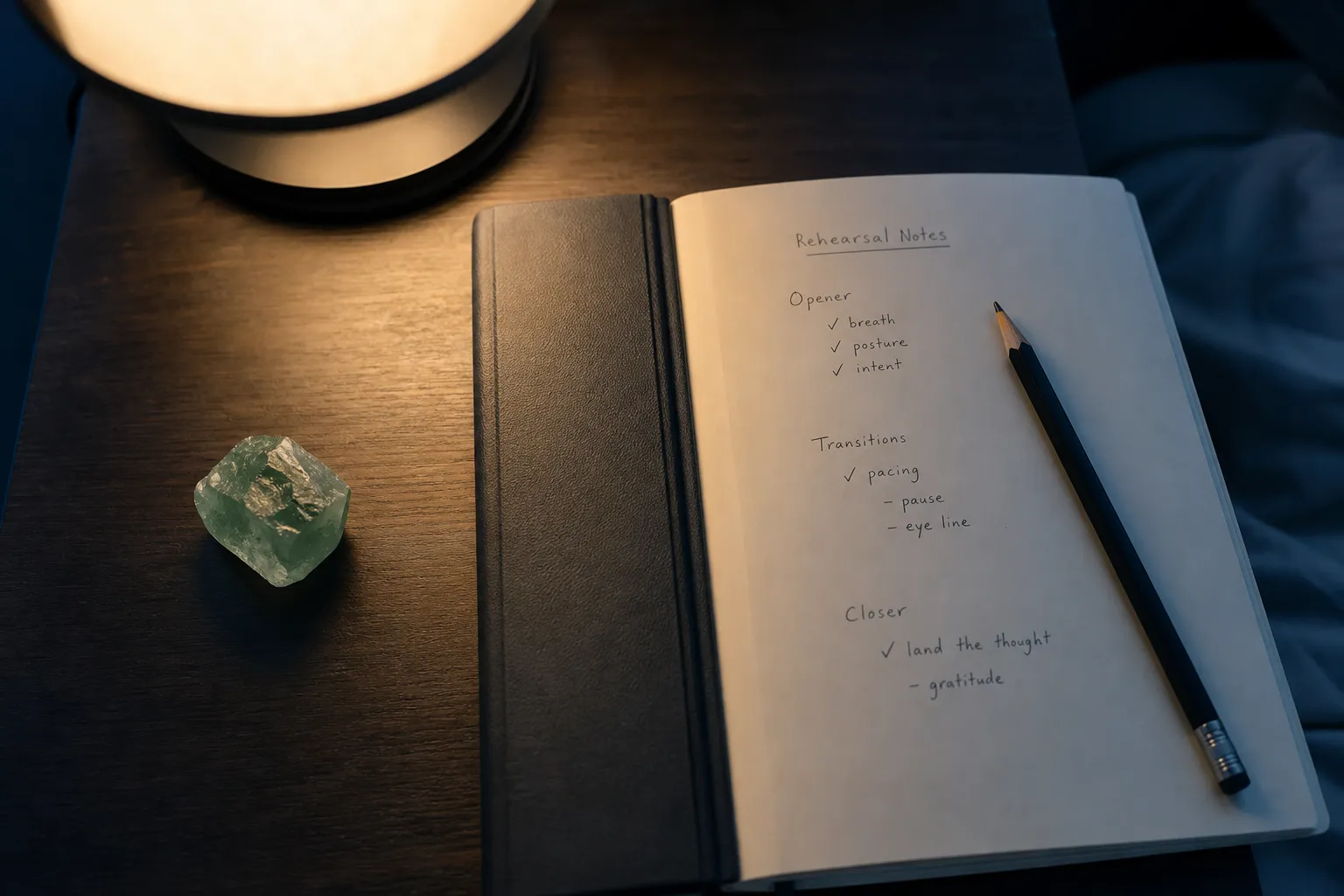
Sit or lie down as you normally would before sleeping. Hold the crystal briefly or place it where you can see it. Let the object signal: this is the moment to set the intention.
Say or think:
“I will remember to recognize when I am dreaming.”
Then add imagery. Picture yourself inside a dream, noticing something unusual, pausing, and realizing that the scene is a dream. This rehearsal is closer to the MILD method than repeating a phrase with no mental scene behind it.
The specific stone is secondary. Moldavite, quartz, amethyst, or another crystal can all serve the same practical role if you use the object consistently: intention, rehearsal, release.
After waking during the night
MILD is often practiced around wakeful moments because the intention can be refreshed before returning to sleep. If you wake naturally and want to rehearse, touch the crystal lightly, repeat the intention, and return to the dream-recognition scene.
Keep it brief. The crystal is a cue, not a reason to build a long ritual that keeps your mind active.
In the morning
If you remember a dream, write down whether anything felt unusual or dreamlike, even if you did not become lucid. If you remember nothing, avoid turning that into a verdict about the crystal or the method. Lucid-dream induction varies by person, timing, sleep continuity, recall, and practice history.
This morning note is not a way to prove the stone “worked.” It is a way to keep the MILD practice tied to what you actually remember.
What changes the answer
The answer depends on what you expect the crystal to do.
If you expect the crystal to work as a symbolic anchor
The integration is reasonable. It may help you remember the routine and give the practice a clearer ritual container.
If you expect the crystal to be the cause of lucid dreaming
The claim goes beyond the available support. The research base can discuss MILD as a cognitive lucid-dream induction technique, with limits. It does not establish crystals as an independent dream-induction mechanism.
If you expect the crystal to change the sleep cycle
That is also outside the supported claim. MILD is about intention, memory, and dream recognition. Crystal placement should not be described as changing sleep architecture.
If you expect a stone’s origin story to explain dream effects
The answer is still no. Moldavite, for example, is often valued in spiritual communities because of its unusual identity and symbolism. Geologically, it belongs to the broader tektite family: natural glass associated with meteorite impact events. That origin can be symbolically powerful, but it does not establish an effect on dreaming.
The most grounded version is modest: the crystal supports the ritual frame; the cognitive protocol remains the method.
Common confusion: resonance language versus MILD language
The most common mistake is mixing two vocabularies as if one validates the other.
In spiritual practice, someone may describe a stone as intense, resonant, clarifying, or linked with transformation. In MILD research language, the central ideas are intention, prospective memory, mnemonic rehearsal, and recognizing that you are dreaming.
Those languages can sit beside each other. They do not automatically prove each other.
Careful wording
- “This crystal helps me focus my intention before sleep.”
- “I use this stone as a reminder to rehearse my MILD affirmation.”
- “Moldavite has symbolic meaning for me, so I use it to mark the practice.”
Less careful wording
Less careful wording would imply that the crystal produces lucid dreams, changes REM sleep, or guarantees conscious dreaming. That is where the claim becomes too strong.
Another confusion is assuming that a more dramatic ritual must be a stronger induction method. A ritual may feel powerful because it is emotionally vivid, aesthetically focused, or personally meaningful. That does not mean it has been shown to outperform ordinary MILD practice. Even lucid-dream induction methods with research support show variability.
Moldavite and tektite symbolism
Moldavite often enters this conversation because it has a strong cultural presence among crystal readers. Its tektite identity gives it a dramatic origin story, which can make it appealing as a symbol for disruption, transformation, or sudden recognition.
For this MILD question, that symbolism can be used carefully. If moldavite represents “awakening” or “recognition” to you, it can mark the intention:
“When the dream begins, I remember.”
That is a coherent symbolic pairing.
But geology should stay in its lane. Tektite formation explains material origin. It does not demonstrate an effect on memory, dreams, or sleep stages. A striking origin story can make a stone meaningful; it does not turn the stone into the active part of the MILD protocol.
Compact checklist
Use this if you want the crystal layer without losing the MILD structure:
- Choose one crystal and connect it to one intention.
- Use a short phrase about recognizing the dream state.
- Rehearse a dream-recognition scene, not just the words.
- Treat the crystal as a cue, not the cause.
- Keep mineral-resonance language symbolic or spiritual.
- Avoid claims that the stone changes sleep cycles or guarantees lucid dreams.
- Track what you remember without judging the whole practice from one night.
Bottom line
Crystals can be integrated into MILD when they function as symbolic anchors for attention and repetition. They can make the practice feel more embodied, especially for readers who already work with ritual objects or tektite symbolism.
But the MILD method remains cognitive: intention setting, mnemonic rehearsal, and preparing to recognize that you are dreaming. Mineral resonance may belong to your personal practice language. It should not be presented as established sleep evidence.
Keep that boundary clear, and a crystal can sit beside MILD without distorting it: not as the engine of lucid dreaming, but as a quiet object that reminds you what to remember.