Moldavite microscopy
Lechatelierite Unidirectional Flow: The Ultimate Micro-Proof of Ballistic Flight
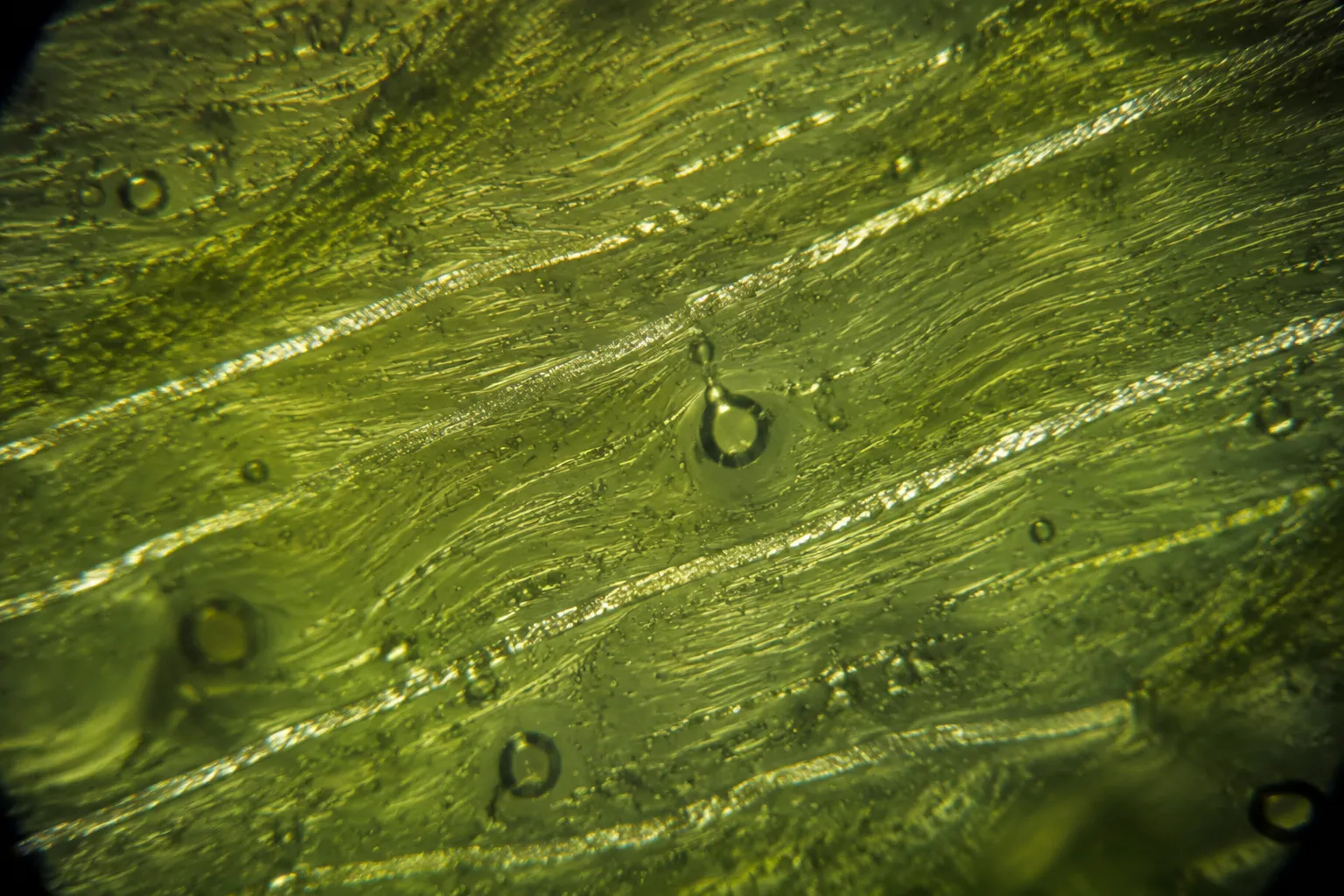
A unidirectional trail of Lechatelierite Inclusions inside moldavite is not a standalone micro-proof of ballistic flight. It is better read as one of the stronger microscopic clues that the glass was once molten, moving, stretched, and then cooled into a directional internal fabric.
The useful answer is narrow: pale silica-rich inclusions, aligned moldavite flow textures, schlieren, and vesicles can be consistent with impact-formed glass shaped under motion. When several of those features point the same way, the specimen gives a more coherent microscopic story than a random inclusion would.
That story has limits. Microscopy can show texture. It cannot, by itself, certify a specimen, reconstruct a full flight path, prove locality, establish market value, or turn one visible feature into a final verdict.
broader context
Broader moldavite archive
This narrower page makes more sense after the broader moldavite archive page.
What Lechatelierite Shows Inside Moldavite
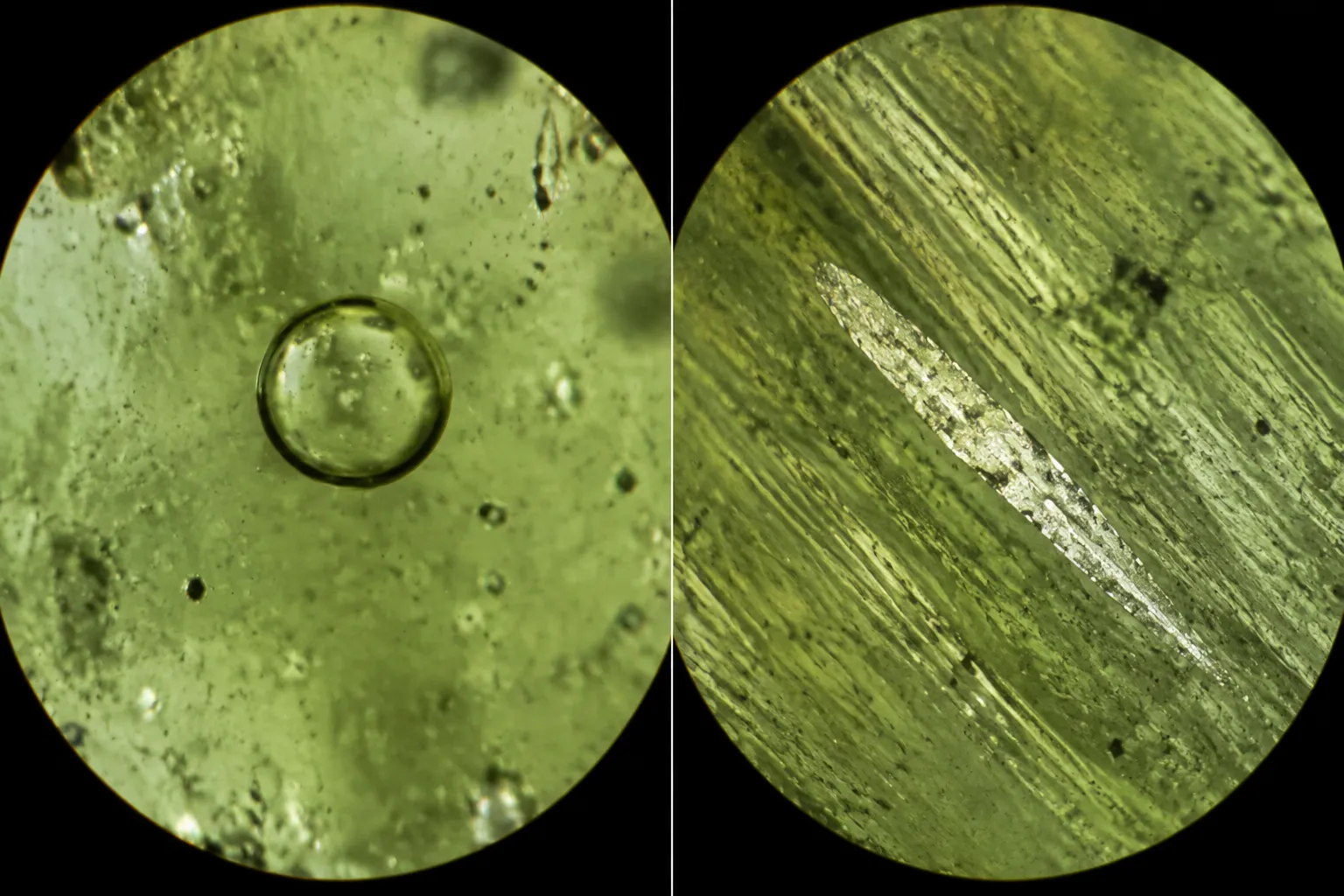
Lechatelierite is silica-rich glass associated with very high-temperature melting of quartz-rich material. In moldavite and other tektites, it may appear under magnification as pale threadlike, worm-like, rodlike, or irregular inclusions. Collectors often describe these as strands, wires, or internal worms because that is the language most people use when looking through a loupe or microscope.
The petrographic language is more careful. Lechatelierite inclusions are not decorative marks. They are internal features within impact glass, and in moldavite they sit inside a host glass tied to impact melting, ejection, movement, and rapid cooling. Optical microscopy and cathodoluminescence studies of moldavites have documented these inclusions as real textural features, not just market folklore.
The more important question is how the inclusion relates to the surrounding glass. A single pale strand says less than a field of related features. When lechatelierite appears with schlieren, flow bands, vesicles, and stretched internal structures, the microscope is no longer showing one isolated object. It is showing glass that was mobile before it cooled.
That is where the ballistic-flight interpretation begins. Moldavite is a tektite, and tektites are understood as natural glasses linked to impact ejecta. If molten glass was thrown outward, deformed, and cooled while traveling, some internal features may preserve directional motion. A one-way-looking texture can fit that process.
Fit is not the same as final proof.
Why Directional Flow Matters
Hot glass does not form as a still archive. It can stretch, fold, mix, trap bubbles, and pull inclusions into shape. As it cools, those temporary movements can become fixed inside the object. In tektite microscopy, terms such as flow bands, flow structure, schlieren, vesicles, and lechatelierite inclusions describe different parts of that frozen record.
Schlieren
Streaky or wavy optical differences in glass.
Flow bands
Layered or banded structures created by differences in composition, viscosity, or thermal history during movement.
Vesicles
Gas bubbles or bubble-shaped voids.
Lechatelierite inclusions
Silica-rich glass features, often visually distinct from the surrounding moldavite.
These features can appear together, but they are not the same thing.
When several of them share orientation, the reading becomes stronger. A pale silica-rich strand stretched in the same direction as adjacent flow bands suggests that the inclusion and host glass were affected by related motion. If vesicles are elongated or arranged along the same broad fabric, they can add to the directional reading. Transmitted light, relief, refraction, and contrast make these differences easier to see, especially in thinner, polished, or faceted areas.
This is why a collector may find unidirectional internal texture more persuasive than a random inclusion. The eye is not only seeing something inside the stone. It is seeing a pattern. Pattern is what turns an internal feature into a formation clue.
The phrase “ultimate micro-proof” needs restraint. Directional flow can support an impact-flight interpretation, but the available technical material does not show that unidirectional lechatelierite flow alone conclusively proves ballistic flight in any individual moldavite. The stronger wording is this: it is a meaningful internal consistency marker.
When the Clue Becomes Stronger
The clue becomes stronger when the microscope view shows more than one aligned feature. Lechatelierite silica glass alone is useful. Lechatelierite with flow bands, schlieren, and vesicles is more informative. A coherent internal fabric matters more than a single pale streak.
The viewing surface matters too. Polished or faceted moldavite often makes internal observation easier because light can pass through more cleanly. Rough moldavite, especially pieces with deep sculpting, weathered skin, or heavy surface etching, may hide internal inclusions. The absence of visible lechatelierite in a rough piece is not automatically meaningful. The microscope may simply be looking through a difficult surface.
Magnification also changes the answer. Low magnification may show bubbles or broad flow lines while missing finer silica-rich features. Higher-resolution imaging, including SEM/EDS work in technical settings, can add composition information. That is not the same thing as a casual authenticity check. It can help distinguish silicon-rich domains from the surrounding glass, but the result still needs interpretation.
Composition deserves careful wording. Market language sometimes calls lechatelierite “pure silica rods.” That phrase is easy to remember, but it can be too neat for actual moldavite material. Technical work points toward silica-rich or compositionally distinct domains, with boundaries that may not behave like a simple pure-SiO2 label. For a reader, “silica-rich glass inclusions” is the safer phrase.
The strongest reading is cumulative: silica-rich inclusions, directional flow textures, moldavite vesicles, and schlieren-like fabric together make a better microscopic case than one feature viewed alone.
Where Readers Overread the Pattern
Mistaking inclusions for bubbles
Vesicles are gas-related voids or bubbles in glass. Lechatelierite inclusions are silica-rich glass features. Both can matter in tektite inclusion morphology, but they do not mean the same thing.
Treating one feature as certain authenticity
Visible lechatelierite does not prove authenticity with certainty. It can be an important clue when the surrounding texture is consistent with natural tektite glass, but one microscopic feature should not carry the whole judgment. Provenance, surface character, internal texture, color, weight, context, and skilled examination all matter. A seller’s claim that a feature is impossible to fake is stronger than the evidence allows.
Turning direction into a full flight record
Internal directionality may reflect movement while the glass was molten, stretching during shaping, local flow within the mass, or deformation before cooling. Those processes can be consistent with ballistic shaping, but the microscope is reading preserved structure after the fact. It is not watching the flight happen.
Expecting every genuine specimen to show the same view
Moldavite pieces vary in thickness, transparency, surface condition, strain, weathering, and cutting history. A clean view in one faceted stone does not create a rule for all rough pieces.
Lechatelierite inclusions are useful because they slow down vague seller language and give the reader something observable. They become risky only when the observation is turned into a shortcut.
What Microscopy Can and Cannot Prove
Moldavite microscopy can support a bounded conclusion: directional lechatelierite inclusions, flow bands, schlieren, and vesicles are consistent with impact-formed glass that experienced movement before cooling. In a moldavite context, that movement fits the broader tektite model of molten ejecta and flight-shaped glass.
Microscopy can support
- Whether an internal feature looks more like a silica-rich inclusion than a bubble.
- Whether flow textures are random, layered, stretched, or directionally organized.
- Optical relief and internal contrast under suitable viewing conditions.
- Compositional clues from SEM/EDS analysis in technical work.
Microscopy cannot do alone
- Guarantee origin from one view.
- Prove a particular locality.
- Establish value.
- Turn a seller’s label into provenance.
- Verify symbolic meaning or any promised personal effect.
Those belong to different kinds of claims, and the microscope does not carry them.
The precise answer is this: unidirectional lechatelierite flow is a strong microscopic pattern consistent with molten impact glass moving and cooling under directional stress. It is not a standalone certificate of ballistic flight.
A Practical Reading Sequence
- First
Start with the whole internal scene rather than the most dramatic strand. Ask whether the visible fabric contains several related features: pale silica-rich inclusions, flow bands, schlieren, and vesicles. Then ask whether those features appear directionally related or merely scattered.
- Next
Separate categories. A rounded bubble is not a lechatelierite inclusion. A pale worm-like feature is not automatically diagnostic unless it fits the surrounding glass texture. A flow band is not proof by itself, but it can become meaningful when it runs with other internal structures.
- Then
Consider the viewing limitation. If the specimen is rough, deeply sculpted, very dark, or thick, the absence of visible internal strands may say more about visibility than origin. If the piece is polished or faceted, inspection may be easier, but a clearer view still needs careful interpretation.
- Finally
Keep the evidence in proportion. Lechatelierite inclusions can support a moldavite authenticity discussion, but they should sit beside provenance and broader specimen traits. A narrow microscope clue is valuable because it is observable. It is not valuable because it ends the conversation.
The Bounded Answer
Lechatelierite unidirectional flow is best understood as a microscopic consistency signal. In moldavite, silica-rich inclusions aligned with directional flow textures can preserve a small-scale record of molten glass movement. That record fits the impact-formed, flight-shaped tektite model better than a random internal mark would.
The word “proof” has to stay bounded. The available material supports lechatelierite inclusions, schlieren, flow bands, vesicles, and moldavite microscopy as meaningful evidence categories. It does not support the stronger claim that one unidirectional pattern is conclusive proof of ballistic flight in a single specimen.
So the collector’s answer is restrained: look for the pattern, read it with the surrounding glass, and treat it as a strong clue. Let impact science guide the interpretation; let provenance and broader specimen traits carry the rest.