Visual inspection note
Visualizing Fluvial Flow vs. Crucible Swirling in Raw Glass Matrices
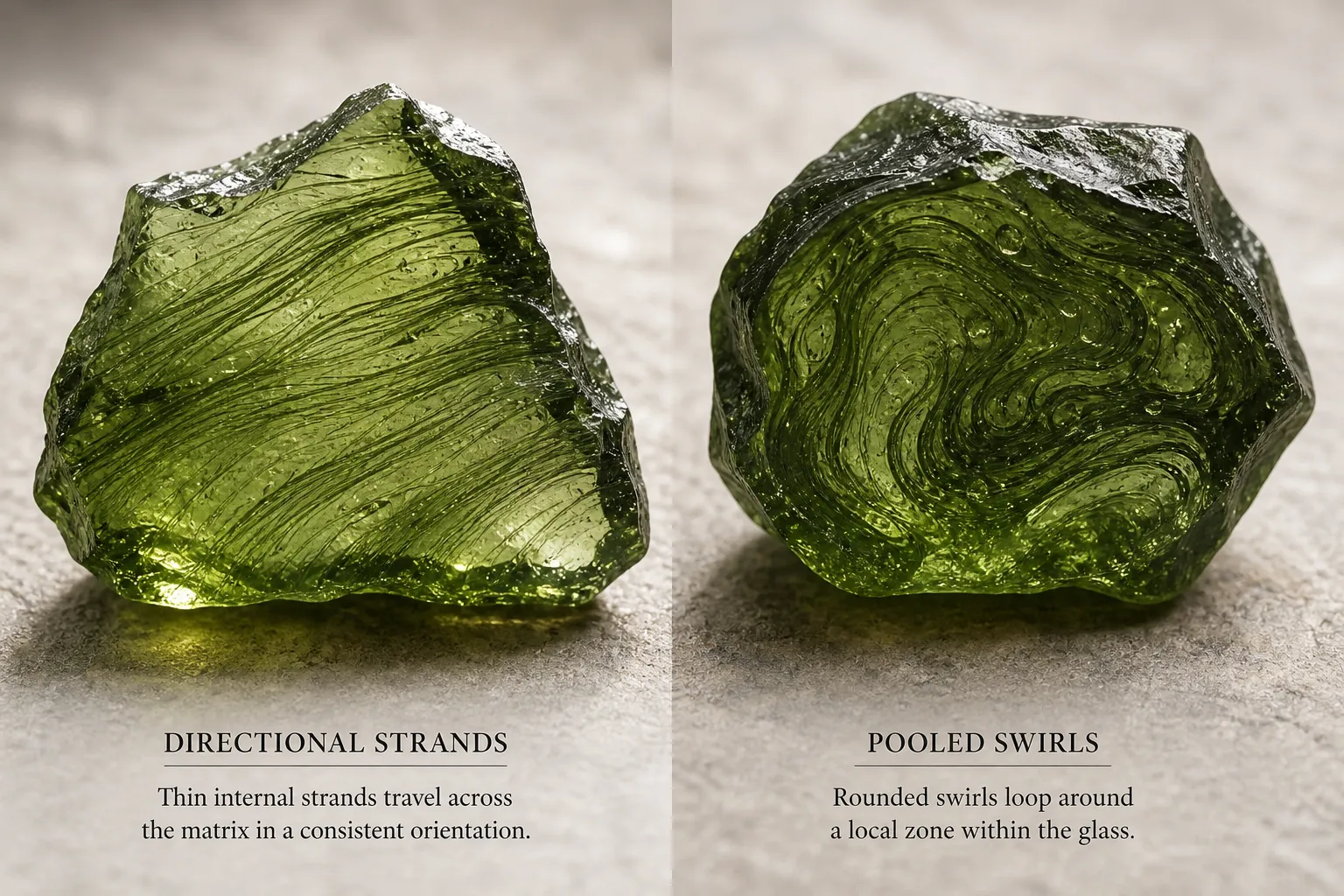
Fluvial-looking Flow Lines usually read as directional: thin strands, veils, or bands seem to travel through the glass, bend, narrow, and sometimes rejoin like movement held inside the matrix. Crucible swirling reads differently. It often looks stirred, pooled, or rotated, with rounded curves that loop back on themselves instead of extending along a longer path.
That contrast can help you describe what you are seeing in a raw green glass specimen. It cannot, by itself, prove natural moldavite, identify a lab melt, establish origin, determine age, or support value claims. Treat it as careful glass observation: useful for asking sharper questions, not for closing authentication.
broader context
Broader moldavite archive
This narrower page makes more sense after the broader moldavite archive page.
The Visual Difference to Look For
When collectors use Flow Lines language around moldavite, they are usually describing internal linework that feels riverlike. The eye follows a direction. The pattern may be faint, broken, layered, or uneven, but the overall movement seems to pass through the specimen rather than circle around one spot.
Crucible-style swirling points to a different visual impression. In a crucible glass context, molten material may appear mixed, folded, or rotated before cooling. The visible pattern can look more circular, clouded, or centered around a stirred zone. This is why dramatic curls in a raw glass matrix can make a collector pause, especially when they look more like mixed syrup than stretched internal movement.
Direction
Fluvial-looking Flow Lines seem to move across the piece.
Crucible-style swirling seems to rotate, pool, or fold.
Rhythm
Flow Lines are stretched, layered, and sometimes tapering.
Swirling is looped, rounded, and sometimes turbulent.
Main impression
Flow Lines suggest a path or current-like movement.
Swirling suggests a stirred or mixing-like feature.
Use in inspection
Flow Lines describe internal visual character.
Swirling raises a question about melt behavior.
Authentication role
Flow Lines are one clue, not proof.
Swirling is one caution sign, not proof.
This is not a diagnostic test. A single photograph can exaggerate contrast, hide depth, or make surface texture look like internal structure. A better comparison needs steady light, more than one angle, and a patient look at whether the pattern sits inside the glass, on the surface, or only in the camera effect.
How to Inspect the Pattern Without Overreading It
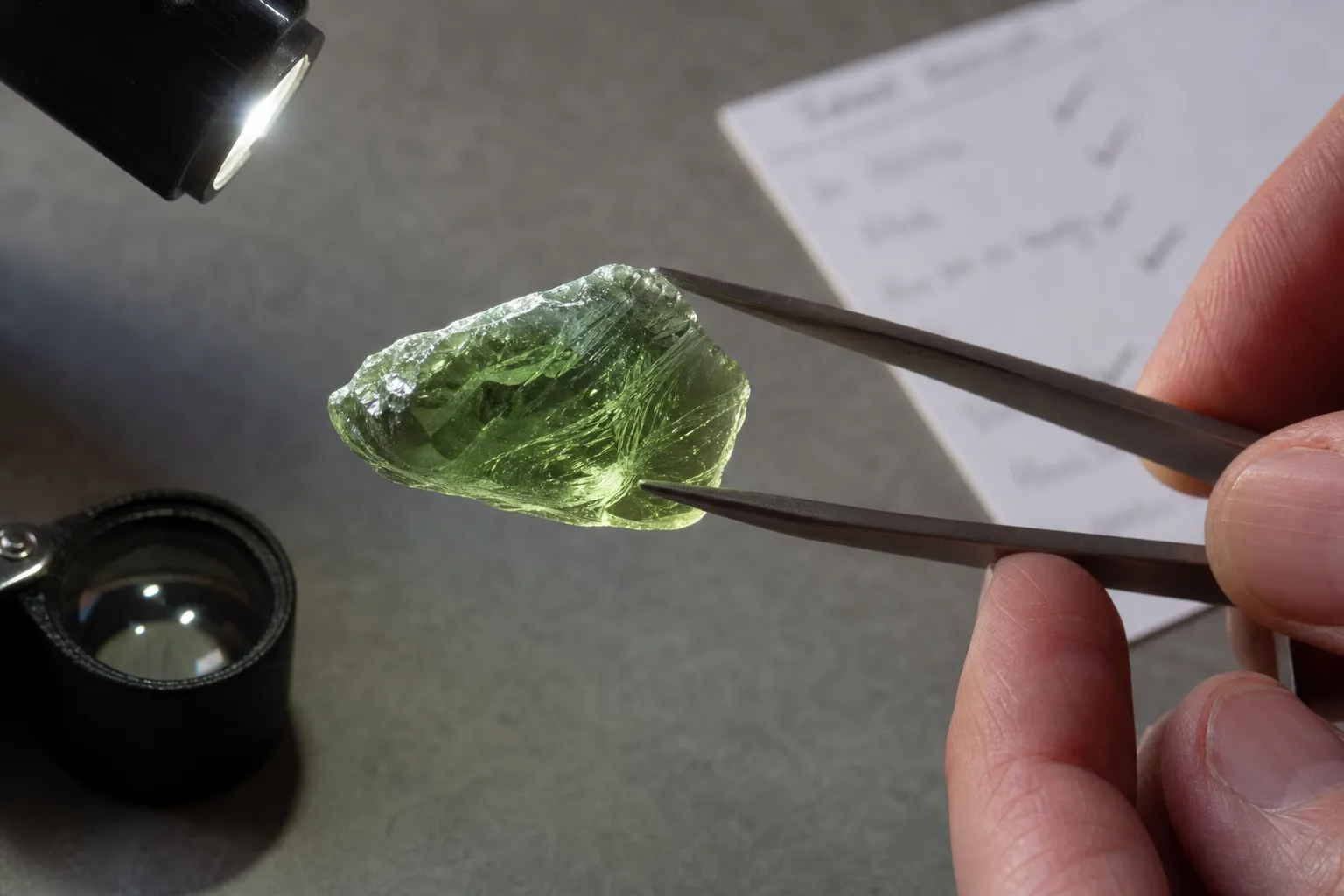
Start with quiet light. Strong glare can turn pits, chips, bubbles, scratches, or surface ridges into false linework. Diffuse daylight or a steady lamp makes it easier to separate reflection from actual internal features. Rotate the specimen slowly instead of holding it at one dramatic angle. A line that remains visible as the glass turns deserves more attention than one that appears only when light flashes across the surface.
Next, separate surface relief from internal glass flow. Raw moldavite can have external texture, and many green glass objects can show worked surfaces, stress marks, bubbles, or scratches. A surface groove catches light at the edge and may disappear as the angle changes. Internal linework feels embedded; it sits within depth rather than on top of the specimen.
Then look for continuity. Fluvial-looking Flow Lines often reward a slow scan. They may fade, cross, or become uneven, but they still suggest longer movement through the matrix. Crucible swirling may feel more locally concentrated, with curves folding around one another. Some pieces will sit between the two. Do not force a label when the pattern is mixed.
A useful inspection sequence
- View the specimen under soft, even light before using magnification.
- Rotate it through several angles and note which lines remain visible.
- Separate surface texture from internal linework.
- Ask whether the pattern travels directionally or folds into swirls.
- Compare the observation with provenance and other specimen traits.
That last step matters. Visual authentication becomes weakest when one feature is asked to carry the whole verdict. Flow Lines can be part of a collector’s vocabulary, but they should not replace provenance, qualified examination, or broader specimen context.
What Can Change the Answer
The same raw glass matrix can look different depending on lighting, thickness, color depth, and surface condition. A thin edge may reveal internal features that are hidden in the darker body of the piece. A broken or polished face may show linework more clearly than a rough exterior. A heavily textured surface may create visual noise that competes with the internal pattern.
Photography changes the comparison even more. A seller photo can make a subtle feature look bold through backlighting, contrast, magnification, or selective angle. It can also flatten a three-dimensional pattern into a decorative surface effect. A single image of “flow” may be showing glass structure, surface reflection, camera contrast, or some combination of all three.
Color also affects perception. Darker green glass can hide fine linework. Lighter or thinner areas can make bubbles, inclusions, folds, or stress features easier to see. A vivid swirl may draw attention because it is more visible, not because it carries stronger authentication meaning.
The comparison also changes when the object is not raw in the same way. A natural-looking fragment, a tumbled piece, a cut surface, and a decorative glass object can all present internal movement differently. “Raw glass matrices” keeps the focus on unmounted, inspectable glass bodies, but it does not remove the need for caution.
The balanced answer is this: fluvial-looking linework suggests directional glass movement; crucible swirling suggests mixing-like movement. Neither visual impression is enough to identify the material conclusively.
Common Confusion Around Flow Lines and Lab Melts
The first confusion is treating Flow Lines as a password for authenticity. They are not. A line pattern can help describe a specimen and may raise or lower suspicion, but it does not turn a raw green glass object into confirmed moldavite. The same restraint applies in reverse: a swirl-like feature does not automatically identify a lab melt.
The second confusion is assuming that natural-looking means natural. Moldavite is valued partly for its impact history and tektite identity, but an irregular, ancient-looking, or dramatic surface does not establish that history. Seller language often leans on the emotion of texture. Collector literacy starts by separating that language from what the specimen actually shows.
The third confusion is reading every rounded curve as crucible glass. Glass flow can be visually complex. Lines may bend. Internal features may overlap. A specimen may show both directional and curved features depending on the viewing angle. If the pattern is ambiguous, the honest answer is to keep it open.
The fourth confusion is overusing magnification. Magnification can help reveal depth, but it can also make ordinary marks feel important. A small bubble, shallow scratch, or stress feature may become visually dominant under close inspection. The better question is not “Can I find a line?” but “Does the line behavior stay coherent across the specimen?”
For moldavite observation, the goal is not to win an argument from one visual trait. The goal is a cautious reading: specimen traits before seller language, provenance before certainty, and visual observation before symbolic interpretation.
Where Visual Authentication Stops
This page can compare two visual patterns. It cannot supply the missing evidence for a firm authentication claim. No citable external reference set was provided for this article, and no firsthand testing, lab review, or professional examination is being used here. That keeps the scope narrow.
A stronger authentication discussion would need better support, such as gemological references, tektite research, museum or university material, or technical documentation on glass flow and crucible melt behavior. Without that support, the responsible wording stays modest. A pattern may suggest. It may resemble. It may raise a question. It does not prove.
If you are assessing a piece before buying, trading, or assigning value, do not let the flow-versus-swirl comparison stand alone. Ask for provenance information where available. Compare the piece with multiple known reference examples from reliable contexts. Consider surface texture, internal features, shape, color behavior, and documentation together. If the decision carries financial weight, casual photo inspection is not enough.
For spiritually curious readers, the boundary is similar. A specimen may carry personal meaning, and some people use moldavite within symbolic transformation language. That meaning should not be used as evidence of geological identity. Keep impact science, collector judgment, and symbolic interpretation in separate lanes.
The practical takeaway is simple: use Flow Lines as visual vocabulary, not as a verdict.
A Compact Field Note for Comparing the Two
When you are holding a raw green glass specimen, write down the pattern before labeling the object. “Long, faint, directional lines through the body” is more useful than “real.” “Rounded internal swirls concentrated in one area” is more useful than “fake.” Description comes before conclusion.
A fluvial-looking pattern tends to feel like movement across the matrix. Crucible swirling tends to feel like movement around itself. That contrast is the center of the comparison. But glass is visually slippery; lighting, surface texture, thickness, and expectation can all pull the eye toward the answer it wants.
If the pattern remains directional from several angles, note it as a possible Flow Lines trait. If it loops, pools, or looks stirred, note it as a possible crucible-style feature. If the view changes too much to tell, keep the result open. Uncertainty is not a failure in moldavite observation. It is often the most accurate position.
The evidence here supports a bounded visual comparison only: fluvial-looking Flow Lines and crucible swirling can be described differently, but neither can authenticate or disqualify a specimen on its own. Use the distinction to ask better questions, then let broader evidence carry the judgment.