Moldavite thermal history
The 42-Second Crucible: Reconstructing the Extreme Thermodynamic Formation of Vltavín
A deeply etched moldavite fragment can look as if it froze while still in flight. The surface invites that story, but it cannot carry the whole thermal history by itself.
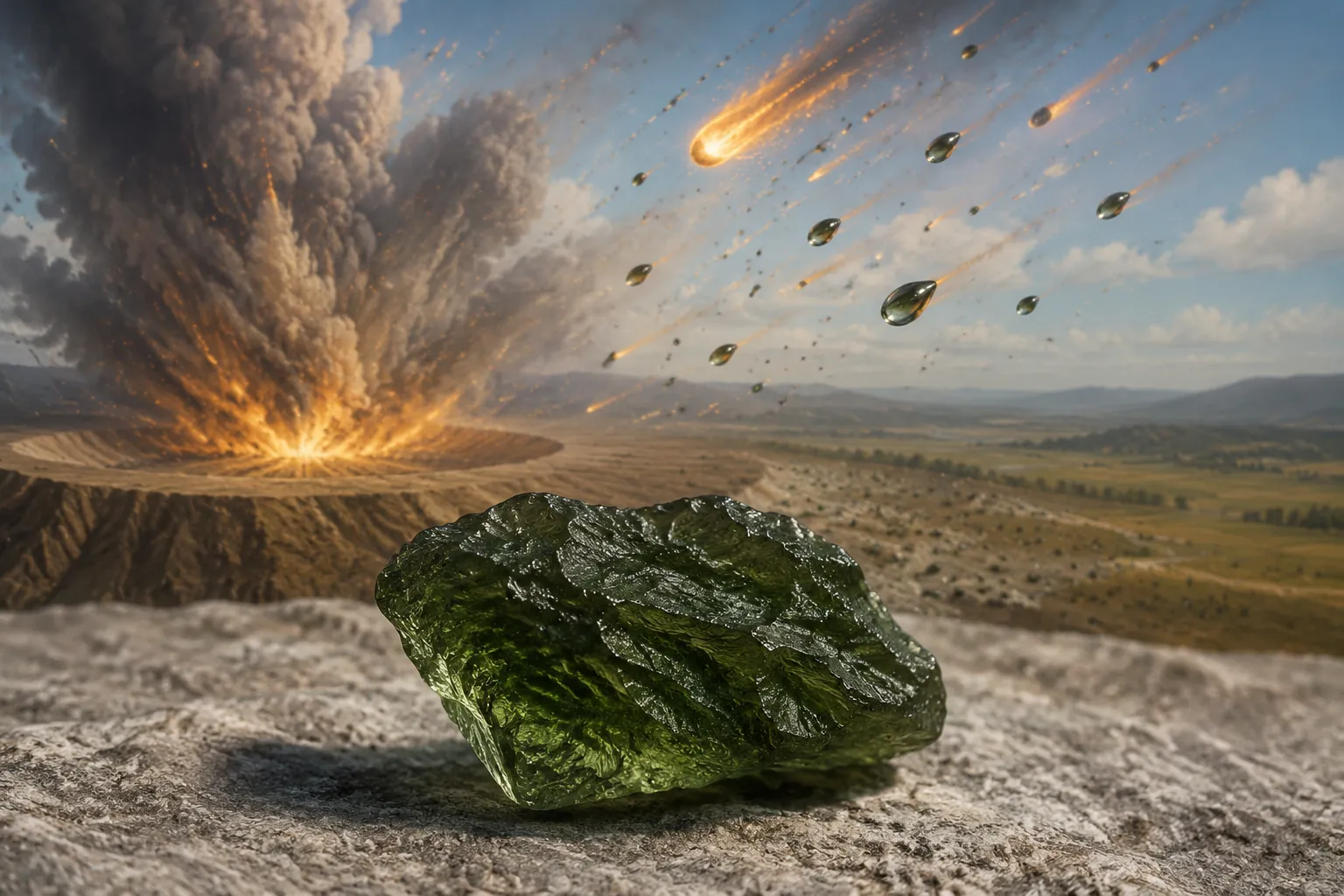
The responsible reconstruction of Moldavite thermal history is narrower and stronger: moldavite is a tektite linked to the Ries crater impact, about 14.7 to 14.75 million years ago. The impact acted on Earth-derived, sand-rich source material—often discussed in relation to Middle Miocene sands in the Ries region—and transformed part of that material into silica-rich natural glass. That glass was ejected far from the crater into the moldavite strewn field and cooled rapidly enough to arrive as solid glass.
The title phrase, “42-second crucible,” should be read as a model-bound image for an extremely brief thermal passage, not as a proven stopwatch value for every specimen. The available evidence supports shock, transformation, ejection, rapid quench behavior, and later surface alteration. It does not support one universal moldavite formation temperature or one exact formation duration.
broader context
Moldavite context note
This narrower page makes more sense after the broader moldavite archive page.
What the Ries impact evidence can actually support
The strongest sequence begins with the Ries impact event in southern Germany. Moldavite was not made from the meteorite or asteroid itself. The impact supplied the energy; the glass came from terrestrial material.
That distinction matters because moldavite is sometimes described in market language as “meteorite glass.” Geologically, that phrase is too loose. Moldavite is a tektite: natural impact glass made from Earth-derived source material and transported away from the crater environment.
The source-material evidence points toward sand-rich surface deposits, especially Middle Miocene sands associated with the Ries area. That is more precise than saying “flash-melted soil.” Soil is a familiar word, but it blurs the reconstruction. Sand-rich sediments better explain why moldavite is silica-rich glass rather than volcanic glass, crater rock, or a fragment of the impacting body.
The broader Ries impact system involved extreme shock, pressure, and heat. Some literature discussing impact conditions and associated products uses very high temperature and pressure ranges for the event as a whole. Those figures should not be copied onto a handheld moldavite piece as if it were a direct thermometer reading. They show that the system had enough energy to transform surface material dramatically; they do not give a precise droplet temperature for every green glass fragment.
The next supported step is ejection. Moldavite is not simply melt frozen inside the Ries crater. It occurs in a strewn field away from the crater, with distribution distances commonly discussed in the hundreds of kilometers. That geography is part of the heat story. The material had to be launched, transported, shaped, and cooled outside the crater setting.
The final supported step is rapid cooling. Tektite research supports fast quench behavior and solid-state arrival. That does not mean every internal part of every specimen cooled at the same rate. It does explain why moldavite preserved a glassy structure rather than slowly crystallizing like an ordinary igneous rock.
The reconstruction is short, violent, and specific. It is not vague cosmic melting.
Why “42 seconds” needs a boundary
The “42-second” phrase is useful because it keeps the reader’s attention on scale: seconds, shock, ejection, and quench behavior rather than slow geological baking. But the available material does not let us say that all moldavite formed in exactly 42 seconds.
A precise duration would need direct support from a named model, method, and assumption set. Without that, the careful wording is simpler: moldavite’s decisive thermal episode was extremely brief compared with normal geological heating and cooling, and some reconstructions may express that brevity in second-scale terms.
Impact heating is not one stage.
Shock compression, melt generation, ejection, and cooling are separate moments.
Size and shape matter.
Small glass bodies cool differently from thicker fragments or larger masses.
Surface cooling is not whole-body cooling.
A droplet can lose heat rapidly at the outside while the interior follows a different path.
Later alteration changes what we see.
Some grooves and pits may reflect post-depositional etching, not only flight texture.
Ries products are not interchangeable.
Suevite, ejecta deposits, impact melt rocks, and moldavite record related but different thermal histories.
So the phrase can work as a reconstruction lens. It should not be treated as a universal laboratory result.
That restraint makes the story cleaner.
Moldavite formation temperature is not one number
A common misunderstanding is to ask for “the moldavite formation temperature” as if moldavite had a single firing point, like glass in a furnace. The Ries impact thermal context was not that simple.
A better way to read the evidence is by stage:
| Thermal stage | What it can support | What it cannot prove |
|---|---|---|
| Peak Ries impact conditions | The broader impact system reached extreme pressure and temperature conditions capable of transforming terrestrial material. | A direct temperature for every moldavite droplet. |
| Source-material transformation | Sand-rich or Middle Miocene sands were likely involved in forming glassy tektite material. | That all precursor material behaved identically. |
| Ejection and flight | Moldavite was transported away from the crater into a strewn field. | That distance alone gives a cooling temperature. |
| Tektite glass cooling | Rapid quench behavior and solid-state arrival are supported by tektite research. | One cooling rate for every specimen. |
| Later surface alteration | Some visible texture may reflect post-formation etching. | That every groove is a primary flight feature. |
This staged view also prevents confusion with suevite. Suevite is an impact breccia associated with the Ries structure. It can contain glassy or melt-related components and records important thermal history near the crater or in ejecta deposits. But suevite is not moldavite.
Temperature indicators from suevite or other Ries impact products should not be transferred directly onto moldavite as if they were the tektite’s own formation temperature. Moldavite versus suevite is not just a collector distinction; it is a thermal-history distinction.
Moldavite is the ejected tektite glass in the strewn field. Suevite belongs more closely to the crater and ejecta system. Same event, different evidence.
What source material adds to the heat story
If moldavite began as sand-rich terrestrial material, the thermal reconstruction becomes more constrained. We are not imagining random rock turning green through vague cosmic influence. We are looking at a specific impact scenario in which surface sediments were shocked, melted or transformed, and launched.
The Middle Miocene sands connection also helps explain why the age matters. Ries-related work places the event around 14.7 to 14.75 million years ago. For a reader-facing page, “about 14.7 million years ago” is a safe rounded age; “about 14.75 million years ago” is the more precise version when the context supports it.
The important point is not the last decimal place. It is that moldavite’s age aligns with the Ries impact event, not with volcanic activity or ordinary sedimentary processes.
The source material also guards against another misconception: moldavite is not a piece of the impacting body. The impactor supplied energy. The glass itself is terrestrial in origin. That is why “Ries crater impact moldavite” is useful phrasing, while “meteorite glass” can mislead.
For collectors, this matters because surface appearance, color, and cultural aura should not replace provenance and geological context. A green, pitted glass object can be attractive. Its identity as moldavite depends on more than being green, sculpted, or strongly marketed.
This page does not authenticate individual specimens. It explains the formation evidence behind real moldavite.
Cooling, quench behavior, and the surface you see today
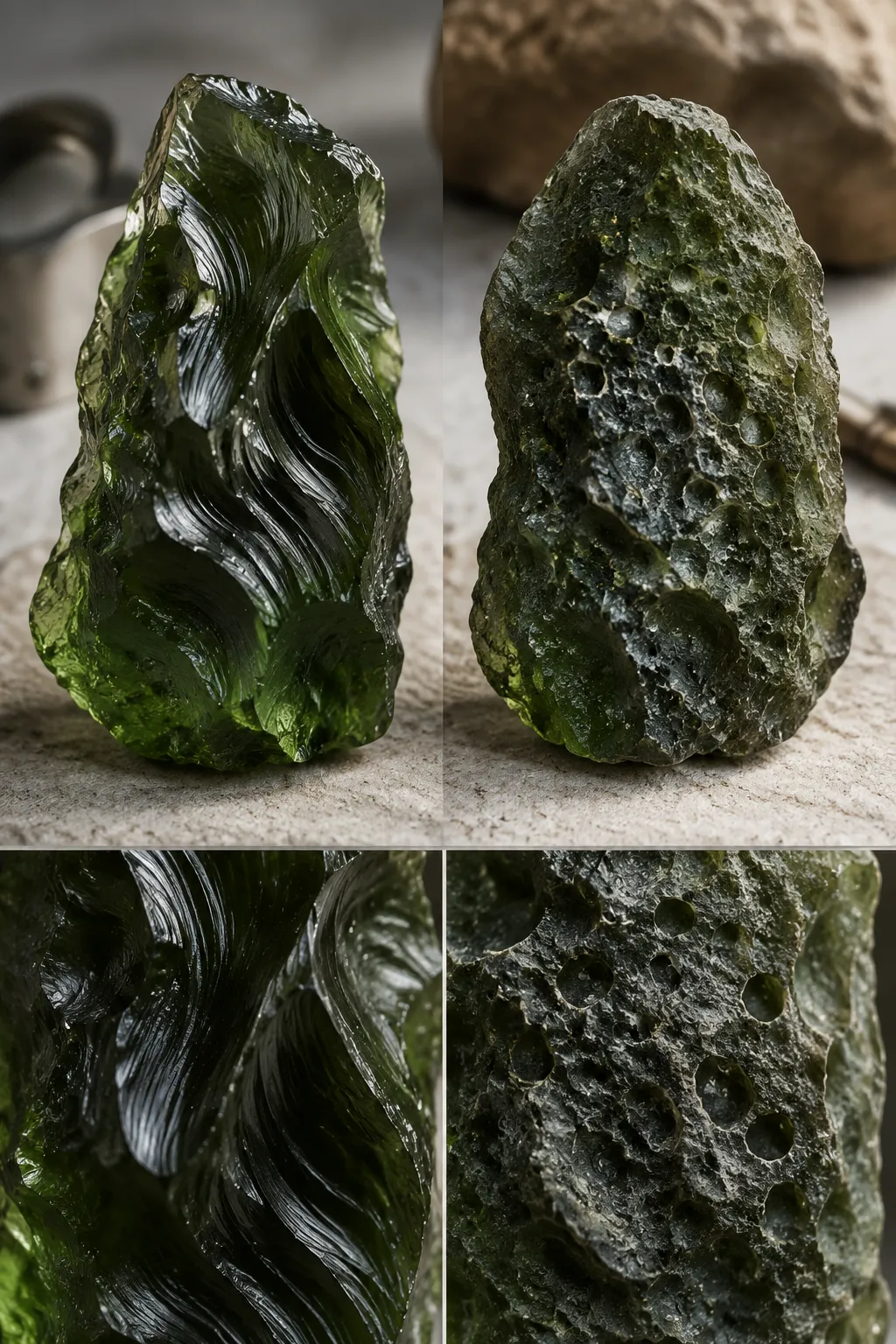
Moldavite cooling behavior is one of the places where dramatic language has a real geological basis. Tektite glass cooled rapidly compared with ordinary magmatic material. The glass had to lose heat quickly enough to preserve a glassy state and reach the ground solid.
That does not mean the entire visible surface is original from flight. Moldavite primary formation texture may include shaping during ejection and aerodynamic transport, but later modification also matters. Groundwater, sedimentary conditions, and post-depositional alteration can deepen or reshape surface features.
A collector holding a deeply etched piece may be seeing both the ancient impact event and later geological weathering.
This is why surface texture should not be used as a simple heat gauge. A rough, sculpted surface does not prove a higher moldavite formation temperature. A smoother piece does not prove lower heat. Texture belongs to several stages: formation, transport, deposition, and alteration.
The same caution applies to bubbles, flow structures, and inclusions often mentioned in seller descriptions. These features may be relevant to specimen study, but they should not be turned into instant proof of the whole thermal pathway without context.
One feature alone is not enough.
The responsible reconstruction in one sequence
A careful reconstruction of moldavite impact formation can be stated as a short chain:
- Before impact: Sand-rich surface material, likely including Middle Miocene sands in the Ries region, existed near the future crater area.
- During impact: The Ries crater impact generated extreme shock, pressure, and heat in the broader system.
- Material transformation: Some terrestrial source material was melted or transformed into silica-rich natural glass.
- Ejection: That glass was launched away from the crater and distributed across the moldavite strewn field.
- Cooling: The tektite glass cooled rapidly, with tektite research supporting fast quench behavior and solid-state arrival.
- After deposition: Groundwater and surface processes may have modified the visible texture of many specimens.
That is the evidence-supported story. It is intense enough without exaggeration.
The main limit is precision. If someone gives an exact second count, exact droplet temperature, or exact cooling curve for moldavite in general, the claim should point back to a specific model and its assumptions. Without that, it is interpretive compression rather than settled measurement.
The Ries impact gave moldavite its origin. The source sands gave it material identity. Ejection gave it distance from the crater. Rapid cooling gave it glass. Later alteration gave many specimens part of the surface character collectors notice today.
That is the crucible we can responsibly reconstruct. The rest should stay qualified.