Moldavite Zen
home / Moldavite Verification & Value Index: The Complete Investment Guide (2026) / Textural Taxonomy: Identifying High-Grade Moldavite Structures

Textural Taxonomy:
Identifying High-Grade Moldavite Structures

In 2026, the permanent closure of the primary Bohemian mining fields shifted the geological curation focus. We no longer passively catalog; we actively preserve 14.7-million-year-old impact glass. Mastering Moldavite Textures & Grades separates the archivist from the amateur.

The Scarcity Baseline: A Veteran's Reality Check

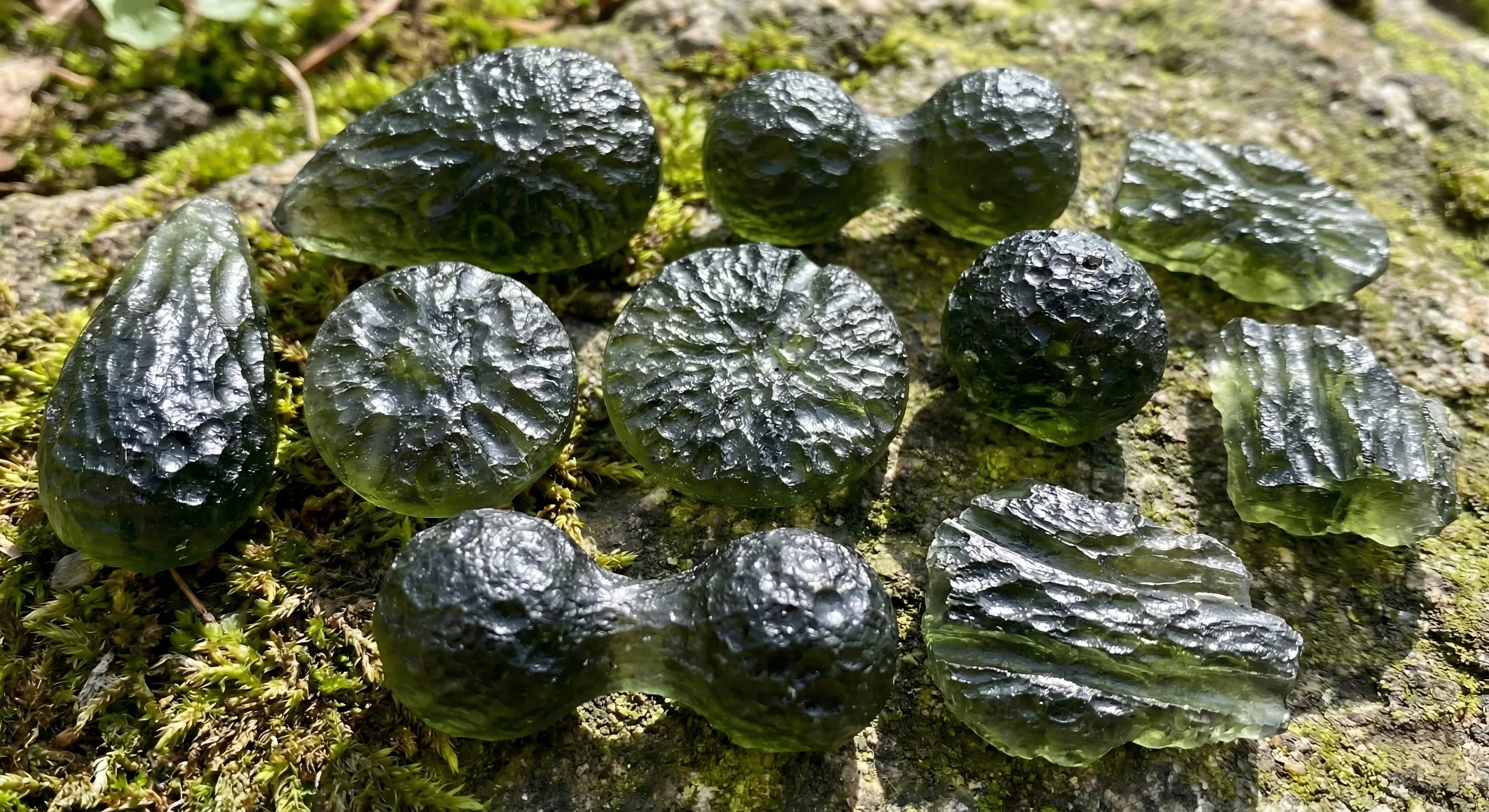
I have examined thousands of specimens over the last decade. The ugly truth? A "Museum Grade Moldavite" is defined entirely by its intact morphological structure, yet over 90% of excavated material consists of violently fragmented chips. Stop prioritizing sheer weight; start prioritizing structural fidelity. True aerodynamic primary shapes—formed during atmospheric reentry—are vanishingly rare.

"The classification of a Besednice Hedgehog or a Slavetice Snowflake texture requires an understanding of micro-topographical erosion. You are looking at a chemical war between silica and soil."

Global Geological Distribution (2026 Audit)

Deep Dive: The Stratigraphic Reality of the 2026 Field Closures

The popular narrative suggests that tektite fields simply "run dry." This is a fundamental misunderstanding of Bohemian geology. The fields did not run dry; the accessible stratigraphic layers became economically and legally unviable to breach. By 2026, the Vrábče layers and the Koroseky sands—the primary hosts for the most deeply etched specimens—are buried beneath strict environmental protection mandates. We are currently analyzing the residual surface supply.

Consider the physical reality of extraction. In the early 2000s, prospectors could casually sift topsoil. Today, reaching a pristine gravel bed requires penetrating meters of dense, heavy clay. This clay is unforgiving. I have personally witnessed mechanical excavators crush museum-grade specimens into silica dust because the clay matrix was denser than the tektite's internal tensile strength. The friction here is immense: the very soil that protects the stone from human hands also acts as a hydraulic vice, snapping delicate primary shapes before they ever see daylight.

This brings us to the core thesis of textural taxonomy. We are not just cataloging shapes; we are reverse-engineering the violent journey of molten silica. 14.7 million years ago, a binary asteroid struck the Nördlinger Ries in modern-day Germany. The impact generated temperatures exceeding 30,000 degrees Celsius and pressures crushing bedrock at a million atmospheres. The ejecta blanket was shot into the stratosphere at an angle of roughly 30 to 50 degrees. What landed in the Czech Republic was a rain of liquid glass. The shapes we obsess over today—the teardrops, the discs, the dumbbells—are frozen records of fluid dynamics interacting with terminal velocity. To handle a flawless piece is to hold a localized snapshot of planetary devastation.

Aerodynamic Primary Shapes: The Physics of Flight

Interact with the spatial canvas below. Drag your cursor horizontally to rotate the mathematical representation of a primary Dumbbell shape, visualizing how centrifugal forces manipulated the molten silica mid-air.

↔ Drag horizontally to rotate ↔

Teardrop vs Dumbbell: A Structural Trade-off

Aesthetic perfection comes at the cost of structural integrity. Most collectors demand an intact "tail" on a teardrop, fundamentally ignoring the physical impossibility of such preservation in heavily acidic, shifting soils.

  • ■ The Teardrop (Stable Ablation) Formed through stable aerodynamic flight, orienting itself like a reentry capsule. The tapered tail is incredibly fragile. If you find one completely intact, it usually means it landed in soft mud, missing the aggressive acid-etching of the Besednice clays.
  • ■ The Dumbbell (Centrifugal Elongation) Formed when a molten globule rotated end-over-end at high velocity, pulling the mass to the extremities. The thin connecting "neck" is a structural nightmare. Handling these requires extreme caution.
Deep Dive: The Mechanics of Atmospheric Quenching

Let’s strip away the romance and look at the thermodynamics. When the silica melt was ejected into the upper atmosphere, it existed in a state of low-viscosity liquid. The physical form it ultimately adopted was a direct battle between surface tension pulling it into a sphere and aerodynamic forces stretching it out. This process, known as atmospheric quenching, happens in a matter of seconds.

I often see novices misidentifying "stretched bubbles" inside the matrix as signs of a fake. In reality, these elongated voids are the internal proof of flight. As the dumbbell spun, the centrifugal force didn't just pull the exterior glass; it stretched the trapped internal gasses (mostly carbon monoxide and carbon dioxide from the vaporized bedrock) into long, elliptical tubes. A fake glass poured into a mold will have perfectly spherical bubbles because the liquid rested passively as it cooled. If you don't see chaotic, stretched, and folded flow lines—the Schlieren—you are likely holding a modern factory reproduction.

Furthermore, the "neck" of the dumbbell is a study in material failure. Because it is the thinnest part of the structure, it cooled faster than the bulbous ends. This differential cooling locked massive internal stresses into the glass grid. Millions of years later, even a minor shift in the gravel bed or a clumsy tap from a prospector's trowel is enough to snap it. To hold a complete primary dumbbell is to hold an object that has defied statistical probability every day for fourteen million years.

The Textural Taxonomy Engine

Surface textures are dictated by millions of years of chemical weathering in specific soil profiles. Review the static index below to understand the distinct localized pedology of each classification.

Specimen Index

Besednice Hedgehog

Deep-Etched Matrix

Geological Scarcity Extreme (Top 1%)

Visual Topography

  • Deep, sharp, spike-like erosion profiles.
  • Translucent edges due to extreme geological thinning.
  • Visually resembles a crown of thorns.

Soil Origin & Erosion

Found exclusively in specific acidic clay/sand layers in the Besednice field. The unique PH of the groundwater aggressively etched the amorphous silica over 14 million years.

🔍 Anthropological & Curatorial Notes

Museum curation tip: Look for matte finishes in the deepest "chimneys". Modern counterfeiters using hydrofluoric acid often leave an unnatural, uniform vitreous (shiny) gloss across the entire surface.

Deep Dive: The Chemical War of Pedology and Micro-Etching

It is a common fallacy to assume the "Hedgehog" spikes were formed in the air. They were not. All tektites landed relatively smooth, albeit with some aerodynamic pitting. The extreme textures we classify today are the result of 14.7 million years of silent, slow-motion chemical warfare underground. The weapon is water, specifically groundwater laced with humic and fulvic acids derived from decaying plant matter.

In the Besednice field, the soil profile contains specific clay layers with a remarkably low pH (highly acidic). As water percolated through this clay over millions of years, it selectively dissolved the silica matrix. Why selectively? Because Moldavite is not perfectly uniform. The rapid cooling process left microscopic stress fractures and variations in chemical composition. The acidic water attacked the weakest points first, digging microscopic trenches that eventually became deep "chimneys" and sharp spikes. The glass literally dissolved away, leaving only the most resistant core skeleton. This is why a 10-gram Besednice stone has more visual volume than a 30-gram Chlum stone; you are looking at the surviving framework of a much larger piece.

Contrast this with the Slavetice Snowflake texture. The Moravian soil chemistry is different. It relies less on aggressive acidic channeling and more on micro-topographical frosting. The surface disruption is shallow but intensely complex. When counterfeiters try to recreate this using industrial hydrofluoric acid, they fail miserably. Hydrofluoric acid burns uniformly. It creates a melted, glossy "wet" look that completely lacks the dry, matte, mathematically chaotic fractal patterns generated by millions of years of gentle soil chemistry. I reject any specimen that looks "wet" unless it has been recently oiled—a practice I strongly condemn as it masks the true microscopic texture.

Interactive Authentication Lab: The Physics of Verification

Visual inspection is no longer sufficient. High-fidelity artificial glass molds pose a severe challenge to archivists. Engage with the simulation protocols below to understand the microscopic and physical barriers that industrial counterfeiters cannot bypass.

Protocol 01

Schlieren Optical Flow & Lechatelierite

Authentic Moldavite formed at extreme temperatures (>1700°C), melting quartz grains into Lechatelierite (pure silica glass wires) and trapping chaotic flow lines (Schlieren). Factory glass melts uniformly and lacks this aggressive internal scarring.

Instructions: Drag your cursor over the dark matrix block. The X-Ray lens simulates microscopic verification. Toggle the modes to observe the structural divergence.

X-RAY LENS ACTIVE
Specimen
Alpha
Specimen
Beta
💧 Hydrostatic Beaker
Drag & Drop a specimen here
Calculated Specific Gravity (SG) 0.00

Awaiting Test Input...

Protocol 02

The Hydrostatic Density Barrier

I recently examined a flawless 40g "specimen" that passed superficial visual checks. But it felt dense in the hand. A simple hydrostatic test yielded an SG of 2.51. It was lead-doped factory glass. The aesthetic obsession had completely bypassed basic physical realities. Amorphous silica has a rigid density limit.

  • ✔️ Authentic Parameter: 2.32 – 2.38 SG
  • ❌ Common Fakes: > 2.45 SG (Due to flux additives)

"Visuals can be faked with acid. Hydrostatic physics cannot be negotiated."

Protocol 03

The Thermal Shock Threat

I once watched an inexperienced handler drop a soil-caked specimen into a heated ultrasonic cleaner. It sounded like a gunshot. Moldavite harbors massive internal stress networks from its rapid cooling cycle. Sudden thermodynamic shifts cause catastrophic structural failure.

Scenario: You must process a delicate Slavetice Snowflake texture caked in Moravian clay. Select a methodology:

🌡️

Select an action to view structural outcome.

Deep Dive: The Gladstone-Dale Relation and Authentication Failures

Why do optical flow lines (Schlieren) matter so much in the Micro-CT scanner? It comes down to the Gladstone-Dale relation, which links the refractive index of a substance to its density. In a natural tektite, the glass is highly inhomogeneous. The rapid, chaotic cooling resulted in micro-bands of slightly different chemical compositions (some richer in silica, some poorer). These bands have differing refractive indices. When light passes through them, it bends irregularly, creating the visible, wavy Schlieren effect. Factory glass is homogenized in a crucible for hours; its refractive index is perfectly uniform. A perfectly clear, "clean" moldavite is almost certainly a piece of bottle glass.

Regarding Lechatelierite: This is pure silica glass ($SiO_2$). Quartz grains from the impact site melted, but because pure silica requires a significantly higher melting point (~1713°C) than the surrounding mixed silicates, these grains didn't fully integrate into the melt. They remained as viscous, stringy 'wires' while the rest of the material flowed around them. Modern counterfeiters simply cannot reproduce this without specialized, prohibitively expensive high-temperature vacuum furnaces. They rely on the buyer's ignorance, hoping a superficial acid-etch will distract from the sterile, uniform interior.

We must establish strict archival protocols. The visual aesthetic of a stone is secondary to its physical and optical data. Relying solely on a jeweler's loupe is a gamble. A comprehensive hydrostatic specific gravity test, coupled with polarized light microscopy to identify internal strain and Lechatelierite inclusions, forms the only impenetrable barrier against the modern influx of high-fidelity synthetic glass.

E-E-A-T Archival References & Geological Data Sources

  • 🔗
    Meteoritical Society (MetSoc) - Tektite Nomenclature & Origins https://meteoritical.org

    Authoritative database on impact crater ejecta dynamics and silicate material classification.

  • 🔗
    Geological Society of America (GSA) - Ries Impact Crater Studies https://www.geosociety.org

    Peer-reviewed studies detailing the thermodynamic formation of Lechatelierite within the 14.7 Ma impact event.

  • 🔗
    Gemological Institute of America (GIA) - Specific Gravity Testing Protocols https://www.gia.edu

    Standardized non-destructive hydrostatic testing methods for amorphous silica and counterfeit glass detection.

AUTH_SIG_VERIFIED
ENCRYPTION_ACTIVE

Investigator Profile

Hi, I’m Emily Carter, a long-time crystal researcher and writer with a special focus on Moldavite and high-vibration tektites. For over a decade, I’ve studied the geological origins and spiritual interpretations of rare stones, combining scientific literature with mindful, experience-based insight. This blog is where I share what Moldavite has taught me about transformation, awareness, and inner alignment.

Moldavite enthusiasts
Access Full moldavite geology origins Database