Measurement Tools
Digital Calipers and Precision Scales: Essential Tools for Verifying Locality Weight Tiers
A moldavite specimen can look persuasive before it has been checked: etched green glass, a locality name, a seller note, and a weight written beside the listing. Digital calipers and precision scales are useful Measurement Tools because they help record physical dimensions and compare weight against a stated locality weight tier or a collector’s own checklist.
They do not prove locality, authenticity, value, quality, or provenance. A number on a scale is a physical data point. A width reading from calipers is a physical data point. For moldavite collectors, these tools work best as physical firewalls: they slow a claim down before it becomes a buying decision, a rarity assumption, or a symbolic certainty.
broader context
Moldavite context note
This narrower page makes more sense after the broader moldavite archive page.
What These Tools Can Actually Check
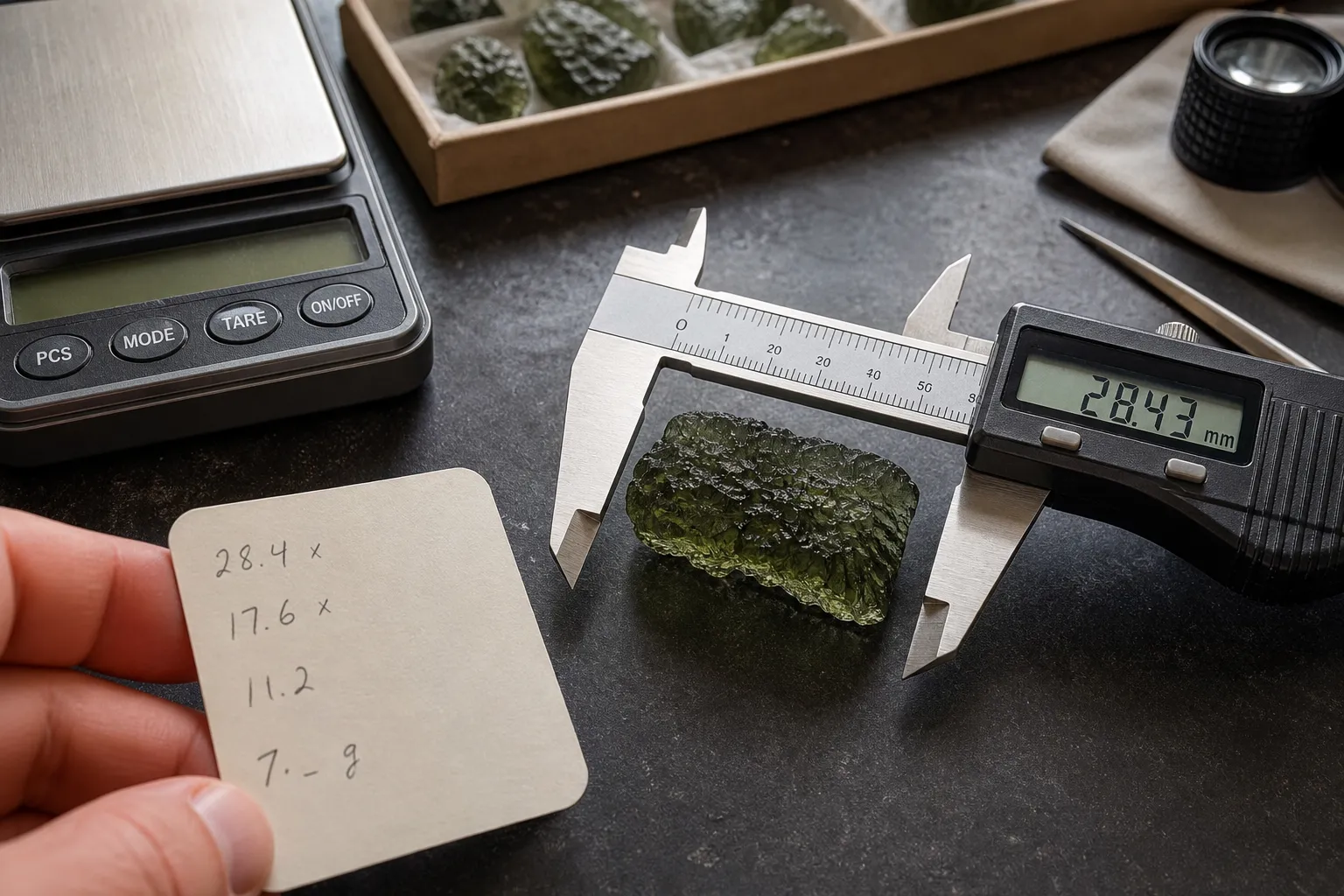
Digital calipers help with checking physical dimensions: length, width, thickness, and the accessible profile of a chipped, mounted, or irregular specimen. Precision scales help record mass, usually against the weight shown in a listing, label, invoice, or collector note. Together, they let you compare the object in hand with the description attached to it.
That is where their value begins. A listing may describe a specimen as fitting a locality weight tier, or imply that a certain size-and-weight combination supports a locality story. Measurement tools do not validate that story. They only help you ask whether the physical object matches the stated measurements closely enough to keep evaluating it.
For a collector, this means:
- A scale can show whether the received specimen is close to the listed weight.
- Calipers can document whether the stated dimensions are plausible for the piece in hand.
- Repeated notes can help compare specimens without relying only on memory or seller language.
- Measurements can expose obvious mismatches, such as a label that appears to belong to another object.
- The data can support a more careful question to a seller, appraiser, or experienced collector.
The key word is “support.” These tools support comparison. They do not complete authentication.
Moldavite is an impact glass with collector interest tied to appearance, locality narratives, provenance, and symbolic meaning. Measurement belongs to the observable side of that picture. It can keep a claim attached to the object, but it cannot turn the object into a fully verified specimen by itself.
Using Measurements as Physical Firewalls
A physical firewall is a pause point, not a verdict. In moldavite collecting, digital calipers and precision scales create that pause by asking a claim to meet the specimen’s measurable traits before the claim is trusted further.
If a seller or label gives a weight tier, treat it as something to check. Weigh the specimen. Record the value in your own notes. Then measure the main dimensions and write down how you measured them, especially if the piece is irregular. Moldavite is rarely a tidy geometric object; a long natural edge, broken point, deep texture, or mounted setting can change what “length” and “thickness” mean in practice.
A modest measurement workflow is enough:
- Record the stated weight and dimensions before handling the specimen.
- Weigh the specimen separately from packaging, display pads, or labels.
- Measure the longest visible length, widest width, and thickest accessible point.
- Note anything that affects the reading, such as a setting, glue, mount, chip, or unstable surface.
- Compare your numbers with the stated claim and mark anything that needs follow-up.
This is general measurement guidance, not a calibration procedure or professional testing method. The available material for this page does not support exact tool accuracy, scale resolution, tolerance ranges, or official locality thresholds.
Still, a basic record can protect collector judgment. If the listing weight and the weight in hand are meaningfully different, pause. If the dimensions suggest a different object than the one described, pause. The measurement does not prove fraud, origin, or quality; it simply keeps the claim from passing unexamined.
Specimen traits before seller language.
Why Weight Tiers Are Easy to Misread
Locality weight tiers can sound more precise than they are in ordinary collector conversation. A tier may appear as a neat category, while the specimen itself may be irregular, chipped, mounted, mislabeled, or described with inconsistent rounding. Without citable locality-tier sources in the supplied research, this page cannot state exact thresholds or treat any tier system as official.
That limitation should shape how the numbers are read. A weight threshold is best treated as a comparison point inside a larger inspection routine, not as a standalone locality test. A specimen that sits inside a claimed tier is not automatically from that locality. A specimen that sits outside a claimed tier is not automatically fake. The reading only shows that the physical data deserves attention.
Directly measured
Does the object weigh what the seller says it weighs?
Conditionally compared
Does the object fit a claimed weight tier or collector category?
Not settled by tools
Does the object truly come from the stated locality?
Only the first question is directly measured by a scale. The second can be compared only if the tier system is documented and relevant. The third requires provenance and supporting evidence beyond basic measurement.
That separation matters because locality language can carry emotional and market weight. A named locality may sound grounded. A precise gram value may look scientific. A tidy measurement set may feel reassuring. None of those impressions should replace evidence.
Digital calipers and precision scales help keep the physical side visible. They do not settle the locality story.
Tool Accuracy and Calibration Limits
Measurement tools have limits, and those limits should stay visible. The research material provided for this page does not include manufacturer documentation, standards, calibration instructions, or firsthand testing. Because of that, this article cannot responsibly claim that a specific caliper type, scale model, decimal place, or calibration routine is enough for moldavite verification.
The narrower point is safer: tools help only when the reading is recorded carefully and interpreted modestly. A scale reading may be affected by what is placed on the pan. A caliper reading may vary depending on where the jaws touch an uneven surface. A mounted or wire-wrapped piece may not be directly comparable to a loose piece.
Write down the conditions with the measurement:
- Loose specimen or mounted specimen
- Measured with or without packaging
- Longest point or average-looking point
- Visible chips, glue, matrix, wrapping, or display material
- Seller-stated number versus your recorded number
Those notes matter because moldavite is not a machined object. Its surface and form are part of its collector identity, but they also make clean measurement harder. A reading without context can create a false sense of precision.
If a tool has not been checked, or if the user does not know how it was checked, the number should be treated as a working note rather than a final authority. Do not let a tool’s display create more certainty than the situation deserves.
Measurement is useful. Overconfidence is not.
Where Measurement Fits in Moldavite Authentication
Measurement sits near the beginning of a cautious moldavite review, not at the end. It belongs beside visual inspection, documentation review, seller claim analysis, provenance questions, and comparison with known collector references. This page does not have the source base to define those methods in detail, but the order still matters: a physical reading should narrow the question, not answer every question.
A careful collector might use digital calipers and a precision scale to decide whether a claim deserves further attention. If the object’s weight and dimensions roughly align with the stated description, the next step is not certainty; it is continued evaluation. If they do not align, the next step is not panic; it is asking why.
Possible explanations can be ordinary. A seller may have rounded the weight. A listing may have reused a template. A scale may have included packaging. A caliper measurement may have been taken across a different axis. A label may have followed the wrong specimen. Some explanations are harmless; others are not. Measurement only tells you there is something to resolve.
This is especially important when moldavite is discussed through symbolic or transformational language. Personal meaning can be part of how a collector relates to a specimen, but it should not bypass physical evidence. If a stone is described with strong locality, rarity, or value implications, the measurable traits still deserve ordinary scrutiny.
Impact history before interpretation. Provenance before certainty.
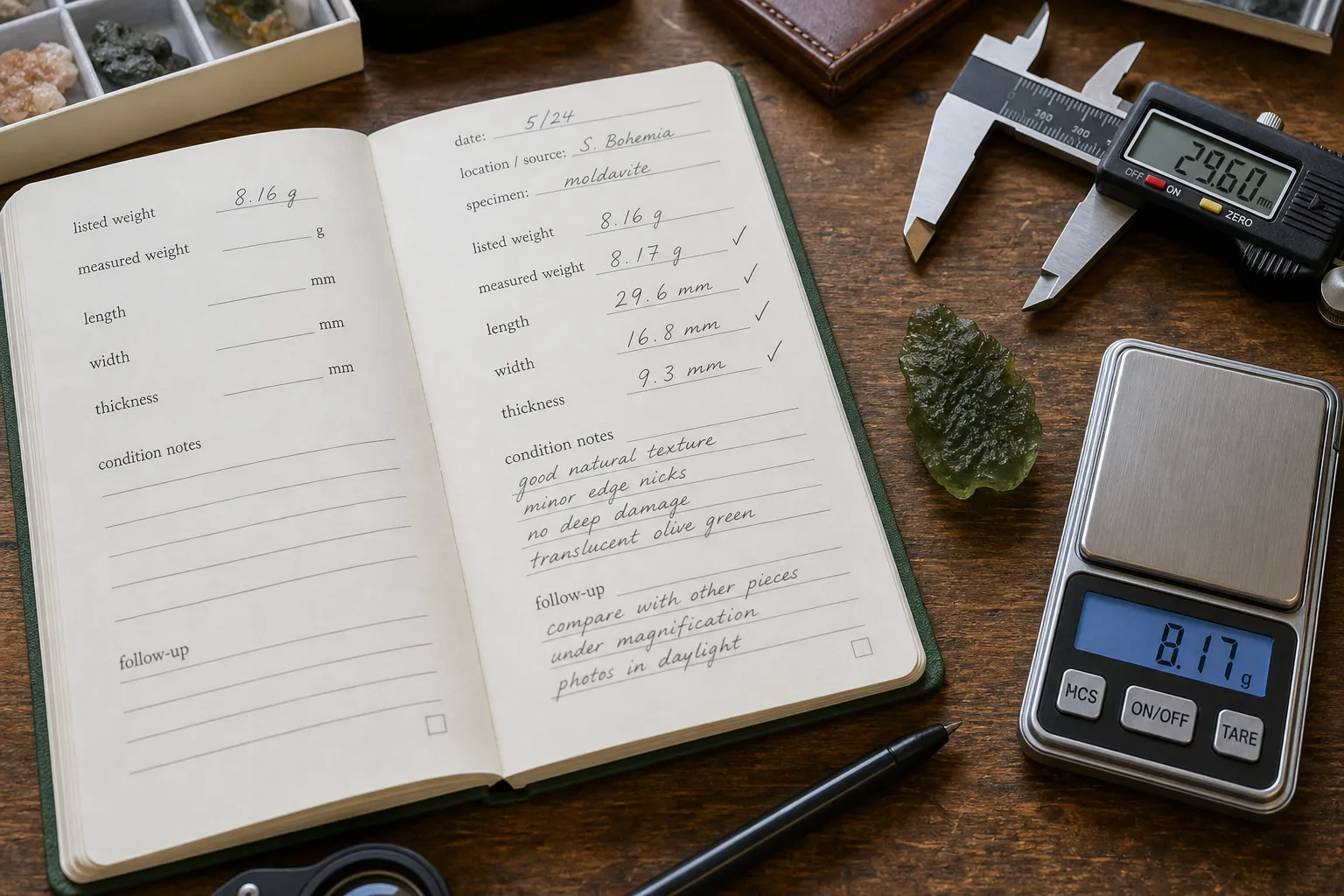
A Practical Measurement Note Format
A simple note format is often enough. It keeps the collector’s record readable without pretending to be a lab report.
Use a structure like this:
- Specimen label or seller name:
- Listed locality or locality claim:
- Listed weight:
- Measured weight:
- Listed dimensions:
- Measured length, width, thickness:
- Loose, mounted, wrapped, or packaged:
- Visible condition notes:
- Follow-up question:
The goal is not to make the record sound official. The goal is to preserve what was actually observed. If you later compare the specimen with another listing, ask a seller a question, or organize your own collection, these notes keep the discussion attached to the object.
For locality weight tiers, this format also prevents a common shortcut: treating a category name as proof. A tier may be useful as a collector sorting device, but it still needs supporting context. Your measurement note can show whether the physical claim holds together well enough to continue investigating.
That is a narrow role, but it is a valuable one.
When the Numbers Should Not Decide
There are situations where measurement should stay secondary. If provenance is missing, vague, or contradictory, a matching weight does not repair that gap. If a specimen has been altered, mounted, broken, glued, or paired with an uncertain label, dimensions may be harder to interpret. If a locality claim depends on a precise threshold that is not publicly documented, the threshold should not be treated as settled fact.
This page also does not support value conclusions. A heavier specimen is not automatically better. A smaller one is not automatically less meaningful. A piece that fits a claimed tier is not automatically more desirable. Those are market and collector judgments that require evidence beyond the measurement tools discussed here.
The same restraint applies to quality. Texture, shape, color impression, condition, and provenance may all matter to collectors, but this page cannot use weight and dimensions to rank them. Calipers and scales are not quality judges. They are record-keeping tools.
That restraint may feel unsatisfying when a listing is persuasive. It is still the stronger position. Moldavite has layered language around geology, authenticity, and symbolism; one narrow tool should not carry the whole decision.
The Short Answer for Collectors
Digital calipers and precision scales are essential only in a limited sense: they are essential for documenting physical dimensions and weight when a moldavite claim depends on those numbers. They are not essential because they prove locality, authenticity, value, quality, or symbolic meaning. They do not.
Use them to build a cleaner record. Use them to compare a specimen with its listing. Use them to flag mismatches around locality weight tiers. Then stop where the evidence stops.
A moldavite specimen deserves both curiosity and restraint. Measurement tools give that restraint a place to start: observable weight, observable dimensions, and a written note that can be checked later. The rest still depends on provenance, careful inspection, and collector judgment under uncertainty.