Moldavite authenticity
Sinterless Silica: Can You Spot the New Wave of 3D-Printed Fakes?
Short answer: 3D Printed Moldavite is a realistic future forgery concern, but current public evidence does not support saying that a confirmed “new wave” is already circulating in the moldavite market. Glass-printing research has become good enough that buyers are right to be cautious. But spotting an advanced glass imitation by eye alone is not dependable, because natural moldavite can already show varied bubbles, pores, flow structures, surface textures, and internal irregularities.
For ordinary shopping, visual clues can help reject obvious moldavite fakes. For expensive, unusually clean, unusually sculptural, or heavily promoted pieces, the safer question is not “Can I see layer lines?” It is “Can the material be examined properly?”
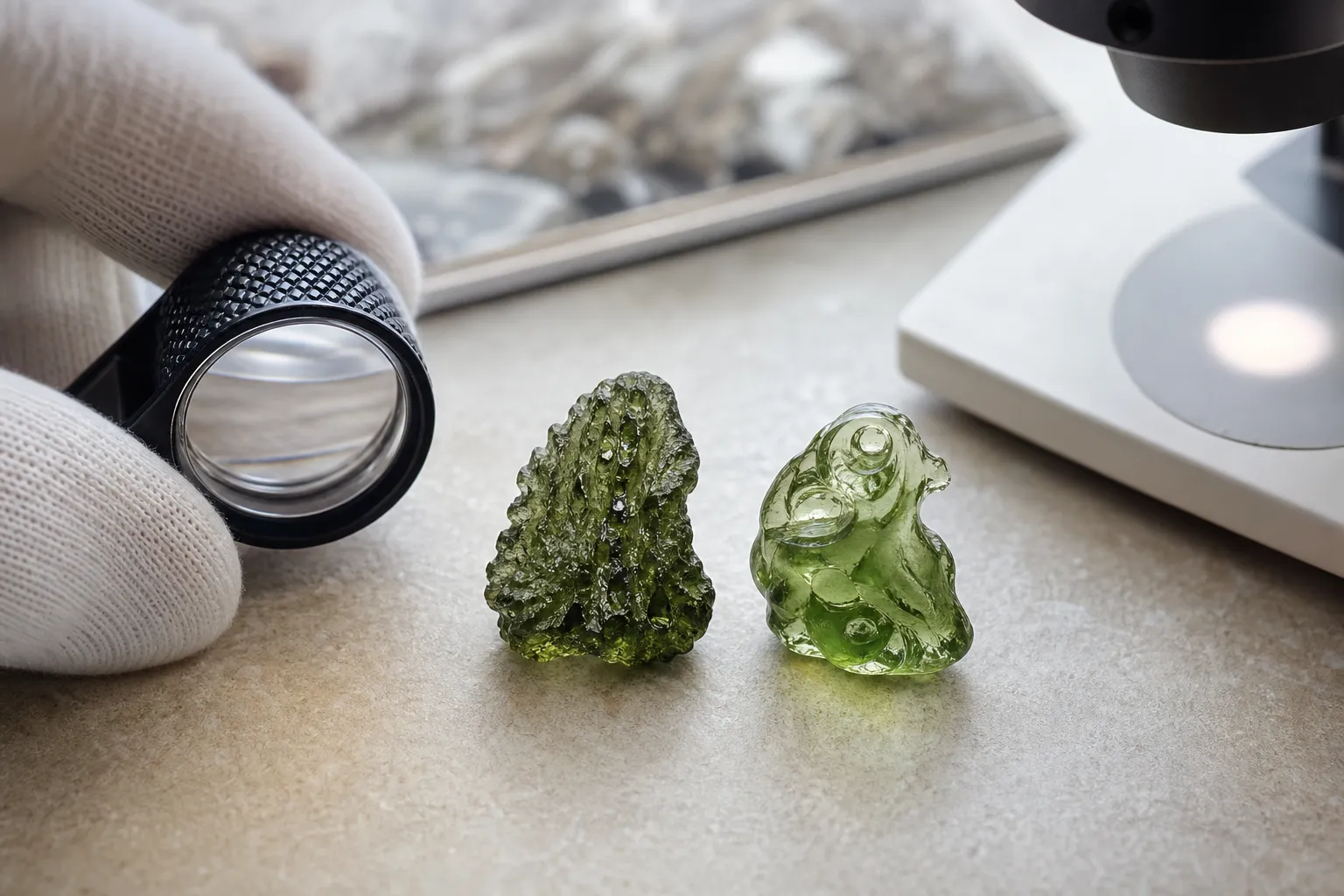
The technology concern is real; the market claim is not proven
“3D-printed moldavite” can sound like collector panic until you look at modern glass fabrication. Research has shown transparent fused silica glass made through 3D-printing routes, including methods that use printed precursors, lower-temperature conversion, post-processing, and newer sinterless approaches.
That matters because older moldavite imitations are often easier to screen out: molded green glass, repeated cast textures, suspiciously identical shapes, or surfaces that look too uniform. If glass-printing and finishing methods continue to improve, future imitations may not carry the same obvious signs.
But there is a hard boundary here. The available research supports technical feasibility in glass fabrication. It does not, by itself, prove that sinterless silica or high-resolution printed glass is already being used to produce commercial moldavite fakes at scale. Public evidence still lacks the kind of confirmation buyers should want: gem-lab bulletins, museum warnings, law-enforcement notices, marketplace investigations, or documented professional authentication reports on alleged printed moldavite.
So the balanced position is simple: watch the technology, but do not treat “a new wave is here” as established fact.
Why “layer lines” are not a reliable shortcut
Many people expect 3D printed glass fakes to show obvious stacked ridges. That idea comes from familiar plastic prints, but glass printing is not one process, and visible lines are not guaranteed.
Some printed silica methods can produce smooth, transparent glass after conversion, shrinkage, sintering, polishing, or other finishing steps. In high-resolution systems, the relevant features may be too small for a listing photo, phone macro lens, or casual loupe check to show clearly.
The reverse mistake is also common: assuming any layered-looking structure must be artificial. Natural moldavite is not visually simple. Research using X-ray micro-CT describes strong variation in pore size, pore shape, pore distribution, and internal structure. Some moldavite types can show pronounced heterogeneity, dense pore fields, lechatelierite inclusions, and layered-looking internal features related to natural glassy portions.
So a layer-like feature is a prompt for closer inspection, not a verdict.
A practical way to read it
- Obvious, repetitive print ridges can be suspicious.
- No visible ridges does not prove natural origin.
- Natural-looking bubbles or flow do not prove natural origin either.
- Layer-like structure can occur in natural moldavite contexts, depending on type and texture.
For moldavite imitation detection, layer lines belong in the screening category, not the proof category.
Visual clues still help, but only as a first filter
Photo checks are still useful for avoiding low-effort fakes. They are weaker against sophisticated glass imitations.
Does the surface look copied or repetitive?
Natural moldavite can be etched, pitted, wrinkled, glossy, matte, sharp, softened, or worn. A pattern that looks stamped, tiled, or repeated across multiple pieces is more concerning than one odd surface mark.
Does the shape look molded rather than natural?
Mold seams, identical silhouettes, and repeated “dramatic” textures often point toward cast or molded glass. This is more relevant to conventional fakes, but it remains a useful warning sign.
Are bubbles being used as the main proof?
Natural moldavite can contain bubbles and pores, but ordinary manufactured glass can also contain bubbles. “It has bubbles” is not enough.
Is green color doing too much work?
Moldavite is green glass, but green color alone is not diagnostic. A convincing imitation can be colored, and controlled glass fabrication can include modified or doped glass.
Is the seller leaning on intensity instead of material evidence?
Moldavite is often marketed with dramatic language. That does not authenticate a specimen. Identity depends on material origin, texture, composition, and context.
These clues can help you reject obvious moldavite fakes. They cannot confirm a valuable piece by themselves.
Material clues matter more than photo impressions
The real question is not only “Can it look like moldavite?” It is “Does the material match moldavite closely enough under appropriate examination?”
Moldavite is a natural tektite associated with the Ries impact event and Central European strewn fields. Its identity is tied to more than surface shape: glass composition, internal texture, inclusions, pores, flow structures, and geological context all matter.
That is why sinterless glass is interesting but not a simple moldavite duplicate. A printed silica object can be impressive glass technology without matching the natural formation history or full material profile of moldavite. A future fake might become visually persuasive before it becomes materially persuasive under serious testing.
Many of the useful clues are not visible in seller photos. Depending on the specimen and the question, examination may involve magnification, polarized light, density or refractive checks, spectroscopy, chemical analysis, or X-ray imaging. The exact method depends on the value of the piece and what needs to be ruled out.
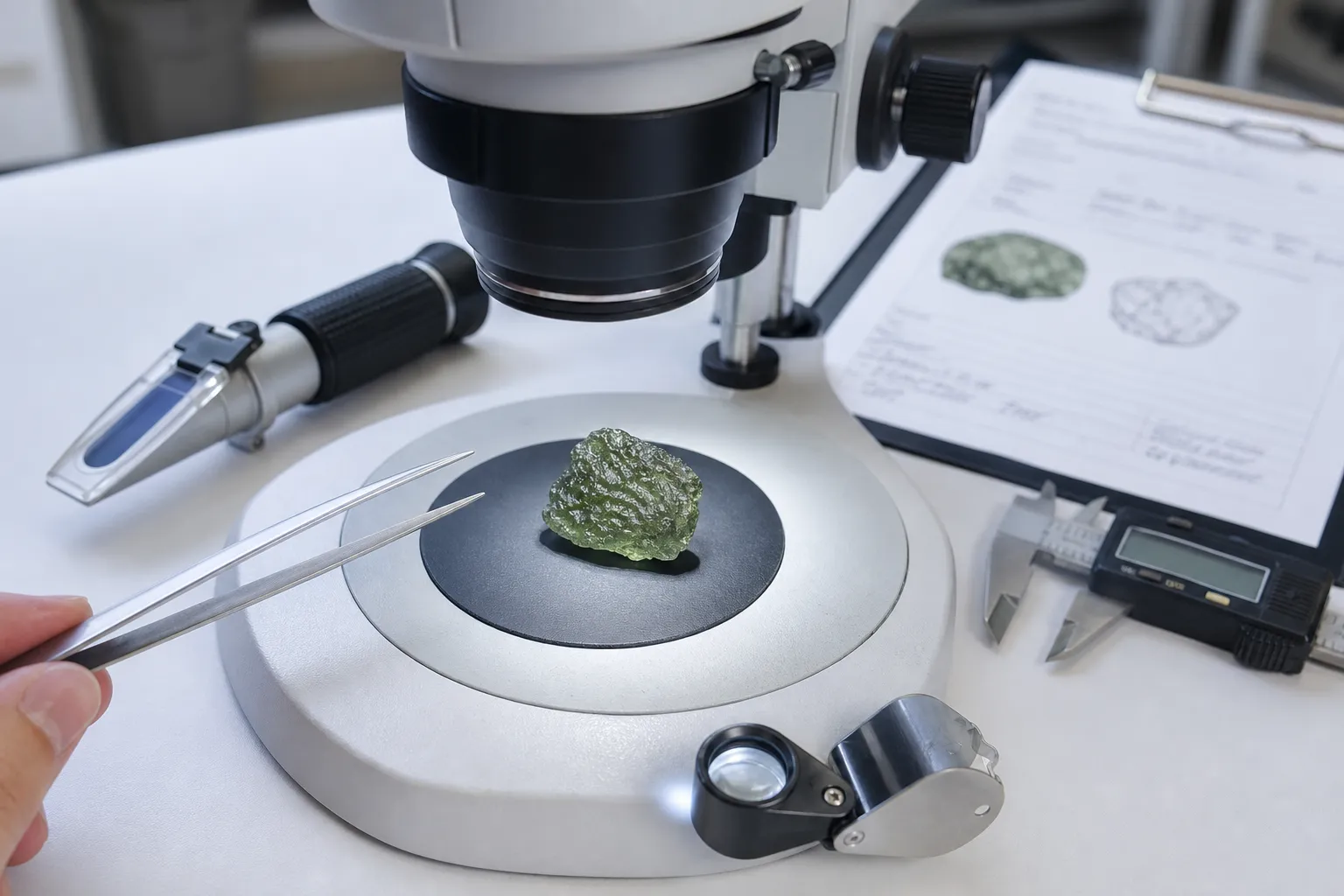
When to stop guessing from photos
There is a point where more images do not solve the problem. Stop relying on visual clues alone when:
- the price is high relative to your budget;
- the piece is unusually large, clean, or sculptural;
- the origin story is vague;
- the same shape or texture appears across several listings;
- the seller avoids clear daylight photos, scale, weight, or provenance details;
- the listing uses rarity claims without material support;
- you are trying to distinguish natural moldavite from a sophisticated glass imitation, not just an obvious fake.
The next step is not a more confident online opinion. It is examination by someone equipped to evaluate tektite material, or buying from a source that provides credible documentation and a reasonable return path. Documentation is not automatically meaningful, but it moves the decision away from guesswork.
For lower-cost pieces, screening may be enough: reject obvious molded glass, repetitive textures, suspiciously cheap “bulk moldavite,” and listings built mostly on hype. For collector-grade pieces, use a higher threshold.
Common confusion: printed glass, printed molds, and rapid prototyping fakes
“Rapid prototyping fakes” can refer to several different things. A moldavite imitation could be:
- cast or pressed green glass;
- carved, etched, or polished glass;
- molded glass with artificial texture;
- ordinary glass shaped in a 3D printed mold;
- glass directly printed or printed as a precursor and converted;
- a hybrid process involving printing, casting, coloring, polishing, and etching.
A 3D printed mold is not the same as directly 3D printed glass. A mold may shape glass or resin. Direct glass printing uses different materials and leaves different possible traces. A sinterless silica route may not leave the thick ridges people imagine when they hear “3D printed.”
That distinction matters because the signs differ. Molded objects may show seams, repeated cavities, or copied textures. Printed and finished glass may show subtler surface or internal artifacts, and some may be reduced by post-processing.
The safer buyer rule is broader: do not hunt for one manufacturing signature. Look for mismatch across the whole object—surface, internal features, provenance, price, and documentation.
Bottom line
Can you spot the new wave of 3D-printed moldavite fakes? If you mean reject clumsy imitations, often yes. If you mean reliably identify a well-made future printed glass fake from photos or a simple loupe check, no.
The research behind transparent silica glass printing and sinterless glass makes the concern reasonable. It does not prove a current retail wave of printed moldavite fakes. Use visual clues as a first filter, treat layer lines as only one possible warning sign, and do not let bubbles, green color, dramatic texture, or seller confidence stand in for material evidence.
For pieces where the price or rarity matters, move from “Does it look right?” to “Can it be examined properly?”