Direct answer
The “No-Sensation” Panic: Does Lack of Heat Mean Your Moldavite is Fake?
No. Feeling no heat, tingling, pressure, rush, or other dramatic reaction is not one of the reliable Fake Moldavite Signs. A quiet experience does not mean your stone is fake, and a strong personal reaction does not confirm that it is real.
That is the main answer.
The panic usually starts because moldavite is often described online as if an authentic piece should create an instant body response. That expectation can feel convincing, especially if this is your first piece. But authenticity is a material question, not a sensation question. Moldavite is a natural impact glass; stronger evidence comes from physical characteristics, Czech provenance, seller transparency, and, when needed, independent inspection.
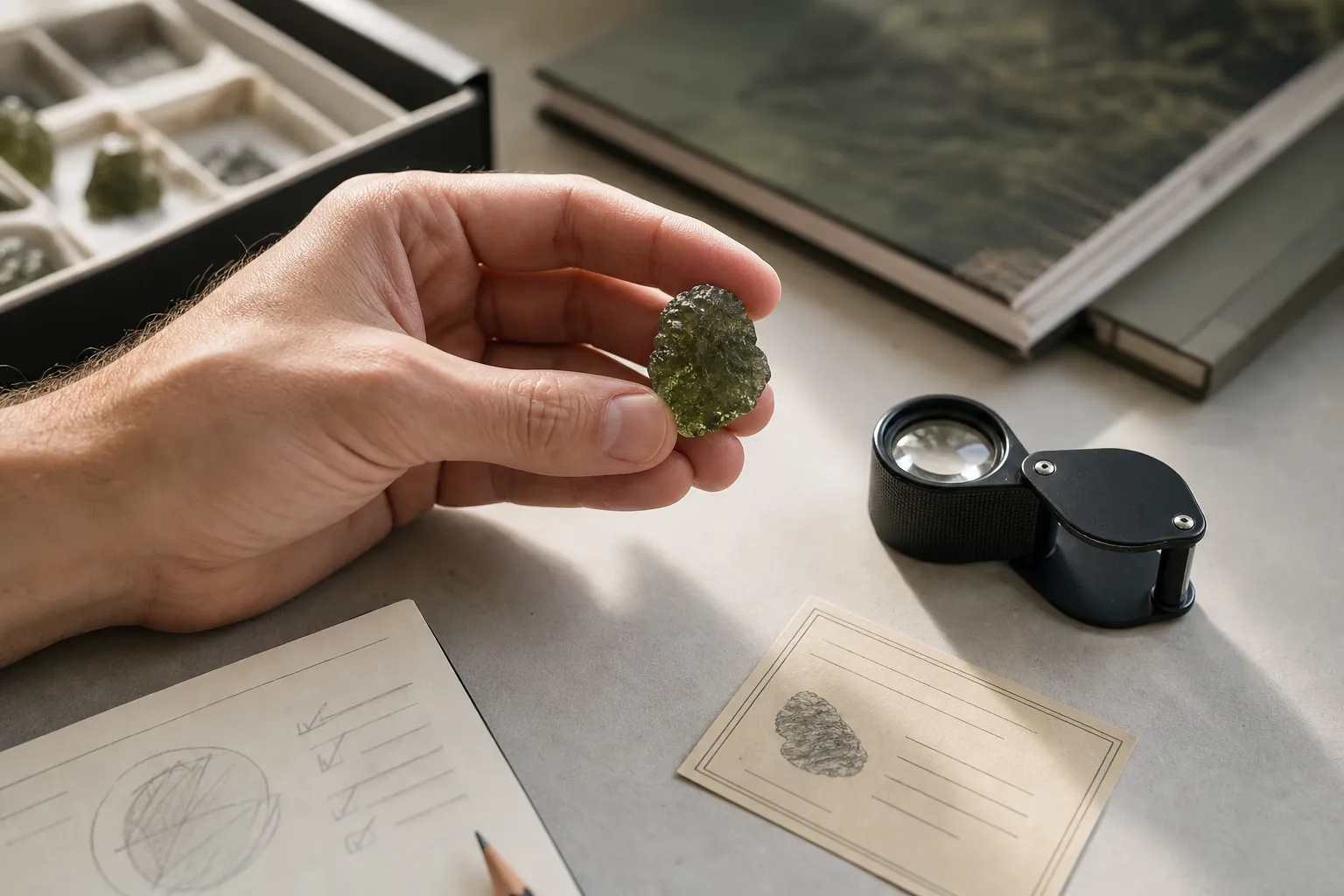
Why “I feel nothing” is a weak real-vs-fake test
Two questions often get tangled together:
- 1Is this physically authentic moldavite?
- 2Did I notice a personal sensation when I held it?
Those are different questions.
In crystal communities, moldavite is often talked about through words like warmth, tingling, intensity, or the so-called “moldavite flush.” Some people find that language personally meaningful. Others feel nothing at all. As an authentication method, though, sensation is too variable to carry the answer.
A person’s experience can change with expectation, attention, mood, setting, touch, and the story they have heard about the stone. That does not make the experience meaningless. It simply means it is subjective. Subjective experiences can matter to the person having them, but they do not work like a gemological test.
So if your moldavite feels like “just a stone” in your hand, that alone is not evidence against it.
What moldavite authenticity is actually based on
Gemological and mineralogical sources describe moldavite as a tektite: a natural glass associated with an ancient impact event, with well-known occurrence in the Czech Republic. That framing puts the authenticity question in the world of material evidence.
If you are trying to judge real vs fake moldavite, better questions include:
- Does the piece broadly match known moldavite appearance rather than generic green glass?
- Is there believable locality or provenance information?
- Are the photos clear and consistent?
- Does the seller explain the object itself, not only the feeling it is supposed to create?
- For a costly or uncertain piece, has an independent gem or mineral professional inspected it?
That is the right lane for authenticity concerns.
Research and mineral references discuss moldavite through material features such as natural glass structure, pores, inclusions, transparency, color range, and locality. Those details are not the same as a simple home pass/fail rule, and they should not be reduced to “it must feel hot” or “it must do nothing.” The stone’s identity does not depend on your body’s response.
Why this misconception is so common
The confusion makes sense. Moldavite is often sold and discussed with dramatic expectations around it. A buyer hears that it is intense, waits for an immediate reaction, and then worries when nothing happens.
That creates a loop:
- “I felt no heat from moldavite.”
- “Maybe it is fake.”
- “Maybe I am not sensitive enough.”
- “Maybe I bought the wrong thing.”
The problem is the leap from sensation language to authentication language.
Spiritual community language may focus on subtle energy, symbolism, emotional intensity, or personal timing. Collector and gemology language focuses on origin, physical features, surface character, internal structure, and provenance. Those are different ways of talking about the object.
It is reasonable to say, “Some people report subtle energy experiences, and some people do not.” It is not reasonable to conclude, “Feeling nothing means the piece is fake.”
The reverse is also true: if you do feel warmth, tingling, or a strong reaction, that still does not confirm authenticity. A personal response can happen around expectation, focus, meaning, or ritual. It should not replace physical verification.
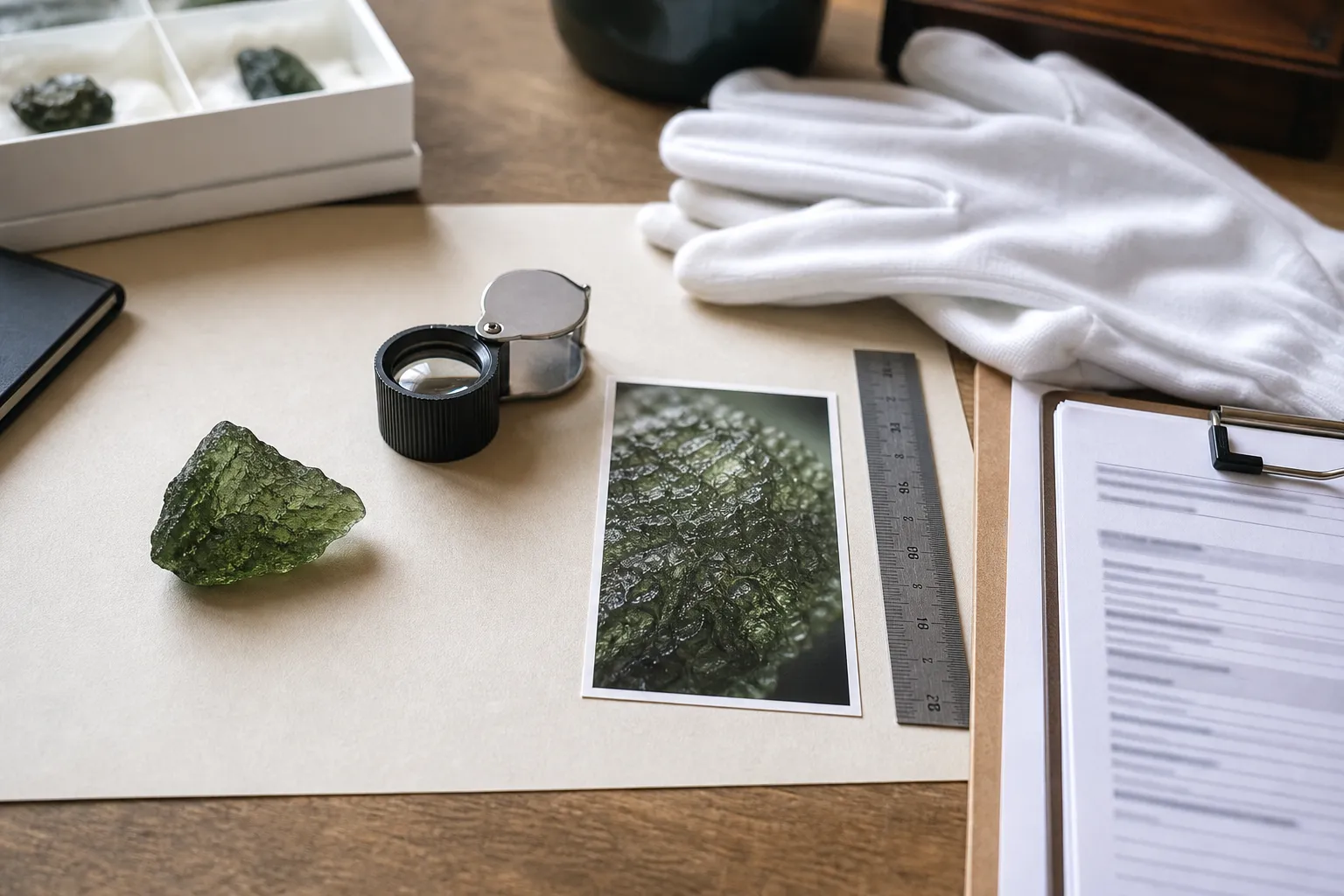
What to check instead
If your worry started with a lack of moldavite sensation, shift the question away from your body and back to the specimen.
Look at the stone as a material object
Authentic moldavite is a natural impact glass. It should be assessed by its physical character, not by whether it produced a reaction on cue.
Ask about provenance
Czech moldavite authenticity is stronger when the seller can explain what the piece is claimed to be, where it came from, and how that information is supported. Provenance is not a perfect shield against mistakes, but it is more useful than repeating a hand-feel test.
Review seller transparency
Clear photos, consistent descriptions, and straightforward sourcing answers matter. Be cautious when a listing leans heavily on emotional promises while staying vague about the object itself.
Consider independent inspection
If the piece is expensive, unusually large, or still doubtful, independent moldavite inspection is a better next step than trying to force a sensation. A qualified inspection looks at the material, not your reaction to it.
The practical shift is simple: move from “What did I feel?” to “What evidence supports what this is?”
When no sensation appears alongside other warning signs
No sensation is not the warning sign. But it can appear in the same situation as other concerns.
You may have more reason to question a piece if:
- the seller cannot explain origin at all
- the listing uses generic, recycled, or heavily edited photos
- the description is full of dramatic claims but thin on material details
- the piece looks broadly inconsistent with known moldavite appearance
- the item came from a vague mass-market listing with little accountability
Even then, the concern comes from the overall evidence picture, not from the absence of tingling.
There is also an exception in the other direction: a genuine piece may feel personally meaningful without producing a strong physical sensation. Another person may notice something subtle only later, or not in a bodily way at all. If you use spiritual language for your own experience, that is your experience. It just should not be treated as an authentication tool.
A cleaner way to think about “energy sensitivity”
Many readers quietly worry that no reaction means they are “not sensitive enough.” That conclusion is not supported by a reliable public standard.
There is no dependable moldavite authentication test that sorts people into sensitive and not sensitive based on heat, tingling, or a first-contact reaction. That is community language, not a stable verification category.
A better frame is:
- Some people describe vivid subtle energy experiences.
- Some describe something quieter.
- Some describe nothing noticeable.
- None of those outcomes, by itself, settles authenticity.
That boundary removes two unnecessary fears at once:
- “My stone must be fake.”
- “Something is wrong with me.”
Neither follows from a quiet first experience.
The bottom line
If your main question is, “Why can’t I feel my moldavite?” the calm answer is: maybe nothing is wrong.
Lack of heat, no tingling, and no dramatic moldavite reaction are not reliable signs of a fake. They only mean you did not have that particular experience. Authentic moldavite characteristics belong to the stone’s material identity and origin, not to a required body response.
If doubt remains, check the specimen, the provenance, the seller’s transparency, and, when appropriate, seek independent examination. That is the better way to handle the no-sensation panic without dismissing your experience or giving it more evidentiary weight than it can carry.